

Workflow management platforms are powerful tools for automating and managing complex tasks. Integrating workflow platforms can help companies coordinate and ease their business processes as well as increase the productivity of their teams. When the instances are misconfigured, they can expose the systems to potential attacks and data loss. This is why it’s crucial to properly set up these instances.
Companies recently learned this the hard way when misconfiguring popular open-source workflow platforms Argo and Airflow. This post will focus on misconfigurations in the Prefect workflow platform.
We have identified hundreds of misconfigured Prefect instances which could be the target of disruptive attacks. By using Prefect’s web UI and API function, attackers can potentially modify and delete workflows, tasks, and agents, including the history logs of previous executions, belonging to companies with exposed instances. Disruptive attacks can cause data loss and business delays affecting teams that integrate workflows into their daily routines and the clients that depend on these workflows functioning properly.
We did not find any evidence of Prefect users having their information leaked as of yet. Prefect users should verify that their instances are not exposed to the internet and enable multi-factor authentication.
What is Prefect?
Prefect is a workflow management platform launched in 2018 and powered by the open-source Prefect Core workflow engine. It’s a popular platform marked by its 7.6K stars on GitHub.
There are two ways to set up Prefect: 1) Using the Prefect Cloud engine or 2) Setting up a local Prefect server. The main difference between the two options is Prefect Cloud has everything already configured and ready to use while the latter option requires users to put more effort into configuring the infrastructure.
Prefect uses a full GraphQL API for interacting with the platform and easily accessing all of the information stored in the platform. The API can be accessed using the web UI or through a Python client. When using Prefect Cloud, authentication is required to access the platform. However, when using the Prefect server, authentication is not required by default, meaning that anyone with access to the server can get information from the Prefect platform.
For companies that have instances exposed to the internet and which don’t incorporate authentication, essentially this means that anyone can view the information stored by those companies on Prefect. This includes flows, tasks, agents and projects. Unlike Argo and Airflow, Prefect is a much more secure platform and we did not find any evidence of companies that use Prefect having their information leaked.
We examined the functions exposed by the API and the actions that users can make in the web UI. There are several functions in the web UI and GraphQL API that can be used by attackers to delete elements in the workflow platform and launch disruptive attacks on the companies that own the exposed instances.
How is the Attack Executed?
Workflows can be deleted with a single button click in the web UI as shown below.
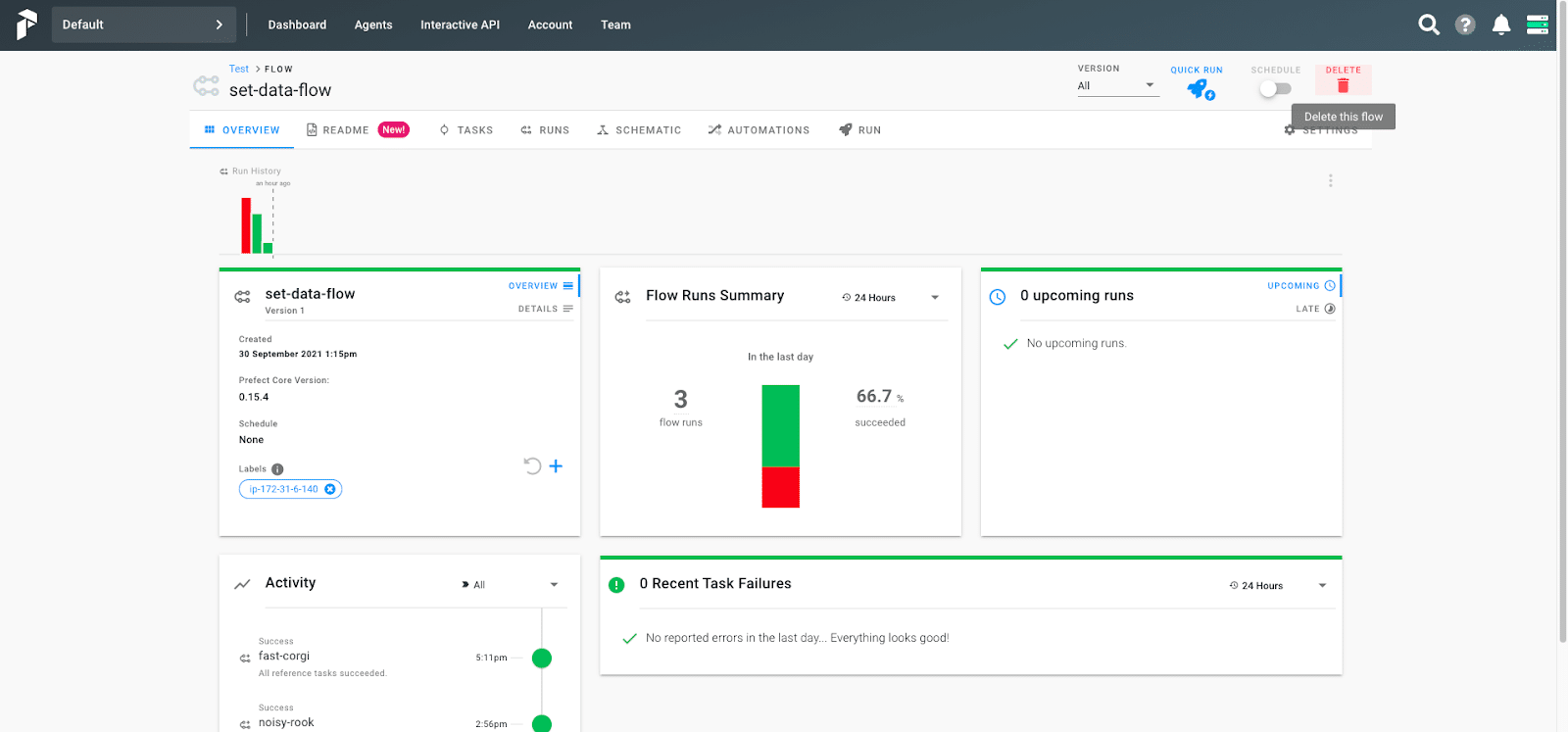
Another way to delete workflows, as well as projects, tasks and agents, is by using queries from the GraphQL API, which is available in the web UI or on port 4200 of the server that runs the Prefect platform. Using a simple query, an attacker can retrieve the ID of the elements they plan to delete and then use the suitable API functions to delete the elements. Those elements are “delete_task”, “delete_flow”, “delete_project” or “delete_agent”.


Nicole Fishbein
Nicole is a senior security researcher and malware analyst at Intezer. Prior to this, she was an embedded researcher in the IDF Intelligence Corps.
In this article
Share article
Related Articles
.svg)
AI SOC
The emergence of the tierless SOC
AI is retiring the SOC pyramid. Learn how a tierless AI SOC investigates 100% of alerts with forensic evidence while your analysts supervise outcomes.
.svg)
Research
5 min
NinjaMare and the enterprise security epidemic hiding behind a harmless label
The PUA label, aka "potentially unwanted application" means nuisance. Adware, toolbars, and other things that change your settings without asking. Our research team's findings say this label is far more serious than a mere nuisance.
.svg)
Alert Triage
AI SOC
3 min
We let a fruit fly brain triage 12,716 real SOC Alerts. Here is what happened.
On behalf of people who run SOCs, we explore how a fly brain triages alerts compared with a boring linear model you could train in eleven seconds.