
AI SOC: How It Works, Key Capabilities and Top 16 Solutions
In this article

What Is an AI SOC?
An AI SOC (Security Operations Center), often called an agentic SOC, is a proactive security operations model that integrates artificial intelligence to automate threat detection, triage, and incident response. Unlike basic AI assistants that only summarize alerts, an AI SOC uses autonomous agents to investigate and take action across your entire security stack.
An AI SOC helps security organizations operate more efficiently by increasing investigation capacity without requiring proportional growth in headcount. By automating repetitive work such as alert triage, evidence collection, and initial analysis, it allows analysts to spend more time on high-value activities like threat hunting, incident response, and improving detections.
How an AI SOC works:
- Automated alert triage: AI analyzes and prioritizes alerts, distinguishing real threats from false positives to help analysts focus on genuine incidents.
- Enhanced threat hunting: AI can correlate data across different security dimensions—such as network, email, and endpoint activity—to uncover sophisticated and coordinated attacks that might be missed by human analysts.
- Accelerated incident response: AI can initiate automated response actions, like isolating compromised devices or blocking malicious traffic, to contain threats faster.
- Adaptive workflows: AI agents can dynamically adjust response strategies based on situational context and past outcomes, improving efficiency over time.
- Natural language interaction: Some systems allow analysts to use natural language to generate reports, create automation workflows, and ask complex questions of their data.
Top AI SOC solutions include:
In this guide we review the following notable AI SOC platforms.
- Intezer:Enterprise AI SOC platform that provides automated alert triage and forensic-depth investigations across security alerts.
- UnderDefense Agentic AI SOC:Combines vendor-agnostic AI investigations with human security analysts to provide coverage across existing security tools.
- 7AI:Uses coordinated autonomous AI agents to handle security workflows from threat detection through investigation and response.
- Conifers.ai (CognitiveSOC): Uses a network of AI agents to automate SOC workflows, including contextual analysis and Tier-2 investigations.
- Exaforce: Combines multiple AI models, a unified security data layer, and a knowledge graph to investigate threats across cloud and SaaS environments.
- Dropzone AI: Provides autonomous alert triage and investigations using pre-trained AI agents without requiring predefined playbooks.
- Prophet Security: Automates security investigations while providing visibility into the evidence and reasoning behind its findings.
- Radiant Security:Uses adaptive AI to triage different alert types, reduce alert noise, and support lower-cost security logging.
- Qevlar AI:Uses graph-based investigation workflows that incorporate findings from previous investigations.
- Bricklayer AI: Coordinates more than 50 specialized AI agents to perform security operations tasks under centralized governance.
- Legion Security: Learns analyst workflows through browser interactions and uses them to automate recurring SOC investigations.
- SentinelOne Purple AI: Provides agentic threat investigation and response capabilities within the SentinelOne Singularity platform.
- CrowdStrike Charlotte AI:Automates security alert triage, investigation, and response within the CrowdStrike Falcon ecosystem.
- Vectra AI: Uses behavioral analytics to detect threats across network, identity, cloud, and SaaS environments.
- BlinkOps: Provides an automation platform for building AI-driven security workflows and coordinating response actions.
- Torq HyperSOC: Uses multiple AI agents and security automation workflows to support autonomous SOC operations.
This is part of an extensive series of guides about cybersecurity.
The Need for an AI SOC: What Problems Does It Solve?
Security teams face growing alert volumes, talent shortages, disconnected tools, and increasingly automated attacks. An AI-powered security operations center (SOC) helps address these challenges by streamlining triage, connecting security data, and supporting faster detection and response.
- Alert overload and triage bottlenecks: AI correlates, enriches, and prioritizes alerts to reduce noise and manual review, helping analysts focus on high-risk threats.
- Skills gaps and scaling constraints: AI-assisted investigations and response recommendations support less-experienced analysts and help teams expand coverage without proportional staffing increases.
- Fragmented data and tool sprawl: AI SOCs integrate and normalize telemetry across security tools, improving visibility and enabling coordinated investigations and responses.
- Rapidly evolving threats and attacker automation: Behavioral analysis helps identify suspicious activity beyond known signatures, while automated workflows accelerate response as attacker techniques evolve.
Evaluating managed detection and response? Explore leading MDR providers in our detailed guide.
How an AI SOC Works
Intelligent Triage
An AI SOC begins by collecting alerts from security tools such as endpoint detection and response (EDR), SIEM, email security, identity providers, cloud platforms, and network monitoring systems. Instead of treating each alert in isolation, the AI correlates related events, removes duplicates, and determines whether multiple signals belong to the same incident.
The system then evaluates the likelihood that an alert represents a real threat by analyzing behavioral patterns, historical activity, threat intelligence, and the environment in which the activity occurred. Low-risk or known benign events can be automatically closed, while higher-risk incidents are prioritized for investigation or escalation. This significantly reduces alert volume and shortens the time analysts spend on manual triage.
Contextual Enrichment
After identifying an alert that requires investigation, the AI gathers additional context from internal and external sources. This can include asset information, user identity, endpoint telemetry, authentication logs, vulnerability data, previous incidents, and threat intelligence feeds. Collecting this information automatically eliminates much of the manual work traditionally required during an investigation.
The AI combines these data points into a single investigation record and explains why the activity appears suspicious. Analysts receive a timeline of events, evidence supporting the assessment, and the likely attack techniques involved. This richer context helps security teams make faster, more consistent decisions without switching between multiple security tools.
Autonomous Remediation
Once the AI reaches sufficient confidence that an incident is malicious, it can trigger predefined response actions without waiting for manual approval, depending on organizational policy. Common actions include isolating compromised endpoints, disabling user accounts, blocking malicious IP addresses or domains, quarantining emails, and creating tickets for follow-up.
Many AI SOC platforms integrate with security orchestration, automation, and response (SOAR) tools and security products to execute these actions across the environment. Human analysts remain in control of high-impact decisions, while routine containment tasks are automated. This reduces response times, limits attacker movement, and allows security teams to focus on complex investigations rather than repetitive operational work.
AI SOC vs. Traditional SOC vs. SOAR: Key Differences
A traditional SOC relies heavily on human analysts to monitor alerts, investigate threats, correlate security events, and coordinate incident response. While traditional SOCs may use tools with embedded machine learning capabilities, most investigation and decision-making processes remain human-driven.
SOAR platforms introduce automation by integrating security tools and executing predefined playbooks for repetitive tasks, such as alert enrichment, ticket creation, and incident containment. However, conventional SOAR automation depends largely on explicitly configured rules, integrations, and workflows.
An AI SOC extends these capabilities through agentic AI systems that can autonomously investigate alerts, gather evidence, correlate findings across security platforms, and determine appropriate next steps. Depending on configured permissions and guardrails, AI SOC systems can also initiate response actions without requiring human intervention at every stage.
| Capability | Traditional SOC | SOAR | AI SOC |
|---|---|---|---|
| Primary approach | Human-led security operations | Rule-based workflow automation | AI-driven security operations |
| Alert triage | Primarily manual | Automated through predefined rules | Automated with contextual analysis and reasoning |
| Threat investigation | Analysts investigate alerts | Executes predefined investigation steps | Performs adaptive, multi-step investigations |
| Decision-making | Human analysts | Preconfigured rules and playbooks | AI reasoning within defined guardrails |
| Threat correlation | Manual analysis supported by security tools | Correlation through configured integrations | Contextual correlation across multiple data sources |
| Incident response | Human-directed | Automated playbook execution | AI-recommended or autonomously executed actions |
Key Capabilities of an AI SOC
Automated Alert Triage
AI SOCs automate the intake, analysis, and prioritization of security alerts to reduce reliance on manual review. Incoming alerts are evaluated using statistical models and learned patterns to estimate threat likelihood based on signal quality, affected assets, user context, and historical outcomes. This allows the system to distinguish between benign activity, low-risk noise, and alerts that warrant deeper investigation.
AI SOC capabilities include:
- Automated alert scoring and prioritization
- Context enrichment using identity, asset, and environment data
- Historical correlation with past incidents and outcomes
- Automated suppression and closure of low-confidence alerts
- Analyst feedback loops for model tuning
Enhanced Threat Hunting
AI-driven threat hunting focuses on identifying suspicious behavior that does not match known attack signatures. AI SOCs analyze large volumes of telemetry across endpoints, networks, identities, and applications to identify deviations from established behavioral baselines. These systems surface patterns that would be impractical to detect through manual querying or rule-based detection alone.
AI SOC capabilities include:
- Behavioral baselining across users, devices, and workloads
- Cross-domain telemetry analysis and correlation
- Automated anomaly detection and clustering
- AI-generated investigation hypotheses and leads
- Continuous refinement based on new data patterns
Accelerated Incident Response
AI SOCs reduce response latency by automating actions once a threat reaches a defined confidence threshold. Response logic is encoded into playbooks that trigger containment steps such as isolating hosts, revoking credentials, or blocking traffic without waiting for manual execution. This shortens the window between detection and mitigation.
AI SOC capabilities include:
- Automated execution of response playbooks
- Policy-based containment and remediation actions
- Pattern recognition across past incidents
- Dynamic adjustment of response sequencing
- Analyst approval controls for high-impact actions
Adaptive Workflows
AI SOC workflows change based on incident context rather than following static investigation paths. The system adjusts investigation steps according to severity, affected assets, threat intelligence updates, and real-time findings. This allows resources to be allocated dynamically as incidents evolve.
AI SOC capabilities include:
- Context-aware investigation orchestration
- Dynamic escalation and de-escalation logic
- Automated case management and task assignment
- Continuous learning from investigation outcomes
- Integration of real-time threat intelligence
Natural Language Interaction
AI SOC platforms increasingly expose natural language interfaces to simplify interaction with complex security data. Analysts can request summaries, query incident details, and initiate investigation steps using conversational commands instead of specialized query languages or dashboards.
AI SOC capabilities include:
- Natural language querying of incidents and alerts
- Automated summarization of investigations
- Generation of incident reports and timelines
- Contextual explanations of threat activity
- Simplified access to analytics and workflows
How AI SOC Analysts Transform SOC Teams and Workflows
AI is transforming security operations centers (SOCs) by automating routine security tasks and changing how human analysts investigate and respond to threats. A central part of this transformation is the AI SOC analyst, an autonomous system that uses agentic AI to perform tasks traditionally handled by human security analysts, including alert triage, threat investigation, event correlation, and initial incident response.
Unlike traditional SOAR tools that rely primarily on predefined workflows, AI SOC analysts can reason through investigations, select appropriate tools, and adapt their actions based on new evidence. They can investigate incidents across cloud, endpoint, identity, and email environments, correlating findings from multiple security platforms. Depending on their permissions and configured safeguards, they can recommend or execute predefined response actions.
The adoption of AI SOC analysts changes the responsibilities of human security professionals. Rather than spending most of their time reviewing alerts and gathering logs, analysts increasingly focus on complex investigations, threat hunting, risk prioritization, and oversight of automated decisions. Security engineers take greater responsibility for integrating AI systems, configuring workflows, and validating AI-generated findings.
Key Use Cases of AI in Security Operations
AI helps security operations teams detect threats, prioritize alerts, and accelerate investigations by analyzing large volumes of data and connecting signals across systems. Automated workflows support faster containment and response while allowing analysts to focus on complex or high-risk incidents.
- Faster phishing investigation and response: AI analyzes emails, URLs, and attachments, enriches alerts with contextual data, and supports actions such as blocking malicious links, resetting passwords, and notifying users.
- Behavioral identity-based threat detection: AI establishes baselines for account activity and correlates deviations with signals such as unusual devices or privilege changes to identify potential account compromise and abuse.
- Endpoint malware triage and containment: AI analyzes endpoint activity and threat intelligence to assess malware severity and spread, then supports approved containment actions such as isolating devices and blocking malicious traffic.
- Correlation-driven insider threat detection: AI connects activity across email, cloud storage, endpoints, and physical access to uncover suspicious patterns, assemble investigation timelines, and guide human review.
##INLINE1##
Types and Models of AI SOC
There are a few common models for integrating AI technology into a security operations center.
AI-Augmented SOC
An AI-augmented SOC is a traditional security operations center where AI tools are integrated alongside human analysts to optimize workflows and boost productivity. Automation handles repetitive tasks, such as alert triage, enrichment, basic correlation, while humans oversee decisions, investigate incidents in depth, and guide complex response efforts. The AI’s role is supportive, assisting but not replacing human expertise.
AI-Driven SOC (Automated Detection + Response)
An AI-driven SOC shifts a larger share of detection and response duties to machine intelligence. Advanced models continuously monitor endpoints, networks, and cloud environments for threats, with incident response workflows triggered and carried out by automation in real time. Humans retain oversight of high-impact incidents and model tuning, but the system is designed to work autonomously for most day-to-day cases.
Agentic/Autonomous AI SOC
The agentic or autonomous AI SOC represents a future-forward model in which AI agents independently conduct detection, investigation, and response with minimal to no human intervention. These agents learn from the environment, adapt to novel attack techniques, and adjust workflows dynamically as the threat landscape evolves. Human involvement is largely reserved for exception management, compliance validation, and major incident oversight.
Outsourced/Managed-AI SOC Service (Managed Detection and Response)
Organizations lacking in-house expertise or resources may leverage external managed detection and response (MDR) providers offering AI-powered SOC-as-a-service solutions. These providers operate SOCs staffed with AI-driven automation, advanced analytics, and experienced analysts delivering 24/7 monitoring, triage, and response on behalf of customers.
Top AI SOC Platforms Compared
The table below summarizes the key differences between the 16 platforms covered in this guide, grouped by category. We explore each one in more detail in the sections that follow.
How we selected these tools: We shortlisted AI SOC platforms based on how well they autonomously triage, investigate, and respond to security alerts across an existing stack, the breadth and explainability of their coverage, and their fit for enterprise, mid-market, and specialized security operations.
| Solution | Category | Best For | Key Strengths | Things to Consider |
|---|---|---|---|---|
| Intezer | Enterprise AI SOC | Enterprise SOCs and MSSPs that need full alert coverage | Forensic-depth investigation across 100% of alerts | Some screens present a large amount of information at once |
| UnderDefense Agentic AI SOC | Enterprise AI SOC | Enterprises wanting full coverage on top of existing tools | Vendor-agnostic AI investigation plus concierge analysts | Outcomes depend partly on the provider's analyst team |
| 7AI | Enterprise AI SOC | Enterprises adopting autonomous, agent-driven SOC work | Swarming agents cover the full detection-to-response cycle | Newer platform with a shorter enterprise track record |
| Conifers.ai (CognitiveSOC) | Enterprise AI SOC | Enterprises and MSSPs needing deep Tier-2 investigation | Mesh of agents covering the full SOC lifecycle with context | Adaptive learning means onboarding takes weeks, not days |
| Exaforce | Enterprise AI SOC | Cloud and SaaS-heavy teams cutting SIEM cost and load | Multi-model AI on a unified data layer and knowledge graph | Newest entrant with limited independent validation so far |
| Dropzone AI | Emerging / Specialized | SOCs needing fast, low-friction autonomous alert triage | Pre-trained agents deploy in about an hour with no playbooks | Focused on investigation, so response needs other tools |
| Prophet Security | Emerging / Specialized | Teams wanting deep investigation with visible reasoning | Agents show their full reasoning and evidence for every step | Relies on the quality of upstream alerts it receives |
| Radiant Security | Emerging / Specialized | Mid-market teams drowning in alert noise and SIEM cost | Adaptive AI triages any alert type plus low-cost logging | Focused on triage rather than deep forensic investigation |
| Qevlar AI | Emerging / Specialized | SOCs wanting investigation that compounds over time | Graph-orchestrated reasoning that reuses past investigations | Investigation layer that pairs with existing detection tools |
| Bricklayer AI | Emerging / Specialized | Teams wanting coordinated AI agents under tight control | 50+ agents share context under enforced governance | Specialized to SOC work; less suited to broader use cases |
| Legion Security | Emerging / Specialized | Teams wanting agents that learn their own workflows | Learns analyst workflows in the browser with no integrations | Value depends on documented, validated analyst workflows |
| SentinelOne (Purple AI) | Within a Platform | Enterprises invested in the SentinelOne Singularity platform | Agentic investigation native to the Singularity platform | Value is tied to adopting the Singularity platform |
| CrowdStrike (Charlotte AI) | Within a Platform | Organizations already standardized on CrowdStrike Falcon | Agentic triage and response native to the Falcon platform | Depth is tied to the Falcon ecosystem and its data |
| Vectra AI | Within a Platform | Enterprises prioritizing network and identity visibility | Behavioral detection across network, identity, cloud, and SaaS | Specialized in network and identity rather than full stack |
| BlinkOps | Within a Platform | Teams building custom automation across security operations | End-to-end agents on a broad automation platform | Realizing full value involves building and tuning workflows |
| Torq (HyperSOC) | Within a Platform | Teams building an autonomous SOC on a hyperautomation engine | Multi-agent system on a mature automation platform | Steep learning curve for advanced workflow building |
Enterprise Agentic AI SOC Platforms
Purpose-built, vendor-neutral platforms that autonomously triage, investigate, and respond to alerts across an existing security stack, proven at enterprise and MSSP scale.
1. Intezer: Best AI SOC platform for enterprise SOCs

Best for: Enterprise SOCs and MSSPs that need full alert coverage.
Strengths: Forensic-depth investigation across 100% of alerts.
Things to consider: Some screens present a large amount of information at once.
Intezer AI SOC investigates every security alert at forensic depth and returns evidence-based verdicts. It combines a proprietary forensic toolset, including endpoint forensics, memory scanning, reverse engineering, network artifact analysis, and sandboxing, with multiple AI models and agentic reasoning.

The platform triages alerts across endpoint, identity, SIEM, phishing, network, and cloud sources. It resolves most alerts autonomously, escalates fewer than 2% to analysts, and feeds investigation outcomes back into detection engineering. Intezer uses per-endpoint pricing rather than a per-alert or data-ingest model, so every alert can be investigated regardless of severity.
Key features include:
- Endpoint alert triage: Integrates with CrowdStrike, SentinelOne, and Microsoft Defender to collect and analyze files, logs, command lines, and memory images, resolve false positives, and escalate real threats with recommended actions for review or automated remediation.
- Identity alert triage: Queries identity provider data from Entra ID and Okta, reviews findings against threat intelligence, contacts users for feedback, and proposes and executes the next steps to close identity-related alerts.
- Reported-phishing handling: Connects to Office 365 and Proofpoint abuse mailboxes, parses raw email data, scans attachments, and analyzes URLs to return a verdict with priority, classification, and context so only alerts that need a human reach one.
- SIEM and network triage: Analyzes IPs and URLs, correlates alerts to identify patterns, and reviews environment context across tools such as Splunk, Microsoft Sentinel, Sumo Logic, and Elastic, resolving false positives and escalating real threats.
- Cloud alert investigation: Integrates with SIEM, cloud workload protection tools, and Wiz to investigate cloud alerts with full log context, determine the scope of a threat, and recommend or automatically execute remediation steps.
- Detection engineering feedback loop: Feeds investigation outcomes back into detection rules at the source and tracks detection coverage against the MITRE ATT&CK framework to reduce noise and close gaps over time.
- Response actions: Executes response such as disabling users or isolating devices automatically via API or webhook, or routes them for analyst review, with on-demand access to Intezer security experts for complex incidents.
Intezer is highly rated on Gartner Peer Insights. See what users have to say.
Limitations
- Requires mature telemetry to work. Investigation quality depends on the customer’s existing EDR/SIEM health. Organizations with immature tooling won’t get full value out of the box.
- MITRE ATT&CK coverage has a realistic ceiling with Intezer benchmarking 60–70% as “top-tier” and flags anything higher as likely inflated. Some technique categories remain outside reliable coverage for any vendor.
- Focused on enterprise-size customers with a minimum of 1,000 employees.
Experience Intezer in action with a custom demo.
2. UnderDefense Agentic AI SOC: Best for coverage without replacing your stack

Best for: Enterprises wanting full coverage on top of existing tools.
Strengths: Vendor-agnostic AI investigation plus concierge analysts.
Things to consider: Outcomes depend partly on the provider's analyst team.
UnderDefense delivers its Agentic AI SOC through the MAXI platform, which runs on top of an organization's existing SIEM or XDR without a rip-and-replace project. Agentic AI handles detection, triage, and enrichment, while concierge analysts own the last mile of verification and response.
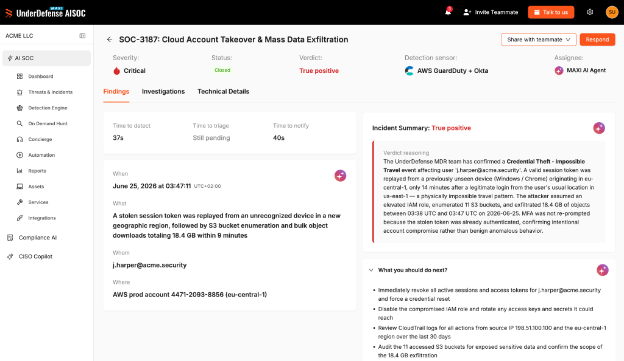
Source: UnderDefense
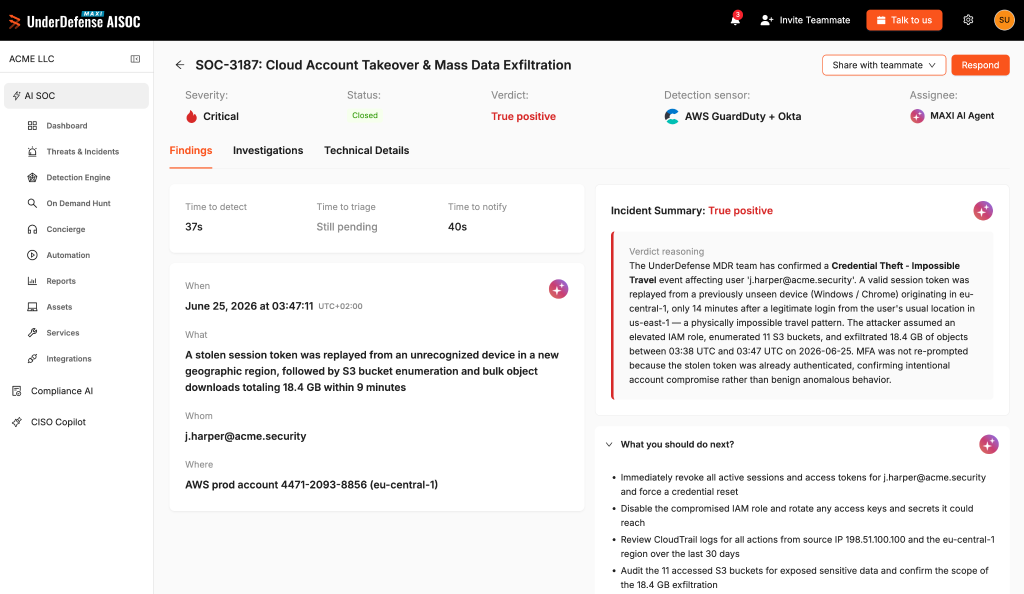
The platform integrates with more than 250 security tools, assigns a verdict to every alert, and reaches affected users directly over Slack, Teams, email, or SMS when it needs missing context. It can be deployed as SaaS, in the customer's own cloud, or fully on-premise and air-gapped, and it publishes per-asset pricing openly.
Key features include:
- Vendor-agnostic integration: Connects to Splunk, Microsoft Sentinel, Google SecOps, CrowdStrike, Elastic, and more than 250 tools in total, so investigations run across the existing stack with full data portability and no forced replacement.
- Automated alert investigation: Auto-investigates every alert with context collection, multi-system correlation, and verification, producing structured investigation reports and reducing alert noise before anything reaches an analyst.
- ChatOps user verification: Reaches affected users directly through Slack, Microsoft Teams, email, or SMS to confirm anomalous activity, capturing the human context that fully autonomous systems cannot gather on their own.
- Concierge analyst response: Pairs the platform with a 24/7 analyst team that handles hands-on containment and incident response through the same channels, so containment does not require engaging a separate vendor.
- Detection logic as code: Writes detection rules in Python that are versioned, unit-tested, and deployed through CI/CD, keeping every investigative step observable and auditable rather than hidden in a black box.
- Built-in compliance: Maps the same security telemetry to frameworks including SOC 2, HIPAA, PCI-DSS, GDPR, NIS2, DORA, and ISO 27001, and answers posture questions in plain language through a built-in copilot for executives and auditors.
- Flexible deployment: Runs as SaaS, in the customer's own cloud, or fully on-premise and air-gapped on Kubernetes, with sovereign AI model support so telemetry can stay inside a jurisdiction or closed network.
Limitations (as reported by users on G2):
- Onboarding setup effort: Some users report that initial setup requires attention before the platform is fully tuned to the environment.
- Integration breadth in edge cases: A small number of reviewers note limits when connecting less common or highly customized tools.
- Shared control of automation: Because response leans on the provider's concierge analyst team, some control over automated actions sits with the vendor rather than fully in-house.
3. 7AI: Best for autonomous, multi-agent investigation

Best for: Enterprises adopting autonomous, agent-driven SOC work.
Strengths: Swarming agents cover the full detection-to-response cycle.
Things to consider: Newer platform with a shorter enterprise track record.
7AI is an agentic security platform whose swarming AI agents run security operations autonomously, with agents specialized by domain such as cloud, email, identity, and endpoint. Rather than following fixed playbooks, the agents reason through alerts case by case.
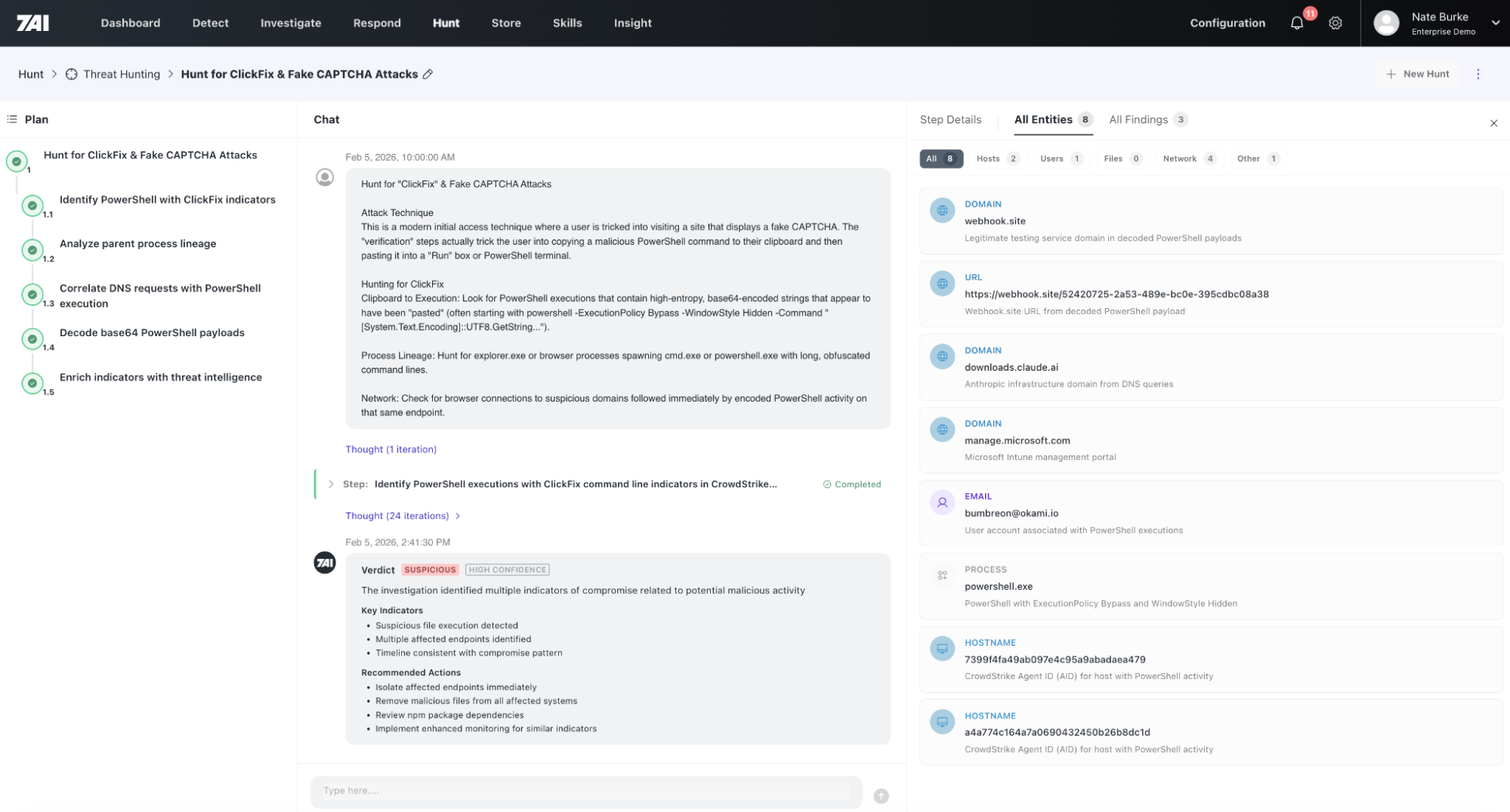
Source: 7AI
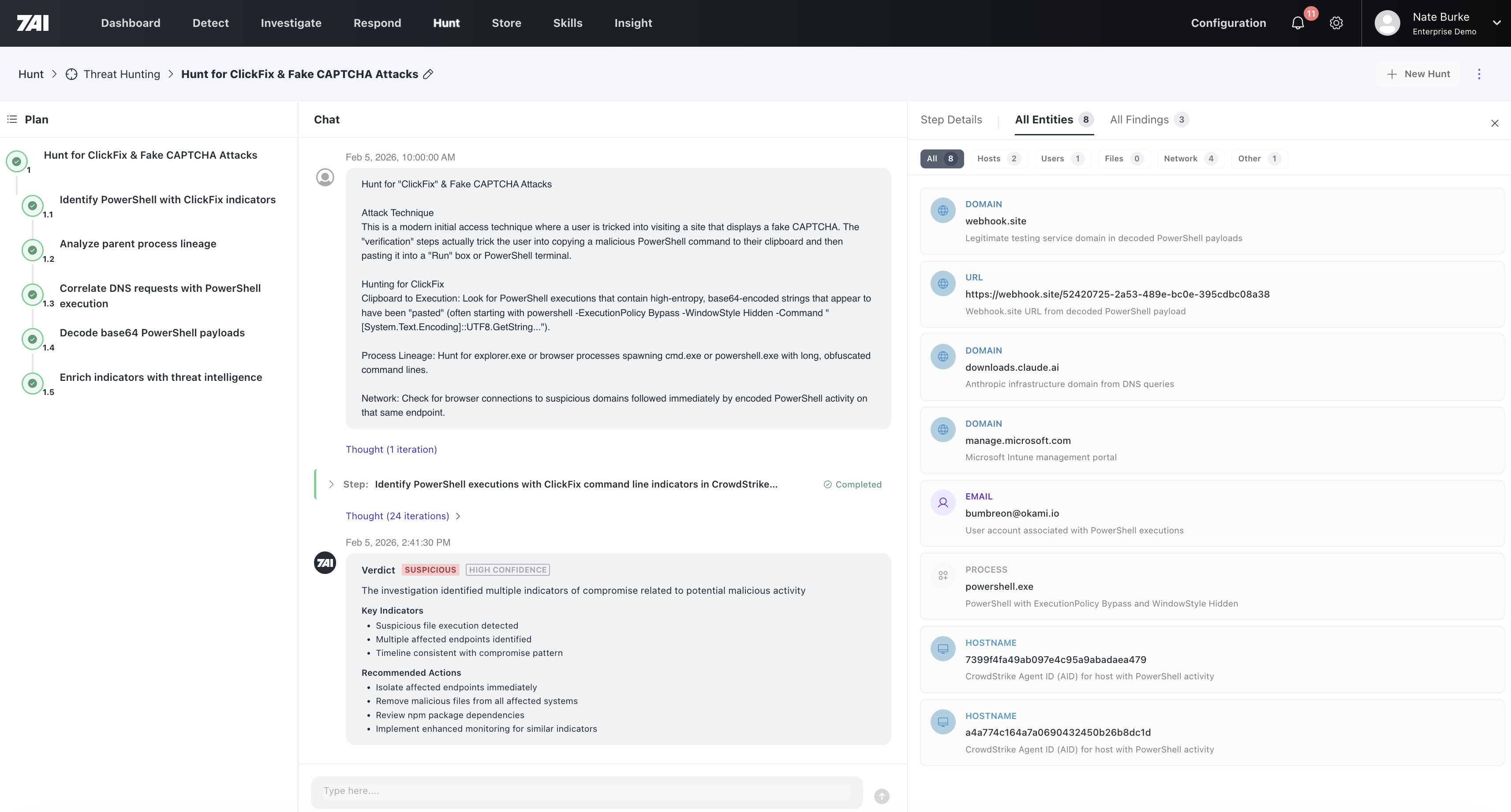
The platform covers the full lifecycle from alert ingestion and detection through investigation, response, threat hunting, and case management. Agents enrich data, query the environment, correlate across systems, and form conclusions, then drive response actions tied to those conclusions. It is available through the AWS Marketplace.
Key features include:
- Swarming investigation agents: Deploys domain-specialized agents that enrich data, query the environment, correlate across systems, and form conclusions with a full evidence trail, compressing work that previously took analysts hours.
- Intelligent detection and triage: Ingests alerts from existing security tools, applies AI-powered triage and enrichment, and surfaces context-aware conclusions so teams see actionable findings instead of raw alert volume.
- Conclusion-driven response: Takes automated remediation actions, such as isolating endpoints, disabling accounts, or blocking IPs, based on investigation conclusions rather than pattern matching, with one-click approval and human-in-the-loop options.
- Unified case management: Brings investigations, evidence, and team collaboration into a single case, auto-populating investigation summaries, correlating related alerts, and maintaining an audit trail and handoffs.
- Proactive threat hunting: Provides cross-system correlation, hunt suggestions, IOC extraction, and historical analysis so analysts can hunt for threats hiding in the environment once agents handle routine triage.
- Workflow builder: Lets teams build custom response workflows with drag-and-drop logic, conditional branching, and integrations to existing tools, without coding, to match organizational policies and procedures.
- Enterprise context awareness: Considers enterprise context dynamically at the time of investigation and reports on activity across the environment through real-time dashboards and scheduled reports.
Limitations (based on publicly available sources):
- Shorter enterprise track record: As a company founded in 2024 and launched from stealth in 2025, 7AI has less history in complex, multi-SIEM enterprise environments with legacy tooling and strict compliance requirements.
- Tuning for reliability: Published comparisons note that innovation-driven, multi-agent architectures can require fine-tuning before teams rely on them for consistent production results.
- Limited independent reviews: Third-party verified customer reviews remain sparse relative to more established platforms, so buyers have fewer external data points to evaluate.
4. Conifers.ai (CognitiveSOC): Best for Tier-2 investigation and MSSPs

Best for: Enterprises and MSSPs needing deep Tier-2 investigation.
Strengths: Mesh of agents covering the full SOC lifecycle with context.
Things to consider: Adaptive learning means onboarding takes weeks, not days.
Conifers.ai builds CognitiveSOC, an agentic AI SOC platform structured as a mesh of coordinated agents that share context across five SOC functions: threat intelligence, threat hunting, detection engineering, investigation, and response. Rather than looking at alerts in isolation, the agents weave together multiple alerts, endpoint telemetry, identity signals, and business context.

Source: Conifers.ai
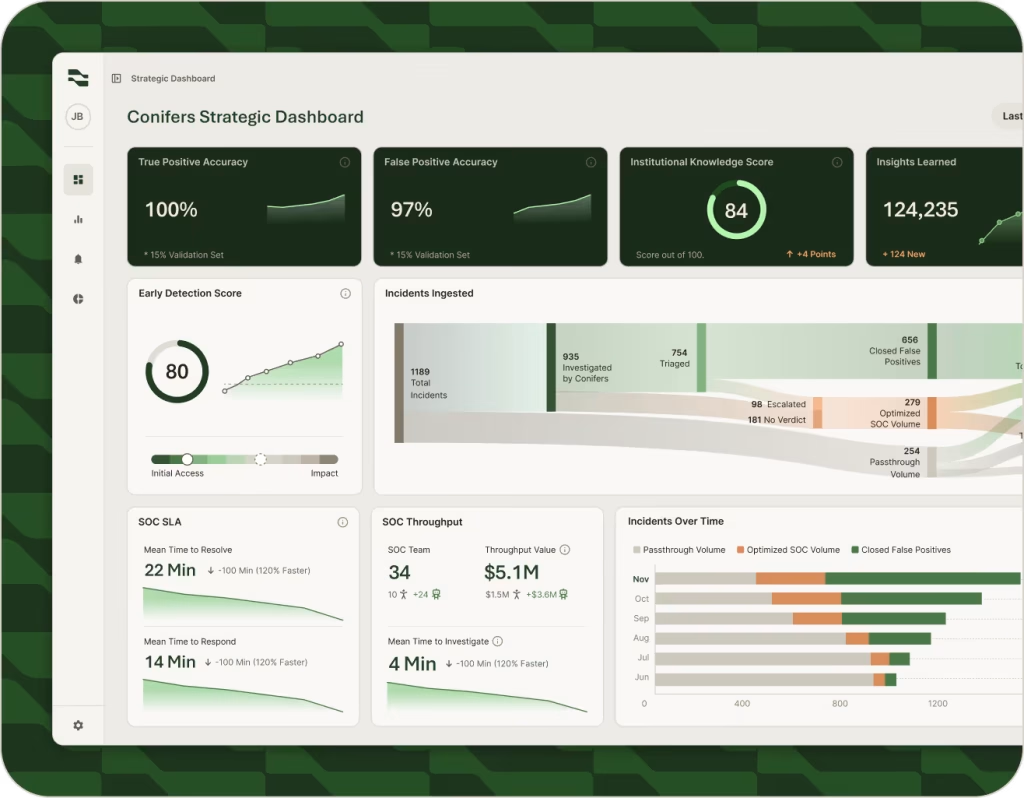
The platform runs on top of an organization's existing SIEM, SOAR, and XDR through a semantic layer with no data movement and no rip-and-replace, connecting to Splunk, CrowdStrike, AWS, Wiz, Abnormal, and more than 60 tools. It is built for enterprise SOCs and for the MSSPs and MDRs that serve them, with multi-tenant isolation.
Key features include:
- Mesh-agentic architecture: Coordinates specialized agents across five SOC functions that share context and operate as one system, so investigative knowledge accumulates across incidents rather than resetting with each alert.
- Tier-2 investigation: Reasons through an entire investigation the way a senior analyst would, correlating signals across systems and forming a narrative about what happened, reaching a verdict with a transparent reasoning chain.
- Semantic integration layer: Connects to existing SIEM, SOAR, and XDR tools through a semantic layer that reads telemetry and writes findings back without moving data, connecting to more than 60 security tools.
- Institutional knowledge: Learns each environment's specific context and reuses it, so investigations become grounded in how a particular organization operates and improve with every incident.
- Threat hunting and detection engineering: Forms and scores hypotheses, runs proactive hunts across live data, and surfaces silent, noisy, or broken detections to keep coverage healthy as the environment changes.
- Governed response: Proposes and executes scoped, reviewable response actions within defined guardrails, with autonomy that expands gradually under human oversight and every action logged.
- Multi-tenant operation: Runs dozens of tenants from one place, each grounded in its own environment with data isolation and per-tenant reporting, addressing the segregation needs of MSSPs and MDRs.
Limitations (based on publicly available sources):
- Longer time to value: The adaptive learning model means onboarding and full value are measured in weeks rather than days, so teams needing immediate Tier-1 relief may start with a narrower tool first.
- Thin public case studies: As a company that raised its first major round in 2025, public reference customers and independently verified before-and-after metrics remain limited.
- Pricing not published: Pricing is available only on request, which makes early budget comparison harder than with vendors that publish a starting price.
5. Exaforce: Best for reducing SIEM cost and load

Best for: Cloud and SaaS-heavy teams cutting SIEM cost and load.
Strengths: Multi-model AI on a unified data layer and knowledge graph.
Things to consider: Newest entrant with limited independent validation so far.
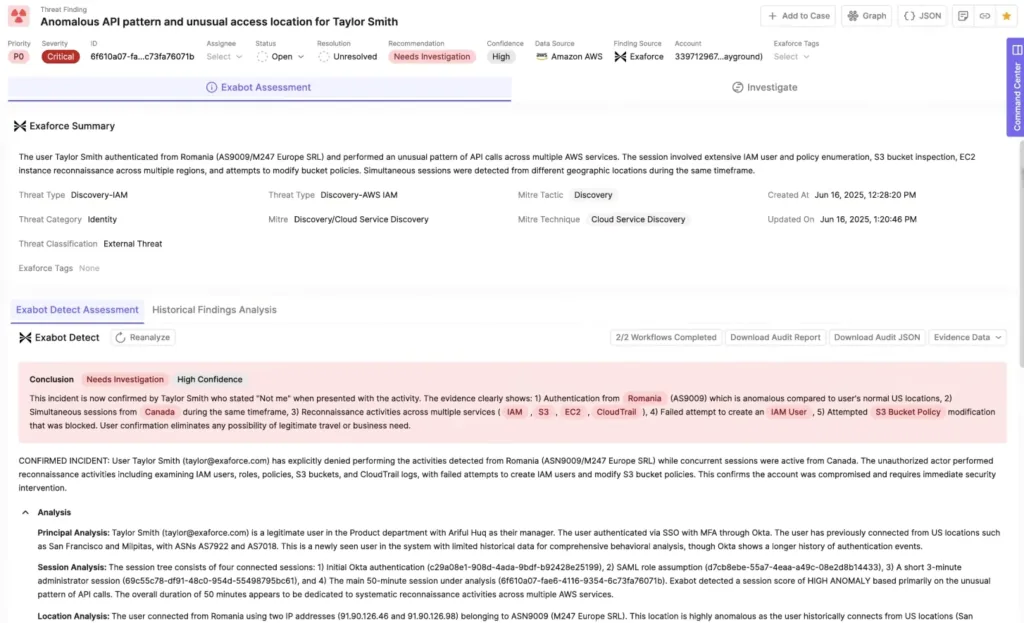
Exaforce is an agentic SOC platform built on a unified data layer and a real-time knowledge graph. Its multi-model AI engine combines data-ingestion models, behavioral machine learning, and large language models so that reasoning does not rely on a single LLM.
Source: Exaforce
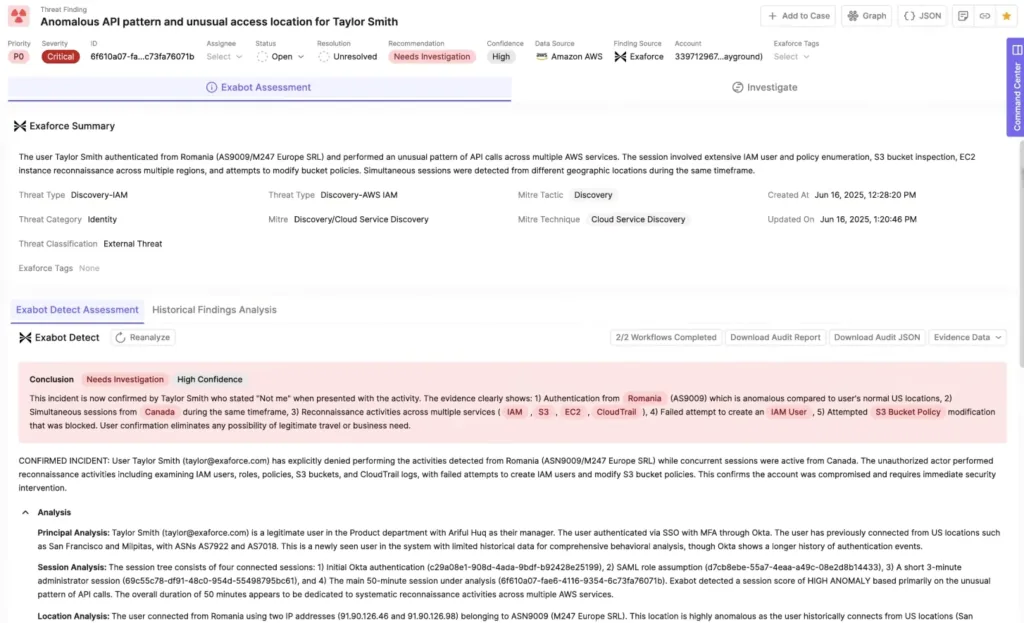
The platform uses a fleet of agents called Exabots that detect, triage, investigate, and respond across identity, IaaS, SaaS, endpoint, email, and insider attack surfaces. Its data platform is built to replace a traditional SIEM by ingesting, normalizing, and transforming security data at scale, which reduces SIEM storage and licensing cost. Teams can operate the platform themselves or have Exaforce run it as MDR.
Key features include:
- Multi-model AI engine: Runs several AI techniques in concert, combining data-ingestion models, behavioral machine learning, and large language models tuned for SecOps tasks, which reduces the hallucination risk of LLM-only approaches.
- Unified data platform: Ingests, normalizes, and transforms security data at scale to power AI-driven analysis and to replace a legacy SIEM, cutting storage and licensing costs tied to data-ingest pricing.
- Exabot Detect and Triage: Applies AI-powered detection to reduce the noise and blind spots of SIEM rules and automates triage to cut false positives before alerts reach analysts.
- Exabot Investigate: Investigates and hunts across a real-time knowledge graph without SIEM query complexity, giving analysts context and correlation without hand-writing queries.
- Exabot Respond: Executes automated response actions with analyst oversight, keeping humans in control of decisions while agents handle the mechanical steps of containment.
- Attack-surface coverage: Correlates signals across identity, IaaS, SaaS, endpoint, email, and insider attack surfaces, linking alerts to user and service-identity behavior for full-context findings.
- Flexible operating model: Runs as a self-operated platform for an in-house team or as an Exaforce-run MDR service using the same architecture and agents, with full visibility into every decision either way.
Limitations (based on publicly available sources):
- Early market validation: Founded in 2023, Exaforce is the newest entrant among these platforms, and independently verified customer reviews remain limited to a small number.
- Conservative procurement fit: Enterprises with strict procurement standards may prefer to wait for broader peer validation before committing to a young vendor.
- Pricing not published: Public pricing is not available, so budget modeling requires a direct sales conversation.
Emerging and Specialized AI SOC Platforms
Newer, focused agentic platforms that concentrate on autonomous alert triage and investigation, often designed to layer on top of an existing SIEM or XDR.
6. Dropzone AI: Best for fast autonomous Tier-1 triage
Best for: SOCs needing fast, low-friction autonomous alert triage.
Strengths: Pre-trained agents deploy in about an hour with no playbooks.
Things to consider: Focused on investigation, so response needs other tools.
Dropzone AI is an autonomous AI SOC analyst that investigates security alerts by mimicking the reasoning process of an expert analyst. It ingests alerts from existing tools, correlates data, and produces decision-ready reports in plain English so analysts can follow the reasoning.
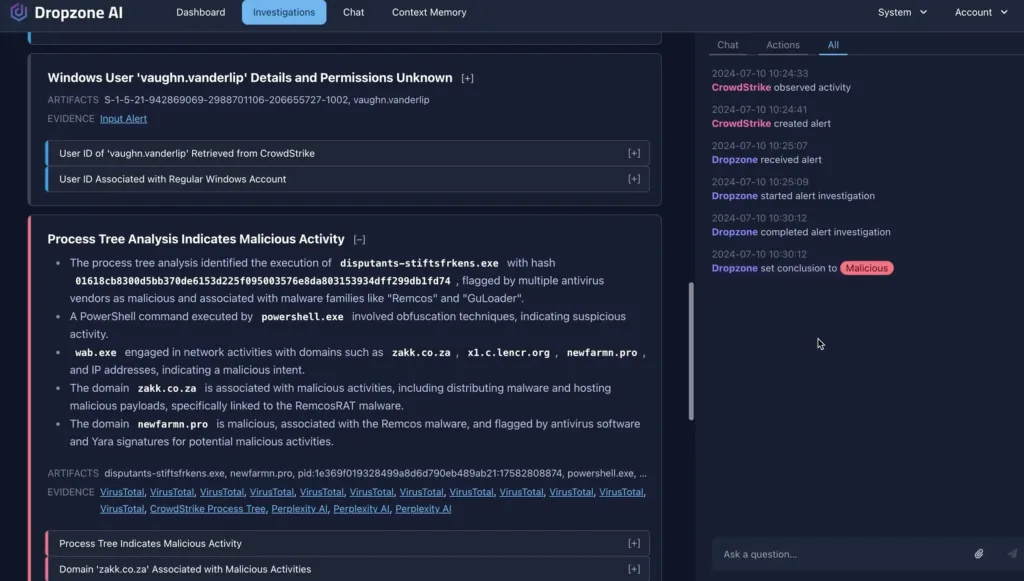
Source: Dropzone AI
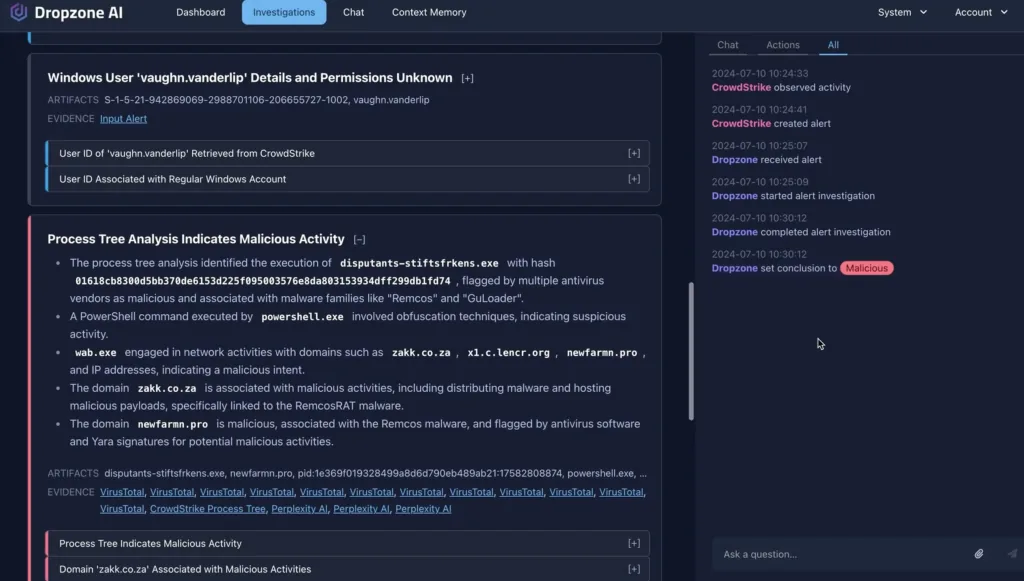
The platform comes pre-trained on investigation techniques and integrates with more than 90 tools across SIEM, EDR, cloud, identity, and email, deploying in about an hour with no playbooks or code to build. It learns environment-specific context over time and includes bundled threat intelligence subscriptions with each deployment.
Key features include:
- Autonomous alert investigation: Investigates every alert using expert analyst techniques, collecting evidence and correlating data across the stack, then delivers a full report with reasoning that analysts can verify step by step.
- Pre-trained rapid deployment: Connects to existing tools through API in about an hour with no log normalization, data migration, or playbooks, and begins investigating alerts immediately after connection.
- Broad integrations: Provides more than 90 ready-to-go integrations across SIEM, EDR, cloud, identity, and email, querying tools the way an analyst would and understanding each SIEM schema to pull the right data.
- Context memory: Learns details about the environment through analyst input and on its own, applying that context to future investigations to align results with organizational workflows and risk tolerance.
- Analyst chatbot: Offers a built-in chatbot for analysts to ask follow-up questions and run ad-hoc investigations without switching tools, extending the platform into Tier-2 work.
- Automated containment: Fires auto-containment actions when a threat is confirmed, such as blocking malicious IPs and disabling compromised accounts, and runs full blast-radius analysis on a confirmed phishing click.
- Bundled threat intelligence: Includes threat intelligence subscriptions with each deployment, such as CrowdStrike Falcon Intelligence and GreyNoise, plus common analyst utilities, at no additional cost.
Dropzone AI is highly rated on Gartner Peer Insights, so the items below reflect the most common critical themes rather than strongly negative reviews.
Limitations (as reported by users on Gartner Peer Insights):
- Initial tuning effort: Reviewers note an optimization phase during implementation to refine alert accuracy and reduce false positives before results stabilize.
- Usage-based cost model: Charges are tied to the number of investigations, which can grow at high or unpredictable alert volumes and may push teams to be selective about which alerts to ingest.
- Investigation-focused scope: The platform centers on autonomous investigation, so full response orchestration and detection engineering typically require pairing it with other tools.
Read about what CISOs are looking for in an AI SOC platform
7. Prophet Security: Best for transparent, analyst-in-the-loop investigation
Best for: Teams wanting deep investigation with visible reasoning.
Strengths: Agents show their full reasoning and evidence for every step.
Things to consider: Relies on the quality of upstream alerts it receives.
Prophet Security is an agentic AI SOC platform built by SecOps practitioners that spans alert investigation and remediation, scalable threat hunting, and continuous detection tuning. Its AI SOC Analyst instantly summarizes alerts and dynamically builds a complete investigation plan.
Reasoning agents mimic the process of an expert analyst, asking probing questions and pivoting across the stack to gather evidence, then identify true positives and prioritize critical threats. The platform integrates with SIEMs, EDR, cloud providers, and other sources, and continuously ingests organizational context and analyst feedback to refine its reasoning.
Key features include:
- Autonomous triage and investigation: Summarizes alerts and builds a dynamic investigation plan, then executes it by asking probing questions and pivoting across the stack to gather evidence the way a senior analyst would.
- Prioritized response: Identifies true positive alerts, prioritizes critical threats, and supports both autonomous remediation for high-confidence cases and human-in-the-loop decision points for complex ones.
- Transparent reasoning: Shows its work for every investigation, including the investigative plan, the queries used to retrieve information, and the evidence gathered, so analysts can validate each conclusion.
- Agentic threat hunter: Launches analyst-driven hunts from natural-language questions to validate hypotheses, and runs always-on and scheduled hunts to identify emerging threats that bypass existing measures.
- Threat hunter library: Provides a curated library of pre-codified hunt templates compatible with existing data sources so teams can operationalize global threat intelligence immediately.
- Bi-directional integrations: Connects to endpoint, email, identity, cloud, and data-loss-prevention sources with bi-directional communication that supports the full investigation lifecycle, not just alert ingestion.
- Continuous adaptation: Ingests organizational context and learns from analyst feedback on an ongoing basis, adjusting its reasoning logic to reduce noise and align with organizational policies.
Limitations (based on publicly available sources):
- Dependence on upstream alerts: As an investigation-layer platform, its results depend on the quality and coverage of the alerts produced by the tools that feed it.
- Response orchestration scope: The platform centers on investigation and triage, so teams needing heavy response orchestration may combine it with additional tooling.
- Limited public reviews: As a newer vendor with modest market mindshare, independently verified customer reviews are still limited.
8. Radiant Security: Best for mid-market teams cutting SIEM cost

Best for: Mid-market teams drowning in alert noise and SIEM cost.
Strengths: Adaptive AI triages any alert type plus low-cost logging.
Things to consider: Focused on triage rather than deep forensic investigation.
Radiant Security is an AI SOC platform that ingests, triages, and responds to alerts from any source, with an agentic SOC analyst that investigates each alert like a senior analyst and escalates only real threats. Its adaptive AI is designed to handle alert types it has not seen before rather than being limited to predefined use cases.
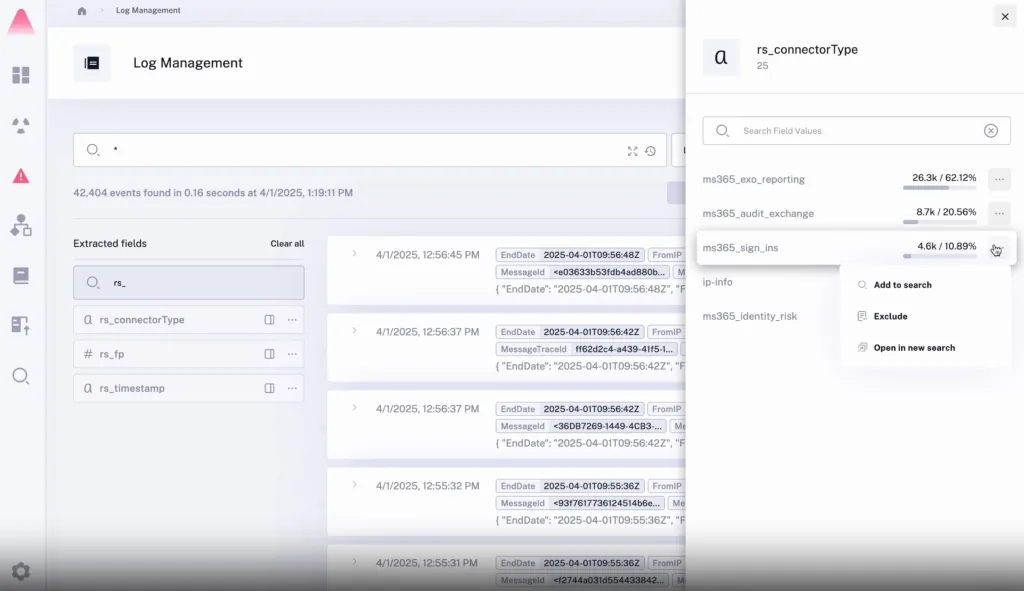
Source: Radiant Security
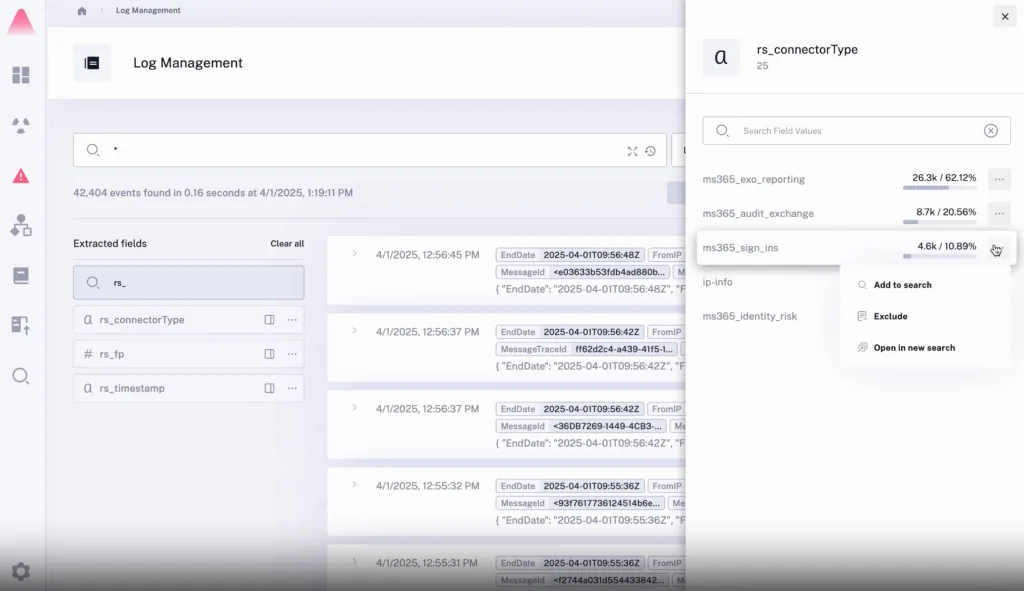
The platform emphasizes explainable AI, providing full traceability of its reasoning so analysts can review each escalation and dismissal for compliance. It includes integrated log management with unlimited retention at a fraction of traditional SIEM cost, and connects through more than 100 API integrations across the existing stack.
Key features include:
- Adaptive alert triage: Triages and investigates alerts across email, endpoint, identity, network, cloud, insider threat, SIEM, WAF, DLP, OT and IoT, dark web, and supply chain, including alert types the system has not encountered before.
- Explainable reasoning: Attaches full traceability to every escalation and dismissal, including which data sources were queried, what patterns were detected, and why the AI reached its conclusion, for audit and compliance.
- One-click response: Generates tailored remediation plans for each incident that analysts can launch manually with one click or automate for future incidents, keeping analyst control over actions.
- Integrated log management: Stores, searches, and analyzes security logs with unlimited retention and predictable pricing, positioned to reduce logging costs relative to a traditional SIEM.
- Broad integrations: Connects through more than 100 plug-and-play API connectors across the existing security stack, ingesting alerts and pushing enriched information and response actions back through them.
- Guardrails and policies: Lets SOC teams influence the AI through guardrails, policies, and exclusions so triage and response align with organizational priorities and risk tolerance.
- Continuous learning: Refines detection models and response recommendations over time as analysts interact with the system, aligning increasingly with the organization's environment and priorities.
Radiant Security is highly rated on Gartner Peer Insights, so the items below reflect the most common critical themes rather than strongly negative reviews.
Limitations (as reported by users on Gartner Peer Insights):
- Reporting flexibility: Some reviewers note that the reporting and dashboarding capabilities could be more flexible for their needs.
- Triage-layer dependence: Because it works from upstream alerts, its behavioral analytics are lighter than platforms with direct access to raw telemetry.
- Depth of forensic analysis: The platform prioritizes speed through detection and mitigation, so organizations needing heavy forensics and post-incident recovery workflows may need additional tooling.
- Change in ownership. In August 2026, Cribl acquired Radiant Security's AI SOC technology and related intellectual property, so buyers should confirm how the product, roadmap, and support will continue under Cribl.
9. Qevlar AI: Best for compounding, self-improving investigation

Best for: SOCs wanting investigation that compounds over time.
Strengths: Graph-orchestrated reasoning that reuses past investigations.
Things to consider: Investigation layer that pairs with existing detection tools.
Qevlar AI is an autonomous SOC platform that turns daily security activity into a self-improving defense system. It investigates every alert across the stack, connects related activity into a single incident story, maps the full blast radius, and moves containment forward while following the customer's procedures under analyst control.

Source: Qevlar AI
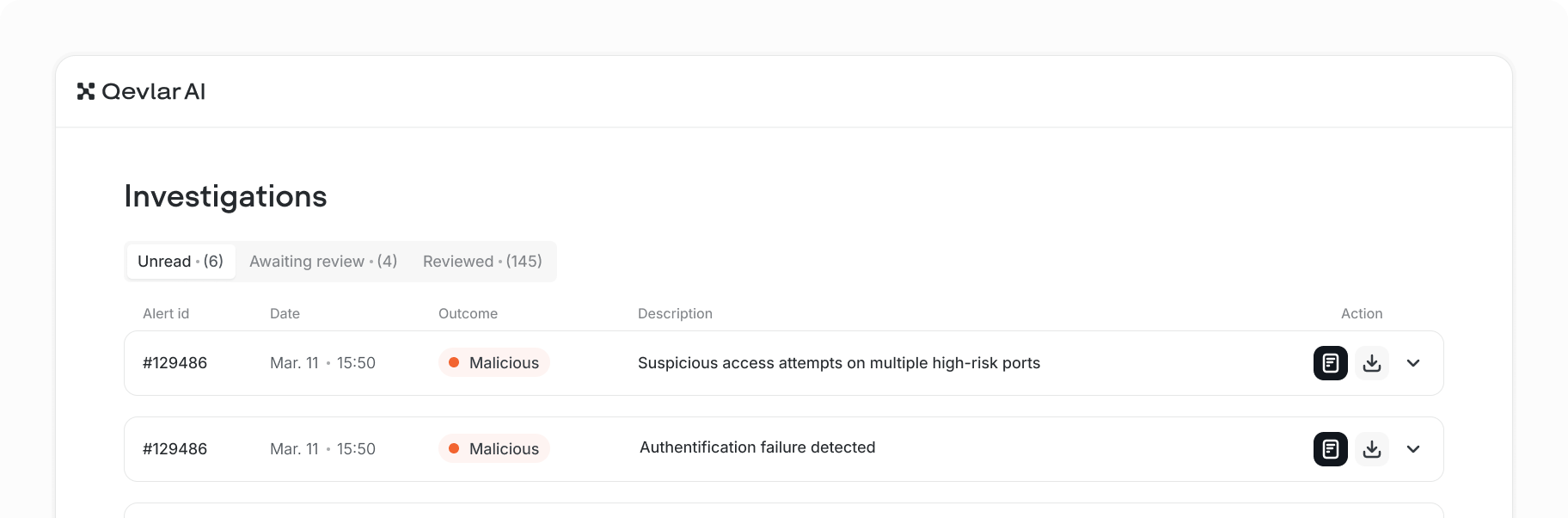
Rather than letting a single LLM run the investigation, Qevlar's core is a graph orchestrator with structured, reproducible reasoning and decision paths, using LLMs only for narrow, bounded tasks such as enrichment and summarization. It connects to the existing stack via API and is in production across 1,500 organizations.
Key features include:
- End-to-end investigation: Investigates every alert across the stack, connects related activity into a single incident story, and maps the full blast radius so analysts see a complete picture rather than isolated alerts.
- Graph-orchestrated reasoning: Runs on a graph orchestrator that keeps reasoning and decision paths structured and reproducible, using large language models only for bounded tasks like enrichment and summarization.
- Closed-loop response: Drives the next action for each outcome, including containment for malicious activity, tuning for false positives, and policy or compliance follow-up for benign violations, following defined procedures.
- Continuous threat hunting: Hunts autonomously for emerging threats, attacker techniques, behavioral anomalies, active exploitation, and patterns hidden across past investigations, turning each finding into action.
- Compounding institutional knowledge: Adapts to the environment and retains knowledge in the platform so investigations get faster and decisions more consistent regardless of analyst turnover.
- SOC and vulnerability linkage: Provides a shared intelligence layer so confirmed exploitation elevates vulnerable assets in the remediation queue and critical exposures become new hunt priorities for the SOC.
- API integration: Connects the existing tech stack via API within minutes, with results available in the customer's own console or in Qevlar, and supports on-premise deployment.
Limitations (based on publicly available sources):
- Investigation-layer positioning: Qevlar enriches and interprets alerts rather than generating detections, so it pairs with, rather than replaces, existing detection and SIEM tooling.
- Newer capabilities still maturing: Some recently announced agents, such as those unifying SOC and vulnerability operations, are scheduled for general availability later in 2026.
- Pricing not published: Public pricing is not available, and independent third-party reviews remain limited relative to larger vendors.
10. Bricklayer AI: Best for governed, coordinated agent teams

Best for: Teams wanting coordinated AI agents under tight control.
Strengths: 50+ agents share context under enforced governance.
Things to consider: Specialized to SOC work; less suited to broader use cases.
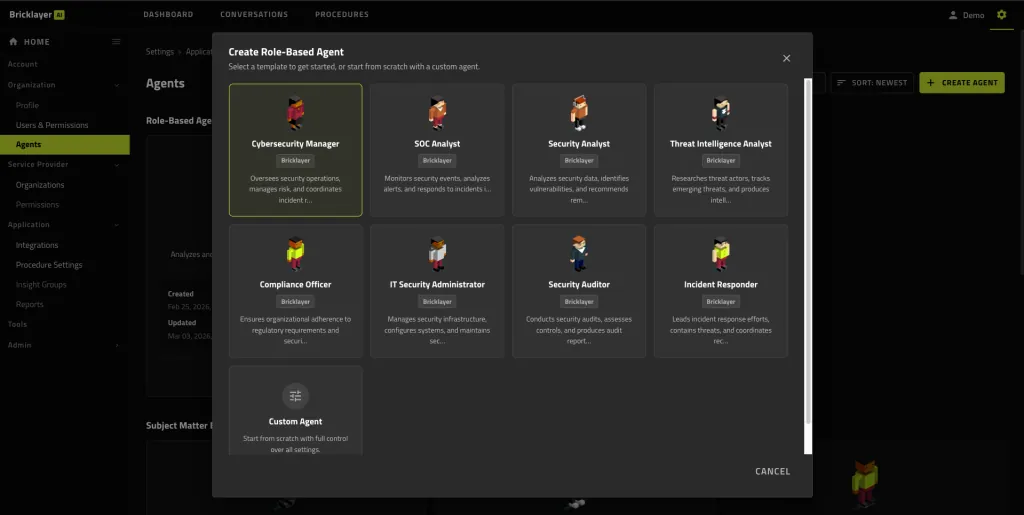
Bricklayer AI is an agentic cybersecurity platform that deploys a coordinated workforce of AI agents into the SOC. More than 50 expert agents triage, investigate, and execute across the security stack while following approved procedures, with every action visible and auditable.
Source: Bricklayer AI
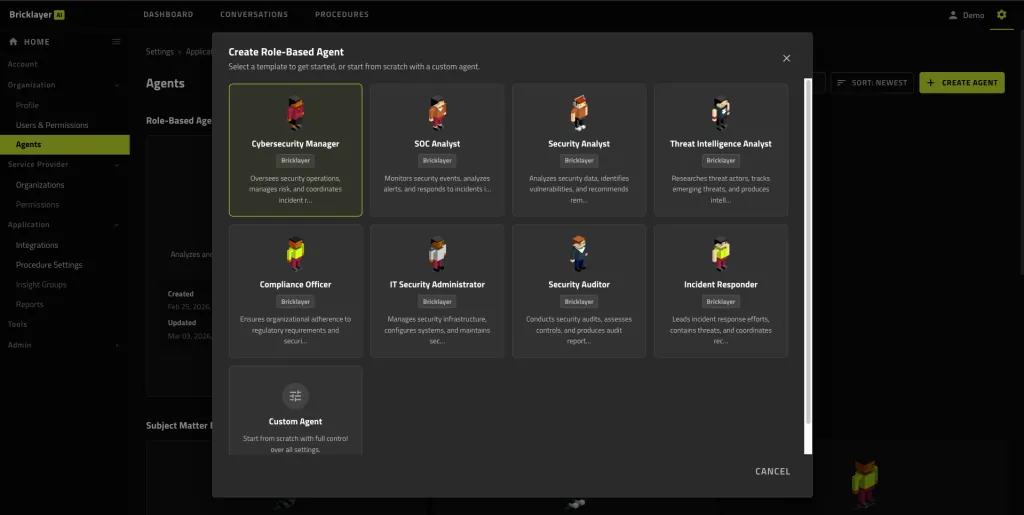
The platform is built around three principles: context, coordination, and control. Agents share investigative context through a system Bricklayer calls Multi-Agent Context Engineering, collaborate with analysts in a shared workspace, and operate within enforced governance. It connects existing tools through agent-powered integrations with no coding.
Key features include:
- Coordinated agent workforce: Deploys more than 50 out-of-the-box agents plus custom agents that triage, investigate, and execute across endpoint, identity, and cloud, assembling the right agents for each defined goal.
- Multi-Agent Context Engineering: Treats investigative knowledge as a structured system asset so agents inherit prior evidence, reasoning, and outcomes, preventing context from being lost as multiple agents work an investigation.
- Collaborative workbench: Provides a shared workspace where analysts and agents work together, with visibility into agent plans, evidence, and reasoning and the ability to question, drill down, and modify any procedure.
- Procedure-based workflows: Turns a defined goal into an auditable, task-based workflow that agents execute while humans oversee, so work follows approved procedures rather than isolated prompts.
- Enterprise governance: Enforces role-based access control, defined boundaries, and complete audit logging on every agent action, with multi-organization management and separate development, staging, and production environments.
- Agent-powered integrations: Connects existing security tools, data stores, and context to subject-matter-expert agents with no coding, so agents operate with awareness of the environment from the start.
- Cross-SOC use cases: Covers alert triage and response, incident investigation, vulnerability management, threat intelligence, and threat hunting, each adoptable independently and expandable into a broader system.
Limitations (based on publicly available sources):
- Specialized scope: Aggregated user feedback notes that the platform's focus on SOC tasks makes it less versatile for broader applications outside security operations.
- Smaller vendor: Bricklayer is an early-stage company with a modest headcount and seed-stage funding, which some enterprise buyers weigh when assessing long-term support.
- Limited public reviews: As a newer platform, independently verified customer reviews are limited relative to established vendors.
11. Legion Security: Best for teams that want agents trained on their own workflows

Best for: Teams wanting agents that learn their own workflows.
Strengths: Learns analyst workflows in the browser with no integrations.
Things to consider: Value depends on documented, validated analyst workflows.
Legion Security is an agentic security operations platform that learns an organization's own tools, context, and processes and deploys agents optimized for that team. Its starting premise is that AI should learn how a specific SOC works before it is trusted to work on its behalf.
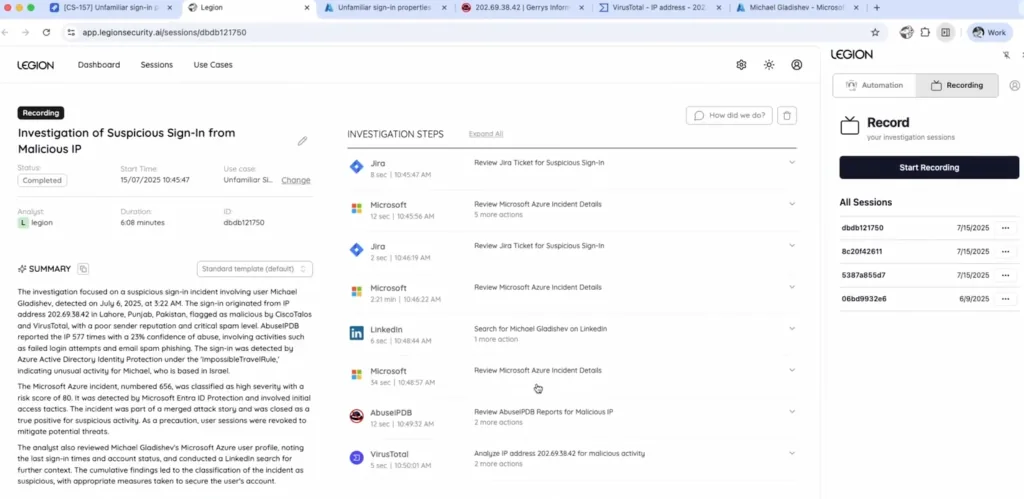
Source: Legion Security
Legion operates through the browser and observes analyst investigations, playbooks, runbooks, and past cases to turn that knowledge into agentic workflows. It runs in three modes, learning, companion, and autonomous, so autonomy is granted in phases under human oversight, and it requires no integrations to begin.
Key features include:
- Learning mode: Observes analyst context in the browser and other sources, including investigations, playbooks, runbooks, and past cases, and turns that knowledge into reusable agentic workflows specific to the team.
- Companion mode: Executes complete workflows directly through analysts' browsers while maintaining full human oversight and control at every step, so analysts stay in the loop as agents act.
- Autonomous mode: Becomes an autonomous extension of the team once trust is established, scaling the team's own investigative expertise across every alert on the organization's terms.
- Zero-integration deployment: Works through the browser without building integrations for each tool, so it can operate across customized, homegrown, and legacy tools that are otherwise hard to connect.
- Workflow capture and reuse: Records the steps of an analyst's workflow, including data reviewed, actions taken, and judgments made, and builds reusable investigative logic that reflects in-house best practices.
- Phased autonomy controls: Lets teams grant autonomy in stages and always on their terms, showing exactly what it plans to do, doing it, and logging every step for review.
- Analyst-aligned operation: Aims to mirror how a team's own analysts think and work so agents stay aligned with existing operating rhythm rather than imposing generic logic.
Limitations (based on publicly available sources):
- Dependence on existing workflows: Because it learns by observing analyst work, value depends on having documented and validated workflows and a learning period before autonomy.
- Browser-based model: Its tab-native, browser-based approach differs from API-integrated platforms and may fit some environments and tools better than others.
- Limited public reviews: As a newer vendor, independently verified customer reviews are limited relative to established platforms.
AI SOC Within Broader Security and Automation Platforms
AI SOC capabilities delivered inside an established endpoint, network, or automation platform rather than as a standalone AI SOC product.
12. SentinelOne (Purple AI): Best for endpoint-centric SOCs

Best for: Enterprises invested in the SentinelOne Singularity platform.
Strengths: Agentic investigation native to the Singularity platform.
Things to consider: Value is tied to adopting the Singularity platform.
Purple AI is SentinelOne's agentic AI security analyst, built into the Singularity platform as its reasoning layer and interface. It reasons across native and third-party data normalized to the Open Cybersecurity Schema Framework, so analysts get consistent context without switching tools or writing queries.

Source: SentinelOne
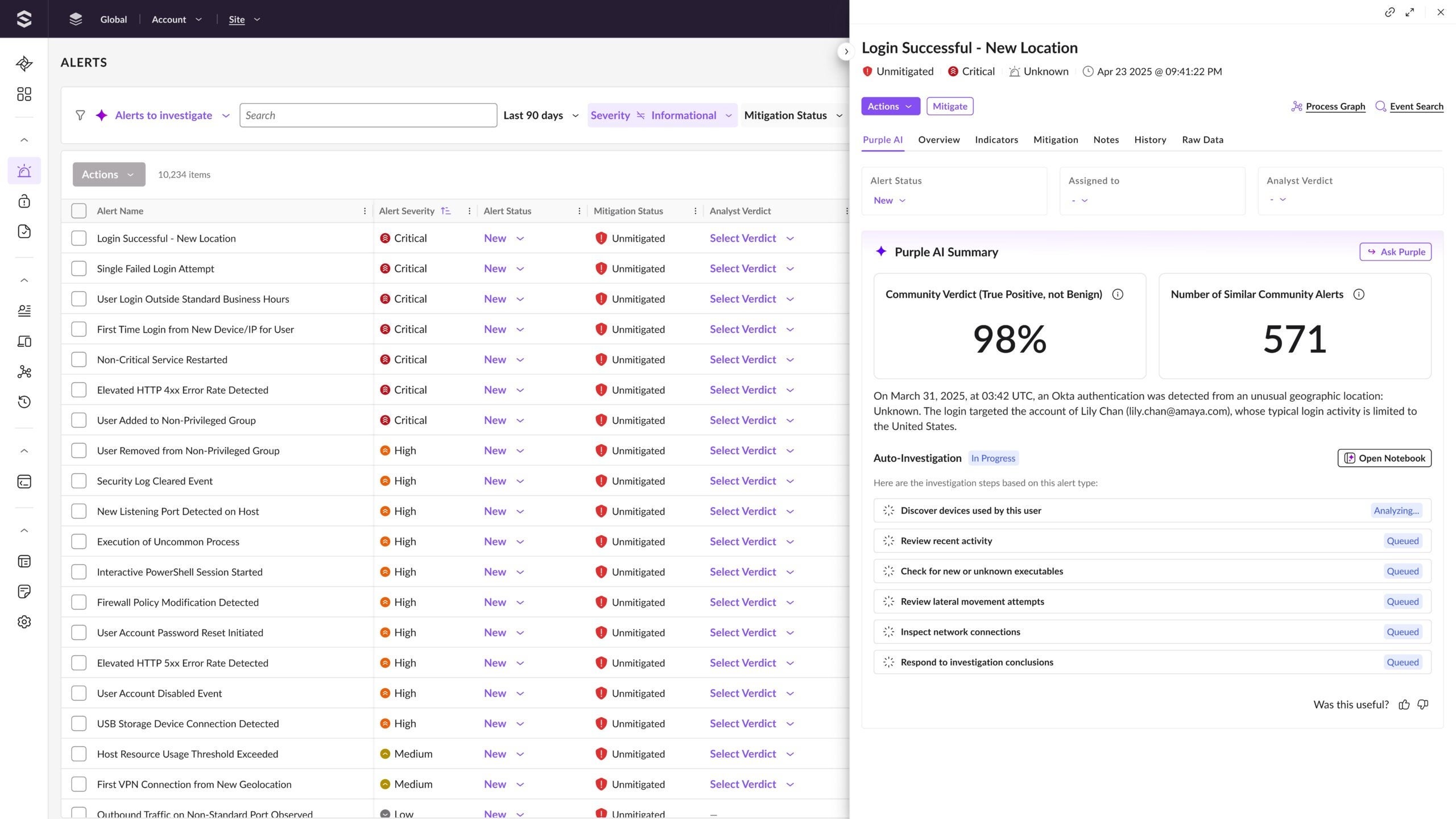
Its Agentic Investigation capability runs analysis from alert to verdict, collecting evidence, correlating telemetry, and building the attack timeline so analysts start at the verdict rather than the raw alert. For critical threats, investigations can trigger automatically and deliver verdicts that can be acted on autonomously or by an analyst, with a full evidence chain.
Key features include:
- Agentic investigation: Runs the analysis from alert to verdict, surfacing evidence and recommended next steps, and can trigger autonomously for critical threats so analysts begin with a completed investigation.
- Natural-language operations: Lets analysts query data and run investigations in plain language, translating natural language into structured queries so teams do not need to know a query syntax.
- Normalized cross-source reasoning: Reasons across native and third-party data normalized to the Open Cybersecurity Schema Framework, giving analysts a single consistent view of context across tools.
- Multi-model reasoning: Combines frontier models from Anthropic and OpenAI with SentinelOne's own models to compress investigations that previously took hours into minutes.
- Native platform integration: Runs inside the Singularity platform on telemetry already present across endpoint, identity, cloud, and third-party data, with activation by a single click and no separate deployment.
- Workflow documentation: Documents decisions, generates summaries and emails, and saves investigations in shared, exportable notebooks so teams can collaborate and hand off work.
- Community verdict: Draws on similarity analysis and verdicts from SentinelOne's managed services community to indicate which alerts to prioritize based on real investigations.
Purple AI is delivered as part of the SentinelOne Singularity platform, so the reviews below reflect experience with the broader platform.
Limitations (as reported by users on G2):
- Premium pricing: Reviewers describe the platform as a premium product with pricing on the higher side, which can be a factor for smaller organizations.
- Setup and tuning effort: Users note that initial setup and policy configuration can be complex and time-consuming in larger or more diverse environments.
- Learning curve: Some reviewers report a learning curve when first working with the feature-rich console before it becomes routine.
13. CrowdStrike (Charlotte AI): Best for Falcon-standardized teams
Best for: Organizations already standardized on CrowdStrike Falcon.
Strengths: Agentic triage and response native to the Falcon platform.
Things to consider: Depth is tied to the Falcon ecosystem and its data.
Charlotte AI is CrowdStrike's agentic AI security analyst and the interface and orchestration engine for the Falcon platform. It combines generative and agentic AI trained on decisions from CrowdStrike's managed detection and response team, and it powers chat, embedded insights, and agentic operations across detections, investigations, and response.
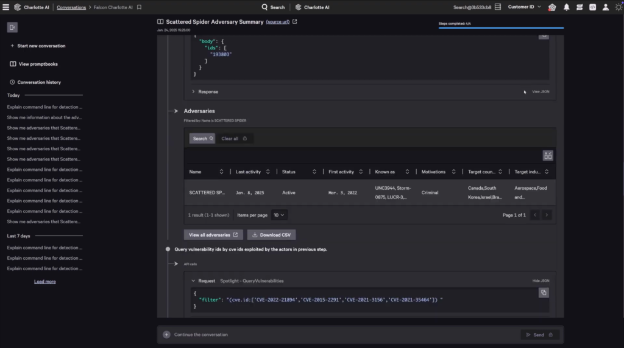
Source: CrowdStrike
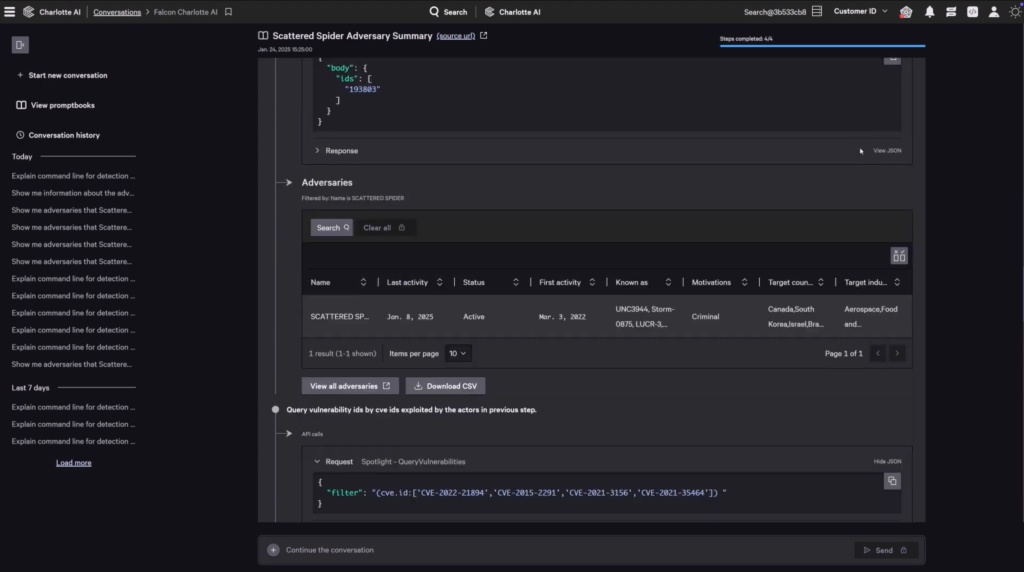
Its Detection Triage agent automatically analyzes endpoint, identity, and cloud detections within seconds of creation and classifies them, while its Response agent drives investigations by asking and answering the questions an analyst would. Charlotte Agentic SOAR orchestrates CrowdStrike, custom-built, and third-party agents together under human command.
Key features include:
- Detection triage agent: Automatically analyzes every new endpoint, identity, and cloud detection within seconds, assigns a priority, classifies it as true or false positive, and recommends a course of action.
- Agentic response: Drives investigations by asking and answering the questions a seasoned analyst would in a dynamic workspace, and lets analysts inject context and set priorities in real time.
- Charlotte AI AgentWorks: Lets teams build, test, and deploy custom security agents using natural language with no code, within the Falcon platform and with enterprise governance built in.
- Charlotte Agentic SOAR: Orchestrates CrowdStrike, custom, and trusted third-party agents as one system across prevention, detection, investigation, and response, combining structured automation with agentic reasoning.
- Mission-ready agent library: Provides purpose-built agents for tasks such as malware analysis, exposure prioritization, threat hunting, and detection rule generation, delivered natively through Falcon modules.
- Natural-language platform access: Lets analysts interact with the Falcon platform in plain language to ask questions and get context-aware answers without manual compilation or complex syntax.
- Governance and auditability: Operates within role-based access controls, inspectable source data, and audit-ready logs, with bounded autonomy that keeps actions user-authorized and traceable.
Limitations (as reported by users on G2):
- Capabilities still maturing: Reviewers note that some functionality is still in development across certain modules, so teams need to track the roadmap as features are released.
- Ecosystem dependence: Charlotte AI's depth comes from the Falcon platform and its data, so its full value is realized by organizations already standardized on CrowdStrike.
- Credit-based consumption: Pricing is usage-based on credits, which requires monitoring consumption as agentic actions scale across the environment.
14. Vectra AI: Best for network and identity threat detection

Best for: Enterprises prioritizing network and identity visibility.
Strengths: Behavioral detection across network, identity, cloud, and SaaS.
Things to consider: Specialized in network and identity rather than full stack.
Vectra AI is an AI-driven detection and response platform for hybrid and multi-cloud enterprises that delivers integrated signal across public cloud, SaaS, identity, and data-center networks in one platform. Its patented Attack Signal Intelligence analyzes attacker techniques across the kill chain to distinguish real attacks from noise.
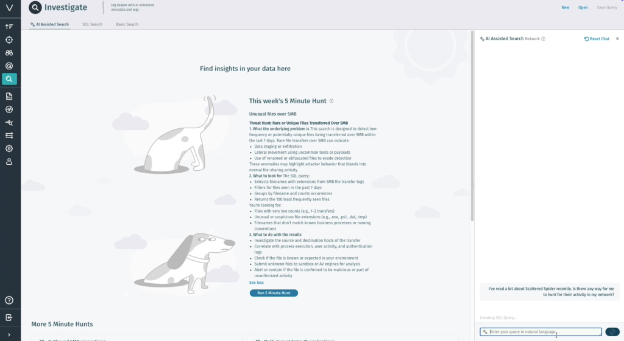
Source: Vectra AI
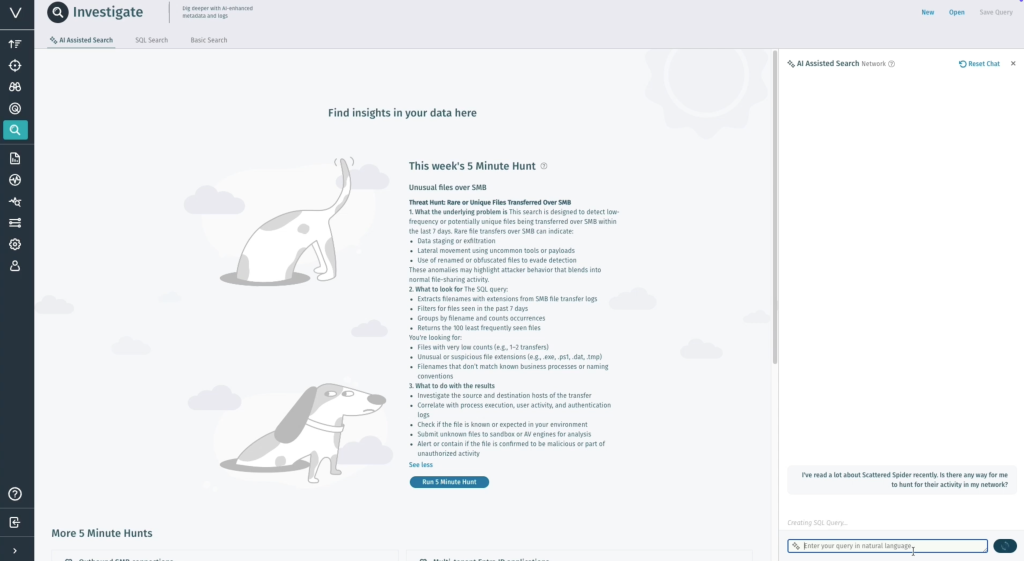
The platform has extended from network detection and response into AI SOC territory with an agentic layer whose AI agents continuously triage, correlate, and prioritize genuine threats. It enriches existing SIEM, EDR, and XDR investments rather than requiring a rip-and-replace, and provides Model Context Protocol servers that give AI agents access to live security data.
Key features include:
- Attack Signal Intelligence: Applies behavioral AI refined over more than a decade to understand attacker techniques across the kill chain, surfacing lateral movement, identity-based attacks, and living-off-the-land activity.
- Hybrid coverage: Delivers integrated signal across public cloud on AWS, Azure, and GCP, SaaS, Active Directory identity, on-premise data centers, and OT and IoT within a single platform.
- Agentic SecOps layer: Runs AI agents that continuously triage, correlate, and prioritize genuine threats in real time, including a triage agent for false-positive investigation and a stitching agent for cross-domain correlation.
- Entity-centric prioritization: Prioritizes entities under active attack with risk scoring so analysts know where to start and which activity is most relevant and urgent across domains.
- Stack enrichment: Enriches existing SIEM, EDR, and XDR investments with high-quality network and identity signals rather than requiring teams to replace their current tools.
- Model Context Protocol integration: Provides Model Context Protocol servers that give AI agents programmatic access to live security data for automated triage and correlation.
- Identity-focused detections: Detects identity threats such as MFA bypass, token theft, privilege escalation, and suspicious activity across Microsoft 365 and Azure AD environments.
Limitations (as reported by users on G2):
- Learning curve: Reviewers note that the platform is terminology-heavy and requires familiarity with network detection and response to interpret and act on its signals.
- Alert noise in some deployments: Some users report a higher false-positive or benign-alert rate that needs tuning, particularly through the managed detection service.
- Specialized coverage: The platform is strongest in network and identity telemetry rather than full-stack SOC coverage, so teams may pair it with endpoint and other tools.
15. BlinkOps: Best for teams building their own automation

Best for: Teams building custom automation across security operations.
Strengths: End-to-end agents on a broad automation platform.
Things to consider: Realizing full value involves building and tuning workflows.
BlinkOps is an agentic security operations platform on which AI SOC is one solution among many. It deploys micro-agents across the full incident lifecycle, from triage and investigation to response and remediation, that correlate data across the stack, apply contextual reasoning, and surface only what needs human judgment.
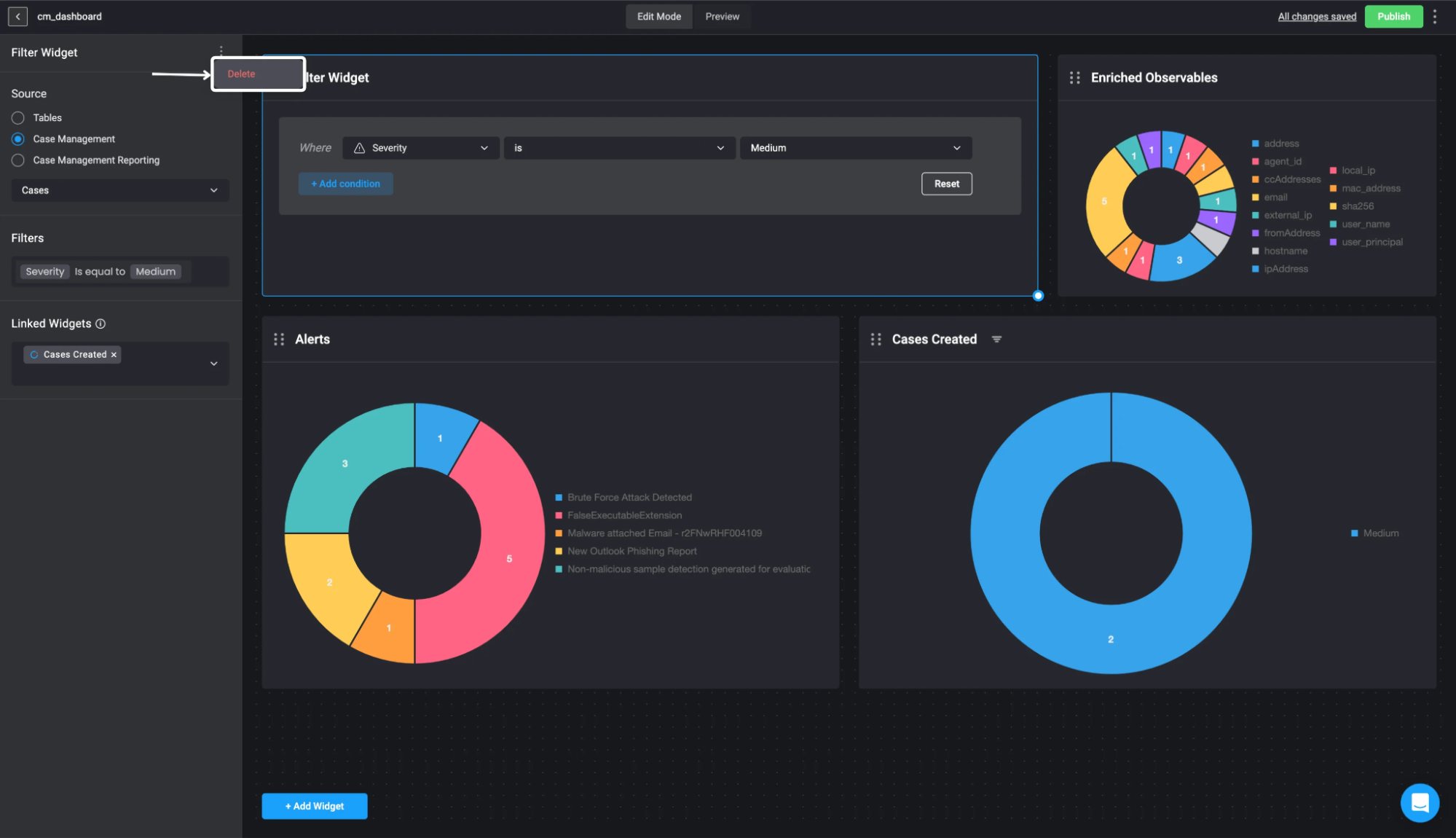
Source: BlinkOps
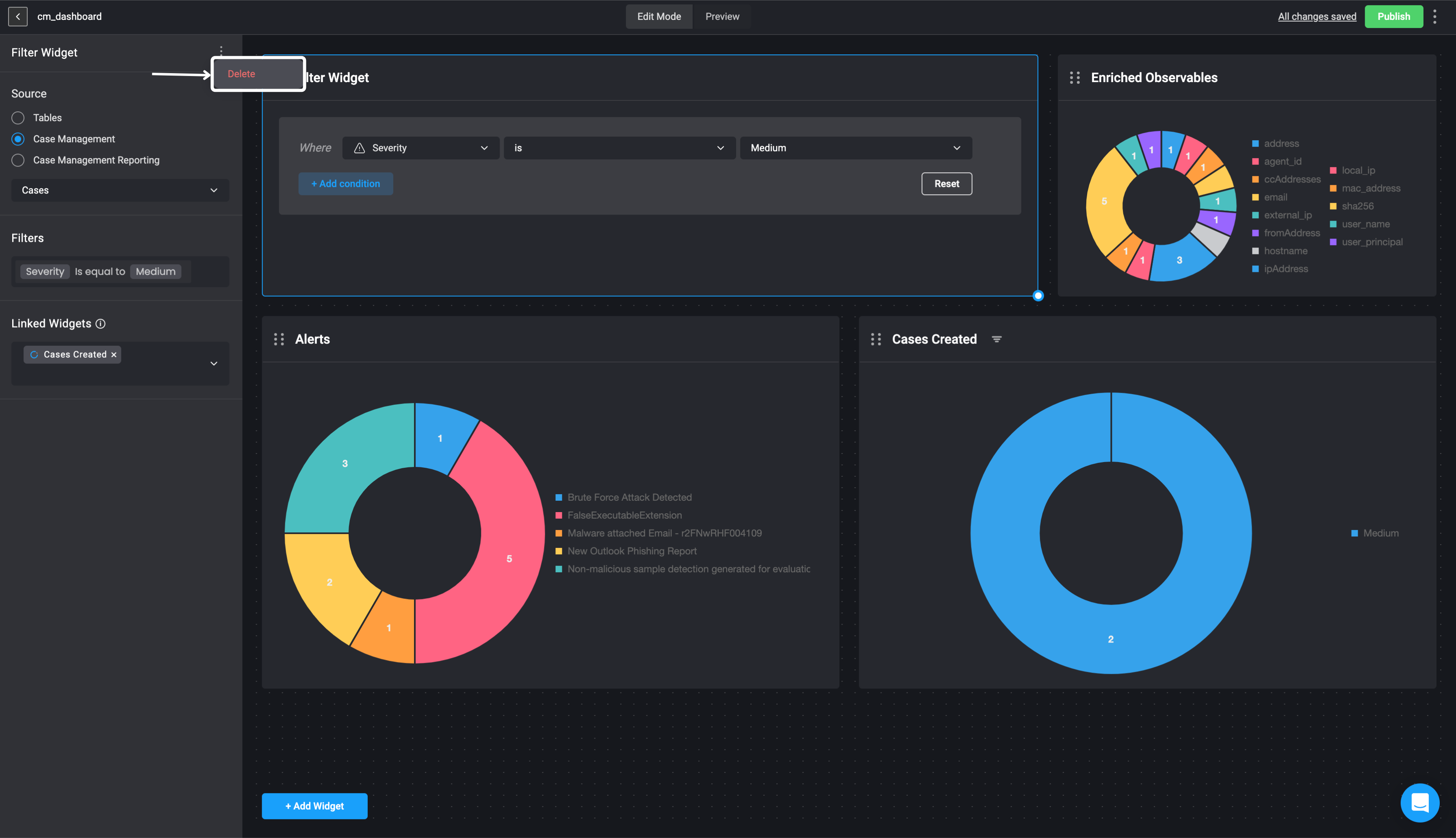
The platform lets teams start with plug-and-play agents and prebuilt workflows, customize them, or build their own with its Agent and Workflow studios, and it lets security leaders set the level of autonomy and where humans stay in the loop. The same foundation also supports threat hunting, threat intelligence, and malware analysis solutions.
Key features include:
- Micro-agent incident handling: Deploys micro-agents across the full lifecycle, from triage and investigation through response and remediation, correlating data across the stack and surfacing only what needs human judgment.
- End-to-end investigation: Goes beyond triage into deep investigation, malware analysis, timeline reconstruction, blast-radius mapping, and full remediation within one platform.
- AI-powered case management: Centralizes the investigation lifecycle in one workspace that pulls context automatically and explains findings, blending autonomous remediation with human-in-the-loop oversight.
- Agent and workflow studios: Lets teams customize prebuilt agents and workflows or build their own from scratch, so automation can be tailored per alert type and environment rather than taken as-is.
- Configurable autonomy: Lets teams define what agents can and cannot do, limit scope, restrict actions, and set confidence thresholds and approval gates so agents operate only within set rules.
- Governance and audit: Applies granular role-based access control, approval gates, and full audit trails on every agent action, logging each decision and reasoning step for compliance and review.
- Broad platform scope: Runs AI SOC alongside prebuilt solutions for threat hunting, threat intelligence, and malware analysis on the same foundation, so teams can expand across security operations.
Limitations (based on publicly available sources):
- Build-your-own effort: As an automation-first platform, realizing full AI SOC value involves building and customizing workflows and agents rather than deploying a finished SOC out of the box.
- Documentation depth: Some users note that the documentation could be more detailed, though many find the platform largely self-explanatory.
- Occasional portal downtime: A small number of reviewers report occasional portal unavailability during platform updates.
16. Torq (HyperSOC): Best for hyperautomation-driven SOCs

Best for: Teams building an autonomous SOC on a hyperautomation engine.
Strengths: Multi-agent system on a mature automation platform.
Things to consider: Steep learning curve for advanced workflow building.
Torq's AI SOC platform combines agentic AI with hyperautomation to triage, investigate, and respond to threats. Its HyperSOC product is an autonomous SOC that fuses the speed and consistency of automation with adaptive AI, handling the incident lifecycle from detection to triage, investigation, and remediation with minimal human intervention.

Source: Torq
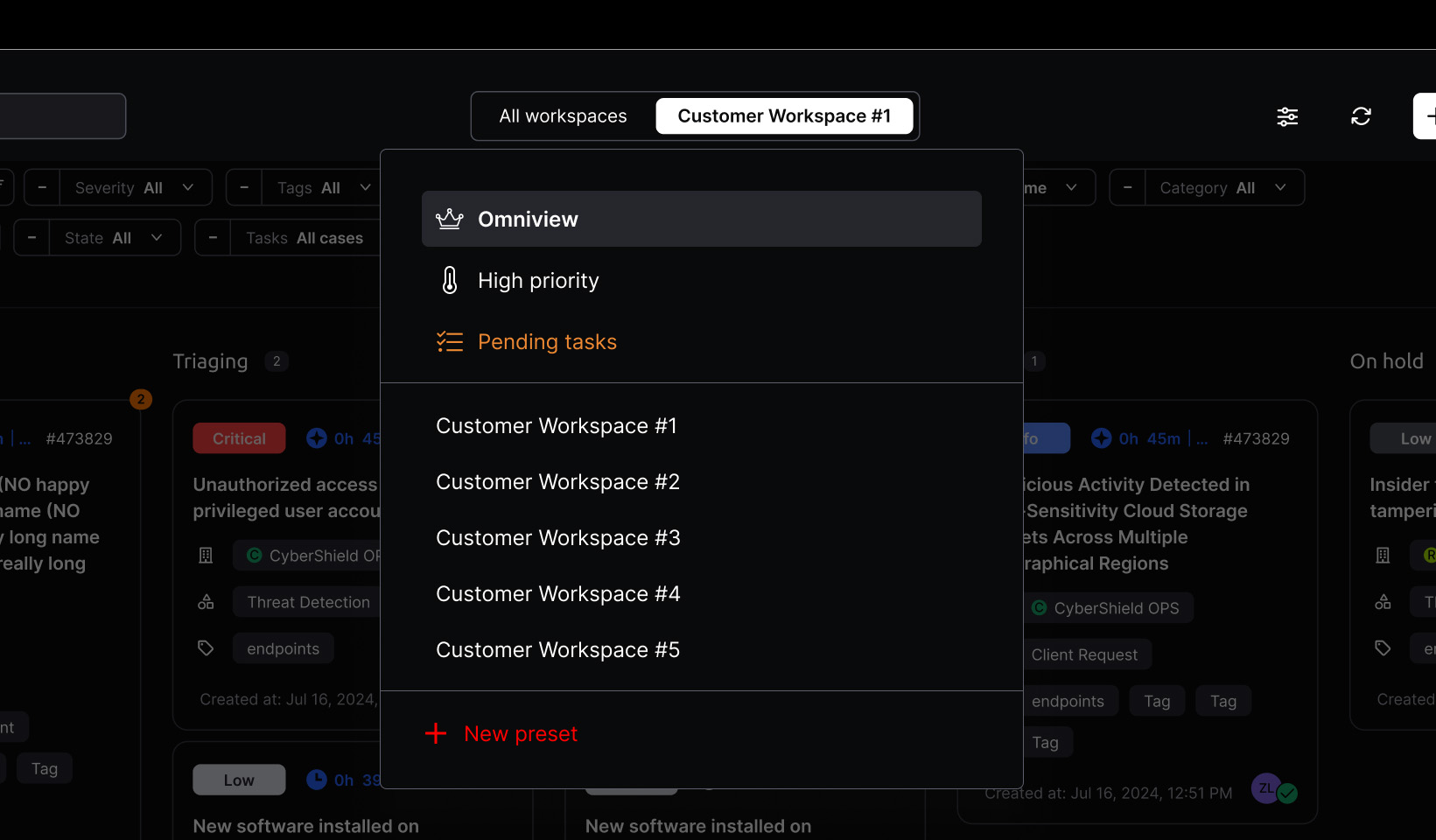
At its center is Socrates, an agentic AI SOC analyst that acts as an orchestrating agent coordinating a multi-agent system of Runbook, Investigation, Remediation, and Case Management agents. The platform runs on a hyperautomation engine with more than 300 pre-built integrations and thousands of ready-to-use automation steps.
Key features include:
- Socrates multi-agent system: Coordinates specialized agents for runbooks, investigation, remediation, and case management under an orchestrating agent that share context in real time to handle Tier-1 and many Tier-2 tasks.
- Investigation agent: Automatically analyzes alerts, enriches them with context, and identifies root causes, so cases arrive with analysis attached rather than as raw alerts.
- Runbook agent: Converts natural-language descriptions into automated workflows with no code, accelerating the creation of response procedures for the SOC.
- Hyperautomation engine: Provides more than 300 pre-built integrations and thousands of ready-to-use automation steps across SIEM, EDR, cloud, identity, and threat intelligence, extensible through a no-code and low-code builder.
- Autonomous case management: Creates and prioritizes enriched security cases with AI-generated summaries, orders them by severity and ownership, and manages the case lifecycle from detection to resolution.
- Human-in-the-loop remediation: Keeps critical decisions and actions under human control, letting analysts intervene in any sensitive automated process so actions align with organizational policy and risk tolerance.
- Open model and integration architecture: Runs in a serverless, cloud-native environment, supports custom no-code connectors that discover schemas, and can use Torq's models or customer-chosen frontier models.
Limitations (as reported by users on G2):
- Learning curve: Reviewers note that Torq has a steep learning curve and that building highly customized workflows requires users to be well trained on the platform.
- Integration configuration: Some users report that connecting certain applications can be complicated to configure during setup.
- Support responsiveness: A few reviewers note that customer service response times can be slow at times.
Metrics for Evaluating AI SOC Performance
When deploying AI technology in the SOC, it’s important to evaluate its effectiveness in improving security operations and ultimately, the organization’s security posture. Here are a few ways organizations can evaluate the impact.
1. Time-to-Detect and Time-to-Respond Improvements
A primary measure of AI SOC effectiveness is the reduction in mean time-to-detect (MTTD) and mean time-to-respond (MTTR) to security incidents. By applying real-time analytics, automated playbooks, and rapid incident orchestration, AI SOCs identify and address threats faster than traditional manual workflows. These improvements directly correlate with reduced attacker dwell time and minimized business impact.
Measuring and trending detection and response times before and after AI SOC implementation helps organizations quantify operational gains. Continuous monitoring ensures that performance does not degrade as attack volumes grow or adversaries change strategies, providing an objective benchmark for the SOC’s maturity and agility.
2. Reduction in False Positives and Manual Workload
AI SOCs are designed to cut through noise and decrease the number of false positives requiring analyst attention. High-fidelity detection models and automated triage ensure that analysts focus only on relevant, credible alerts. Over time, this reduces cognitive overload and allows teams to allocate resources where they are most needed.
Tracking the percentage decline in false positives and the number of manual investigations over a sustained period is a strong indicator of AI SOC efficiency. These metrics directly map to reduced burnout and improved focus within SOC teams, contributing to better analyst retention and higher job satisfaction.
3. Analyst Efficiency and Skill Amplification
AI SOCs amplify analyst capabilities by automating mundane tasks and providing data-driven insights. Analysts can investigate threats faster and more thoroughly, leveraging AI to surface correlations and evidence that would take hours to compile manually. Automation eliminates repetitive work and enables less-experienced analysts to perform at higher levels with machine support.
Evaluating the volume and complexity of incidents handled per analyst, alongside time spent per investigation, reveals the degree of skill amplification achieved. These metrics help demonstrate ROI for AI SOC investments and guide workforce planning as operations scale.
4. Coverage Improvements Across the Kill Chain
AI SOCs enhance security coverage by continuously monitoring and correlating events across all stages of the attack kill chain, from initial access to lateral movement and exfiltration. AI-driven analysis allows for early detection of subtle signals and chaining together disparate events that would otherwise be missed by siloed tools.
Metrics for evaluating coverage include the variety and depth of attack techniques detected, the speed and consistency of response at each attack stage, and the reduction in successful breaches or undetected incidents. Improved kill chain coverage highlights the comprehensive nature and effectiveness of the AI SOC in defending modern enterprise environments.
Tips for Successful Deployment and Operations of an AI-Driven SOC
1. Start With Incremental Adoption
Organizations should avoid a big-bang approach when implementing AI in the SOC. Starting with pilot projects in areas like automated triage or enrichment allows teams to gain comfort with new technologies, validate benefits, and minimize disruption. Early successes build momentum for broader AI integration and help surface process or technology gaps before scaling.
Pilot deployments also provide valuable data on integration complexity, user acceptance, and operational impact—insights that can be leveraged to refine strategy and chart a realistic roadmap for SOC transformation. This staged adoption minimizes business risk and supports smoother organizational change management.
2. Establish Human-AI Collaboration Guidelines
As AI becomes more integral to security operations, clear guidelines for the division of labor between humans and machines are essential. Define which workflows can be safely automated, when human intervention is mandatory, and how escalations are managed for ambiguous incidents. Policies should address trust boundaries, explainability requirements, and override mechanisms.
Effective collaboration depends on open feedback loops between analysts and AI systems. Regular reviews of automated decisions, incident outcomes, and model suggestions ensure that responsibility remains clear and that the AI continues to align with organizational risk tolerance and values.
3. Standardize Data Quality and Telemetry Hygiene
AI system effectiveness is only as good as the data they process. Organizations should standardize telemetry collection across endpoints, networks, and cloud environments, ensuring complete, accurate, and well-structured data feeds. Proactive data hygiene reduces the risk of missed threats, erroneous conclusions, and bias in automated models.
Implementing good data governance practices—such as schema validation, enrichment, normalization, and retention policies—is critical to preserving high-quality input for AI-driven analysis. These foundational steps maximize the return on AI investment and underwrite robust, reliable SOC automation.
4. Train Analysts to Work With AI Investigation Tools
Developing analyst proficiency in AI-driven tools is central to realizing the full value of an AI SOC. Training should focus not just on operating new interfaces but on interpreting model outputs, understanding AI rationales, and identifying potential blind spots or errors. This empowers analysts to make informed decisions when collaborating with automation.
Continuous professional development, through vendor-led courses, hands-on labs, and real-world scenario drills, keeps skills current as AI features evolve. Training should bridge the gap between cybersecurity fundamentals and data science basics, ensuring analysts are equipped to guide, challenge, and improve the AI SOC over time.
5. Create a Feedback Loop to Improve AI Performance Over Time
No AI system is perfect out of the box. Creating structured feedback loops, where analysts rate automated recommendations, flag false positives, and contribute to model tuning, ensures continual improvement in detection and response accuracy. Feedback data aggregates into training datasets, enabling retraining and optimization of machine learning algorithms.
Automated reporting and user-friendly review interfaces help capture timely, actionable feedback without adding friction to analyst workflows. Over time, these loops create a virtuous cycle in which the AI SOC adapts to new threats, organization-specific contexts, and evolving analyst expertise, driving incremental performance gains.
Intezer AI SOC
To bring these concepts together in practice, organizations need an AI SOC that goes beyond surface-level automation and delivers consistent, defensible security outcomes at enterprise scale. This is where Intezer AI SOC stands apart. Built on ForensicAI™, Intezer combines agentic AI reasoning with deterministic, code-level forensics to investigate every alert, across endpoint, cloud, identity, and email, without capacity limits. Instead of sampling alerts or ignoring “low severity” signals, Intezer provides 100% alert coverage, completing investigations in under two minutes with 98% accuracy, while escalating fewer than 2% of cases to human analysts. Every verdict is evidence-based and explainable, giving SOC leaders confidence that decisions are grounded in real forensic proof, not black-box assumptions.
Critically, Intezer AI SOC closes the loop between detection and investigation. AI-powered Detection Engineering is natively integrated with daily triage and investigation outcomes, so detections are continuously validated, tuned, and strengthened based on what actually happens in production. This eliminates one of the biggest gaps in traditional SOC and MDR models, where detections drift out of alignment with real-world threats. The result is an operating model that allows enterprises to reclaim security operations in-house, reduce risk measurably, and scale without adding headcount. As AI SOCs become the standard, Intezer represents what the model was meant to deliver: forensic depth at machine speed, continuous improvement by design, and a clear path beyond the limitations of traditional MDR.
See Additional Guides on Key Cybersecurity Topics
Together with our content partners, we have authored in-depth guides on several other topics that can also be useful as you explore the world of cybersecurity.
Device42
Authored by Faddom
- Device42: 5 Key Features, Limitations, and Alternatives
- Device42 Pricing: The 5 Pricing Tiers Explained
- Device42 CMDB: Pros, Cons, and a Quick Tutorial
S3 Backup
Authored by N2W
- S3 Backup: How It Works, Pricing, and 6 Key Considerations
- Archiving on Amazon S3: A Practical Guide
- Amazon S3 Glacier Backup: A Practical Guide
MDR Providers
Authored by Intezer