
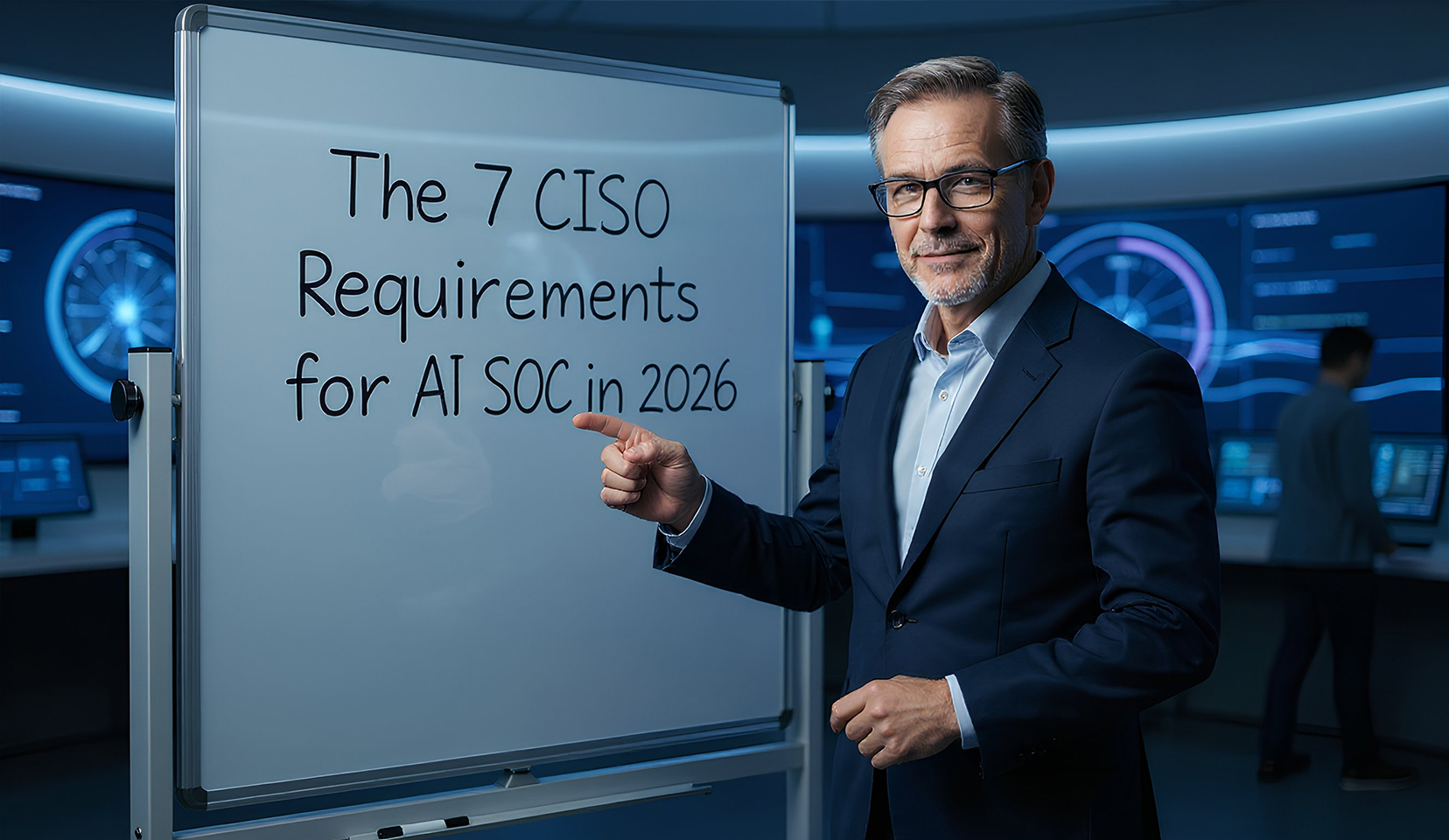
I recently participated in a security leader roundtable hosted by Cybersecurity Tribe. During this session, I got to hear firsthand from security leaders at major organizations including BNP Paribas, the NFL, ION Group, and half a dozen other global enterprises.
Across industries and maturity levels, their priorities were remarkably consistent. When it comes to AI-powered SOC platforms, these are the seven capabilities every CISO is asking for.
1. Trust and traceability
If there was one theme that came up more than anything else, it was trust. Security leaders don’t want “mysterious” AI. They want transparency.
They repeatedly insisted that AI outputs must be auditable, explainable, and reproducible.
They need to show the work, for compliance auditors, for internal governance boards, and increasingly to address emerging legal and regulatory risk.
Black-box decisions won’t cut it. AI must generate evidence, not just conclusions.
2. Reduction of alert fatigue (operational efficiency)
Every leader I spoke with is wrestling with alert overload. Even mature SOCs are drowning in low-value notifications and pseudo-incidents.
A measurable reduction in alerts escalated to humans is now a top KPI for evaluating AI platforms. Leaders want an environment where analysts spend their time on exploitable, high-impact threats, not noise.
If AI can remove repetitive triage work, that’s not just helpful, it’s transformational.
3. Contextual, risk-based prioritization (beyond CVSS)
No one wants yet another dashboard that nags them about high CVSS scores on systems nobody actually cares about.
CISOs want AI that can fuse:
- Telemetry
- Vulnerability data
- Identity information
- Business context (asset criticality, job role, data sensitivity, process impact)
The goal is prioritization that reflects real organizational risk, not arbitrary severity scores.
They want AI to tell them: “This is the one alert that actually matters today and here’s why.”
Get your editable copy of the one deck you need to pitch your board for 2026 AI SOC budget.

4. Safe automation with human-in-the-loop for high-impact actions
Most leaders are open to selective autonomous remediation, but only in narrow, well-defined, high-confidence scenarios.
For example:
- Rapid ransomware containment
- Isolation of clearly compromised endpoints
- Automatic execution of repeatable hygiene tasks
But for broader or higher-impact actions, CISOs still want human review. The tone was clear:
AI should move fast where appropriate, but never at the expense of control.
5. Integration and practical telemetry coverage
Every leader emphasized that an AI platform is only as good as the data it can consume.
The must-have list included:
- Cloud telemetry (AWS, Azure, GCP)
- Identity providers (Okta, Entra ID, Ping)
- EDR/XDR
- SIEM logs
- Ticketing/ITSM
- Custom threat intelligence feeds
They don’t want a magical AI that promises answers without good data.
They want a connected system that can see across the entire environment.
6. Executive & board alignment with demonstrable ROI
CISOs aren’t implementing AI in a vacuum. Their boards and executive leadership teams are pressuring them from two very different angles:
- Some are mandating AI adoption as a strategic priority.
- Others are slowing everything down with extensive governance, risk, and compliance processes.
To navigate this dynamic, CISOs need clear, defensible ROI:
- Reduced operating costs
- Faster mean-time-to-respond
- Fewer escalations
- More predictable outcomes
AI without measurable value is no longer acceptable.
They need something they can put in front of the board and say, “Here’s the impact.”
7. Accountability and legal clarity
Before enterprises allow AI to autonomously take security actions, CISOs need a fundamental question answered:
“Who is accountable when the AI acts?”
This isn’t just a theoretical concern. It's a gating requirement for adoption.
Until there is clear guidance on liability, responsibility, and governance, many organizations will keep AI on a tight leash.
Closing thoughts
Across all of these conversations, the message was consistent:
AI in the SOC is inevitable, but it must be safe, transparent, integrated, and measurable.
CISOs aren’t looking for science fiction. They’re looking for credible, operational AI that enhances their teams, strengthens their defenses, and aligns with business realities.

Mitchem Boles
Mitchem Boles is the Field Chief Information Security Officer at Intezer, where he advises enterprises across industries on threat trends and modern security strategies. With nearly 20 years of experience, including leadership roles at GuidePoint Security, Critical Start, and Texas Health Resources, he has overseen complex security operations for healthcare systems, utilities, and global SOCs. Mitchem strongly advocates AI-driven security, supporting Intezer’s mission to automate alert triage and investigation so analysts can focus on high-impact threats.
In this article
Share article
Related Articles
.svg)
AI SOC
The end of the SOC pyramid
AI is retiring the SOC pyramid. Learn how a tierless AI SOC investigates 100% of alerts with forensic evidence while your analysts supervise outcomes.
.svg)
Research
5 min
NinjaMare and the enterprise security epidemic hiding behind a harmless label
The PUA label, aka "potentially unwanted application" means nuisance. Adware, toolbars, and other things that change your settings without asking. Our research team's findings say this label is far more serious than a mere nuisance.
.svg)
Alert Triage
AI SOC
3 min
We let a fruit fly brain triage 12,716 real SOC Alerts. Here is what happened.
On behalf of people who run SOCs, we explore how a fly brain triages alerts compared with a boring linear model you could train in eleven seconds.