
Dropzone AI: Pros/Cons, Pricing & Top 5 Alternatives
In this article

What Is Dropzone AI?
Dropzone AI is an autonomous security operations center (SOC) analyst platform that automates the investigation and resolution of security alerts. It can handle Tier 1 triage and investigation tasks, enabling security teams to respond faster and scale their operations without adding headcount.
Dropzone AI integrates with over 60 common security tools and starts delivering value on day one, requiring minimal setup. It is able to continuously learn from its environment and analyst feedback, adapting its behavior to fit organizational workflows, policies, and risk tolerance.
This is part of a series of articles about SOC as a Service
Key Capabilities of Dropzone AI
Dropzone AI is designed to automate and enhance core SOC functions, focusing on fast, accurate investigations at scale. Below are its key capabilities that help security teams reduce alert fatigue, improve response times, and stay ahead of threats:
- Autonomous alert investigation: Automatically investigates every alert using expert analyst techniques, collecting evidence from multiple sources and tools.
- Context-aware analysis: Learns the environment, policies, and risk tolerance to adapt investigations and responses to your specific needs.
- Automated threat containment: Takes appropriate action after each investigation, dismissing false positives, escalating threats, or containing real incidents.
- Investigation reports: Generates detailed reports with severity conclusions, summaries, and key findings for every alert.
- Rapid deployment: Deploys in minutes with immediate impact; no complex setup required.
- Scalable AI workforce: Acts as a virtual SOC team that scales automatically to handle high alert volumes without increasing staff.
- Integration with security stack: Connects to over 60 tools including SIEM, EDR, firewall, and cloud platforms to streamline investigations.
Dropzone AI Pricing
Dropzone AI uses a flat pricing model starting at $36,000 per year, which includes up to 4,000 AI-driven investigations annually per AI analyst. This base subscription covers unlimited users and access to all core platform features. However, it’s important to realize that the platform charges per alert ingested, which can be cost-prohibitive for organizations with a large and unpredictable number of alerts. This in particular has forced Dropzone customers to cherry-pick which alerts to ingest creating blind-spots for real threats hiding in low-severity or informational alerts.
Included in the subscription are:
- Access to all alert categories
- Integrations with SIEM, SOAR, EDR, and other data tools
- Curated threat intelligence and enrichment feeds
- AI chatbot for on-demand, ad-hoc investigations
- Direct support from engineers
- 8-hour customer support SLA
Additional plans are offered at higher pricing, available upon request:
- Enterprise plan includes a dedicated, single-tenant AI environment with custom workflows.
- MSSP planmakes it possible to manage multiple clients from a multi-tenant platform with shared investigation capacity and enhanced SLA support.
NOTE: Dropzone recently announced that they are a “channel-only” model so pricing will likely be affected by partner pricing.
Key Dropzone AI Limitations
While Dropzone AI offers strong autonomous investigation capabilities, there are several limitations to be aware of. These limitations were reported by users via Gartner Peer Insights:
- Limited workflow automation: Dropzone AI does not support advanced workflow logic comparable to dedicated SOAR tools. Basic automations are available, but complex or conditional workflows require external workarounds or are not feasible within the platform.
- Inadequate reporting features: The platform lacks robust reporting capabilities. Users cannot export full investigation reports in a usable format, which limits the ability to attach complete context to tickets or incident records. Metric-level reporting is also limited.
- Context memory management challenges: The system automatically creates Context Memory Entries that are reused in future investigations. There is no mechanism to require review before reuse, forcing teams to track CME validation manually outside the platform.
- No dynamic summary updates: When an investigation conclusion changes, the summary is not automatically regenerated. This can result in mismatches between findings and summaries unless the investigation is rerun manually.
- Duplicate alert handling: Alerts related to the same incident are handled as separate items. This increases alert volume and contributes to alert fatigue, particularly in high-noise environments.
- Limited customization and integrations: Customization options and third-party integrations are limited compared to more mature platforms. Feature expansion is ongoing, but current flexibility is constrained.
Notable Dropzone AI Alternatives and Competitors
Intezer

Intezer delivers an AI-powered SOC platform built on forensic-grade investigation, not just AI-driven alert summarization. Unlike AI-only SOC vendors that rely primarily on LLM pattern analysis, Intezer combines autonomous triage with proprietary deep forensics, including advanced endpoint scanning and live memory analysis.
Learn more in our detailed guide to the AI SOC
That forensic depth is what makes it possible to affordably investigate 100% of alerts not just prioritize by severity or capacity (pricing is generally based on number of endpoints).
In 2025 alone, Intezer has investigated over 25 million alerts, operating at a scale far beyond AI-native competitors that may process only a fraction of that volume annually. See more about Intezer AI SOC 2026 report.
Key differentiators:
- 100% alert investigation with forensic validation
- Proprietary endpoint scanner with live memory analysis to confirm true remediation
- Only ~2% of alerts escalated to humans
- 98% verdict accuracy, delivering evidence-based decisions in under 2 minutes
The result: complete coverage without backlog-driven risk acceptance, combining AI scale with forensic confidence.
Simbian
Simbian offers an AI SOC agent that autonomously investigates and responds to security alerts, helping security teams scale without adding headcount. The agent works across SIEM, XDR, and other alert sources by reasoning over alerts using built-in security knowledge and organizational context.
Key features of Simbian:
- Autonomous investigation and response: Handles alert triage, investigation, and remediation across SIEMs, XDRs, and over 70 integrated tools, without requiring playbooks
- Context lake for organizational learning: Learns from internal documentation, team interactions, and tribal knowledge to tailor investigations to the environment
- Continuous learning and analyst feedback integration: Improves over time by learning from past alerts and feedback, allowing it to adapt to new tools and evolving threats
- Transparent decision-making: Provides step-by-step reasoning behind each investigation and enables analysts to steer or adjust outcomes
- Safe AI with TrustedLLM: Ensures data privacy, defends against prompt injection, and keeps actions confined to the environment
Prophet Security
Prophet Security delivers an AI-driven SOC platform to autonomously triage, investigate, and respond to alerts. Aiming to eliminate the limitations of manual workflows and rigid SOAR systems, it replicates the steps of expert analysts while continuously learning from the environment and analyst feedback.
Key features of Prophet Security:
- Autonomous alert triage and planning: Instantly analyzes incoming alerts, summarizes them, and builds a tailored investigation plan without human input
- Automated investigations: Emulates the behavior of experienced analysts to retrieve, correlate, and analyze data across multiple security sources
- Automated response and remediation: Determines alert severity, recommends response actions, and integrates directly into existing incident workflows
- Continuous learning and adaptation: Learns from analyst feedback to fine-tune investigations and stay aligned with evolving organizational needs
- Time and cost reduction: Cuts investigation time and reduces operational costs by minimizing manual triage and investigation tasks
Stellar Cyber

Stellar Cyber offers a Human-Augmented Autonomous SOC platform to simplify security operations through agentic AI, unified tooling, and open integration. Intended for enterprises, MSSPs, and lean security teams, it combines SIEM, NDR, and XDR into a single platform, reducing tool sprawl and manual overhead.
Key features of Stellar Cyber:
- Agentic AI for analyst augmentation: Uses AI to automate routine tasks and guide analysts through embedded response frameworks
- Unified security operations platform: Combines SIEM, NDR, and XDR in one system to reduce complexity and centralize security workflows
- Open ecosystem and tool integration: Supports integration with various EDR, network, or security data sources, allowing deployment across environments
- AI-driven threat detection and correlation: Surfaces real threats with machine learning models that reduce alert fatigue and simplify investigations
- Automated incident response: Executes AI-powered playbooks for threat containment and mitigation without analyst intervention
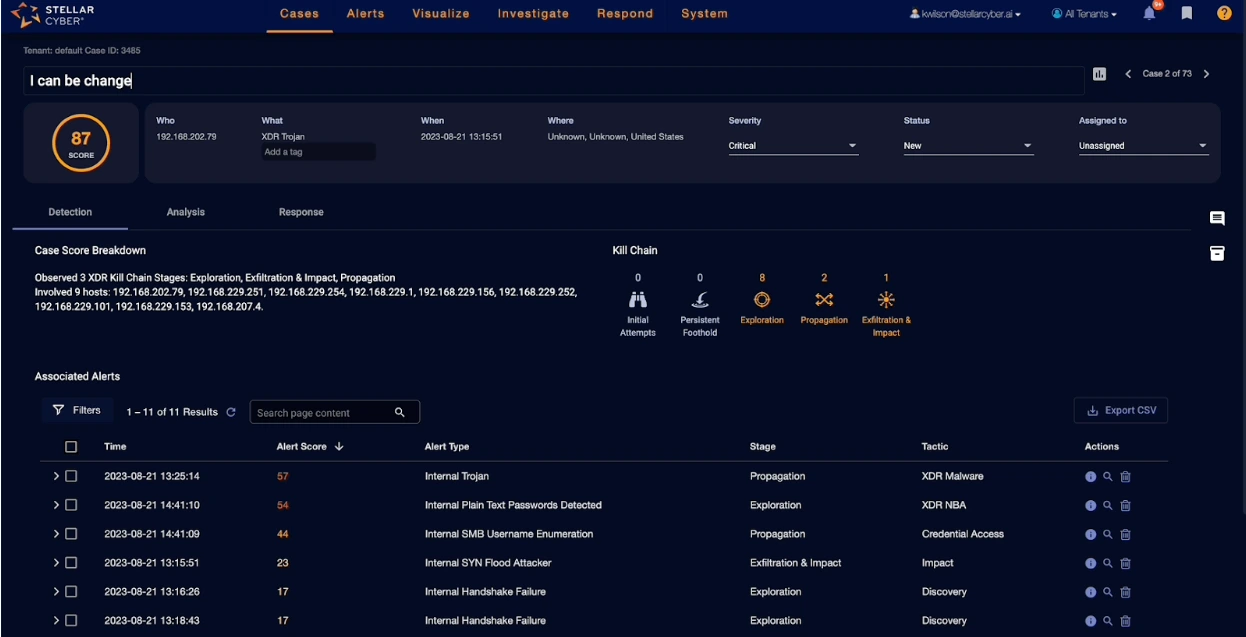
Source: Stellar Cyber
Radiant Security

Radiant Security is an AI-driven SOC platform that competes with Dropzone AI by offering automation for alert triage, investigation, and response. It uses adaptive AI to analyze alerts regardless of type or origin, auto-closing false positives and escalating genuine threats with reasoned, human-readable reports.
Key features of Radiant Security:
- Autonomous alert triage and investigation: Investigates various alert types from different sources, using reasoning capabilities that emulate expert analysts
- Tailored remediation: Auto-generates incident-specific response steps that can be executed manually or automatically, accelerating containment
- Log ingestion and retention: Ingests security-relevant data using cloud archive storage, enabling querying and long-term visibility at a lower cost than SIEM
- Coverage of known and unknown threats: Handles alerts without reliance on static playbooks or prior training, ensuring coverage for novel attack types
- Transparent, reasoned incident reports: Escalates only validated threats and includes step-by-step, human-readable justifications to support trust and auditability
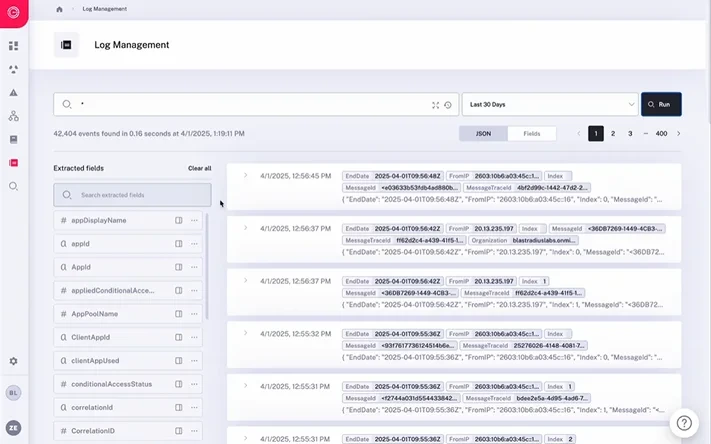
Source: Radiant Security
Conclusion
AI-driven SOC platforms are evolving to automate high-volume alert triage and investigation, helping security teams scale their operations while reducing response times and analyst fatigue. These tools aim to replace manual workflows with reasoning-based automation, integrate with diverse security stacks, and continuously learn from their environment. However, buyers must evaluate trade-offs around integration depth, customization, reporting capabilities, and automation flexibility to ensure alignment with their security operations and maturity level.
Related content: Read our guide to Microsoft Security Copilot
Learn more in our detailed guide to AI SOC automation