
ToneShell is a lightweight backdoor tied to the China-nexus group Mustang Panda. Typically delivered via DLL sideloading inside compressed archives with legitimate signed executables and often spread through cloud-hosted lures. Zscaler’s 2025 analysis described updates to its FakeTLS C2 (shifting from TLS 1.2- to 1.3-style headers), use of GUID-based host IDs, a rolling-XOR scheme, and a minimal command set for file staging and interactive shell access. Notably, some of this activity was observed in Myanmar, a region of strategic importance to China. Targeting Myanmar is particularly interesting as it reflects China’s broader geopolitical interests, spanning border security, infrastructure projects, and political developments, and highlights how cyber operations are leveraged to maintain influence in neighboring states.
This blog is a technical analysis of another variant of the backdoor. While this variant does not introduce major new features, it is worth highlighting the anti-analysis techniques it employs and the new indicators that can support threat hunting and detection. In addition, the continued targeting of Myanmar underscores China’s sustained use of cyber operations to maintain its interests abroad.
Technical Analysis
As previously documented, ToneShell is a dll that is sideloded by a legitimate executable, usually bundled in the archive file. In this case it is a ZIP file ,named: TNLA နှင့် အခြားတော်လှန်ရေးအင်အားစုမျာ. Which translate to: TNLA and other revolutionary forces.
sha256: 1272a0853651069ed4dc505007e8525f99e1454f9e033bcc2e58d60fdafa4f0The backdoor is a DLL named: SkinH.dll, compiled on 2025-07-14 22:38:08.
sha256:e7b29611c789a6225aebbc9fee3710a57b51537693cb2ec16e2177c22392b546 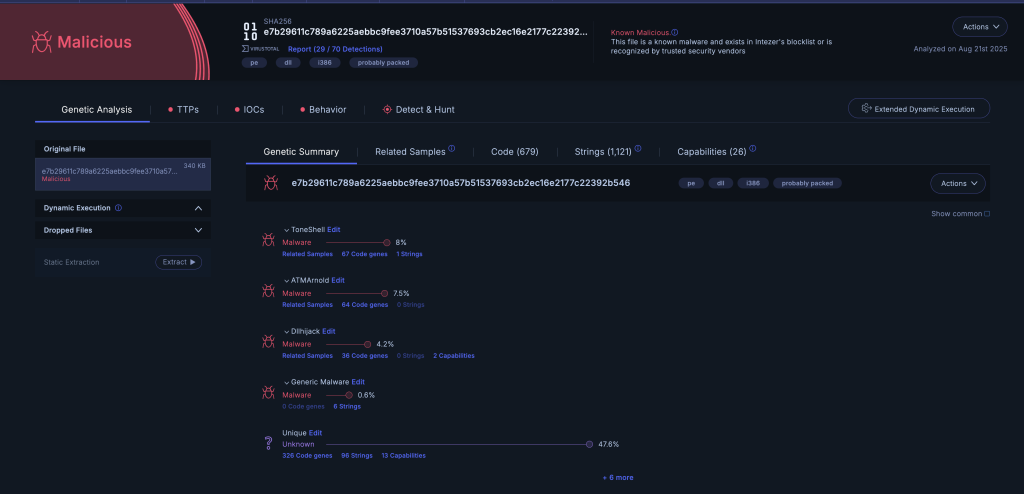
Code reuse with ToneShell
The backdoor first checks the current module path for the string Google\DriveFS\Scratch. If not found, it enumerates processes to identify the parent process, retrieves its image path, and verifies whether it contains GoogleDrive. If found, the backdoor will terminate its execution. This check might be an attempt by the threat actor to prevent infecting themselves. If this validation fails, the code enforces a single-instance policy using a named mutex, Global\SingleCorporation12AD8B. It attempts to create the mutex, storing the handle globally and setting a flag to indicate success or failure. If creation fails or the mutex already exists, it releases any handles and marks it as not created.
Next, the backdoor checks its persistence location. It compares its module path with the user profile directory (CSIDL_APPDATA, 0x1A). If the binary is not under the user profile, it copies itself and the following files: msvcr100.dll, msvcp100.dll, mfc100.dll to a new folder it creates. The new directory name consists of a 6-character random uppercase folder name (e.g., C:\Users\<user>\AppData\<random-6-chars>).
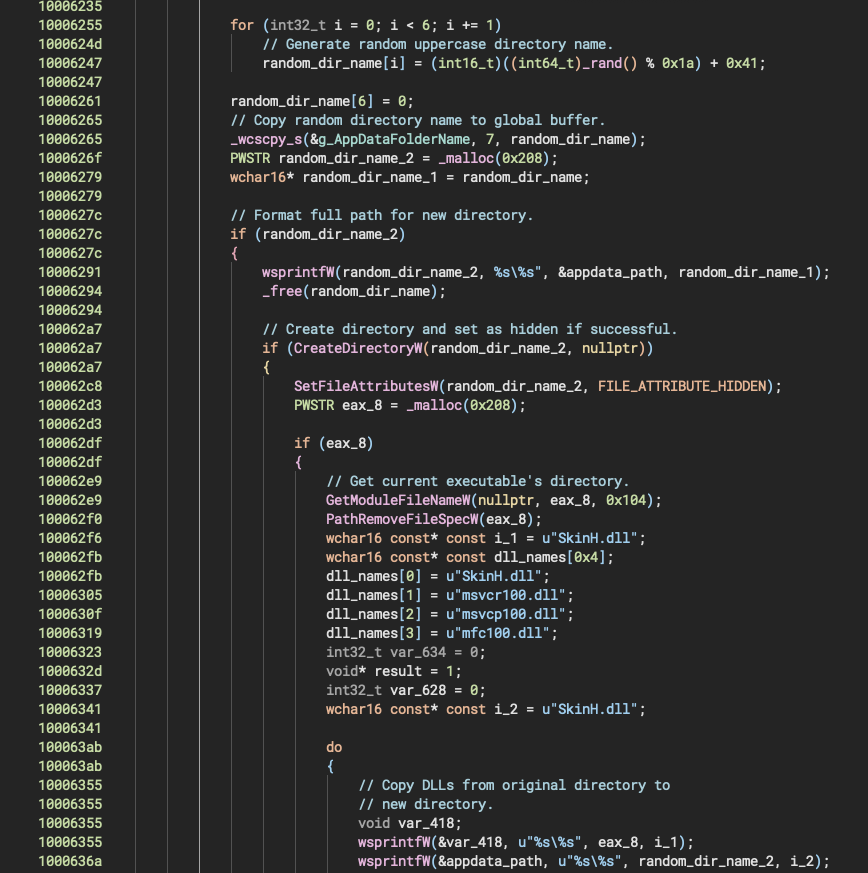
The function that copies the DLLs to a new folder in AppData
Once installed, it attempts to spin up the Task Scheduler COM service, connect to the local scheduler, open the root folder ("\") and obtain an IRegisteredTask for a task named dokanctl. If the task doesn’t exist, it will create it using RegisterTaskDefinition. The task is set to execute every minute, it sets the execution path to the folder in AppData created earlier: %APPDATA%\<random-6-chars>\svchosts.exe, and sets it as the action Path. The task is registered in the root folder with the name dokanctl.
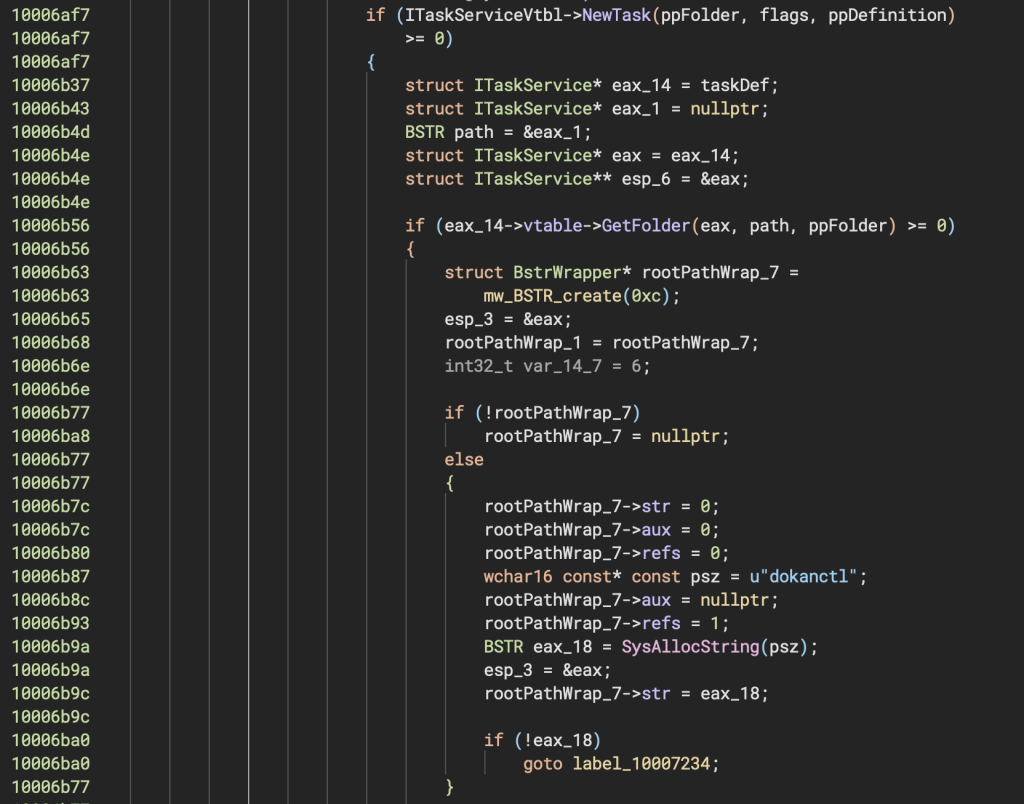
Task creation
If the backdoor is already under the user profile, it performs junk arithmetic before entering its C2 loop, followed by a bounded timing/zero-check loop that appears to serve as anti-analysis noise without affecting the main flow.
API Function Hashing
The malware uses a custom API-resolving scheme based on a simple rolling hash, applying it to module and function names instead of storing them in cleartext. This technique, previously analyzed in previous blogs, is a common evasion method seen in different malware types. With the HashDB project, resolving these hashes back to the original imported functions is straightforward, making analysis and detection easier.
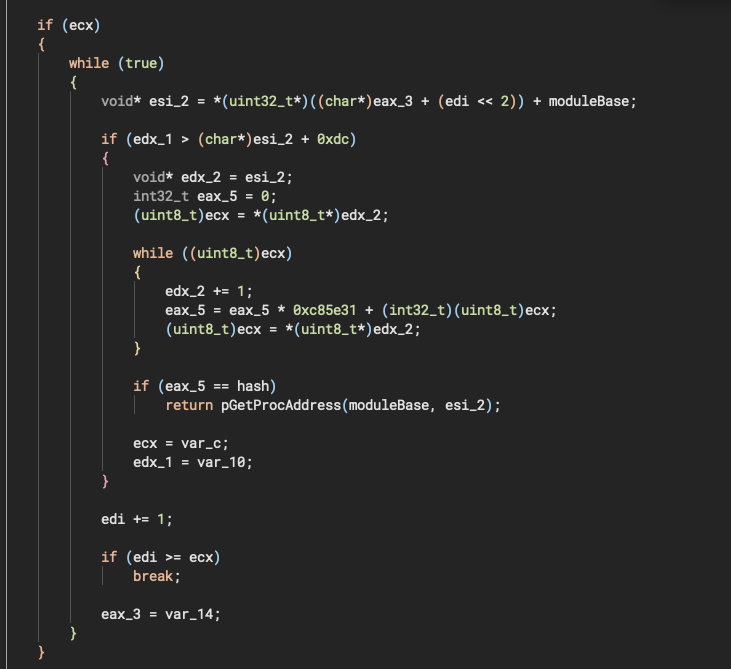
Hash calculation
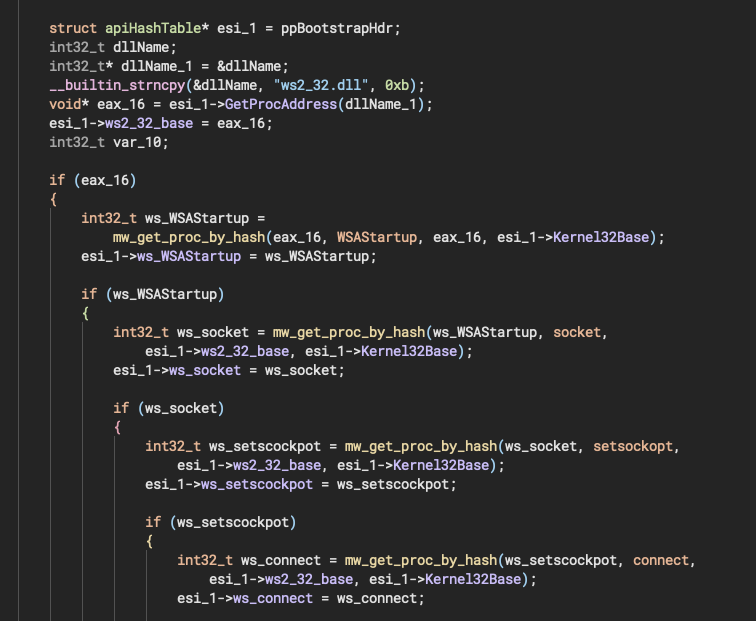
Resolved Windows API functions
Anti-Analysis and Anti-Sandboxing
This ToolShell variant employs several stalling and anti-sandboxing tricks designed to waste time, confuse automated analysis, and evade lightweight sandboxes. These include:
- Repeated file churn: creating, writing, closing, and deleting a temporary file in a loop with Sleep(100) delays, which burns execution time and stresses filesystem emulation.
- Randomized sleep loops: several loops sleep for pseudo-random intervals ranging from ~800 ms to over a second per iteration, accumulating 20+ seconds of startup delay before meaningful behavior begins.
- Tick count checks: uses GetTickCount64() combined with jittered sleeps, waiting until at least 10 seconds of wall-clock time has elapsed. This ensures that emulators that don’t advance the system clock realistically can get stuck.
- Opaque string comparisons: slides across a large embedded wide-string buffer, repeatedly calling lstrcmpW() between overlapping substrings until a break condition. The comparison results are discarded; the loop simply consumes cycles and obfuscates control flow.
- Nonsense randomization: calculates values like 0xBABE or 0xCAFE via contrived branches using rand(). These values are not security checks, but serve as junk arithmetic to make the code harder to follow.
- Decoy API use: occasionally calls APIs such as OutputDebugStringA and sets LastError to unusual constants (0xBADF00D), further muddying behavior without altering core logic.
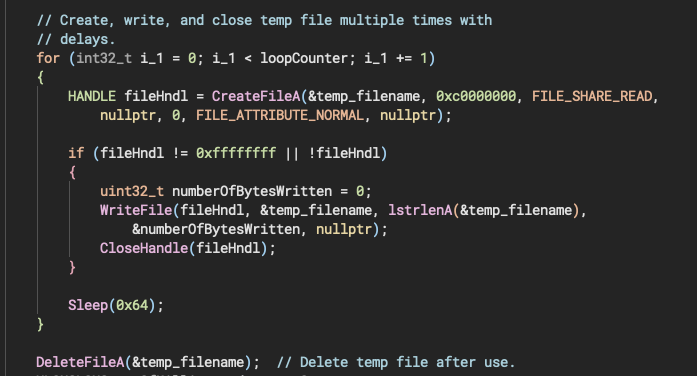
File creation loops
Notably, the large embedded string buffers used in the comparison loop contain text copied from OpenAI’s blog on image generation and from Pega AI’s website. Pega AI refers to the artificial intelligence features integrated into the Pega platform, a software suite for workflow automation and customer relationship management. The backdoor does not use this content functionally; instead, it serves as filler to inflate the binary and supply meaningless strings for comparison.
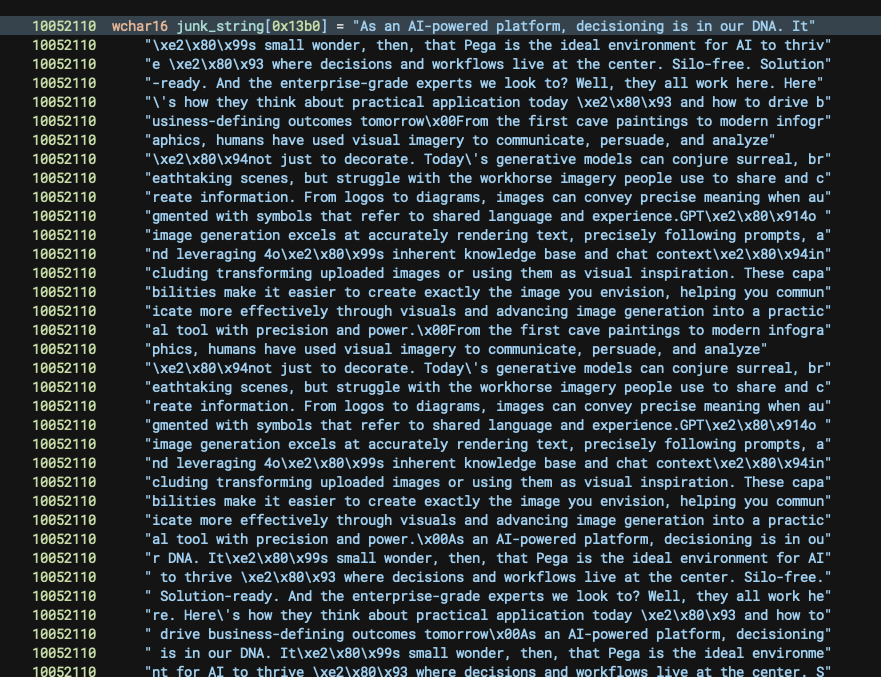
Text taken from PegaAI’s website

Text taken from OpenAI’s website
Together, these techniques do not detect debuggers directly; instead, they stall execution, pollute control flow with junk work, and frustrate automated sandboxing systems that expect short-lived, straightforward malware runs.
GUID Creation
Similar to earlier versions, this variant of ToneShell generates a unique identifier for each infected machine. It first attempts to check if one was already created by reading 16 bytes from C:\ProgramData\SystemRuntimeLag.inc. The malware creates a new seed if the file is missing, unreadable, or does not provide exactly 16 bytes. The primary method is to generate a GUID via CoCreateGuid and use it as the seed. If that fails, it falls back to producing 16 bytes using an internal linear congruential generator (LCG) seeded from the current PRNG state. Once a new seed is generated, it is written back to the designated file path to ensure persistence across executions.
This logic is similar to Zscelar’s blog about the second backdoor variant.
Networking
The malware sets up a socket with a C2 at the address:
146.70.29[.]229:443The malware’s network protocol wraps its messages in a TLS-like record header to blend in with legitimate traffic. Each packet begins with the fixed bytes 17 03 03 (TLS 1.2 Application Data) followed by a two-byte length field, but only the low byte is honored, effectively capping payloads at 255 bytes. The 5-byte header is read into a temporary stack buffer and discarded; only the payload bytes are stored in the context structure’s receive buffer starting at offset 0.
Once the payload is received, the malware XOR-decodes it in place with a 256-byte rolling key. The first decoded byte is treated as a “type/status” field, the second as an additional code, and the remainder (len-2 bytes) as the message body. The decoded buffer pointer is then saved in the structure for later use. This design produces a simple packet format: [TLS-like header][XOR-obfuscated type | code | body…], with the header stripped before the data is available to the rest of the malware.
Interestingly, while the GUID generation logic in this sample aligns with the first version of ToneShell described by Zscaler, the communication protocol remains identical to the second version. Combined with the anti-analysis techniques and the use of text copied from AI platforms, this sample stands out as a hybrid variant.
Pivoting on The C2 Address
Pivoting on the C2 address, we were also able to find another variant:
sha256: a58868b3d50b775de99278eeb14da8b7409b165aa45313c6d9fa35ac30d2cda2This variant was compiled on 2025-03-23 22:42:42, named node.dll. It was part of an archive named: update.zip with the sha256:
543024edc9f160cc1cedcffc3de52bfa656daa0ec9ed351331d97faaa67d0d99This variant reuses the same C2 commands and anti-analysis techniques described above, and it stores the GUID under the same file name.
Migrating to Google SecOps? Check out this migration checklist first.
Conclusion
In summary, this analysis of a new ToneShell backdoor variant highlights the evolving tactics of the Mustang Panda group, particularly their sustained targeting of Myanmar. While not introducing revolutionary features, this variant employs anti-analysis techniques, including elaborate stalling mechanisms and obfuscated code. The blend of old and new elements, such as the consistent communication protocol alongside updated GUID generation and the use of seemingly random, copied text for filler, underscores the adaptive nature of this threat. The continuous refinement of these evasion methods, coupled with the geopolitical significance of the targeted region, reinforces the need for ongoing research and threat hunting to counter cyber operations.
IOCs
ToneShell variants:
a58868b3d50b775de99278eeb14da8b7409b165aa45313c6d9fa35ac30d2cda2
e7b29611c789a6225aebbc9fee3710a57b51537693cb2ec16e2177c22392b546
Archive files:
543024edc9f160cc1cedcffc3de52bfa656daa0ec9ed351331d97faaa67d0d99
1272a0853651069ed4dc505007e8525f99e1454f9e033bcc2e58d60fdafa4f0
C2:
146.70.29[.]229:443

Nicole Fishbein
Nicole is a senior security researcher and malware analyst at Intezer. Prior to this, she was an embedded researcher in the IDF Intelligence Corps.
In this article
Share article
Related Articles
.svg)
AI SOC
The end of the SOC pyramid
AI is retiring the SOC pyramid. Learn how a tierless AI SOC investigates 100% of alerts with forensic evidence while your analysts supervise outcomes.
.svg)
Research
5 min
NinjaMare and the enterprise security epidemic hiding behind a harmless label
The PUA label, aka "potentially unwanted application" means nuisance. Adware, toolbars, and other things that change your settings without asking. Our research team's findings say this label is far more serious than a mere nuisance.
.svg)
Alert Triage
AI SOC
3 min
We let a fruit fly brain triage 12,716 real SOC Alerts. Here is what happened.
On behalf of people who run SOCs, we explore how a fly brain triages alerts compared with a boring linear model you could train in eleven seconds.