
Google says AI attackers just crossed a threshold. We say the SOC has to cross it too.
November 19, 2026

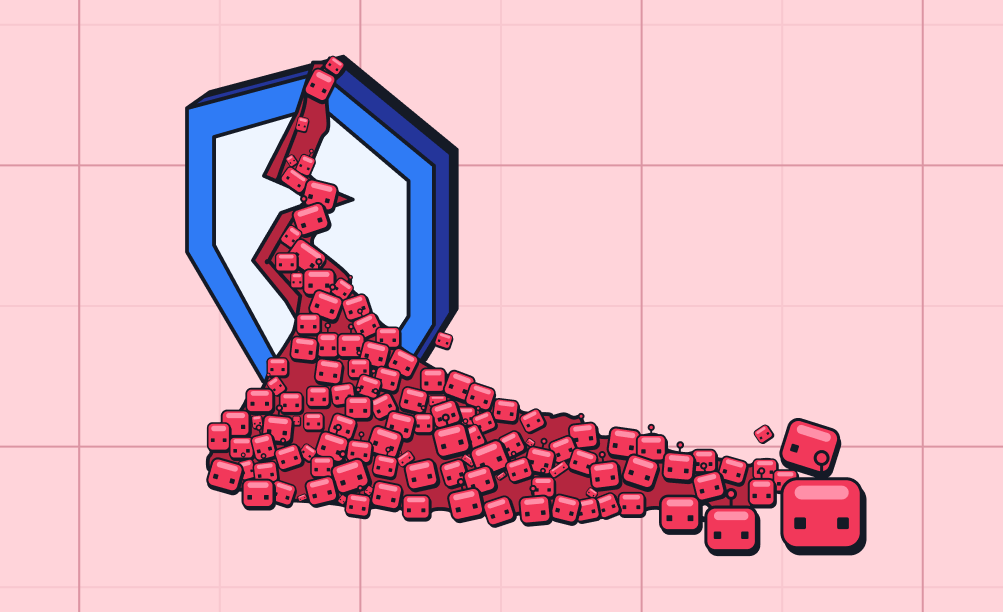
Attackers now run intrusions from vulnerability research to exploitation with no human in the loop. That is the headline of the latest GTIG AI Threat Tracker, published by Google Threat Intelligence Group and Mandiant this week.
In its previous report, GTIG described only partially automated efforts. This quarter it found fully automated ones. Google calls it a critical inflection point, and we agree.
However, most of the commentary will likely draw the wrong lesson from it. The answer to autonomous offense is more than faster patching or another layer of AI detection. It is a SOC that investigates every signal those agents leave behind, at the depth needed to prove what happened. That is the operating model Intezer was built for.
What actually changed this quarter
The biggest shift is the time between a patch and a working exploit, which is collapsing toward zero. GTIG’s report lays out several data points worth sitting with.
- exploit_agent. A framework found on an exposed staging server chains frontier and locally hosted LLMs to compare the code of popular web applications before and after each security patch and find what was fixed. When it infers a flaw, it drafts an exploit and runs it automatically. Victim data on the same server pointed to French media, entertainment and education websites.
- Post-exploitation tooling ships with it. The server also held scripts for brute forcing, internal reconnaissance and installing webshells, plus one that removes webshells left by rival attackers.
- N-days are the efficient target. GTIG believes attackers may get more return pointing LLMs at freshly patched flaws than trying to create zero-days, since the source material for a patched bug is finite and public.
- Disclosure to compromise is now days. Two flaws in PaperCut, a widely used print management server, were chained together and exploited in late August. Researchers built working exploits with LLMs within a day of disclosure. A campaign tracked by GreyNoise four days after disclosure hit hundreds of organizations, and one foothold reached domain admin within minutes.
- Open-source agentic frameworks are in live intrusions. Attackers have turned open-source AI penetration testing tools against real targets. CAIRN was used against organizations including the U.S. aerospace sector, and a customized version of PentAGI scanned organizations across Asia.
- Zero-day volume is climbing too. Google counted 22 exploited zero-days in August alone, up from 11 a month earlier in 2026 and an average of eight a month in 2025.
Put together, the patch cycle is no longer a safe buffer. For a meaningful window after every disclosure, prevention will lose some races. What happens after initial access decides the outcome.
Noise only helps defenders who can investigate it
Buried in GTIG’s findings is a hopeful detail. The agentic frameworks it observed trade stealth for velocity, leaving forensic traffic, recognizable identifiers and distinct code-level traces that make detection more likely. Google also expects that to change as the tools and models improve and grow stealthier.
So the noise is an opening, and a temporary one. It also only helps the defender who investigates it.
An agent that brute forces credentials, drops a webshell and deletes a competitor’s webshell produces plenty of telemetry. Little of it looks dramatic on its own. A failed login burst. A new script in a web directory. An admin tool run by a valid account. Each tends to land as a low or medium severity alert.
Intezer’s 2026 AI SOC Report, drawn from more than 25 million alerts, shows what happens next. Over 60% of alerts are never reviewed by SOC or MDR teams. Nearly 1% of real incidents trace back to the lowest severity alerts, roughly 54 genuine threats a year at average enterprise volume.
So the agentic attacker is loud, for now. But in most environments, the loudness lands in the part of the queue nobody reads.
Severity-based triage was built for human attackers
The SOC operating model most organizations run today assumes humans will do most of the triage. When volume outgrows capacity, teams sort by severity and work down from the top. That was a reasonable trade when intrusions unfolded over days and the loud events tended to be the dangerous ones.
Agentic intrusions break both assumptions. They move in minutes, as the GreyNoise domain admin example shows. And because they log in with valid credentials and run the same admin tools your IT team uses, their early steps look ordinary until someone investigates them.
This is a capacity problem, and it applies to everyone. In-house teams and MDR providers both do serious work under the same constraint. Even the best analysts can only review so many alerts per shift. AI assistants that summarize alerts help analysts move faster, yet a human still has to validate each verdict, and per-alert pricing pushes teams to send only high severity alerts in the first place.
The result is predictable. The agent’s noisy trail gets triaged by the same severity filter that was designed to ignore exactly this kind of noise. A human-paced queue reaches the alert in hours. The agent finished in minutes.
What a SOC built for machine-speed attackers looks like
If the attacker’s pipeline runs without a human, the investigation pipeline has to as well. Humans stay in charge of decisions and response policy. AI does the execution. At Intezer we have built our platform around these principles that map directly to what GTIG describes.
Investigate every alert, at every severity
The agent’s trail only helps if every piece of it gets looked at. Intezer triages and investigates every alert across endpoint, identity, cloud, network, email, DLP, and SIEM, with a verdict in about a minute. Fewer than 2% are escalated to the team, each with its evidence attached. Coverage stops being a staffing question.
Ground the verdict in forensic evidence
Using AI to judge the output of an attacker’s AI is risky if the defending model is only reading log lines and guessing. Intezer pairs AI reasoning with deterministic forensics. The AI plans the investigation and decides what to examine. For endpoint alerts, memory analysis, reverse engineering, sandboxing and threat intelligence return the facts, and the same file or memory region yields the same facts every time. Other alert types are investigated with threat intelligence, AI classifiers and live context queries.
This matters for the post-exploitation half of GTIG’s story. Webshells, injected code and fileless payloads are exactly what live memory forensics is built to surface. Intezer compares code running in memory against a large database of trusted and malicious code, so tooling that reuses code from known offensive frameworks can be identified even when the specific file is new.
Connect the steps into one incident
An agentic intrusion is a sequence, and a sequence split across isolated tickets is easy to miss. Intezer Cases correlates related alerts by shared users, hosts and artifacts into a single incident with a timeline and full audit trail. Correlation stays open as long as the case is open, so a brute force burst, a new account login and a suspicious process on the same host end up in one place.
Know what normal looks like in your environment
Agents blend in by using valid credentials and approved admin tools. Telling legitimate use from abuse requires knowing your organization. Intezer’s Org Brain learns from past cases, tickets and analyst decisions and fetches live context mid-investigation. It can tell a nightly backup job from the same tool run by an account that has never touched that server.
Close the loop faster than the n-day window
When exploits arrive within days of a patch, detection has to keep pace. Every Intezer verdict feeds back into detection logic, showing which rules catch real threats, which only generate noise and where MITRE ATT&CK gaps remain. Rules are tuned and deployed into your own SIEM and EDR continuously. Confirmed threats can then be contained through Intezer Workflows, inside the response policy your team defines, with every action logged.
Make full coverage affordable
Agentic attackers will raise alert volume, by design and as a side effect. Pricing per alert or per token turns that into a reason to look at less. Because deterministic forensics does the heavy lifting, Intezer prices per endpoint. Alert spikes do not change the bill, so there is never an economic reason to skip the low severity queue.
This is the model already running for security teams at NVIDIA, MGM Resorts, Equifax, Salesforce, RSM, DPD and Wyndham, among others.
Five questions to ask your SOC this quarter
GTIG expects threat actors to keep using these frameworks against organizations worldwide. A useful way to respond is to test your own operation against the specific behaviors in the report.
- What percentage of low and medium severity alerts did we actually investigate last month?
- If an attacker exploited a web application flaw four days after disclosure, which alerts would fire, and who would read them?
- Can we inspect the evidence behind every closed alert, or only the summary?
- Would a webshell or injected code on a server be found by memory analysis, or only if a file scanner flagged it?
- Does our cost go up when alert volume spikes, and does that shape which alerts we send for investigation?
If the honest answers are uncomfortable, that is normal. Most SOCs were designed for a slower adversary.
Turning agentic attackers’ noise against them
Google is right that a threshold has been crossed. Offense now runs at machine speed with no human waiting on each step. Defense that still depends on a human reaching each alert in order of severity is running a race it cannot finish.
The good news is that these agents are loud. The work for defenders is making sure every bit of that noise is investigated, with evidence, in minutes. That is what an AI SOC with forensic depth is for, and it is what Intezer delivers today.
Want to see how your own alerts hold up? Bring your noisiest alert source and we will show you every alert investigated, the evidence behind each verdict, and how confirmed threats are contained within your policy.
Zev Schonberg
Zev Schonberg is a product marketing manager with years of experience in deep tech.
As a lead contributor at Intezer, Zev authors research-driven analysis and thought leadership that explores how modern security operations centers can better detect, investigate, and respond to threats at scale.
In this article
Share article
Related Articles
AI SOC
Incident Response
4 min
Google says AI attackers just crossed a threshold. We say the SOC has to cross it too.
Attackers now run intrusions with no human in the loop. The answer to autonomous offense is more than faster patching or another layer of AI detection. It is a SOC that investigates every signal those agents leave behind, at the depth needed to prove what happened.

AI SOC
100 CISOs ranked their 2027 priorities for a16z: AI SOC takes #1
Andreessen Horowitz (a16z), one of the world's biggest venture capital firm, recently published their survey of 100 CISOs at companies with more than 1,000 employees. The findings reflect what we are seeing with our customers and provide a realistic outlook for our era of agentic attacks.
AI SOC
The end of the SOC pyramid
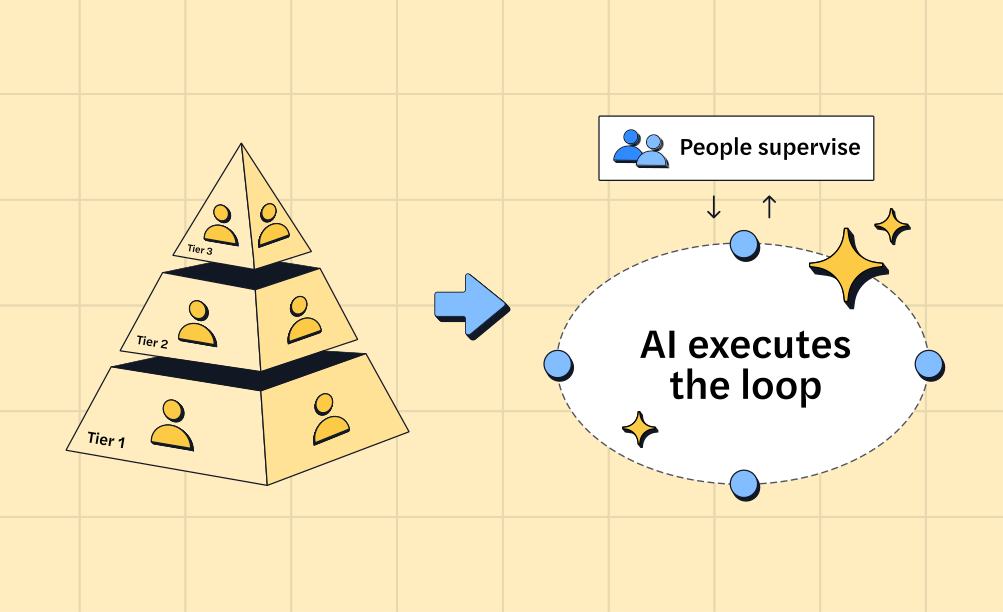
AI is retiring the SOC pyramid. Learn how a tierless AI SOC investigates 100% of alerts with forensic evidence while your analysts supervise outcomes.