

If ARTEX hit your network tomorrow, your analysts would recognize every step of the attack. They just wouldn't get to any of it in time. ARTEX doesn't give attackers new techniques. It gives them a new operating model, and most of the security teams we talk to are still running on the old one.
Ever since the first reports came out, the question I hear most from customers is some version of "how do we deal with ARTEX?" - what they usually want is a list of IOCs, a detection pack or anything else they can block by Monday, and I get the instinct, but I think ARTEX itself is the wrong thing to aim at.
If you haven't been following the story, ARTEX is an open-source penetration testing framework released in July, in which a planner agent turns a goal into tasks for worker agents and each result shapes the next step. Attackers adopted it within weeks, and Microsoft has tied it to the ConnectWise supply chain compromise. The developer pulled the repository after 12,000 forks, but renamed copies still circulate.
Fourteen minutes from login to ransomware
Earlier this week, David Kennedy, the founder of TrustedSec, went on CNN and walked through what happened to one of his clients, and it's about as clear a picture of this new operating model as we've ever seen. More than 30 AI agents probed the company's infrastructure at the same time, logged in with valid usernames and passwords, found a weakness in the way the company handled two-factor authentication, pulled data out and then encrypted the entire file system. The whole thing took 14 minutes, and the company didn't know anything had happened until about four and a half hours later, when its systems started throwing errors and restarting.
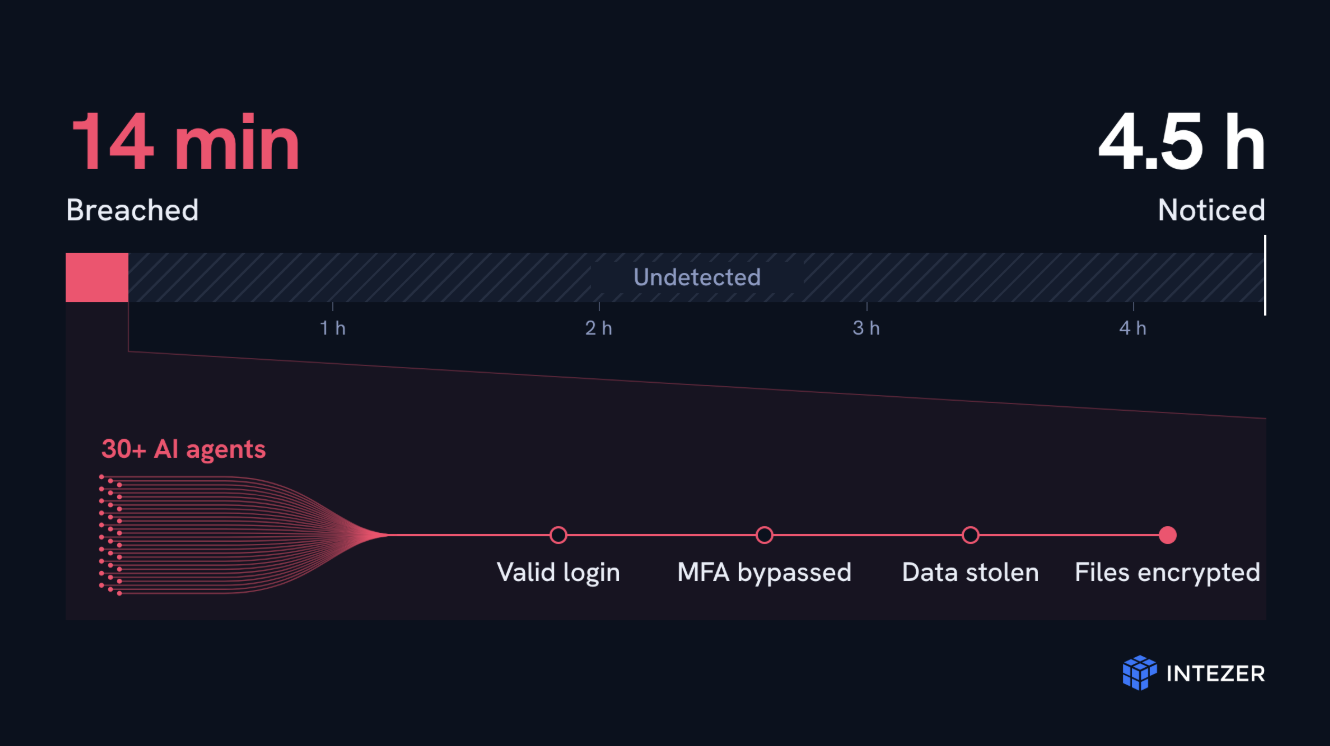
Kennedy didn't say which framework the attackers used, and honestly, for the affected team, it wouldn't have made much difference. Stolen credentials, a weak MFA flow, data theft and ransomware are all things any incident responder has dealt with many times before, so the techniques weren't what made this one so damaging. What was different was the pace, because with agents handling each step, the attack moved from one stage to the next in minutes, and the pauses defenders usually count on, while an attacker works out what to do next, barely existed.
This is not an isolated case, either. Microsoft reported that some of Storm-0940's ARTEX-driven attacks went from first targeting to privileged cloud access in under three hours, and if your team works the alert queue by severity, at human pace, an attack moving that fast is usually over by the time someone opens the first ticket.
The alert that matters is probably marked low-severity
Storm-0940's October campaign is a good example of how this actually looks in the logs. Over five days the group used ARTEX to password-spray 327 accounts across eight organizations, and Microsoft counted more than 151,000 failed sign-ins, peaking at 2,900 a minute, without a single one getting through.
That spray is what everyone noticed, but it isn't how the group got in. The access that mattered came through stolen ConnectWise application credentials that signed in as the applications themselves, with no user logging in at all, so while the same actor was producing a huge amount of failed-login noise, the activity that actually counted looked like an app quietly doing its job. If your queue is sorted by severity, you can probably guess which of the two your team would look at first.
The way these agents work makes the real attack even harder to spot, because they tend to act in bursts of a few seconds and then go quiet while the model decides what to try next. This means an intrusion can show up in your logs as a scatter of small, unrelated events instead of one obvious attack. Google's threat intelligence team says today's frameworks still trade stealth for speed, and it expects them to get quieter as the models behind them improve. For now, staying hidden mostly means being one ordinary-looking alert among thousands, and the only reliable way we know to catch that is to make sure every alert gets investigated, including the low-severity ones nobody usually gets to.
Stop chasing ARTEX IOCs
This is usually where the "how do we deal with ARTEX" conversation goes wrong. The natural reaction is to collect every published indicator, load it into the firewall and the SIEM and call it handled, and I see why that's tempting, but those indicators don't stay valid long enough for it to work.
For one thing, there's no ARTEX file on a victim's machine, because the framework runs on the attacker's own server. ReversingLabs has analyzed 184 operator builds from 11 forks, and the agents switch user agents with every spray burst and swap out blocked IPs within minutes. ARTEX isn't even the only agentic framework out there. CyberStrikeAI and HexStrike work along the same lines, and Google is already seeing attackers use CAIRN and PentAGI the same way. None of them follows a fixed playbook, either. They exploit whatever they can reach, so cutting down what's exposed counts for more than blocking any one tool.
The published indicators are still worth running against your recent logs, but build your defense on them and you'll always be one fork behind.
What doesn't change from one fork to the next is the behavior. Sign-in attempts spaced exactly one second apart, or an application adding new credentials to itself, look the same whatever the framework is called this week. It's telling that when Google rolled out ARTEX coverage for its own SecOps customers, it shipped behavioral and volumetric detection, not a hash list.
The same goes for what the agents leave on your endpoints once they're in. The file might be new, but what it does usually isn't, whether that's a web shell, a remote access tool like vshell or AdaptixC2, or a backdoor like BLOODALCHEMY loaded through a renamed legitimate binary. A verdict you can rely on has to come from analyzing what the file, the memory and the persistence mechanisms do, not from whether a hash sits on someone's list.
Two questions for every new report
Since early October, Microsoft, CrowdStrike, Google, Wiz, Datadog and the FBI have all published research on ARTEX, and each report has added behaviors the others didn't have. There will be plenty more of these, both for ARTEX and for whichever framework attackers move to next.
Our advice is to treat every one of those reports as a prompt for the same two questions. The first is whether you've already been affected, which means hunting for the behaviors the report describes going back at least to August, since that's as far back as the FBI dates malicious use of ARTEX. The second is whether you're covered, which means checking against your own data, and MITRE ATT&CK, that your detection rules would catch those behaviors today, and fixing the ones that wouldn't.
If answering those two questions takes a quarterly detection engineering project, your team will still be closing gaps from the last framework while attackers are already running the next one.
What this means for your team
When you put all of this together, it's hard to see how a human-paced SOC keeps up. Every alert needs to be looked at within minutes, the quiet low-severity ones included. Endpoint verdicts need to rest on what the code actually does, and detection rules need updating every time a new report comes out, and I personally don't know of a team that can staff for all of that around the clock. That's exactly the kind of work an AI SOC is built for.
It does have to be an AI SOC you can trust, though. AI that mainly reasons over logs and other tools' conclusions can hallucinate, and it may give you a different answer each time you ask it the same question. This is the last thing you want when your team has to act on a verdict in the middle of an attack. What they need is the evidence behind that verdict, drawn from your own environment, so they can check it quickly and move.
That's the approach we took with Intezer, which fuses deterministic forensics with AI reasoning and your organizational context - to investigate every alert in about a minute, low severity included, and then uses each verdict to tune your detection rules.
If you'd like to see what that looks like on your own alerts, bring us your noisiest alert source and we'll walk you through it.
So when customers ask us how to deal with ARTEX, our answer is to stop looking for ARTEX and start looking for what it does, and to make sure every alert is being investigated while there's still time to act on it.

Itai Tevet
Co-founder and CEO of Intezer, Itai is on a mission to revolutionize how SOC teams investigate and respond to cybersecurity incidents. He previously led the cyber incident response team for one of the world's most targeted organizations. Itai combines his expertise in AI and security to advise security leaders at Fortune 500 companies on how to defend against threat actors in the AI era.
In this article
Share article
Related Articles
AI SOC
Threat Hunting
4 min
Agentic attacks run on a new operating model. Most SOCs don’t (yet).
If ARTEX hit your network tomorrow, your analysts would recognize every step of the attack. They just wouldn't get to any of it in time.
AI SOC
Incident Response
4 min
Google says AI attackers just crossed a threshold. We say the SOC has to cross it too.
Attackers now run intrusions with no human in the loop. The answer to autonomous offense is more than faster patching or another layer of AI detection. It is a SOC that investigates every signal those agents leave behind, at the depth needed to prove what happened.

AI SOC
100 CISOs ranked their 2027 priorities for a16z: AI SOC takes #1
Andreessen Horowitz (a16z), one of the world's biggest venture capital firm, recently published their survey of 100 CISOs at companies with more than 1,000 employees. The findings reflect what we are seeing with our customers and provide a realistic outlook for our era of agentic attacks.