
SOAR Platform Guide: 14 Top Tools and How They Work
In this article

TL;DR: A SOAR platform connects security tools, automates alert triage and playbooks, and speeds incident response. Best for AI-driven autonomous triage: Intezer; enterprise SOAR: Cortex XSOAR; modern hyperautomation: Torq; SIEM-native SOAR: Microsoft Sentinel.
What Is a SOAR Platform?
A SOAR (Security Orchestration, Automation, and Response) platform is a cybersecurity solution that helps Security Operations Center (SOC) teams simplify incident response. It connects disparate security tools (like SIEM, firewalls, and EDR) and runs automated workflows—called playbooks—to triage alerts, enrich threat data, and remediate attacks at machine speed.
Core capabilities:
- Alert ingestion and normalization: Collect and standardize alerts from security tools into a unified format for analysis.
- Automated alert enrichment: Add threat intelligence, asset context, and user information to prioritize investigations.
- Playbook automation: Execute predefined response workflows for common security incidents with minimal manual effort.
- Tool orchestration: Coordinate actions across SIEM, EDR, firewalls, identity platforms, and other security technologies.
- Threat intelligence management: Aggregate, correlate, and apply internal and external threat intelligence to active incidents.
- Collaboration and escalation: Centralize case management, analyst collaboration, and automated escalation throughout the incident lifecycle.
This is part of a series of articles about SOAR security
SOAR Platforms at a Glance
The table below summarizes the key differences between the platforms covered in this article. We explore each of them in more detail in the sections that follow.
| Category | Solution | Best For | Key Strengths | Things to Consider |
|---|---|---|---|---|
| AI-Driven and Autonomous SOC Platforms | Intezer | Autonomous AI triage and forensic investigation of every alert | Forensic depth, 100% alert coverage, endpoint-based pricing | No built-in ticketing; file-size limits on scanning |
| AI-Driven and Autonomous SOC Platforms | Torq | Agentic AI hyperautomation for cloud-native SOCs | No/low/full-code workflows, 300+ integrations, AI agents | Learning curve; licensing can be complex |
| AI-Driven and Autonomous SOC Platforms | Tines | No-code workflow automation across security and IT | Flexible builder, vendor-agnostic, fast time to value | Lighter case management; advanced steps need API skill |
| Dedicated SOAR Platforms | Palo Alto Networks Cortex XSOAR | Enterprise SOAR with deep playbooks and threat intel | 900+ content packs, war room, Unit 42 intelligence | Complex configuration and steeper learning curve |
| Dedicated SOAR Platforms | Splunk SOAR | Playbook automation tied to the Splunk ecosystem | 2,800+ actions, visual editor, case management | Cost and initial learning curve for new users |
| Dedicated SOAR Platforms | IBM QRadar SOAR | Standardized incident response with breach reporting | Dynamic playbooks, 180+ privacy regs, case management | Complex setup; third-party integration effort |
| Dedicated SOAR Platforms | Swimlane Turbine | High-scale, low-code automation and AI SOC workflows | Agentic AI, big-data ingestion, 25M daily actions | Complex setup; some tasks need coding |
| Dedicated SOAR Platforms | Fortinet FortiSOAR | Centralized IT/OT security automation for SOC and MSSP | 700+ integrations, 6,500 playbooks, FortiAI, FortiGuard | Steep learning curve; custom connectors are hard |
| Dedicated SOAR Platforms | Rapid7 InsightConnect | Connecting security and IT processes with pre-built flows | Plugin library, pre-built workflows, human-in-the-loop | GUI workflow building and some integrations lag |
| Dedicated SOAR Platforms | D3 Smart SOAR | Vendor-agnostic SOAR with high-volume alert triage | Codeless integrations, Event Pipeline triage | Custom reporting and metrics need manual effort |
| SOAR Within SIEM and Security Operations Platforms | Microsoft Sentinel | Cloud-native SIEM with built-in SOAR for Azure users | 350+ connectors, Security Copilot, UEBA and TI built in | KQL learning curve; ingestion-based cost planning |
| SOAR Within SIEM and Security Operations Platforms | Google Security Operations SOAR | SIEM-integrated SOAR at Google scale | Drag-and-drop playbooks, 300+ integrations, Gemini AI | Query-language learning curve; stitched UX |
| SOAR Within SIEM and Security Operations Platforms | Sumo Logic Cloud SOAR | Cloud-native SOAR paired with Sumo Logic analytics | Open Integration Framework, War Room, KPI dashboards | Setup and query learning curve; pricing |
| SOAR Within SIEM and Security Operations Platforms | ServiceNow Security Operations | SecOps workflows built on the ServiceNow platform | SIR playbooks, vulnerability response, CMDB context | High TCO; complex implementation and admin |
Why SOAR Platforms Matter for Modern SOCs
Alert Fatigue and Analyst Overload
Security teams face an overwhelming volume of alerts from various monitoring tools, many of which are false positives or low priority. This constant barrage leads to alert fatigue, where analysts become desensitized and may miss genuine threats. The manual triage and investigation required for each alert can quickly overload even experienced teams, resulting in slower response times and increased risk of breaches.
How SOAR platforms help:
SOAR platforms directly address this challenge by automating the initial triage and enrichment of alerts. By filtering out noise and prioritizing incidents based on severity and context, SOAR reduces the burden on analysts. Automation ensures that high-priority threats receive the attention they require, while routine or benign alerts are handled without human intervention, improving overall SOC efficiency.
Fragmented Security Tools
Most organizations rely on a patchwork of security solutions—firewalls, SIEMs, endpoint protection, threat intelligence feeds, and more. These tools often operate in isolation, making it difficult for analysts to correlate data, gain full visibility, or execute coordinated responses. The resulting tool sprawl complicates workflows and increases the potential for errors or missed threats due to siloed information.
How SOAR platforms help:
SOAR platforms solve this fragmentation by integrating with a wide range of security tools and consolidating their outputs into a single interface. This unified view enables analysts to correlate alerts, automate cross-tool actions, and simplify incident investigations. By orchestrating workflows across tools, SOAR platforms eliminate manual handoffs and reduce the risk of gaps in detection or response.
Slow and Inconsistent Incident Response
Manual incident response processes are often slow and subject to inconsistencies, as different analysts may follow different procedures or miss crucial steps. This variability can result in delayed containment, longer dwell times for attackers, and increased damage from security incidents. Without standardization, organizations struggle to measure and improve their response effectiveness.
How SOAR platforms help:
SOAR platforms enforce consistency by enabling the creation and execution of automated playbooks for common incident types. These playbooks ensure that every incident is handled according to best practices, regardless of who is responding. Automation speeds up containment and remediation, reduces human error, and provides a clear audit trail for post-incident review and compliance.
Core Capabilities of SOAR Platforms
1. Alert Ingestion and Normalization
SOAR platforms ingest alerts from a variety of sources, including SIEM systems, intrusion detection systems, and cloud security tools. Each source may provide data in different formats and with varying levels of detail, making it challenging for analysts to interpret and act on this information efficiently. SOAR solutions address this by normalizing incoming alerts, converting diverse data into a standardized format that enables consistent processing and analysis.
Normalization enables the correlation of related alerts and helps reduce duplicate or redundant notifications. By presenting information in a unified manner, SOAR platforms make it easier for analysts to quickly understand the scope and context of incidents. This improved clarity:
- Accelerates triage
- Reduces investigation time
- Lays the groundwork for automation and orchestration in subsequent response steps
2. Automated Alert Enrichment
Once an alert is ingested, SOAR platforms can automatically enrich it with additional context. This enrichment process may involve:
- Querying threat intelligence feeds
- Gathering asset information
- Pulling historical data from other security tools
Automated enrichment saves analysts significant time by providing critical details needed to assess the severity and relevance of an alert without manual research. The enriched alert data allows for more accurate prioritization and informed decision-making. Analysts can quickly determine whether an alert represents a genuine threat and what response actions are warranted.
3. Playbook Automation
SOAR platforms enable the creation of automated playbooks: predefined workflows that guide the response to specific types of security incidents. These playbooks can include actions such as:
- Gathering evidence
- Containing affected systems
- Notifying stakeholders
- Initiating remediation steps
Automation ensures that each step is executed promptly and consistently, reducing the reliance on manual intervention. By standardizing response procedures, playbook automation minimizes human error and ensures compliance with organizational policies and regulatory requirements. Analysts benefit from reduced cognitive load and can focus on complex cases that require human judgment. The use of automated playbooks also provides a clear record of actions taken, supporting post-incident analysis and continuous improvement.
4. Tool Orchestration
A core strength of SOAR platforms is their ability to orchestrate actions across multiple security tools. Through integrations and APIs, SOAR can trigger responses such as:
- Quarantining endpoints
- Blocking IP addresses
- Updating firewall rules
This orchestration capability eliminates the need for analysts to manually switch between interfaces or coordinate responses across disconnected systems. Effective tool orchestration simplifies incident response workflows, reduces the risk of errors, and accelerates the overall response time. By automating cross-tool actions, SOAR platforms enable security teams to respond to threats in a coordinated and timely manner, maximizing the effectiveness of the organization’s existing security investments.
5. Threat Intelligence Management
SOAR platforms aggregate threat intelligence from both internal and external sources, including commercial feeds, open-source intelligence, and information sharing communities. This aggregation provides analysts with up-to-date information on:
- Indicators of compromise
- Adversary tactics
- Emerging threats
Centralized threat intelligence management ensures that relevant data is readily available during investigations. Integrated threat intelligence allows SOAR platforms to automatically correlate incoming alerts with known threats, enriching incidents with actionable context. This correlation enhances the accuracy of alert prioritization and enables proactive defense measures.
6. Collaboration and Escalation
Incident response often requires input and coordination from multiple stakeholders, including:
- SOC analysts
- IT teams
- Management
SOAR platforms enable collaboration by providing shared workspaces, integrated communication tools, and automated escalation mechanisms. These features ensure that the right people are involved at the right time, improving the efficiency and effectiveness of incident handling.
Automated escalation rules help ensure that critical incidents are promptly brought to the attention of senior analysts or management when necessary. Collaboration tools within SOAR platforms maintain a record of all actions, decisions, and communications related to an incident. This documentation supports knowledge sharing, post-incident analysis, and compliance with regulatory requirements.
Notable SOAR Platforms
How we selected these tools: We shortlisted SOAR platforms based on their ability to ingest and triage alerts, automate playbooks, orchestrate actions across multiple security tools, manage threat intelligence, and support case management and incident response.
AI-Driven and Autonomous SOC Platforms
1. Intezer

Best for: Autonomous triage, forensic investigation, and custom response workflows for every alert
Strengths: Forensic depth, 100% alert coverage, built-in response workflows, endpoint-based pricing
Things to consider: Built for enterprise scale organizations. Out-of-the-box workflow library is currently limited to alert and incident response scenarios, although custom workflows can easily be built using natural language.
Intezer is an AI SOC platform that investigates every security alert at forensic depth and autonomously triages alerts across endpoint, identity, network, cloud, SIEM, and phishing sources. It combines deterministic forensic techniques with agentic AI to reach evidence-based verdicts, escalates fewer than 2% of alerts to human analysts, and executes response through Workflows, a native automation layer that makes a standalone SOAR unnecessary for SOC use cases.
For SOC teams weighing legacy SOAR platforms, the difference is where automation starts. SOAR playbooks act on raw alert payloads that analysts must still investigate, while Intezer workflows are triggered by forensic verdicts that already carry the evidence. Investigation outcomes are fed back into detection engineering, and containment runs automatically or waits for analyst approval, according to policy you define.
Key features include:
- Full alert coverage.Triages 100% of incoming alerts regardless of severity, so low and medium signal alerts are investigated rather than ignored.
- Forensic investigation.Combines endpoint analysis, memory scanning, reverse engineering, and built-in threat intelligence to determine whether activity is malicious.
- Agentic AI triage.Uses deterministic forensic analysis alongside agentic AI to auto-resolve false positives and surface real threats with supporting evidence.
- Response workflows.A built-in workflow engine replaces standalone SOAR for SOC automation, closing alerts back in source tools, isolating devices, disabling users, and running human approval loops, all triggered by forensic verdicts. Workflows can be generated from plain-language descriptions and refined visually.
- Detection engineering feedback. Feeds investigation results back into SIEM and EDR detection rules to improve MITRE ATT&CK coverage and reduce recurring noise.
- Integrations and access.Connects to SIEMs, EDRs, phishing pipelines, ticketing, and existing SOAR tools for teams migrating gradually, and can be operated through a REST API, Python SDK, and MCP.
Intezer is highly rated on Gartner Peer Insights. See what users have to say.
Limitations:
- Requires mature telemetry to work. Investigation quality depends on the customer’s existing EDR/SIEM health. Organizations with immature tooling won’t get full value out of the box.
- MITRE ATT&CK coverage has a realistic ceiling with Intezer benchmarking 60–70% as “top-tier” and flags anything higher as likely inflated. Some technique categories remain outside reliable coverage for any vendor.
- Focused on enterprise-size customers with a minimum of 1,000 employees.
2. Torq

Best for: Agentic AI hyperautomation for modern, cloud-native SOCs
Strengths: No/low/full-code workflows, 300+ integrations, AI agents
Things to consider: Learning curve; licensing can be complex
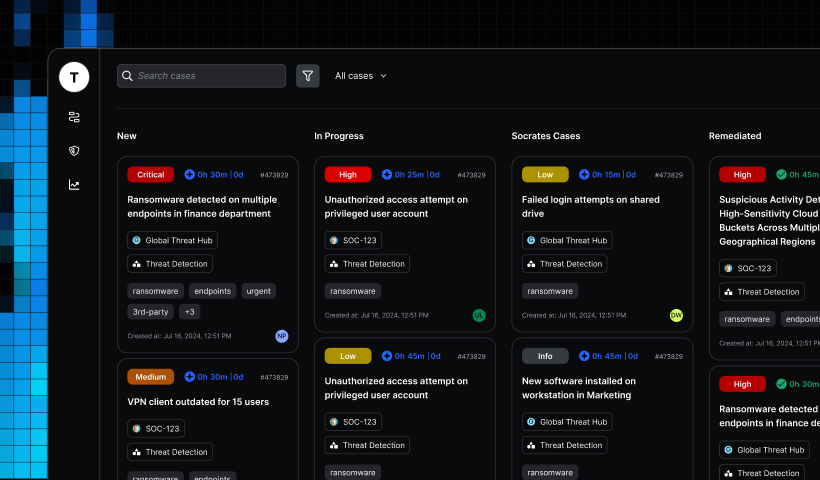
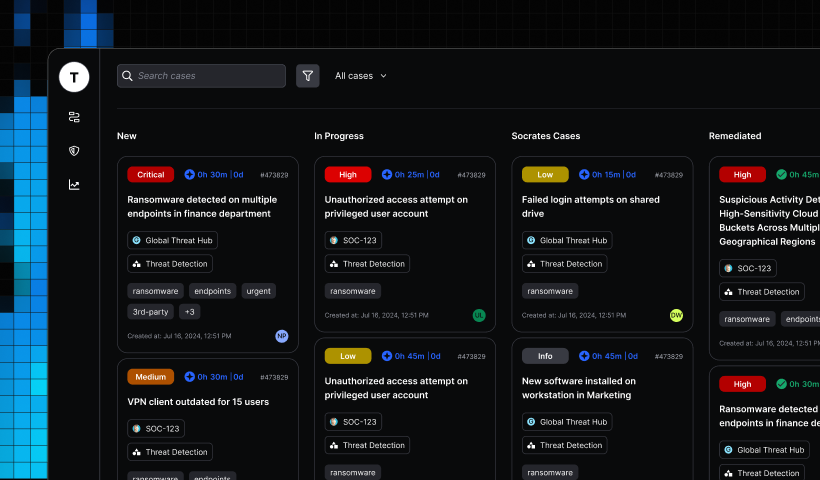
Torq is a security hyperautomation and AI SOC platform that automates security tasks and workflows at scale. Its cloud-native architecture is designed to expand SOC capacity, and it offers both agentic and deterministic workflows so teams can choose autonomous AI agents or repeatable, predictable automation for common tasks.
The platform lets users describe a workflow, use case, or outcome in natural language and then generates production-ready workflows. Torq HyperAgents handle routine investigation tasks, while case management provides a single source of truth from investigation through remediation.
Key features include:
- Agentic and deterministic workflows: Supports autonomous AI agents for flexible tasks and deterministic automation where predictable, repeatable execution is required.
- Natural-language workflow building: Generates and validates production-ready workflows from a described use case or outcome.
- HyperAgents: Deploys autonomous, customizable AI agents to triage, enrich, and investigate events and record evidence, timelines, and recommended actions.
- Integrations: Connects the security stack with 300+ pre-built integrations and thousands of pre-built steps, and can use AI to generate new integrations.
- Case management: Provides native, continuously updated case management with evidence, timelines, and case summaries for collaboration.
- Universal Auto Triage: Uses an agentic AI engine to prioritize threats and separate noise from real risk with transparent, overridable verdicts.
Limitations (as reported by users on G2):
- Learning curve: New users report a steep learning curve, particularly around debugging and documentation.
- Onboarding resources: Some users note a shortage of ready-made templates, which can make initial setup harder.
- Licensing: The licensing model is described as complex and can be difficult to follow.
Source: Torq
3. Tines

Best for: No-code workflow automation across security and IT teams
Strengths: Flexible builder, vendor-agnostic, fast time to value
Things to consider: Lighter case management; advanced steps need API skill
Tines is an intelligent workflow platform that security and IT teams use to connect tools, data, and people. It positions itself as broader than a traditional SOAR, and its vendor-agnostic model means it can connect to any product that offers an API, including internal tools and LLMs.
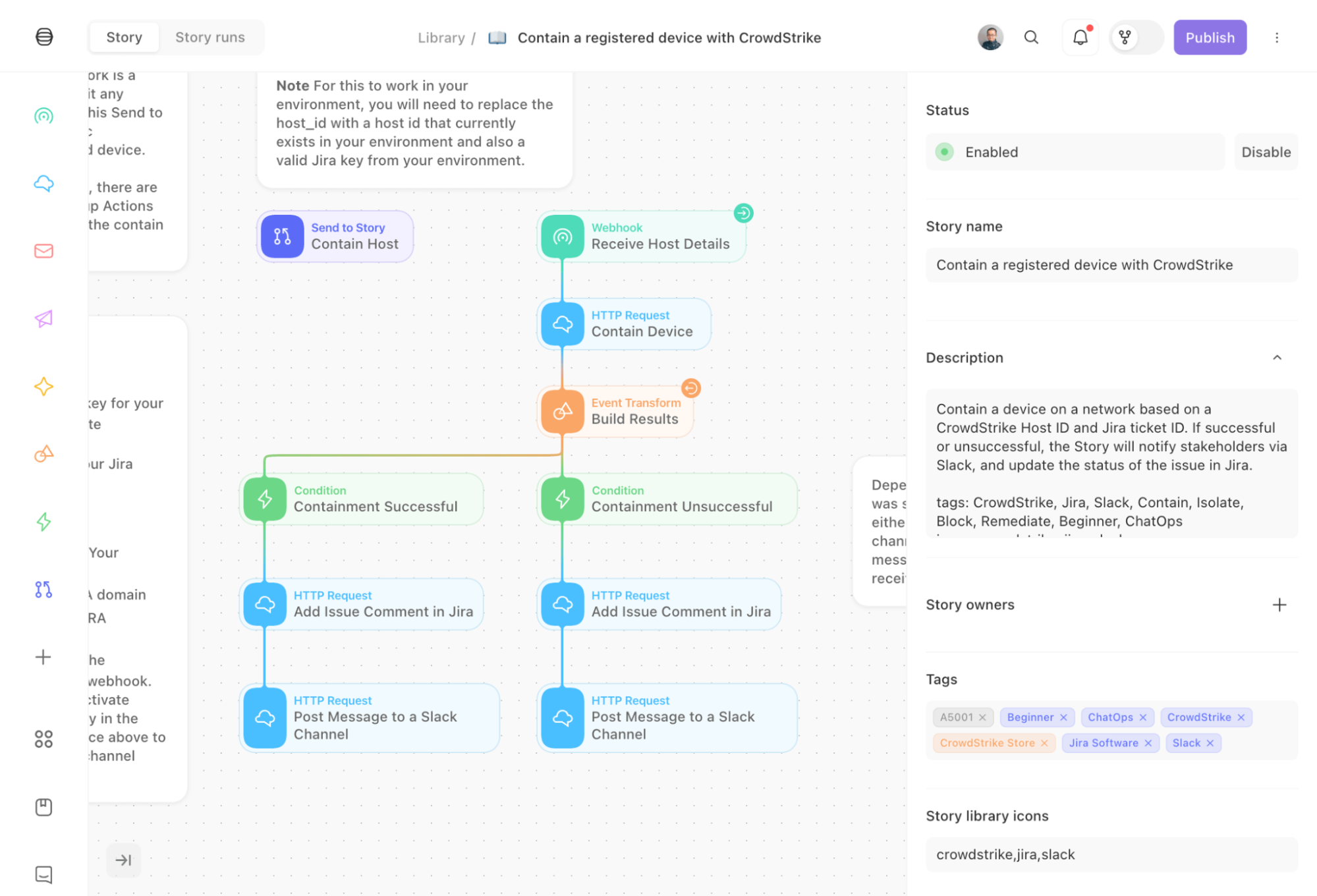
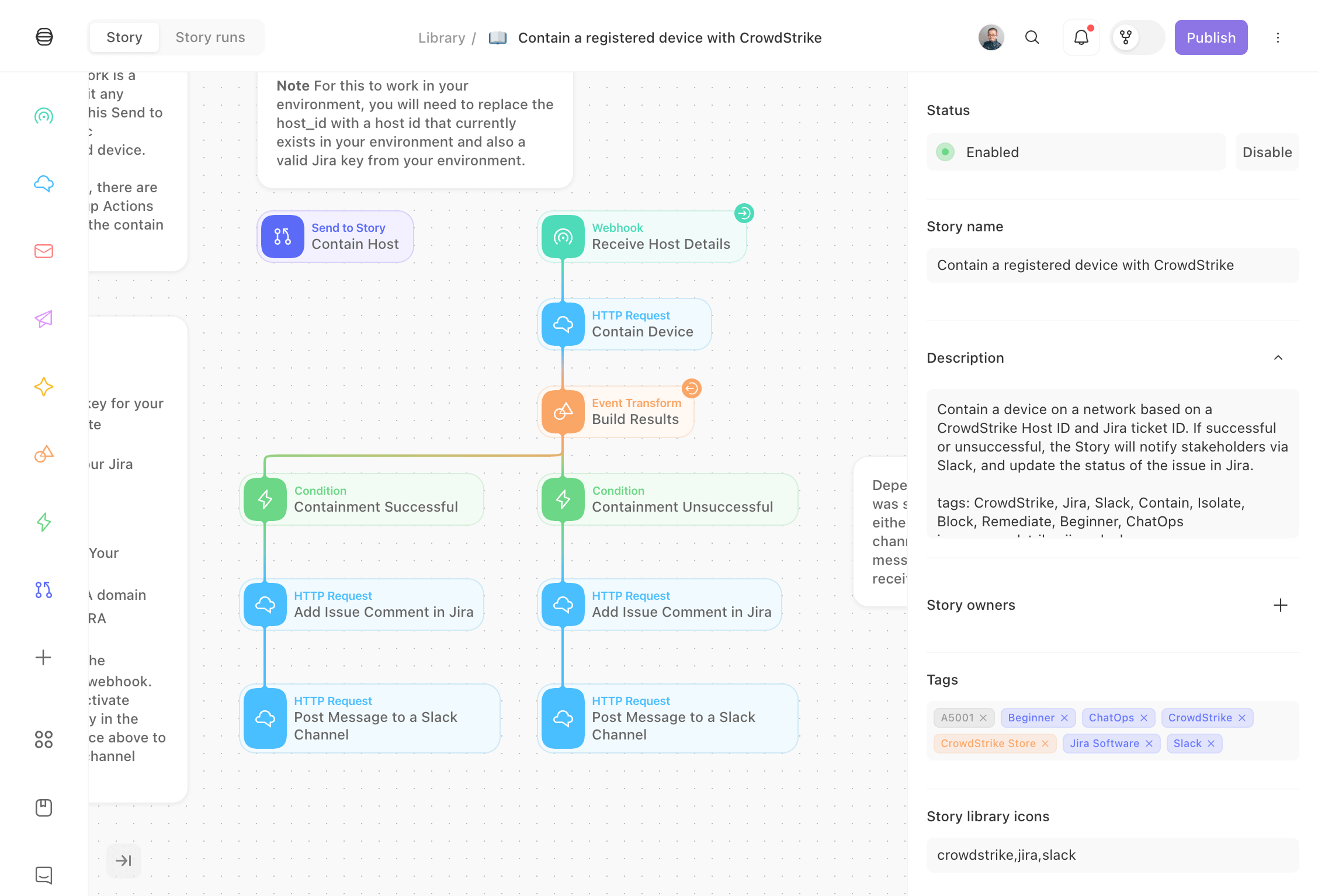
Workflows are built on a visual canvas called Storyboard, and the platform supports human-led, deterministic, and agentic approaches. Tines pairs automation with case management, an AI copilot, and reporting so teams can triage, enrich, and collaborate on higher-impact work.
Key features include:
- Storyboard builder: Provides a drag-and-drop canvas for chaining actions such as webhooks, HTTP requests, conditions, and transforms without code.
- Vendor-agnostic integration: Connects across the stack, including internal tools, LLMs, and MCPs, rather than being bound to a fixed integration list.
- Automation-first case management: Handles triage through case management so workflows resolve routine alerts and teams focus on the highest-impact cases.
- AI copilot (Workbench): Offers a natural-language interface to run actions such as employee lookups or account resets.
- AI agents: Lets teams build and deploy agents for tasks suited to flexible, logical next-step reasoning.
- Reporting and library: Captures workflow data in a structured format for trend analysis and offers a library of pre-built workflows for common security use cases.
Limitations (as reported by users on G2):
- Case management depth: Some teams that already own dedicated case-management tools find the built-in Cases feature less useful for them.
- Pricing for small teams: Users note the platform can be costly for smaller teams.
- Advanced builds: While the core is no-code, some integrations still require API knowledge, which can challenge non-technical users.
Source: Tines
Dedicated SOAR Platforms
4. Palo Alto Networks Cortex XSOAR

Best for: Enterprise SOAR with deep playbooks and threat intel
Strengths: 900+ content packs, war room, Unit 42 intelligence
Things to consider: Complex configuration and steeper learning curve
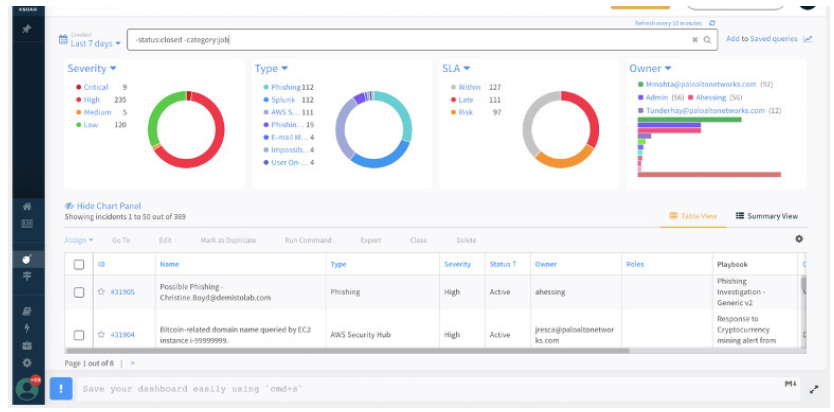
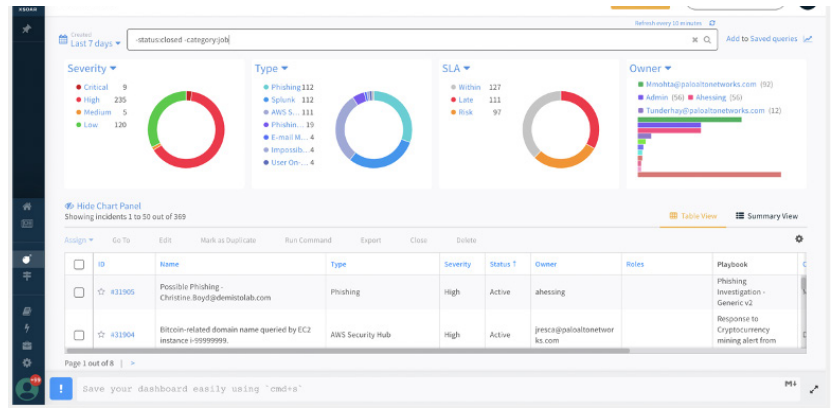
Cortex XSOAR is Palo Alto Networks' security orchestration, automation, and response platform, built around an automation-first approach to incident response. It aggregates incident data, indicators, and threat intelligence in one place and provides a virtual war room where analysts collaborate in real time, manage tickets, and run post-incident analysis.
The platform emphasizes standardized, repeatable processes codified in playbooks, which helps onboard new analysts and makes it easier to swap out point products. Threat intelligence management is integrated so external threats can be mapped directly to internal incidents.
Key features include:
- Playbook automation: Offers 900+ pre-built integration and automation packs and thousands of security actions, with a visual editor for code-free playbook creation.
- Virtual war room: Provides a shared space for incident investigation, with ChatOps and a CLI for on-the-fly analysis.
- Threat intelligence management: Automates indicator processing and scoring, maps external threats to incidents, and draws on Unit 42 intelligence.
- Auto-documentation: Records actions automatically for knowledge sharing and audit reporting.
- Machine learning assistance: Applies machine learning to support analyst decisions during investigations.
- Marketplace and multi-tenancy: Uses a content marketplace to orchestrate response across the stack and supports multitenant deployments for MSSPs.
Limitations (as reported by users on G2):
- Configuration complexity: Some aspects of configuration are considered complex, creating a steeper learning curve for new users.
- Time to proficiency: Users report it can take considerable time to become comfortable working in the platform.
- Support and maintenance: Some reviewers point to customer service and on-premises maintenance as areas needing improvement.
Source: Palo Alto Networks
5. Splunk SOAR

Best for: Playbook automation tied to the Splunk ecosystem
Strengths: 2,800+ actions, visual editor, case management
Things to consider: Cost and initial learning curve for new users
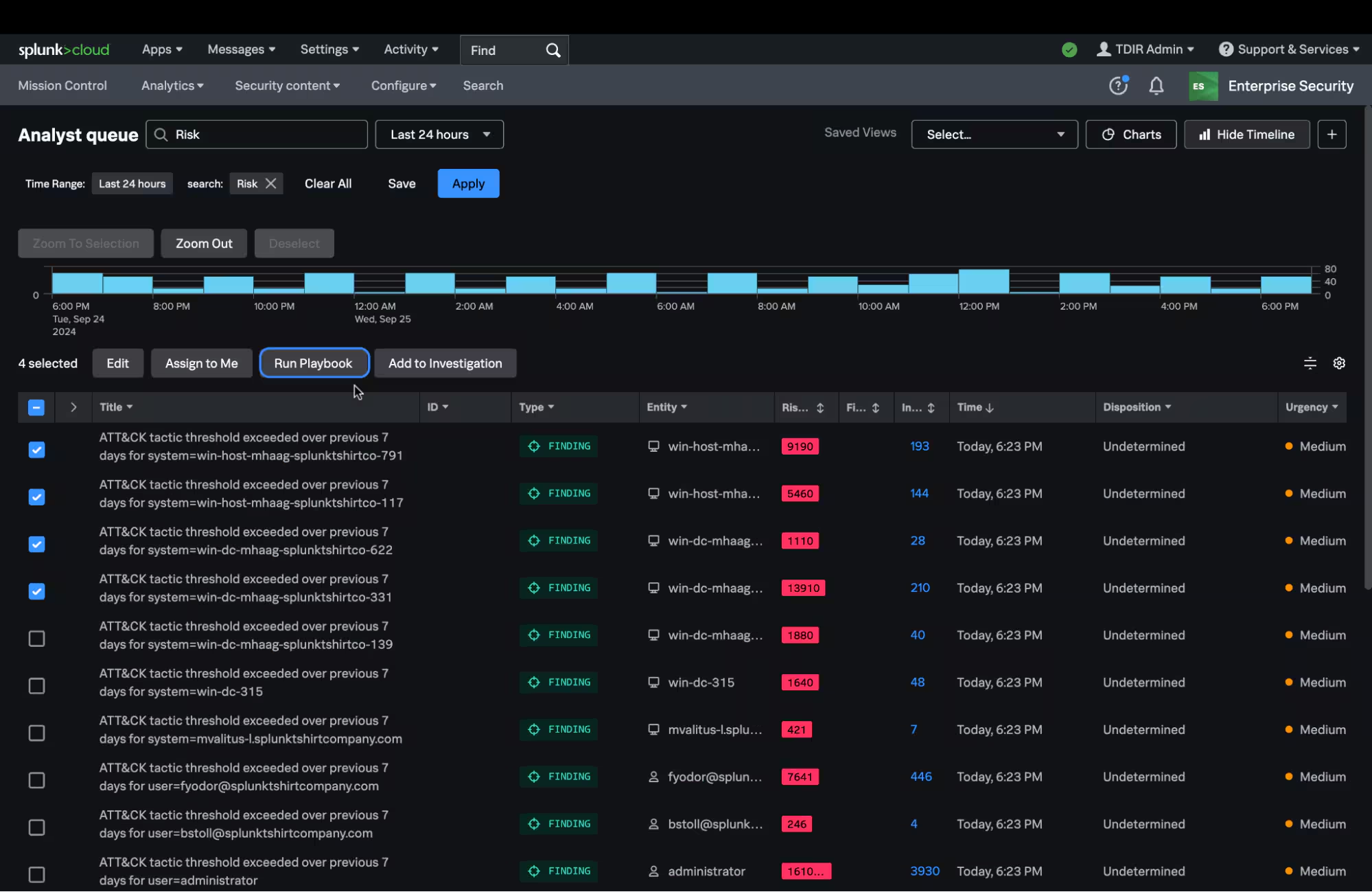
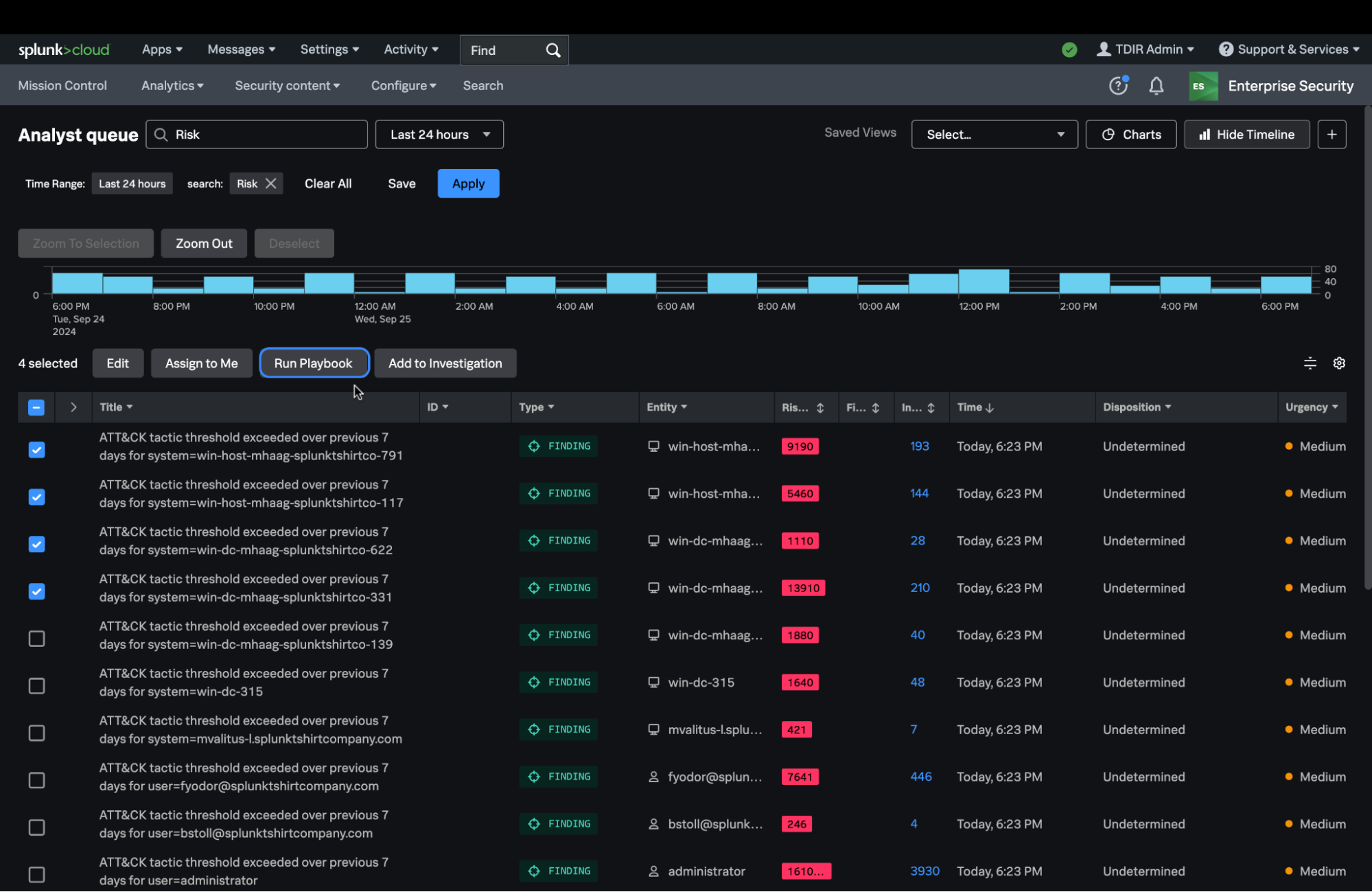
Splunk SOAR orchestrates security workflows and automates tasks across the security stack. It connects with a broad set of third-party tools and can be run on its own or leveraged within Splunk Enterprise Security for a unified workflow experience, so teams do not need to replace their existing stack.
The platform consolidates alerts and data from across the environment for prioritized response and applies a data-centric, machine-learning-backed approach. Prebuilt playbooks aligned to the MITRE ATT&CK and D3FEND frameworks help teams automate everything from small steps to full use cases.
Key features include:
- Automated playbooks: Executes actions across security and IT tools in seconds, with a library of prebuilt playbooks mapped to common SOC tasks.
- Broad integrations: Connects with 300+ third-party tools and supports 2,800+ automated actions.
- Visual Playbook Editor: Lets both new and experienced users assemble workflows from prebuilt code blocks with intuitive editing.
- Case management: Supports task segmentation, assignment, and documentation using custom templates or industry standards.
- Built-in threat intelligence: Provides an investigation panel and insights from the Splunk Threat Research Team to prioritize threats.
- Flexible deployment: Runs in the cloud, on-premises, or hybrid, and integrates with Splunk Enterprise Security.
Limitations (as reported by users on G2):
- Learning curve: Getting started can be challenging, and the interface presents a lot of information for beginners.
- Cost: Pricing is frequently cited as a consideration, particularly for smaller projects.
- Documentation: Some users feel the available documentation could be more complete.
Source: Splunk
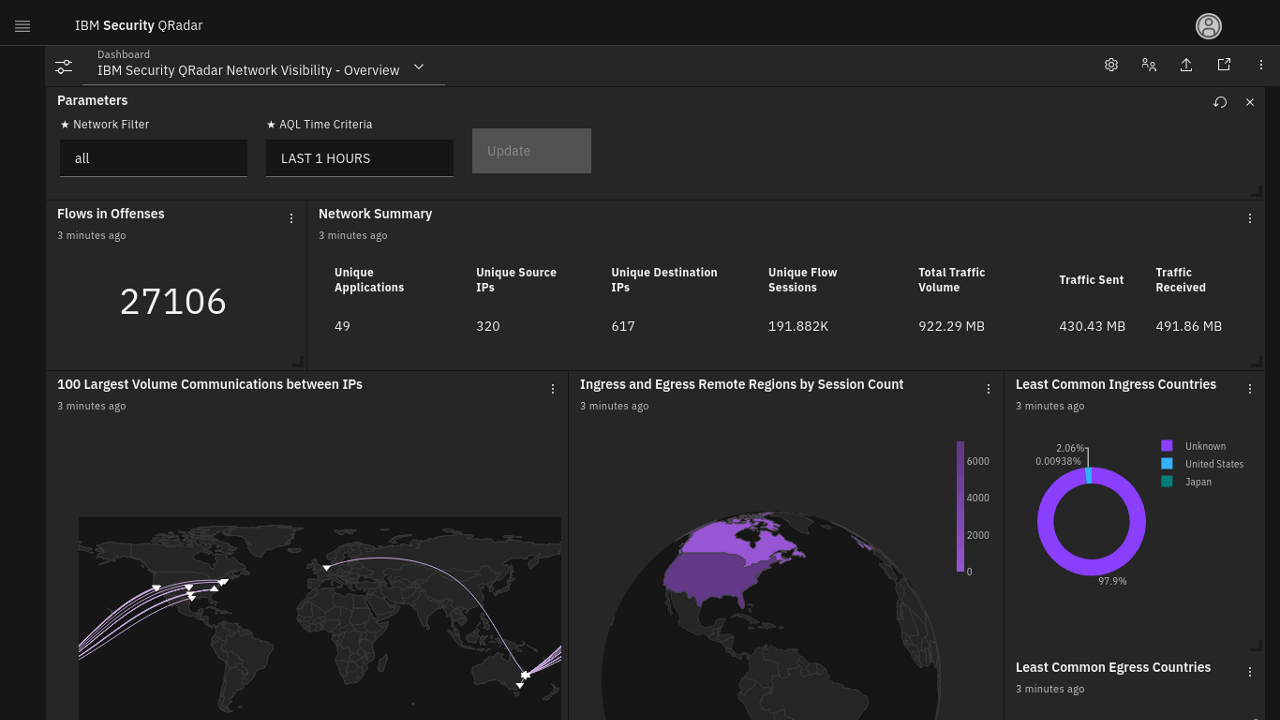
6. IBM QRadar SOAR

Best for: Standardized incident response with breach reporting
Strengths: Dynamic playbooks, 180+ privacy regs, case management
Things to consider: Complex setup; third-party integration effort
IBM QRadar SOAR is built to accelerate incident response through automation and process standardization. It uses automation for correlation, enrichment, investigation, and case prioritization, and its case-management approach works alongside an organization's existing response workflows and integrations.
A distinguishing capability is its Breach Response module, which integrates privacy reporting tasks into incident response playbooks and helps organizations address a large set of global privacy and data breach regulations, coordinating work across privacy, HR, and legal teams.
Key features include:
- Dynamic playbooks: The Playbook Designer builds playbooks that adapt to changing incident conditions, with threat enrichment at each stage of the investigation.
- Automated response: Automates correlation, enrichment, investigation, and case prioritization to speed response.
- Case management: Provides customizable case management and time-stamps key actions for a clear audit trail.
- Breach Response: Integrates privacy reporting into playbooks and supports more than 180 global privacy and data breach regulations.
- Broad integrations: Works with a broad ecosystem of integrations that plug into existing response workflows.
- Guided workflows: Offers an interface with in-app guidance to help analysts build automated workflows for high-fidelity alerts.
Limitations (as reported by users on PeerSpot):
- Setup complexity: Initial setup and configuration are reported as complex.
- Third-party integration: Integrating some third-party tools can require additional effort, and certain data formats need scripting to handle.
- Cost: Renewal, support, and licensing costs are seen by some users as expensive.
Source: IBM

7. Swimlane Turbine

Best for: High-scale, low-code automation and AI SOC workflows
Strengths: Agentic AI, big-data ingestion, 25M daily actions
Things to consider: Complex setup; some tasks need coding
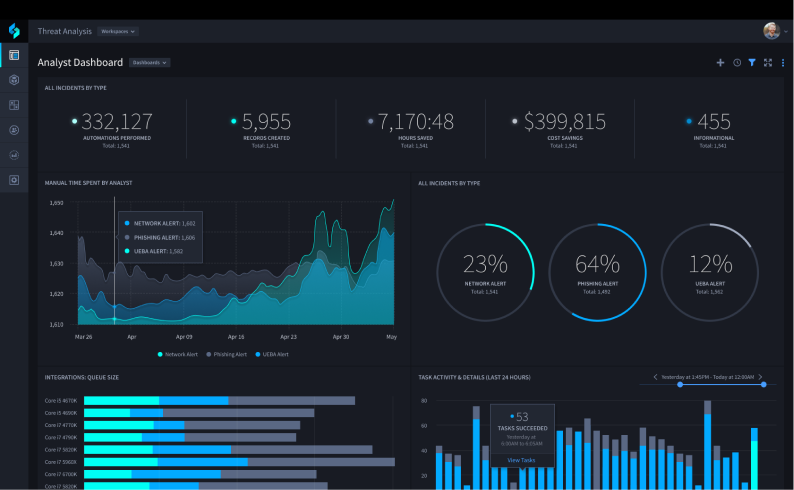
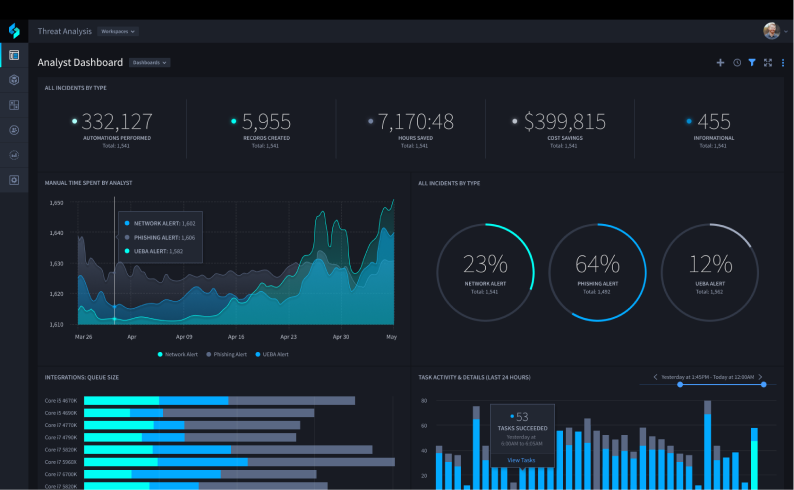
Swimlane Turbine is an agentic AI automation platform that spans SOC workflows, vulnerability management, and compliance. It pairs low-code playbooks with AI agents and is designed for high-scale environments, with distributed big-data ingestion and the ability to execute large volumes of automated actions.
The platform combines a fleet of AI agents (Hero AI) with AI-driven case management and a playbook builder called Turbine Canvas. Its marketplace provides pre-built connectors, and customizable dashboards give visibility into KPIs, ROI, and compliance.
Key features include:
- AI agents: Provides a fleet of Hero AI agents plus an agentic AI companion to speed triage and augment specific SOC skills.
- AI-driven case management: Offers customizable case management with domain-expert AI agents aimed at reducing mean time to respond.
- Turbine Canvas: Delivers a low-code playbook and AI agent builder for automating processes across the organization.
- High-scale architecture: Uses distributed big-data ingestion and cloud-native architecture to execute up to 25 million daily actions for a single customer.
- Marketplace integrations: Connects with any API through an expanding library of pre-built connectors.
- Dashboards and reporting: Provides customizable dashboards and AI-augmented reporting to measure KPIs and prove ROI.
Limitations (as reported by users on PeerSpot):
- Initial setup: The initial setup and deployment are considered complex.
- Stability: Some users report stability issues and latency when handling large data volumes.
- Coding requirements: Certain automation tasks require coding, and some users want stronger version control.
Source: Swimlane
8. Fortinet FortiSOAR

Best for: Centralized IT/OT security automation for SOC and MSSP
Strengths: 700+ integrations, 6,500 playbooks, FortiAI, FortiGuard
Things to consider: Steep learning curve; custom connectors are hard
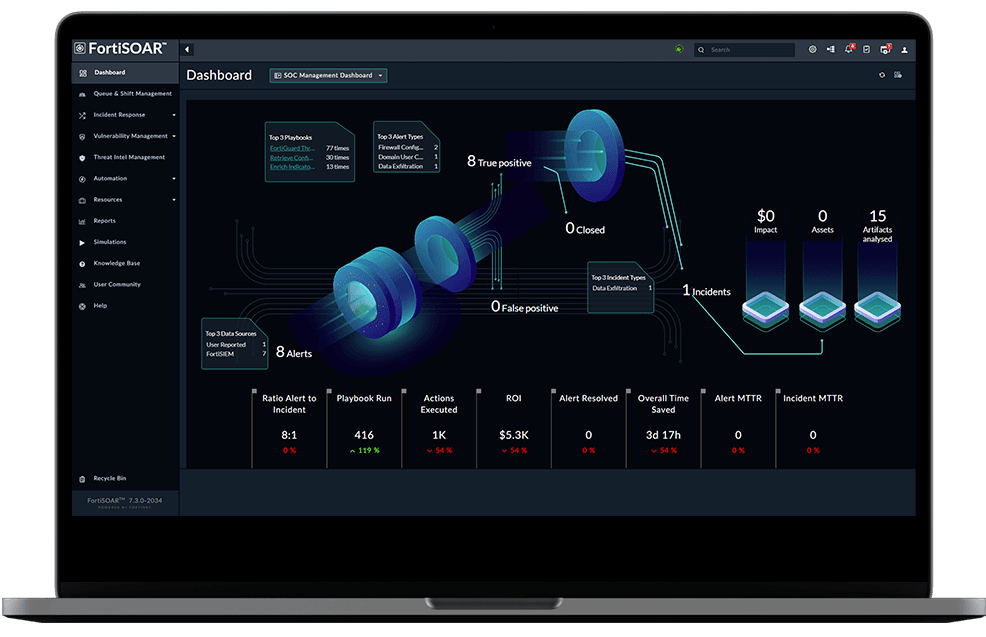
FortiSOAR helps IT and OT security teams centralize incident management and automate the analyst activities involved in threat investigation and response. It acts as a central operations hub that standardizes and executes workflows, and its breadth of integrations and pre-built playbooks supports SOC, NOC, and OT use cases.
The platform layers generative AI on top of its automation through FortiAI and an ML-based Recommendation Engine, which guide analyst activities and playbook creation. FortiSOAR is offered for both enterprises and MSSPs, with multi-tenant and flexible deployment options.
Key features include:
- Extensive content: Provides 700+ integrations and 6,500 pre-built playbooks covering SOC, NOC, and OT use cases.
- FortiAI and Recommendation Engine: Uses natural-language generative AI and machine learning to guide and automate analyst activities and playbook building.
- Built-in threat intelligence: Draws on FortiGuard Labs global intelligence and public sources to enrich investigations and inform actions.
- No/low-code playbooks: Offers a patented visual drag-and-drop design experience for building playbooks.
- Incident management: Centralizes and automates alert investigation and response with war room tooling.
- Flexible deployment: Available as SaaS, on-premises, public cloud, or via MSSP partners, with multi-tenant and shared-tenant options.
Limitations (as reported by users on G2):
- Learning curve: The learning curve is described as steep, which can make playbook creation harder.
- Custom connectors: Building connectors for products without a pre-built option is not straightforward.
- Support and documentation: Some users report that technical support responsiveness and use-case documentation could improve.
Source: Fortinet

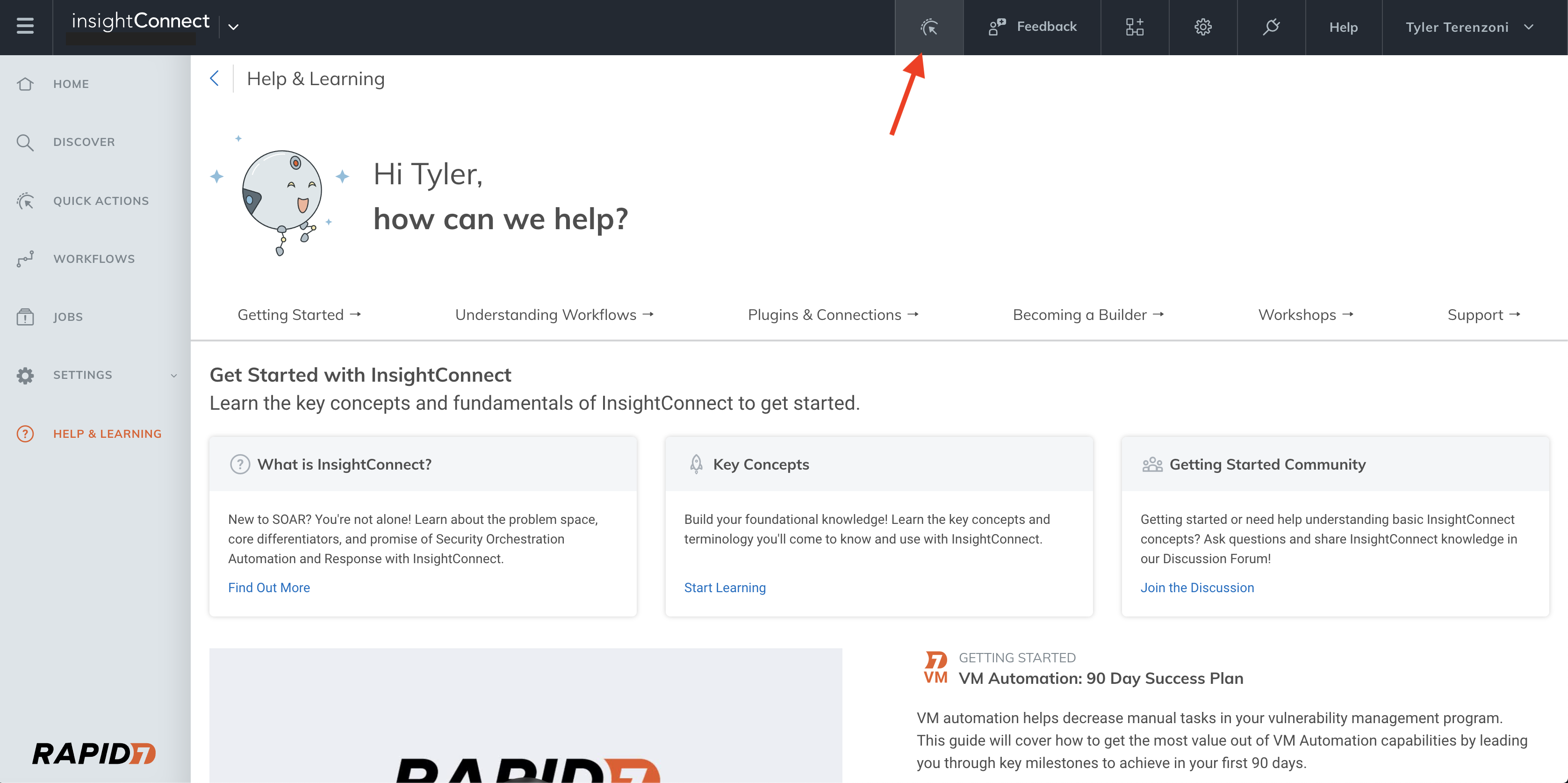
9. Rapid7 InsightConnect

Best for: Connecting security and IT processes with pre-built flows
Strengths: Plugin library, pre-built workflows, human-in-the-loop
Things to consider: GUI workflow building and some integrations lag
Rapid7 InsightConnect is a SOAR solution that connects teams and tools to accelerate security and IT processes. It focuses on moving beyond point-to-point integrations, letting teams build out processes that connect the right people and technology while preserving human decision-making where it matters most.
The platform provides a library of plugins for widely used technologies and a set of pre-built workflows for common use cases, so teams can connect their stack and automate across security and IT quickly, then extend with customized orchestrations.
Key features include:
- Plugin library: Offers plugins for commonly used technologies to connect the security and IT stack without point-to-point integration work.
- Pre-built workflows: Provides workflows for common use cases as starting points that teams can customize.
- Security and IT automation: Automates recurring, time-intensive tasks across both security and IT processes.
- Human-in-the-loop decisions: Allows human decision points within automated workflows for moments that require judgment.
- Building blocks: Supplies easy-to-use building blocks to create and manage integrations and new processes.
- Collaboration focus: Emphasizes flexibility, extensibility, and collaboration when adapting workflows to a team's needs.
Limitations (as reported by users on PeerSpot):
- Integration gaps: Some plugins and connectors need updating, and support for certain tools is limited to specific deployment types.
- Workflow interface: The GUI for creating workflows can be cumbersome for some users.
- Support and flexibility: Users cite technical support and the desire for more advanced custom API options as areas to improve.
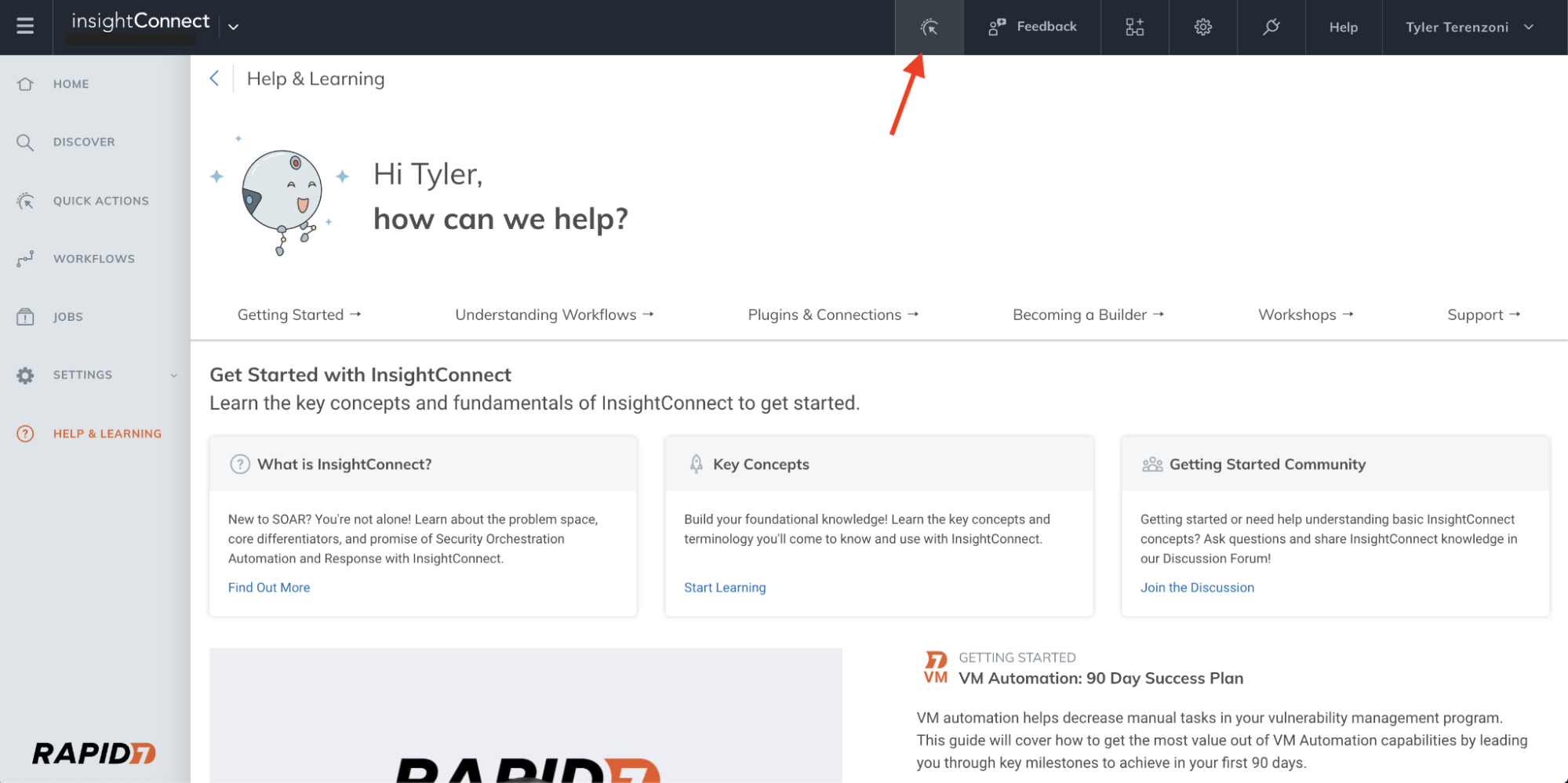
Source: Rapid7
10. D3 Smart SOAR

Best for: Vendor-agnostic SOAR with high-volume alert triage
Strengths: Codeless integrations, Event Pipeline triage
Things to consider: Custom reporting and metrics need manual effort
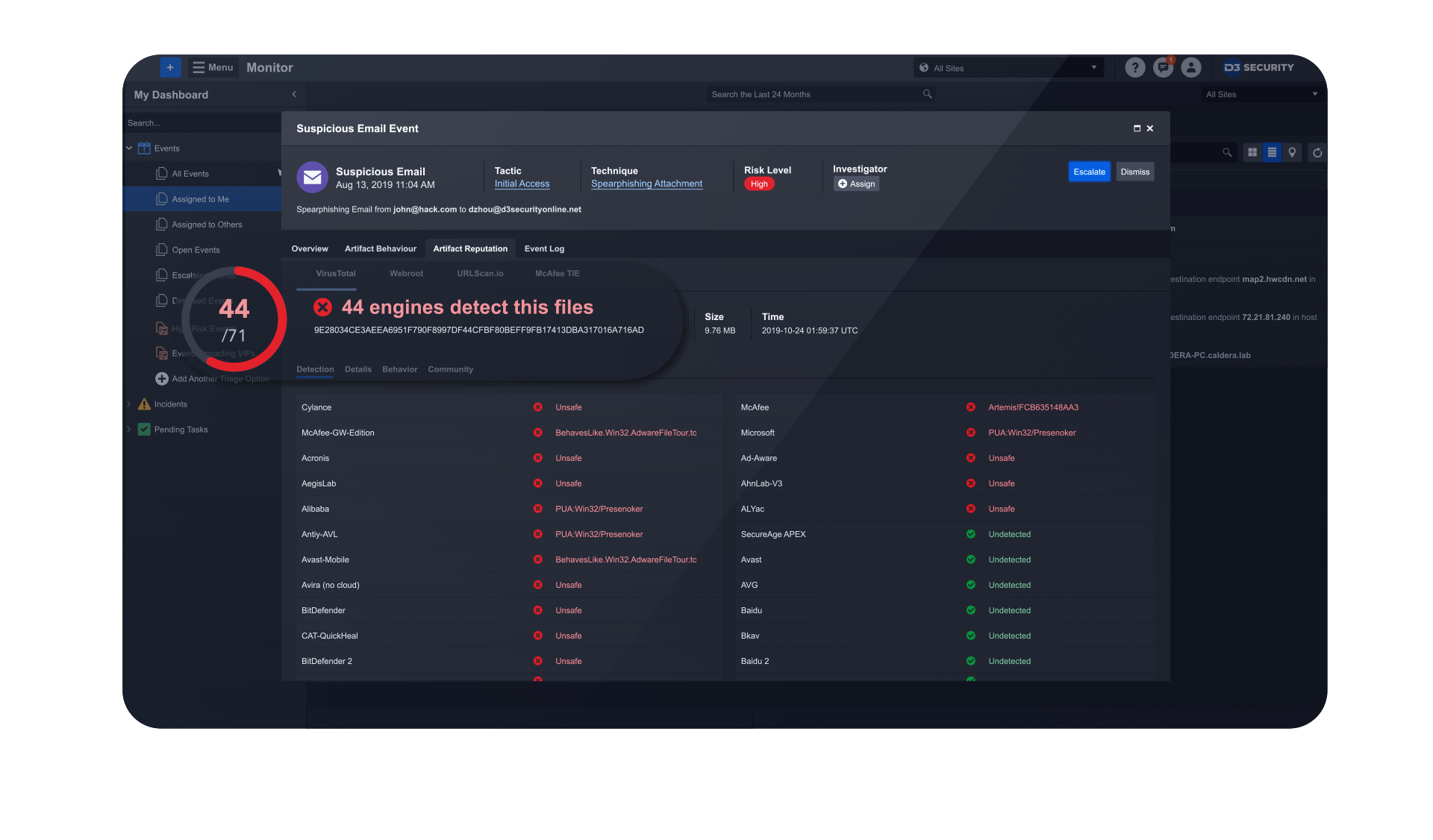
D3 Smart SOAR is a security automation platform focused on simplified processes and incident response. It emphasizes codeless integrations, so teams can connect tools without writing scripts or studying APIs, and its playbooks are designed as end-to-end SecOps workflows rather than simple automated sequences.
A central capability is its Event Pipeline, which provides alert-level automation that normalizes, deduplicates, triages, and enriches incoming alerts. This can sharply reduce the volume of events requiring human attention by automating much of the Tier 1 workload.
Key features include:
- Codeless integrations: Connects tools through unlimited codeless integrations and thousands of drag-and-drop automated actions, with vendor-agnostic connectivity.
- Event Pipeline: Normalizes, deduplicates, triages, and enriches alerts at scale, escalating only genuine threats.
- Playbooks: Provides an out-of-the-box playbook library and a codeless editor, with reusable automation blocks for faster building.
- Advanced execution: Supports capabilities such as looping, parallel tasks, and ongoing surveillance for more thorough execution.
- MITRE frameworks: Includes an embedded MITRE ATT&CK matrix and MITRE D3FEND playbooks for TTP-based analysis and response.
- Correlation: Correlates alerts against data sources such as threat intelligence, past incidents, and an internal CMDB.
Limitations (as reported by users on PeerSpot):
- Reporting: Custom reporting needs improvement, and MTTR and MTTD metrics require manual effort to surface from playbooks.
- Deployment options: Some users would prefer additional hosting options, such as Linux support.
- Onboarding: Getting the most from orchestration and automation can require skilled staff and a learning period.
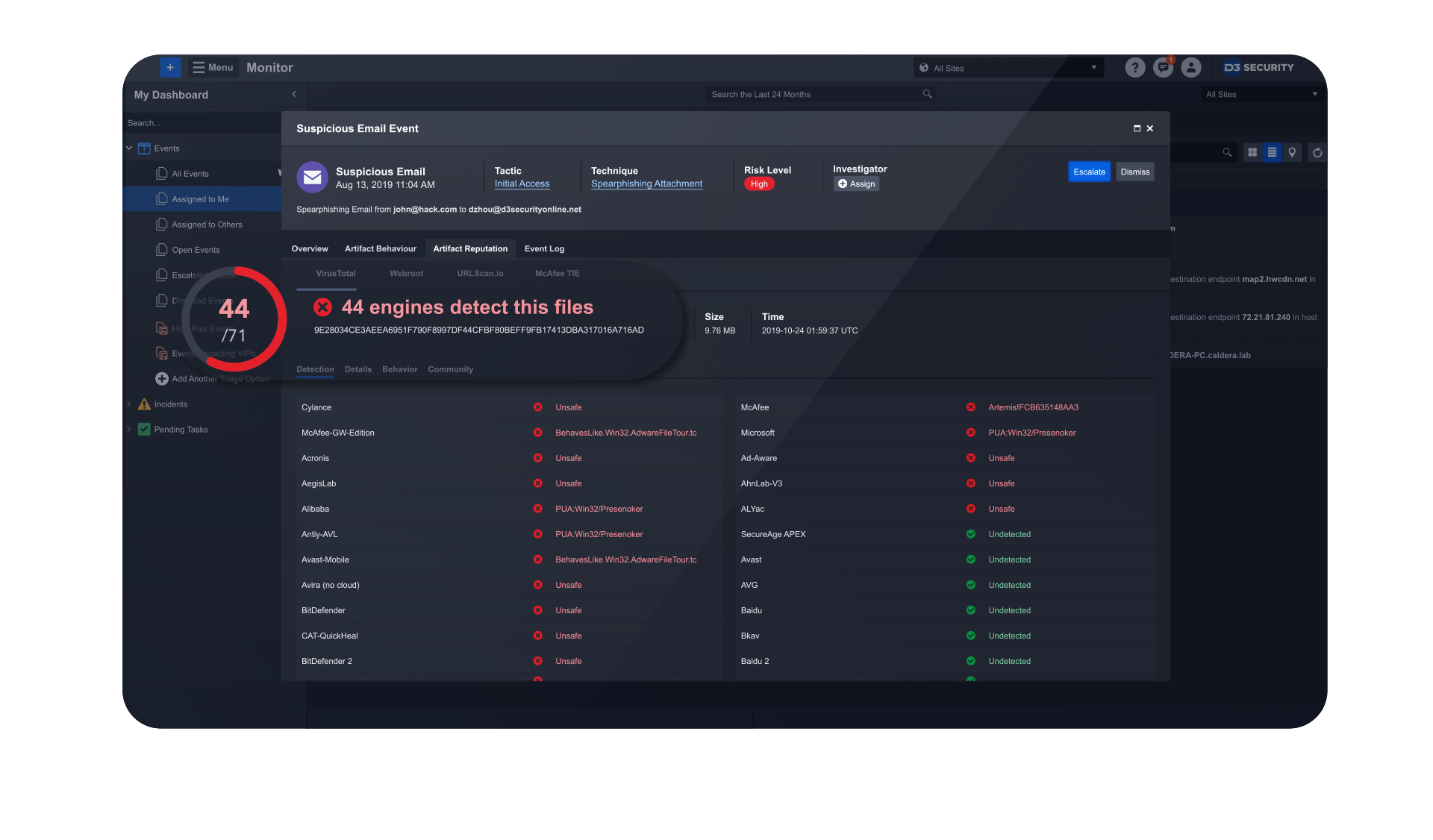
Source: D3
SOAR Within SIEM and Security Operations Platforms
11. Microsoft Sentinel

Best for: Cloud-native SIEM with built-in SOAR for Azure users
Strengths: 350+ connectors, Security Copilot, UEBA and TI built in
Things to consider: KQL learning curve; ingestion-based cost planning
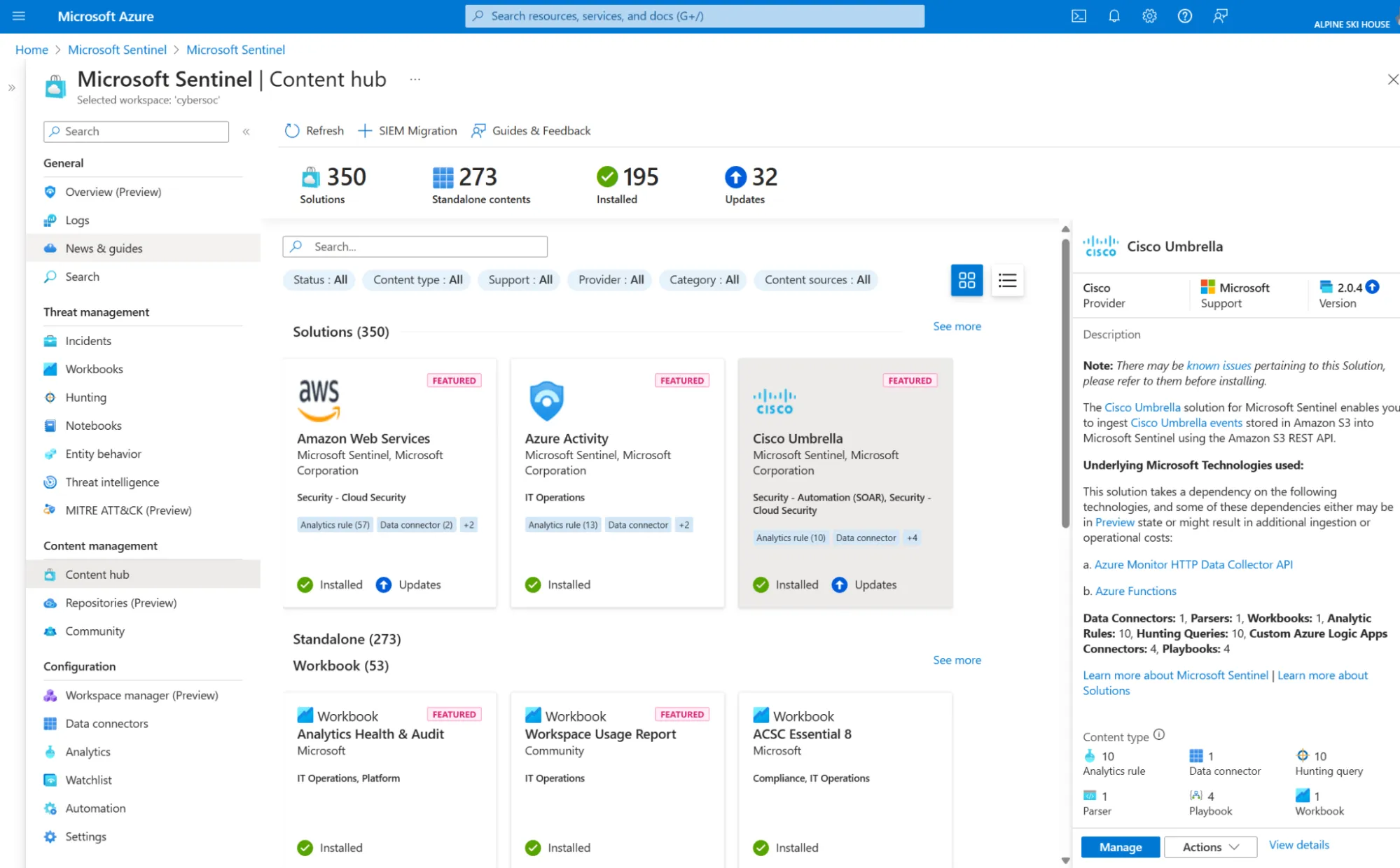
Microsoft Sentinel is a cloud-native SIEM that includes built-in SOAR, user and entity behavior analytics, and threat intelligence, delivered through a unified experience in Microsoft Defender. It centralizes security data in a data lake and adds graph-powered context across Microsoft and non-Microsoft solutions.
Its SOAR capabilities let analysts automate workflows and respond through the same unified experience, and generative AI via Security Copilot supports investigation. The platform is extensible, with a large connector catalog and no-code custom integrations.
Key features include:
- Built-in SOAR: Provides cloud-native security orchestration, automation, and response alongside UEBA, threat intelligence, and advanced analytics.
- Broad connectivity: Offers more than 350 native connectors plus no-code custom integrations for multicloud, multiplatform environments.
- Security Copilot: Uses generative AI to summarize incidents, generate KQL queries, and recommend next steps to reduce mean time to resolution.
- Data lake: Centralizes security data in scalable, cost-efficient storage to support analytics and detection.
- Graph-powered context: Builds a security graph into the platform to centralize visibility and context across use cases.
- Threat intelligence: Unifies Microsoft threat signals with third-party feeds and supports STIX/TAXII.
Limitations (as reported by users on PeerSpot):
- Query language: Getting full value requires learning Kusto Query Language, which adds a learning curve.
- Cost planning: Ingestion-based pricing requires careful planning to manage costs.
- Ingestion timing: Some users report delays between event generation and data availability.
Source: Microsoft
12. Google Security Operations SOAR

Best for: SIEM-integrated SOAR at Google scale
Strengths: Drag-and-drop playbooks, 300+ integrations, Gemini AI
Things to consider: Query-language learning curve; stitched UX
Google Security Operations SOAR (formerly Siemplify and Chronicle SOAR) is the response layer of Google's unified SecOps platform, combining low-code automation with collaboration. It offers a unified experience across SIEM, SOAR, and threat intelligence to drive detection, investigation, and response.
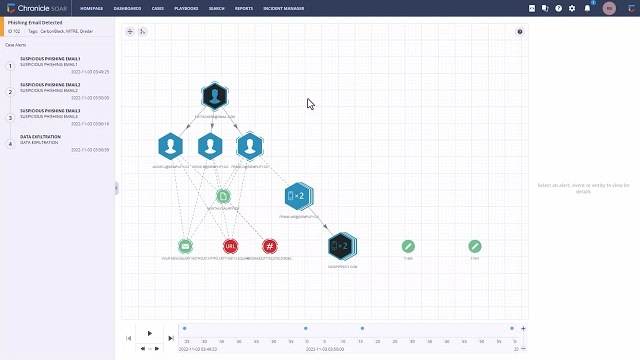
Analysts build playbooks with a drag-and-drop interface that can orchestrate hundreds of tools, and Gemini in Security Operations adds AI-assisted context and playbook creation. Lifecycle management, an auto-documenting case wall, and out-of-the-box reporting round out the platform.
Key features include:
- Automated playbooks: Lets analysts build drag-and-drop playbooks that orchestrate hundreds of tools, with ready-to-run use cases for scenarios like phishing and ransomware.
- Playbook lifecycle management: Provides run analytics, reusable playbook blocks, version control, and rollback.
- Integrations: Offers 300+ SOAR integrations, plus a built-in Python IDE for custom integrations.
- Context and collaboration: Delivers threat context and recommendations with Gemini, plus a case wall for chat, tagging, and task tracking.
- Case management: Combines playbook automation, case management, and integrated threat intelligence in one cloud-native experience, including alert grouping.
- Reporting: Captures SOC activity in a searchable, auditable repository with out-of-the-box dashboards and metrics.
Limitations (as reported by users on PeerSpot):
- Query language: The rule and query language has a steep learning curve for teams coming from other SIEMs.
- Unified experience: The SOAR and SIEM components can feel like separate products with occasional interface inconsistencies.
- Integrations and docs: Building some third-party API connections can be difficult, and documentation and onboarding resources could be more comprehensive.
Source: Google
13. Sumo Logic Cloud SOAR

Best for: Cloud-native SOAR paired with Sumo Logic analytics
Strengths: Open Integration Framework, War Room, KPI dashboards
Things to consider: Setup and query learning curve; pricing
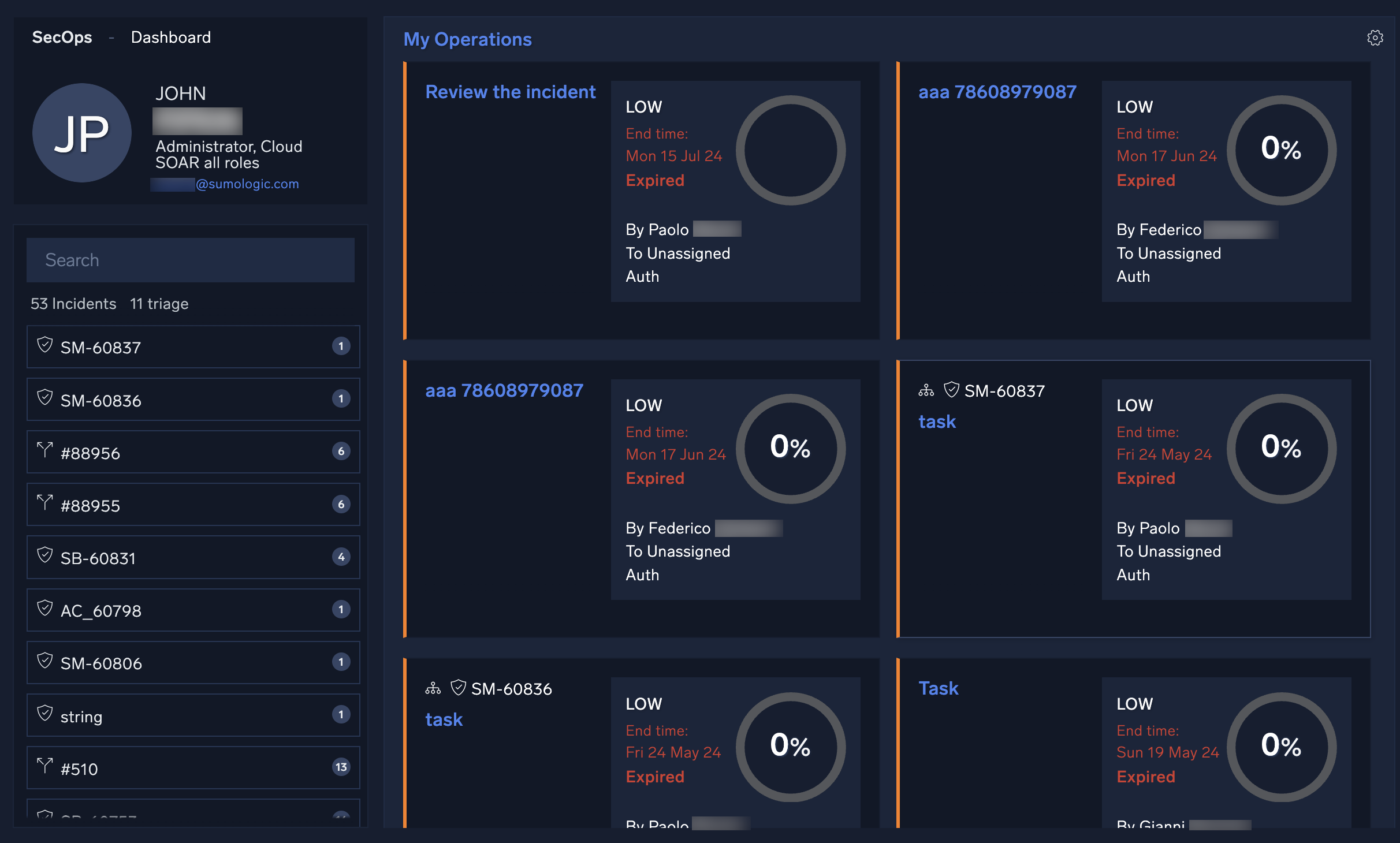
Sumo Logic Cloud SOAR automates real-time threat investigation, incident management, and threat response while reducing false positives and analyst fatigue. It provides hundreds of pre-built integrations and delivers complete SOAR functionality across private, single, multi-cloud, and hybrid cloud environments.
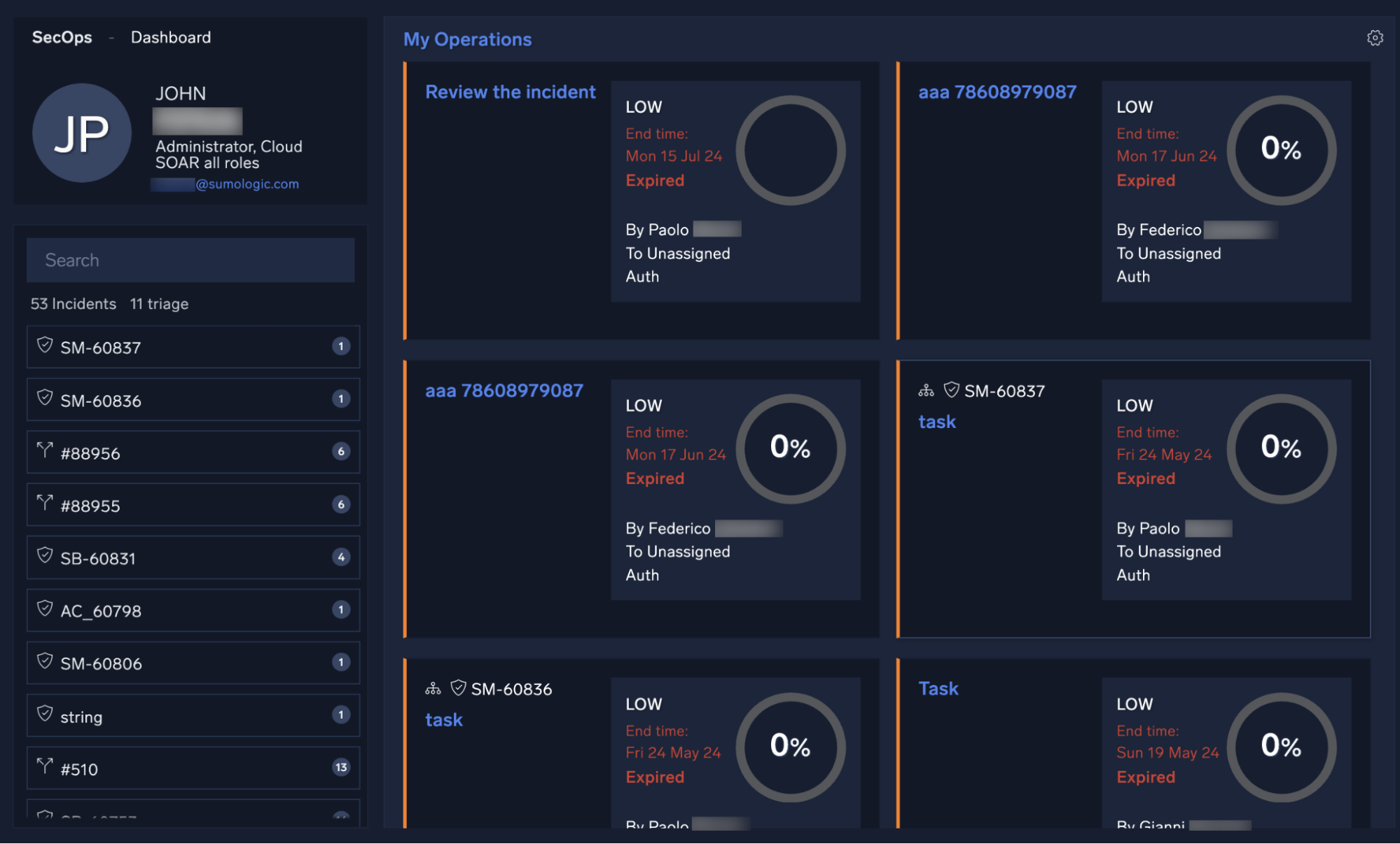
The platform pairs automated triage with structured case management in a War Room, where analysts work on incidents simultaneously with role-based access control. Its near-no-code approach means the Sumo Logic team can add or modify actions for teams without developers.
Key features include:
- Advanced triage: Automates investigation of indicators of compromise for cyber and non-cyber use cases to reduce false positives.
- Case management: Provides a War Room with a chronological view of an incident and granular role-based access control.
- Open Integration Framework: Offers hundreds of out-of-the-box actions and playbooks, with API code accessible for building integrations without coding.
- Automated SOPs: Orchestrates the security stack and automates time-consuming tasks to standardize operating procedures and reduce response time.
- KPI dashboards: Delivers customizable dashboards and reporting with real-time data across the incident response lifecycle.
- Cloud-native architecture: Provides multi-tenant scaling and elasticity for full SOAR functionality across cloud environments.
Limitations (as reported by users on PeerSpot):
- Setup and queries: Dashboard creation and query formulation can be challenging, and there is a learning curve during initial setup.
- Integrations and documentation: API integration and automation documentation could be improved, and some connections can be delayed.
- Pricing: The pricing is considered expensive by some users.
Source: Sumo Logic
14. ServiceNow Security Operations

Best for: SecOps workflows built on the ServiceNow platform
Strengths: SIR playbooks, vulnerability response, CMDB context
Things to consider: High TCO; complex implementation and admin
ServiceNow Security Operations extends the ServiceNow platform to accelerate response and strengthen security posture through SecOps workflows. It connects security incident response, vulnerability response, and threat intelligence with the broader ServiceNow workflow model, ITSM, and CMDB.
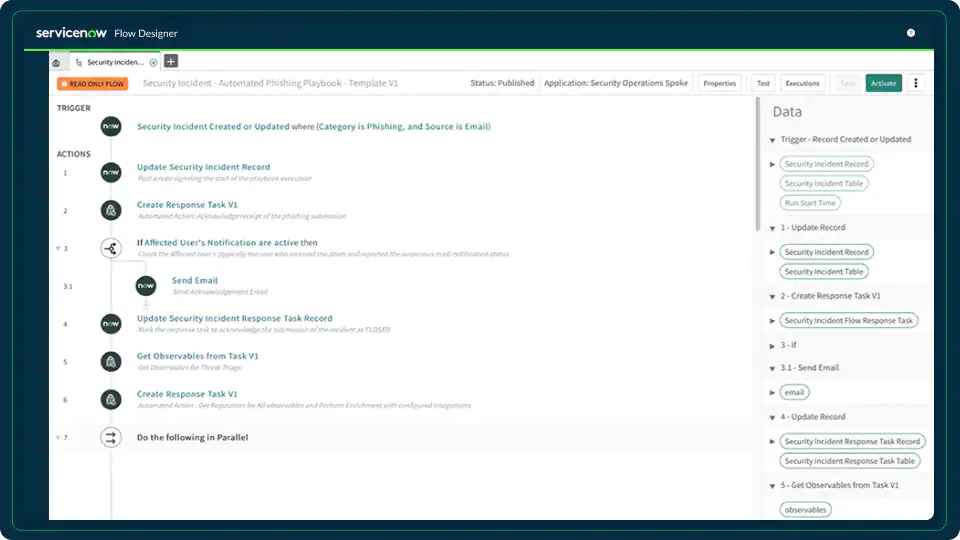
Its Security Incident Response module prioritizes and responds to threats using smarter workflows, orchestration, and autonomous assistance, with pre-built playbooks. Integration with asset and configuration data helps prioritize incidents and vulnerabilities by business impact.
Key features include:
- Security Incident Response: Prioritizes and responds to threats with workflows, orchestration, pre-built playbooks, and autonomous assistance.
- Vulnerability Response: Prioritizes vulnerabilities using business context and automates remediation and change workflows.
- Threat intelligence: Provides a Threat Intelligence Security Center for threat hunting, modeling, and analysis on the ServiceNow platform.
- Platform integration: Connects with ITSM and CMDB so security workflows draw on accurate asset and service data.
- Third-party integrations: Integrates with tools such as Splunk, Tenable, Qualys, and Microsoft Defender to automate processes.
- Deployment flexibility: Adapts to SaaS and on-premises architectures and unifies security views across teams.
Limitations (as reported by users on PeerSpot):
- Cost of ownership: Users cite a high total cost of ownership and complex licensing.
- Implementation: Deployment is time-intensive and typically requires skilled administrators.
- Data dependency and performance: Effective prioritization relies on accurate CMDB data, and reporting and some workflows can feel slow.
Source: ServiceNow
Conclusion
SOAR platforms help security teams scale incident response by combining orchestration, automation, and structured workflows into a single operational framework. The right platform depends on factors such as the maturity of the SOC, the complexity of the security stack, existing SIEM and endpoint investments, and the organization's automation goals. Teams should prioritize broad integrations, flexible playbook development, reliable case management, and strong governance so automation improves response speed without sacrificing visibility or control.