
What Is AI SOC Software?
AI SOC (Security Operations Center) platforms eliminate alert fatigue by autonomously triaging Tier 1 alerts, reducing false positives, and providing decision-ready investigation reports. These solutions dramatically shorten investigation times and free analysts to focus on critical threats and proactive threat hunting.
AI SOC software uses machine learning, natural language processing, and advanced analytics to enhance threat detection, automate repetitive tasks, and optimize incident response workflows. It aims to address the growing challenges faced by security teams, such as alert overload, resource constraints, and the complexity of modern IT environments.
Why Traditional SOC Tools Struggle to Reduce Alert Fatigue
1. Alert Volume vs. Analyst Capacity
Security teams face a high number of alerts generated by traditional SOC tools. These systems often flag every potential anomaly, resulting in thousands of notifications daily. The volume quickly surpasses what human analysts can review, leading to missed threats and burnout. As attack surfaces grow and new threats emerge, this imbalance worsens, making it difficult for SOC teams to keep up.
Analysts often spend most of their time reviewing false positives, which reduces their ability to focus on real incidents. This overload affects response times and increases the likelihood that genuine threats will be overlooked. The gap between alert volume and analyst capacity drives alert fatigue, leaving security teams less effective.
2. Rule-Based Detection vs. Context-Aware Prioritization
Traditional SOC tools typically use static, rule-based detection methods. These rules trigger alerts based on predefined criteria but cannot adapt to new attack techniques or consider the broader context of events. As a result, they generate false positives that require manual investigation.
Without context-aware prioritization, analysts must assess each alert’s severity and potential impact manually. This approach does not scale as environments become more complex. The lack of intelligent prioritization contributes to alert fatigue, as analysts spend time on low-risk or irrelevant events instead of high-priority threats.
3. Tool Sprawl and Fragmented Visibility
Many organizations deploy multiple point solutions for threat detection, log management, and response. This tool sprawl creates fragmented visibility, as each tool operates in isolation and generates its own alerts. Analysts must use multiple interfaces and manually correlate data, increasing the risk of missing incidents.
Fragmented visibility limits the ability to maintain a unified view of threats and incidents. Without centralized management and correlation, connections between alerts can be overlooked, making it harder to detect coordinated attacks. This complexity adds to analyst workload and alert fatigue, reducing SOC effectiveness.
How AI SOC Software Reduces Alert Fatigue
Alert Deduplication and Grouping
AI SOC software uses algorithms to identify and eliminate duplicate alerts generated from the same event. By analyzing alert metadata and event characteristics, these platforms group related alerts into single, actionable incidents. This reduces the number of notifications analysts must review.
Grouping related alerts also provides analysts with richer context for each incident. Instead of piecing together information from multiple alerts, they receive a consolidated view that highlights connections and root causes. This approach speeds up investigation and supports more accurate responses to security events.
AI-Based Alert Prioritization
AI SOC solutions use machine learning models to assess the severity and potential impact of each alert. By analyzing historical data, user behavior, and environmental context, these systems automatically assign risk scores and prioritize alerts. This ensures that critical threats are surfaced first.
Automated prioritization also filters out low-risk or benign events that do not require immediate attention. By learning from past incidents and analyst feedback, the AI refines its prioritization models and adapts to new threats and organizational changes. This approach improves on static rule-based systems and addresses alert fatigue.
Automated Tier 1 Triage
AI SOC software can automate many initial triage tasks handled by entry-level analysts. These tasks include gathering context, enriching alerts with threat intelligence, and performing basic investigations. Automating tier 1 triage allows analysts to focus on complex incidents that require human judgment.
Automation of routine activities ensures consistent processes for incident handling. It reduces the likelihood of human error during initial investigations and speeds up response workflows. As a result, organizations increase the efficiency of their security teams and reduce time spent on low-value tasks.
Incident Correlation Across Tools
AI SOC software can correlate incidents across multiple security tools and data sources. By aggregating and analyzing data from endpoint, network, cloud, and application security platforms, AI identifies patterns and relationships that are difficult to detect manually. This approach improves threat detection and provides a unified view of the security landscape.
Cross-tool correlation reduces the risk of missing complex, multi-stage attacks that span multiple domains. By linking related alerts and events, AI SOC software ensures that analysts see the full scope of an incident, supporting more effective containment and remediation. This capability addresses tool sprawl and fragmented visibility, making SOC operations more cohesive.
Human-in-the-Loop Feedback
AI SOC platforms learn from human analyst feedback. When analysts investigate and resolve incidents, their actions and decisions feed back into the AI models. This process enables the system to improve its detection, prioritization, and automation capabilities over time.
Human-in-the-loop feedback also ensures that AI-driven SOC software aligns with the requirements and risk tolerances of each organization. By incorporating expert judgment, the system can tune its algorithms to reduce false positives and increase alert relevance. This approach combines human expertise and AI to improve security operations.
Notable AI SOC Software for Reducing Alert Fatigue
The platforms below take different approaches to the same core problem: cutting through alert noise so analysts spend their time on real threats. Some are purpose-built autonomous AI analysts that investigate every alert; some are AI layers inside broader detection and SIEM platforms; and some are automation platforms that orchestrate the response. The customer’s category is listed first.
Autonomous AI SOC Analyst Platforms
These platforms sit on top of an existing security stack and act as an AI analyst, ingesting alerts, investigating them end to end, and escalating only what needs a human. They target alert fatigue by automating Tier 1 triage.
1. Intezer

Intezer is an AI SOC platform that investigates every incoming alert at forensic depth and escalates only the fraction that requires human attention. It connects to endpoint, identity, phishing, network, cloud, and SIEM sources, then collects and analyzes evidence to produce a verdict for each alert. The platform pairs agentic AI reasoning with deterministic forensic techniques such as endpoint forensics, reverse engineering, network artifact analysis, and sandboxing.
Key features include:
- Forensic-depth alert investigation: Intezer combines proprietary and commercial AI models with built-in forensic tooling, including memory analysis, reverse engineering, sandboxing, and static analysis.
- Full coverage across alert sources: The platform ingests alerts from endpoint tools (CrowdStrike, SentinelOne, Microsoft Defender), SIEMs, reported-phishing mailboxes, identity providers (Entra ID, Okta), network tools, and cloud workload protection. Every alert is investigated at the same level of scrutiny regardless of severity.
- Closed-loop detection engineering: Investigation outcomes are fed back into detection rules at the source. The vendor describes this as improving MITRE ATT&CK coverage and reducing recurring noise over time.
- Human-in-the-loop transparency: Triage logic is exposed with clear explanations, and analysts can review or override escalated alerts. The platform learns from analyst feedback and is benchmarked through in-house QA, with optional access to Intezer’s analysts for support.
- Endpoint-based predictable pricing: The vendor ties pricing to organizational size, such as endpoint count, rather than alert volume.
- Automated, approval-gated remediation: Native integrations support remediation actions that can be automated with explicit human approval. The platform also integrates with ticketing and SOAR tools such as ServiceNow, Tines and Torq.
Limitations:
- Requires mature telemetry to work. Investigation quality depends on the customer’s existing EDR/SIEM health. Organizations with immature tooling won’t get full value out of the box.
- MITRE ATT&CK coverage has a realistic ceiling with Intezer benchmarking 60–70% as “top-tier” and flags anything higher as likely inflated. Some technique categories remain outside reliable coverage for any vendor.
- Focused on enterprise-size customers with a minimum of 1,000 employees.

2. Dropzone AI
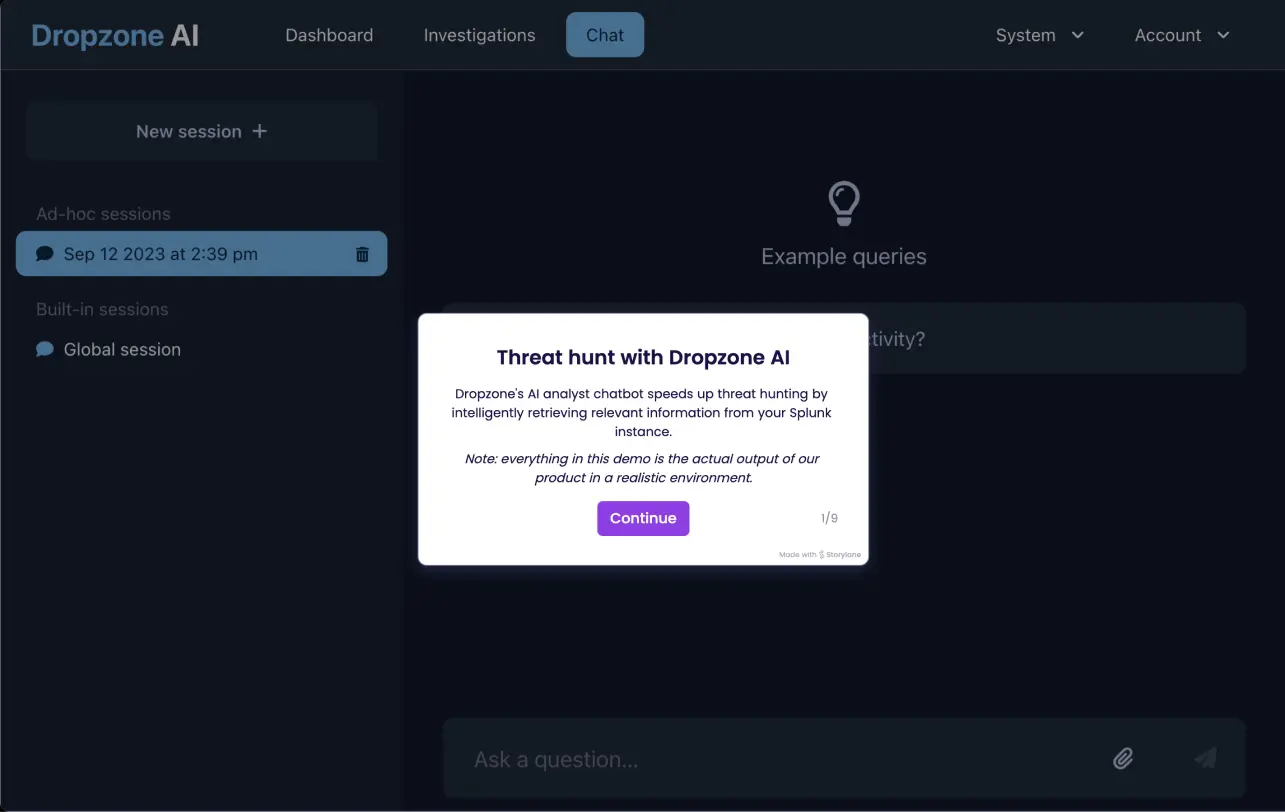
Dropzone AI provides a pre-trained autonomous AI SOC analyst that investigates security alerts around the clock. Its agents are built on large language models and pre-trained on investigative techniques used for common alert types, so they can run end-to-end investigations without playbooks or custom code. The platform connects to SIEM, EDR, cloud, identity, and email tools, gathers relevant data, and produces a plain-language report with a severity conclusion and supporting evidence.
Key features include:
- Pre-trained autonomous investigations: Dropzone’s agents reason through alerts, collect evidence, and correlate data across connected tools.
- Broad integration coverage: The platform connects to over 90 security and data tools without requiring data migration or log normalization.
- Context memory: A context-memory capability learns details about the environment through analyst input and automated learning.
- Transparent, plain-English reporting: Each investigation produces a report that outlines reasoning, tools queried, and findings, with an executive summary and severity conclusion.
- Built-in analyst chatbot: An integrated chatbot lets analysts ask follow-up questions and run ad hoc investigations without switching tools.
- Automated containment: When agents confirm a threat, containment actions such as blocking malicious IPs or disabling accounts can fire automatically.
Limitations (based on publicly available sources):
- Tuning ramp-up: Reviewers on Gartner Peer Insights note that tuning the platform to an environment takes time.
- Dependence on supported sources: Reviews indicate the product performs best with supported data sources.
- Maturing feature set: As a newer product with an expanding roadmap, some capabilities are still being added.
3. Prophet Security

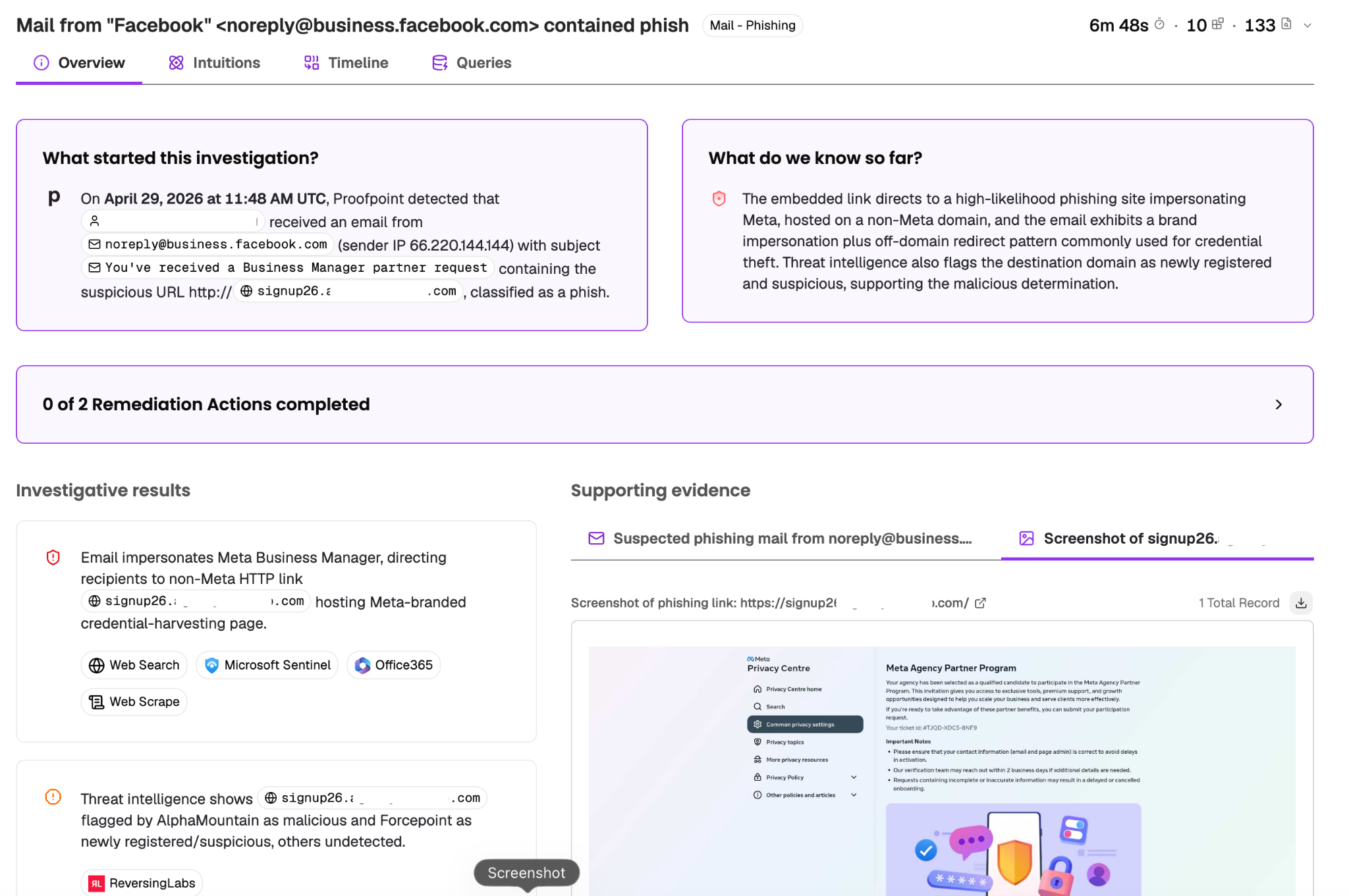
Prophet Security delivers an agentic AI SOC platform centered on Prophet AI, an AI analyst that investigates and responds to alerts while showing its reasoning. The platform ingests alerts, events, and custom detections, summarizes each alert, builds an investigation plan, and gathers evidence to reach a determination. It covers alerts across severities and incorporates organizational context such as playbooks and analyst feedback.
Key features include:
- Agentic AI SOC analyst: Prophet AI summarizes alerts, extracts artifacts, classifies them, and builds an investigation plan.
- Response across the incident lifecycle: The platform identifies true positives, prioritizes threats, and supports autonomous remediation and human-in-the-loop decision points.
- AI threat hunter: A natural-language interface and global search let analysts run threat hunts without writing complex queries.
- Detection advisor: The platform analyzes detection quality and coverage, flags noisy detections, and recommends tuning opportunities.
- Organizational context ingestion: Prophet ingests knowledge from playbooks, analyst feedback, and documentation, adapting investigations to the environment.
- Copilot for ad hoc questions: An interactive copilot lets analysts ask questions or build custom investigations.
Limitations (based on publicly available sources):
- Limited independent review base: As a newer entrant, Prophet has a small number of published third-party reviews.
- Coverage depends on integrations: Its effectiveness is tied to the breadth and quality of connected data sources.
- Pricing not publicly listed: The subscription model requires contacting the vendor.
4. Radiant Security

Radiant Security is an AI SOC platform that combines agentic AI triage, integrated response, and built-in log management. It dynamically builds and executes triage logic for each alert and escalates suspicious alerts to analysts. The platform provides visibility into AI reasoning, one-click response actions from a case view, and an integrated data lake with unlimited retention.
Key features include:
- Dynamic AI triage for every alert: Radiant’s AI builds triage logic for each alert rather than relying on fixed scenarios.
- Transparent AI reasoning: The platform exposes context and step-by-step reasoning behind each verdict.
- Integrated, one-click response: Case management generates response steps and lets analysts execute actions across alerts.
- Built-in log management: An integrated data lake stores, searches, and analyzes security logs with unlimited retention.
- Guardrails and policy controls: Teams shape AI behavior through guardrails, policies, and exclusions.
- Broad source coverage: The platform ingests alerts from SIEM, WAF, DLP, cloud, identity, endpoint, network, OT/IoT, email, and other sources.
Limitations (based on publicly available sources):
- Sparse third-party reviews: Independent peer reviews are limited.
- Broader deployment footprint: Adopting the platform can involve a wider rollout than a single-purpose triage tool.
- Pricing requires direct contact: Detailed pricing is not published publicly.

5. 7AI

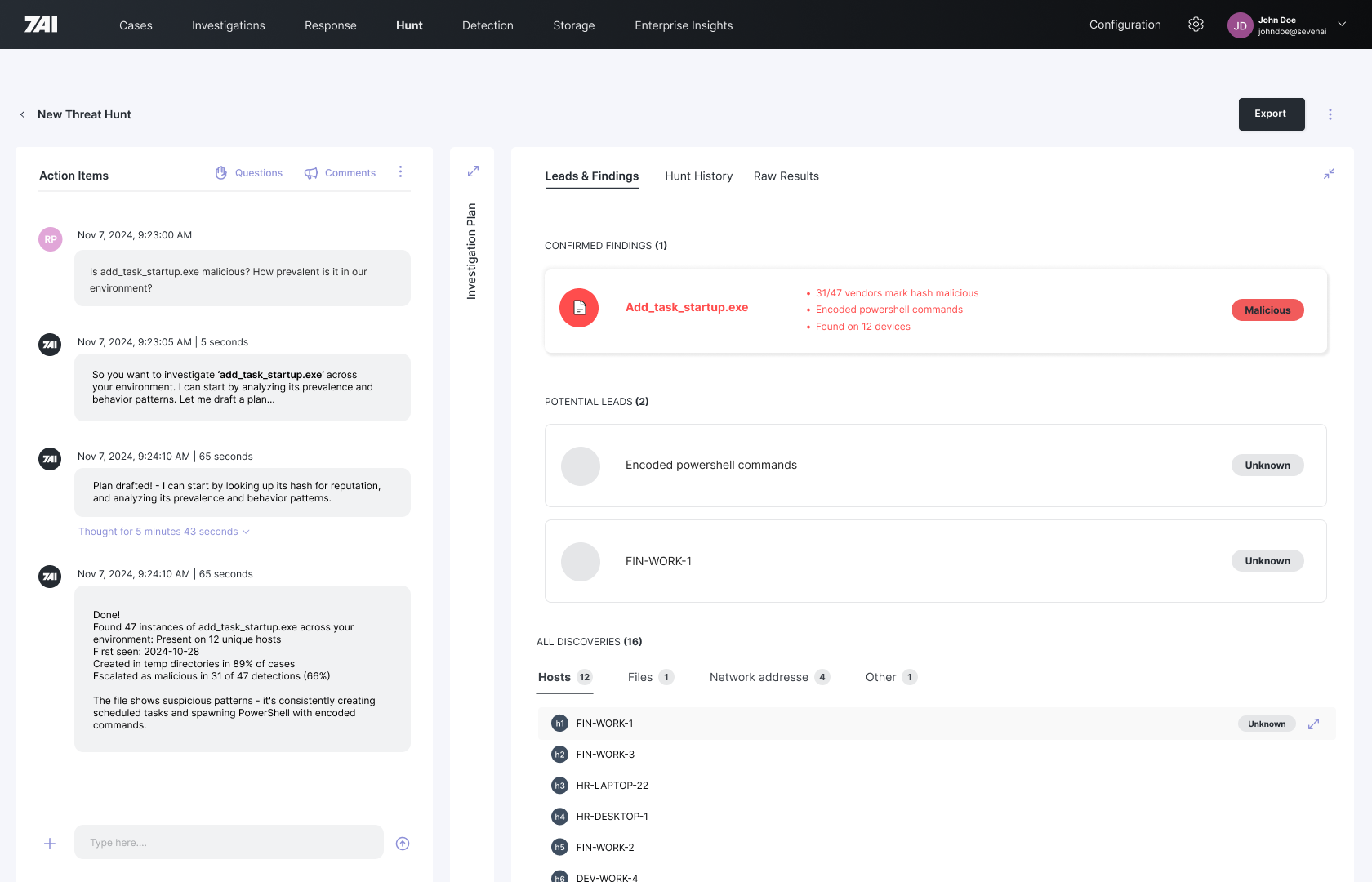
7AI offers an agentic security platform built around autonomous AI agents that investigate alerts, reach conclusions, and take action across cloud, endpoint, identity, network, and DLP environments. Founded by the creators of Cybereason, the platform deploys a library of purpose-built agents that swarm on an alert to enrich data, query the environment, and correlate findings before they reach an analyst.
Key features include:
- Purpose-built agent library: 7AI provides specialized agents for tasks such as endpoint file investigation, device correlation, login-activity analysis, and identity enrichment.
- Swarming autonomous investigations: Multiple agents work in parallel to enrich data, query systems, and correlate evidence, producing a documented conclusion.
- Intelligent detection and triage: The platform ingests alerts from multiple sources and surfaces actionable conclusions.
- Conclusion-driven response: Response actions are tied to investigation conclusions rather than predefined playbooks.
- Unified case management: Cases bring investigations, evidence, and collaboration together with an audit trail.
- Enterprise Insights context: The platform captures organizational context and applies it during investigations.
Limitations (based on publicly available sources):
- Early-stage track record: The product launched in 2025, so independent peer-review validation is limited.
- Vendor-assisted tuning model: The People-Led, AI-Driven approach pairs the platform with 7AI engineers to tune deployments.
- Pricing not publicly listed: Detailed pricing is not published.
AI-Powered Detection and SIEM Platforms
These detection, EDR/XDR, and SIEM platforms have added AI analysts or copilots to help triage and prioritize alerts. They reduce alert fatigue primarily within their ecosystems.
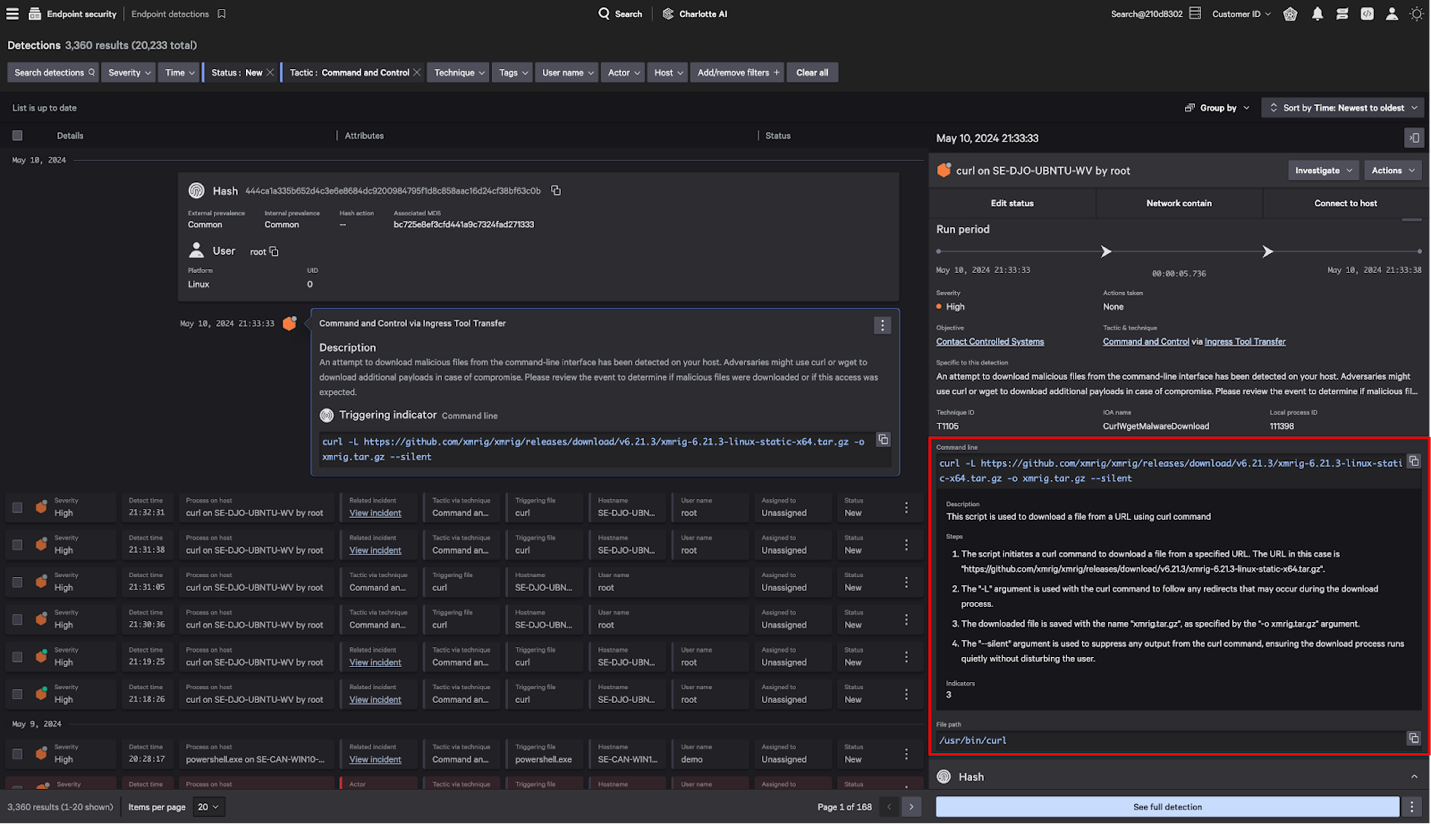
6. CrowdStrike Charlotte AI

Charlotte AI is CrowdStrike’s agentic AI layer for the Falcon platform. It triages detections, filters false positives, and surfaces high-priority issues using models trained on CrowdStrike analyst decisions and platform data. Charlotte AI works with Falcon’s detection and response modules and can build custom agents, conduct collaborative investigations, and orchestrate automated response. Its value is tied to the broader CrowdStrike ecosystem.
Key features include:
- AI detection triage: Charlotte AI classifies detections, filters false positives, and recommends next steps.
- Human-agent collaborative investigations: Analysts can guide AI reasoning in real time within a shared investigation canvas.
- AgentWorks no-code agent builder: Teams can build and manage custom security agents using natural language.
- Charlotte Agentic SOAR: An orchestration layer combines automation with agentic reasoning across agents.
- Governance and bounded autonomy: Charlotte AI operates with ISO 42001-certified AI governance and built-in controls.
- Agentic security workforce: Purpose-built agents automate SOC tasks such as detection triage and threat hunting.
Limitations (based on publicly available sources):
- Maturing agentic features: Some AI capabilities are still rolling out.
- Credit-based consumption: Charlotte AI uses credit-based pricing for agentic actions.
- Ecosystem dependency: Its value depends on adoption of the Falcon platform.
7. Microsoft Security Copilot

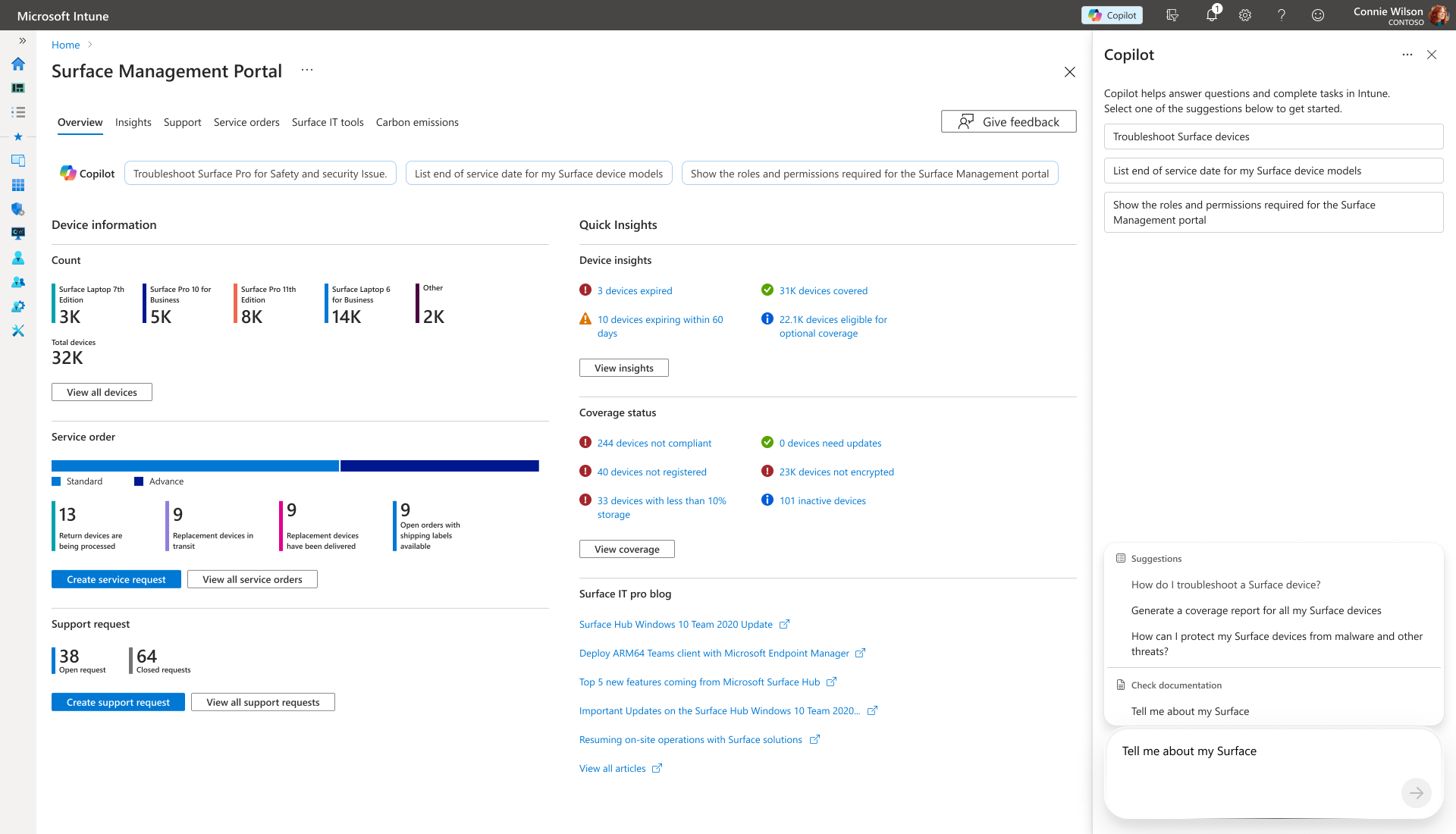
Microsoft Security Copilot brings generative and agentic AI into Microsoft’s security products, including Defender, Sentinel, Entra, Intune, and Purview. It provides agents for phishing triage, alert triage, and vulnerability remediation embedded directly in these tools. Analysts can summarize alerts, translate natural language into query scripts, and generate reports. The platform supports partner-built and custom agents and works across the SOC lifecycle.
Key features include:
- Embedded agents across Microsoft tools: Security Copilot agents run inside Defender, Entra, Intune, and Purview.
- Incident summarization and triage: The platform turns multi-signal alerts into concise summaries with response guidance.
- Natural-language scripting: Analysts can translate plain language into query scripts or analyze malware scripts.
- Extensible agent ecosystem: The platform supports partner-built and custom agents.
- Stakeholder reporting: Security Copilot can generate reports summarizing the environment and open issues.
- Cross-product data context: Agents draw on unified security data across identities, devices, data, clouds, and apps.
Limitations (as reported by users on PeerSpot):
- Consumption-based cost: Reviewers cite cost and the security compute unit model as concerns.
- Licensing complexity: Users report that pricing can be difficult to forecast.
- Reliance on prompt phrasing: Some reviewers report needing to rephrase prompts to get desired results.
- Best value inside the Microsoft ecosystem: The platform delivers the most value when organizations use Microsoft security tools.
8. SentinelOne Purple AI

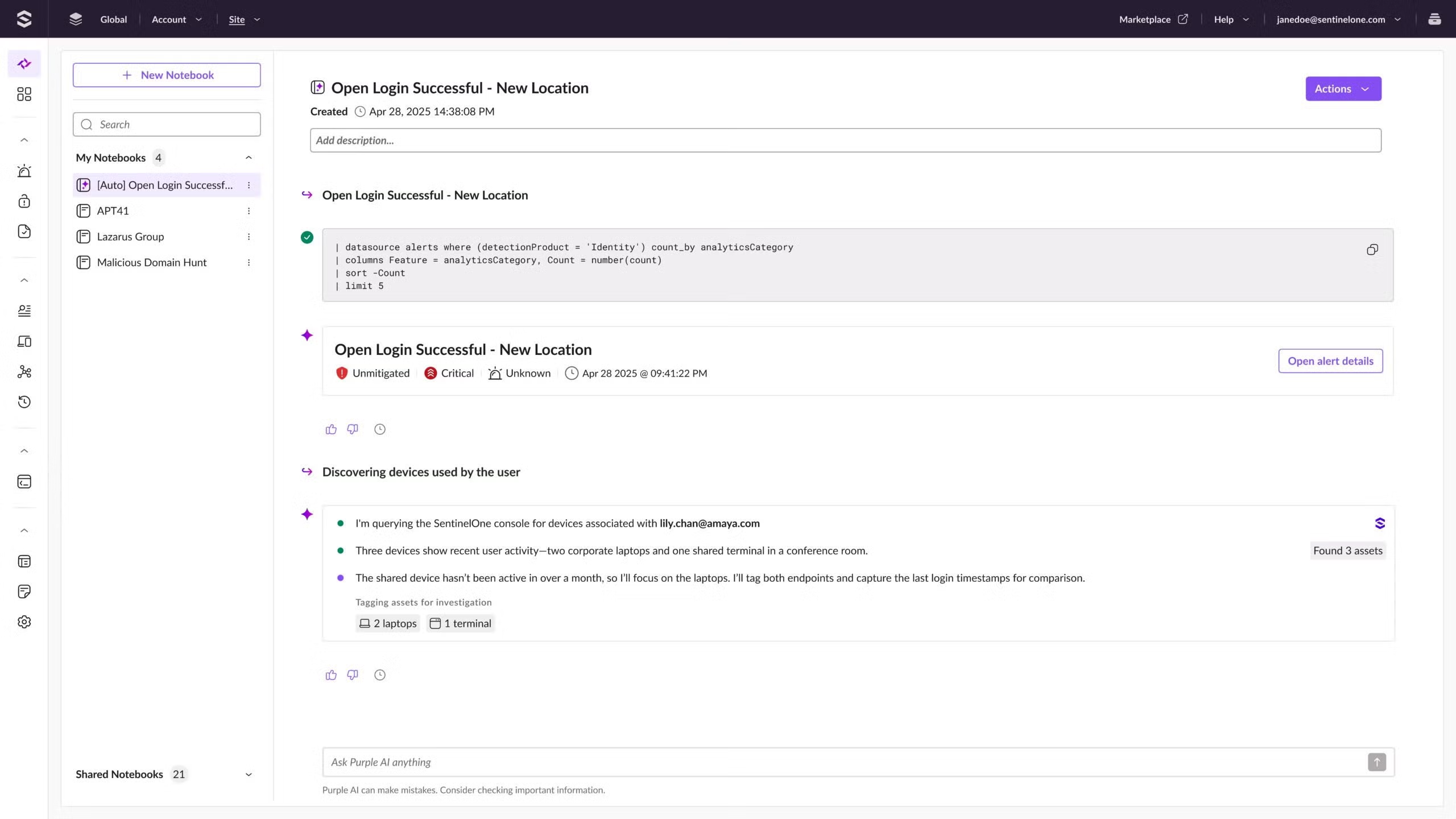
Purple AI is SentinelOne’s AI security analyst within the Singularity platform. It translates natural-language questions into threat-hunting queries, summarizes alerts and logs, and guides analysts through investigations. Its Auto-Investigation capability gathers cross-stack evidence, builds attack timelines, and produces a verdict that can trigger automated remediation. Purple AI analyzes SentinelOne and third-party data within Singularity and includes privacy controls.
Key features include:
- Natural-language threat hunting: Purple AI converts plain-language questions into structured queries across data in Singularity.
- Agentic Auto-Investigation: Purple AI runs autonomous investigations that gather evidence and construct attack timelines.
- Alert and log summarization: The platform summarizes logs and indicators and guides analysts with recommended next steps.
- Community Verdict expertise: Purple AI applies Community Verdict capabilities based on SentinelOne MDR expertise.
- Privacy and human-in-the-loop controls: The platform includes privacy safeguards and analyst oversight.
- Custom agents via MCP server: Teams can build custom AI agents grounded in Singularity data and workflows.
Limitations (as reported by users on PeerSpot):
- Console complexity for new users: The Singularity dashboard can become complex for newer users.
- Platform dependency: Purple AI operates within the Singularity platform.
- Cost considerations: Some users describe the solution as expensive, with advanced capabilities tied to higher tiers.
9. Vectra AI

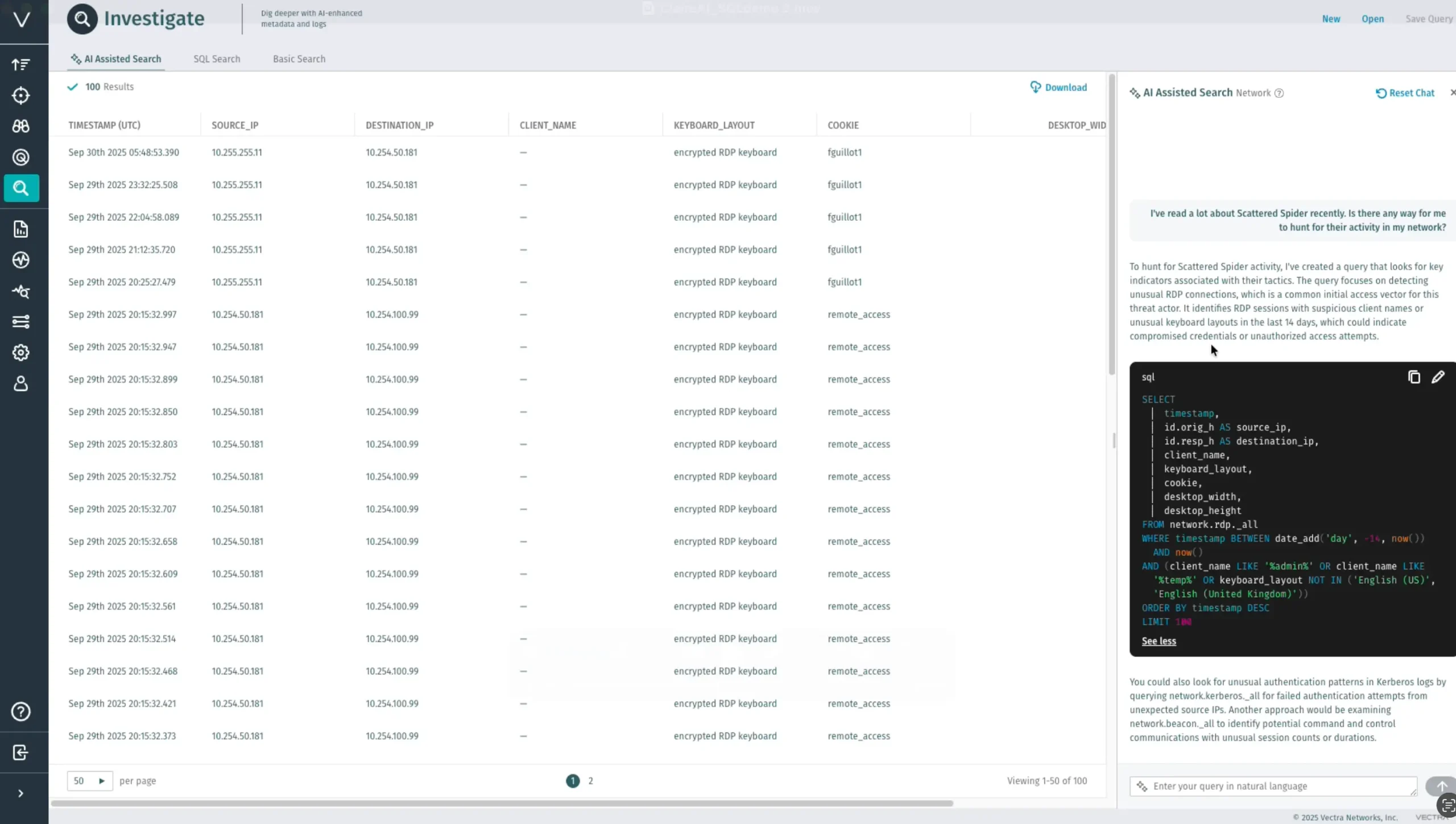
Vectra AI is an AI-driven detection and response platform spanning network, identity, and cloud. It uses behavioral detection to surface attacker activity that signature-based tools may miss. Its Attack Signal Intelligence prioritizes attacks in real time, and AI assistants triage and correlate threats across domains. The platform distinguishes attacker behavior from benign anomalies and connects related detections into an attack narrative.
Key features include:
- Attack Signal Intelligence: Vectra identifies attacker behaviors across network, identity, and cloud, including encrypted traffic.
- AI triage at the source: The platform distinguishes true threats from benign activity before alerts reach analysts.
- AI stitching and prioritization: AI stitching correlates activity across changing IPs and cloud roles, while prioritization ranks urgent threats.
- Investigation tooling: Prebuilt queries support forensics, with support for custom and SQL queries.
- Integrated and managed response: The platform offers native, integrated, and managed response options.
- Hybrid attack-surface coverage: Vectra connects detections across data center, campus, remote, cloud, identity, and SaaS environments.
Limitations (as reported by users on PeerSpot):
- Pricing and licensing complexity: Reviewers describe pricing and licensing as complex.
- Tuning and false positives: Some users report needing to invest in tuning.
- Limited reporting customization: Reviewers cite limited reporting customization.
- Often used alongside a SIEM: Some users continue to rely on a SIEM for detailed logging.
AI-Driven Security Automation (SOAR) Platforms
These platforms automate and orchestrate workflows around alerts, increasingly with agentic AI. They reduce alert fatigue by deduplicating, enriching, and acting on alerts at machine speed.
10. Torq
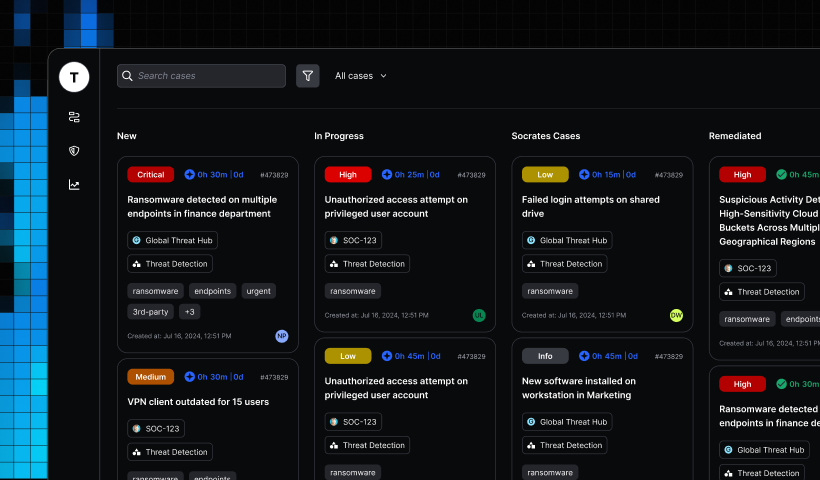
Torq is an AI-driven security automation platform whose HyperSOC product manages the threat lifecycle from triage through response. It ingests and normalizes telemetry, deduplicates and correlates events, and uses agentic reasoning to deliver verdicts. Its multi-agent system, coordinated by Socrates, opens cases, gathers evidence, assembles timelines, and summarizes findings. Torq combines agentic and deterministic workflows with prebuilt integrations and targets enterprise SOCs seeking alternatives to traditional SOAR.
Key features include:
- Agentic triage with deduplication: Torq ingests telemetry, correlates and deduplicates events, and applies agentic analysis to deliver verdicts.
- HyperAgents multi-agent system: Autonomous AI agents gather evidence, build timelines, and summarize findings.
- Socrates orchestration: Socrates coordinates agents, manages cases, and supports natural-language interaction.
- Agentic and deterministic workflows: Teams can use autonomous reasoning or fixed logic.
- Native case management: Built-in case management maintains evidence, timelines, and summaries.
- Extensive integrations: The platform includes around 300 prebuilt integrations and thousands of steps.
Limitations (as reported by users on PeerSpot):
- Interface and large inputs: Reviewers note interface issues and difficulty processing very large inputs.
- Multi-tenancy gaps: Some users mention the inability to create multiple tenants.
- Tooling constraints: Reviewers report limitations with certain tools and use cases.
- Documentation depth: Users point to a need for more documentation.
11. Swimlane

Swimlane Turbine is an agentic AI automation platform for SOC, vulnerability management, and compliance. Built on a low-code engine, it automates alert triage, enrichment, and case management at scale. Hero AI capabilities add incident-response agents and a private AI companion, while Turbine Canvas provides a low-code builder for playbooks and agents. The platform includes case management, dashboards, and reporting and is used by enterprises and MSSPs to reduce manual SOC work.
Key features include:
- Hero AI agents: Incident-response AI agents and a private AI companion assist with triage.
- Turbine Canvas builder: A low-code builder lets teams design automations and insert custom scripts.
- AI-driven case management: A customizable case-management application manages incidents end to end.
- High-scale automation engine: The platform supports large-scale ingestion and throughput.
- Broad integration marketplace: An API-first architecture and marketplace of connectors integrate with tools that expose APIs.
- Dashboards and reporting: Customizable dashboards and AI-augmented reporting provide visibility into SOC metrics.
Limitations (as reported by users on G2):
- Interface and navigation: Some reviewers describe the interface as dated.
- Engineering-heavy setup: Initial deployment and playbook design can be resource-intensive.
- Stability and maintenance: Reviewers mention stability issues and connectors requiring updates.
- Automation risk: Poorly tuned playbooks can escalate false positives into automated actions.

12. Tines

Tines is a workflow platform used by security and IT teams to automate and orchestrate work, including SOC alert triage and response. It connects to tools with APIs and lets teams build workflows through a drag-and-drop interface with little or no coding. Tines supports deterministic logic, human-in-the-loop copilots, and agentic AI. The platform includes case management, a workflow builder, and an AI copilot, and keeps automation and data within its infrastructure.
Key features include:
- Flexible workflow builder: A drag-and-drop builder lets teams design workflows and connect tools with APIs.
- Spectrum of automation modes: Tines supports deterministic workflows, human-in-the-loop copilots, and agentic AI.
- Case management: Built-in case management tracks incidents and supports enrichment and collaboration.
- Universal AI copilot (Workbench): An AI copilot lets analysts take action and query data conversationally.
- Vendor-neutral integration layer: Tines connects across the stack, including LLMs, MCP connections, and internal tools.
- Security-first design: The platform keeps automation and data within its infrastructure and applies governance and monitoring.
Limitations (as reported by users on G2):
- Learning curve: Building complex automations involves a learning curve.
- Feature gaps at onboarding: Some users mention missing features during onboarding.
- Basic reporting and isolated AI: Reviewers describe reporting as basic and AI capabilities as still maturing.
- Pricing: Some users report higher pricing and note that debugging larger workflows can be cumbersome.

Related content: See our roundup of the top AI SOC platforms.
Conclusion
As security environments continue to expand and threat activity accelerates, reducing alert fatigue has become a critical objective for SOC teams. AI SOC software helps address this challenge by automating investigation workflows, improving alert prioritization, correlating activity across security tools, and providing analysts with actionable context. Organizations evaluating these platforms should focus on the depth of automation, transparency of AI-driven decisions, integration capabilities, and long-term operational impact to determine which solution best supports their security operations strategy.