
7AI capabilities, limitations, and 9 alternatives worth evaluating
In this article

7AI is one of the most heavily funded entrants in the agentic security category, and one of the most watched. This guide covers what the platform actually does, where buyers should push back during evaluation, and how it compares to nine alternatives across the AI SOC, SOAR, and XDR markets.
What is 7AI?
7AI is an agentic security platform that runs security operations work with swarms of specialized AI agents. Founded in 2024 by Cybereason co-founders Lior Div and Yonatan Striem-Amit, the Boston-based company launched from stealth in February 2025 and raised a $130 million Series A led by Index Ventures in December 2025, bringing total funding to $166 million.
The core idea behind the platform is a split between what the company calls "non-human work" and "Human Work." Triage, enrichment, telemetry correlation, and known-threat searches are treated as machine-scale problems that agents should own outright. Complex investigation, hunting, and judgment calls stay with people. 7AI positions itself against both traditional SOAR, which runs pre-written playbooks and hands anything novel back to an analyst, and against copilot-style assistants that speed up a human rather than replacing the task.
Architecturally, 7AI is one platform covering four stages of the security operations lifecycle. Detection connects and tunes the existing detection stack. Investigations take every alert to an explainable determination. Response turns those determinations into recorded actions. Threat hunting goes looking for what never tripped a rule. Three context layers sit underneath all of it. Skills encode how a team investigates, Enterprise Insights holds institutional knowledge about the environment, and a Federated SIEM makes security data queryable across sources.
Teams can run the platform themselves with dedicated AI Security Engineers, hand operations to 7AI through its PLAID ELITE managed service, or build their own security offering on top of it. PLAID stands for People-Led, AI-Driven, which is the company's shorthand for keeping humans on the loop while agents do the volume work.
This is part of a series of articles about SOC as a service
Core capabilities of 7AI
Intelligent alert processing
Every alert 7AI receives moves through a five-stage pipeline before a human ever sees it. Alerts arrive from whatever tools a team runs, and the platform categorizes them by domain, groups related signals together, triages each one, and reaches a determination.
Categorization sorts alerts into buckets such as identity, endpoint, cloud, email, threat intel, and insider threat, then dispatches the agents suited to that domain. Grouping is what keeps volume manageable. Rather than treating 867 identity alerts as 867 separate problems, the platform clusters them into recognizable patterns like impossible travel or password spray.
Determinations come back in six flavors rather than a simple binary. An alert can be marked malicious, suspicious, recommended for review, acceptable risk, mitigated, or benign. In one customer environment 7AI publishes, a week produced 6,119 alerts, of which 96% were deflected before reaching a person and 193 were escalated.
The design goal is coverage. 7AI states that it investigates every alert to a conclusion rather than sampling, which matters for teams that currently drop low-severity alerts because there is no capacity to look at them.
AI-powered investigations
A 7AI investigation is the end-to-end work an agent swarm performs on a single alert. The agents fetch source data, enrich it with the customer's own context, run whatever tools an analyst would run, and reach a determination with the evidence attached. Investigations typically conclude in minutes.
What sets the investigation experience apart is how much of the reasoning is exposed. Each investigation opens with the verdict, the one-line reason behind it, and evidence broken out by artifact type. Analysts who want to check the work can open any step and see the agent's mission, the tools it ran, the exact request and response, and the conclusion it drew. 7AI calls this explainable by design, and it is a direct answer to the black-box objection that follows most AI security products.
Behind the verdict sits an artifact graph connecting emails, domains, files, hashes, and users the way the attack actually links them. Analysts can pivot from any node to its raw data and see how common that artifact is across the environment. Each investigation also ships with a copilot grounded in that specific case, so an analyst can ask why something escalated or who else was affected and get an answer drawn from the evidence in hand rather than the open web.
Unified incident and case management
Every alert that reaches a verdict becomes a case. Cases live on a single board showing open, in progress, and closed status alongside priority, verdict, and owner, which closes the gap where work usually falls apart between an investigation finishing and a resolution happening.
Related alerts get tied together automatically, so the case reflects the attack story rather than a stack of isolated events. The platform also auto-closes cases when the investigation and any triggered response resolve the issue without human involvement.
Automated response and remediation
7AI does not stop at a verdict. For every confirmed threat, it lays out the specific containment actions to take, things like revoking a session, resetting a password, or isolating a host, and runs them against tools the organization already owns across endpoint, identity, email, and cloud.
Approval gates keep a person in control of what executes and when, and every action lands in an audit log tied to the artifact and the reason behind it. Teams that want more automation can codify a response into a workflow triggered the moment an investigation completes or a case changes state. Workflows are built in a visual designer with no code required, including conditional branching through If/Else, Switch, and For Each loops, plus versioning and full execution history.
Runbooks round this out by putting documented procedures for ransomware, phishing, account compromise, and cloud anomalies inside the platform rather than in a wiki nobody opens. The practical benefit is consistency. A new analyst on call inherits the team's best response on day one.
Proactive threat hunting
7AI hunts two ways. Ad hoc hunts start from plain language. An analyst describes a technique, a CVE, or a hunch, and the platform turns that into a structured hunt plan, runs every step across connected data sources, and returns entities, findings, and a confidence-rated verdict. No query language is required, which opens hunting to analysts who would otherwise be blocked by KQL or SPL.
The second mode runs off threat intelligence. Connect the feeds a team already trusts, and 7AI hunts every new report as it lands, matching actors, techniques, and indicators against the environment. Each report comes back marked malicious, suspicious, benign, or no hits, with a hit count for every indicator that was seen. That turns a stack of unread intel reports into a short list of confirmed exposure.
Hunts are saved with their plan, findings, and verdict, so they can be re-run, shared, or adapted. Over time the hunt library becomes a reusable asset, and anything a hunt finds can flow straight into an investigation and a response on the same platform.
Enterprise context and knowledge integration
The weakest point of most AI investigation tools is that they treat every domain, user, and file as a stranger. 7AI addresses this with two layers.
Enterprise Insights are short, structured facts about artifacts in a specific environment. Who the executives are and that they are standing phishing targets. Which file-sharing domains are sanctioned and which are banned. What a given host or service is for. Agents pull the relevant insights on every investigation, and each insight tracks its provenance and how many investigations it has shaped, so teams can see which context is earning its keep. 7AI also proposes insights on its own when it keeps seeing the same artifact, surfacing the determination history and offering to capture it in one click. An insight can carry a simple rule as well, such as always treating a specific unwanted file as suspicious.
Skills work at a different level. Where insights describe the environment, skills describe the method. A skill is a plain markdown document explaining a strategy the way you would brief a new analyst, covering the review sequence, what to check, and when to escalate, with references and checklists attached. Each skill carries relevance rules scoping it to a module, alert type, or source connector so it fires only where it belongs. Some skills are written by the team and some are generated by 7AI from the environment, and any of them can be toggled on, off, or held as a draft.
The 7AI Federated SIEM is the third context layer, making security data searchable and correlated across sources as part of the platform. It is currently in design-partner release rather than general availability.
Key 7AI limitations
7AI is a capable platform, and the caveats below are mostly the caveats of a fast-moving young company in a category where the evaluation bar should be high. Buyers should pressure-test each one during a proof of concept.
Short production track record. The platform launched from stealth in February 2025. That is a short history for a system making autonomous decisions about security incidents, and third-party review coverage on Gartner Peer Insights and G2 remains thin compared to established vendors. Most of the available performance data comes from the vendor.
Pricing is not published. 7AI uses a sales-led, channel-first model, so prospective customers have to engage directly for a quote. There is a structural question worth raising here. Platforms built primarily on LLM inference carry per-call costs on every investigation, which compound quickly in high-volume environments. Ask directly how alert volume affects total cost, and what happens to that number if the alert pipeline doubles.
LLM reasoning without a forensic layer. 7AI's investigation engine reasons over logs, telemetry, and tool output. That works well for correlation and summarization. It is less suited to questions that require deterministic answers, such as whether a specific binary belongs to a known threat family, what a packed sample does when it runs, or whether an endpoint was genuinely remediated. Without binary-level analysis, memory inspection, or code-origin validation, probabilistic reasoning can produce confident conclusions that are wrong. In a platform investigating thousands of alerts a day, a small error rate translates into a meaningful number of missed threats or bad escalations.
Effectiveness depends on the stack underneath it. Investigation quality is bounded by the telemetry and detection logic available. Organizations with siloed data, poorly tuned rules, or coverage gaps will not get full value, and no amount of agent reasoning surfaces a threat that was never detected in the first place.
Some capabilities are still maturing. The Federated SIEM is in design-partner release, and several context features are recent additions. Teams evaluating 7AI as a consolidation play should confirm which components are generally available today rather than on the roadmap.
Human oversight remains part of the design. Response actions run with humans on the loop and approval gates by default. This is the right posture, and it is worth naming clearly, because it means 7AI reduces analyst workload rather than removing the need for analyst judgment on consequential actions.
Notable 7AI alternatives
How we selected these platforms. We grouped alternatives into the three categories buyers usually compare 7AI against. AI SOC platforms compete on autonomous triage and investigation. SOAR platforms compete on orchestration and response automation. XDR platforms compete on detection, correlation, and native response inside a unified telemetry stack. Selection weighted alert coverage, investigation depth, integration breadth, and the transparency of the decisions each platform makes.
Alternatives at a glance
| Category | Solution | Best for | Key strengths | Things to consider |
|---|---|---|---|---|
| AI SOC | 1. Intezer | Forensic-depth triage of every alert | Forensic tooling plus AI, sub-minute triage, endpoint-based pricing | Requires mature telemetry, focused on 1,000+ employee orgs |
| AI SOC | 2. Dropzone AI | Autonomous Tier 1 alert investigation | Pre-trained agents, 90+ integrations, fast deployment | Per-investigation pricing, young company |
| AI SOC | 3. UnderDefense | Every alert verdicted on an existing stack | AI verdicts with evidence, 24/7 senior analysts, included IR retainer | Coverage depends on the tools you already own |
| SOAR | 4. Cortex XSOAR | Large enterprises with mature automation teams | 1,100+ integrations, War Room case management, SOAR maturity | Steep learning curve, cost and licensing complexity |
| SOAR | 5. Splunk SOAR | Splunk-centric SOCs building custom playbooks | Visual playbook editor, deep Splunk integration, Python extensibility | Expensive, dense UI, users cite thin agentic AI capability |
| SOAR | 6. Tines | Teams building custom security and IT workflows | Flexible builder, vendor-agnostic integrations, AI Workbench | You build the workflows, learning curve, premium cost |
| XDR | 7. CrowdStrike Falcon XDR | Falcon customers wanting unified telemetry | Strong endpoint detection, single lightweight agent, one console | Best value inside the Falcon ecosystem, module-based cost |
| XDR | 8. Microsoft Defender XDR | Microsoft-first security and IT teams | Cross-domain correlation, KQL hunting, attack disruption | Value tied to Microsoft licensing, slow automated remediation reported |
| XDR | 9. Cortex XDR | Teams that want causality-chain investigation | Root-cause analysis, behavioral analytics, strong correlation | Steep learning curve, complexity for smaller teams |
AI SOC platforms
1. Intezer

Best for: SOC teams that want forensic-depth triage of every alert.
Strengths: Combines forensic tooling with AI for sub-minute triage.
Things to consider: Requires mature telemetry, and is focused on organizations with 1,000+ employees.
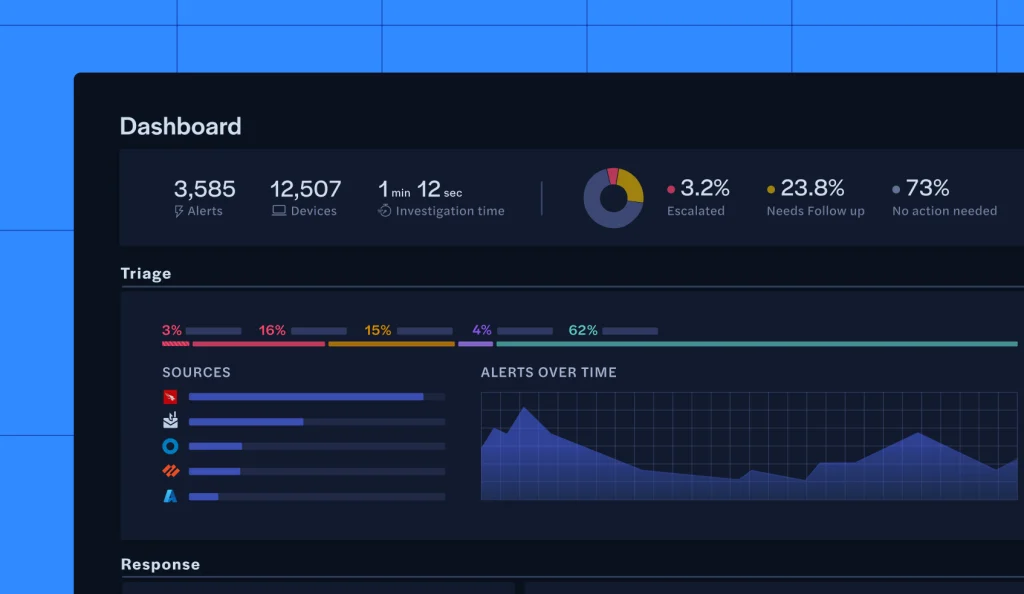
Intezer is an AI SOC platform that automatically triages and investigates alerts across endpoint, identity, phishing, network, and cloud sources. Where most AI SOC platforms reason over logs, Intezer pairs agentic reasoning with forensic techniques including endpoint forensics, memory analysis, reverse engineering, network artifact analysis, and sandboxing. That combination is what allows it to confirm what happened on an endpoint rather than infer it from surrounding telemetry.
The platform investigates every alert, including low-severity ones, escalating roughly 2% to analysts and auto-resolving false positives. Pricing is tied to the number of endpoints rather than alert volume, which removes the incentive to filter what gets ingested.
Key features include:
- Multi-source alert triage. Ingests and investigates alerts from endpoint, identity (Entra ID, Okta), reported phishing (Office 365, Proofpoint), network, SIEM, and cloud tools such as Wiz.
- Forensic investigation toolset. Collects and analyzes files, logs, command lines, and memory images, using reverse engineering, network artifact forensics, and sandboxing to reach verdicts.
- Automated response and remediation. Proposes and executes steps such as disabling users or isolating devices through API or webhook with human approval, and routes incidents to SOAR or ticketing tools.
- Human-in-the-loop review. Shows transparent triage logic, lets analysts override escalations, and learns from analyst feedback and in-house QA.
- Detection feedback loop. Feeds investigation outcomes back into detection engineering to identify noisy or ineffective alerts for tuning.
- Endpoint-based pricing. Ties cost to endpoints rather than alert volume, so every alert can be investigated without volume fees.
Limitations
- Requires mature telemetry. Investigation quality depends on the health of existing EDR and SIEM tooling.
- MITRE ATT&CK coverage has a realistic ceiling. Intezer benchmarks 60 to 70% as top-tier and flags anything higher as likely inflated.
- Enterprise-focused, with a minimum of 1,000 employees.
Intezer is highly rated on Gartner Peer Insights. See what users have to say.
Experience Intezer in action with a custom demo.
Source: Intezer
2. Dropzone AI

Best for: teams that want autonomous Tier 1 alert investigation.
Strengths: Pre-trained agents, 90+ integrations, and fast deployment.
Things to consider: Per-investigation pricing, and a young, growing company.
Dropzone AI runs an AI SOC Analyst that investigates alerts across the full tool stack without playbooks or code. It also ships an AI Threat Hunter and an AI Threat Intel Analyst that run hypothesis-driven hunts and convert new advisories into hunt packs. Agents are pre-trained on investigation techniques for common alert types and coachable in natural language, and the platform queries connected tools through APIs without requiring log normalization.
Key features include:
- AI SOC Analyst. Investigates alerts around the clock and produces reports with a severity conclusion, executive summary, and evidence locker.
- AI Threat Hunter and Threat Intel Analyst. Runs federated hunts across SIEM, EDR, and cloud, and builds hunt packs from new advisories.
- Natural-language coaching. Analysts direct agents in plain English with full attribution on each directive.
- Glass-box transparency. Displays every step, tool queried, and piece of reasoning behind a conclusion.
- 90+ integrations across SIEM, EDR, cloud, identity, and email, with bundled threat intelligence subscriptions.
- Automated response. Fires containment actions such as blocking IPs and disabling accounts when a threat is confirmed.
Limitations reported by users on Gartner Peer Insights
- Per-investigation pricing can become costly and, per reviewers, may push teams to limit which alerts they ingest.
- Young company still expanding features and integrations, with some capabilities on the roadmap.
- Upfront tuning is needed, and investigation summaries are not regenerated after a conclusion changes.
Learn more in our detailed guide to Dropzone AI.
Source: Dropzone AI
3. UnderDefense
Best for: teams that want every alert verdicted on top of their existing security stack.
Strengths: AI triage plus 24/7 senior analysts and an included IR retainer.
Things to consider: Runs on the tools you already own, so coverage depends on that stack.
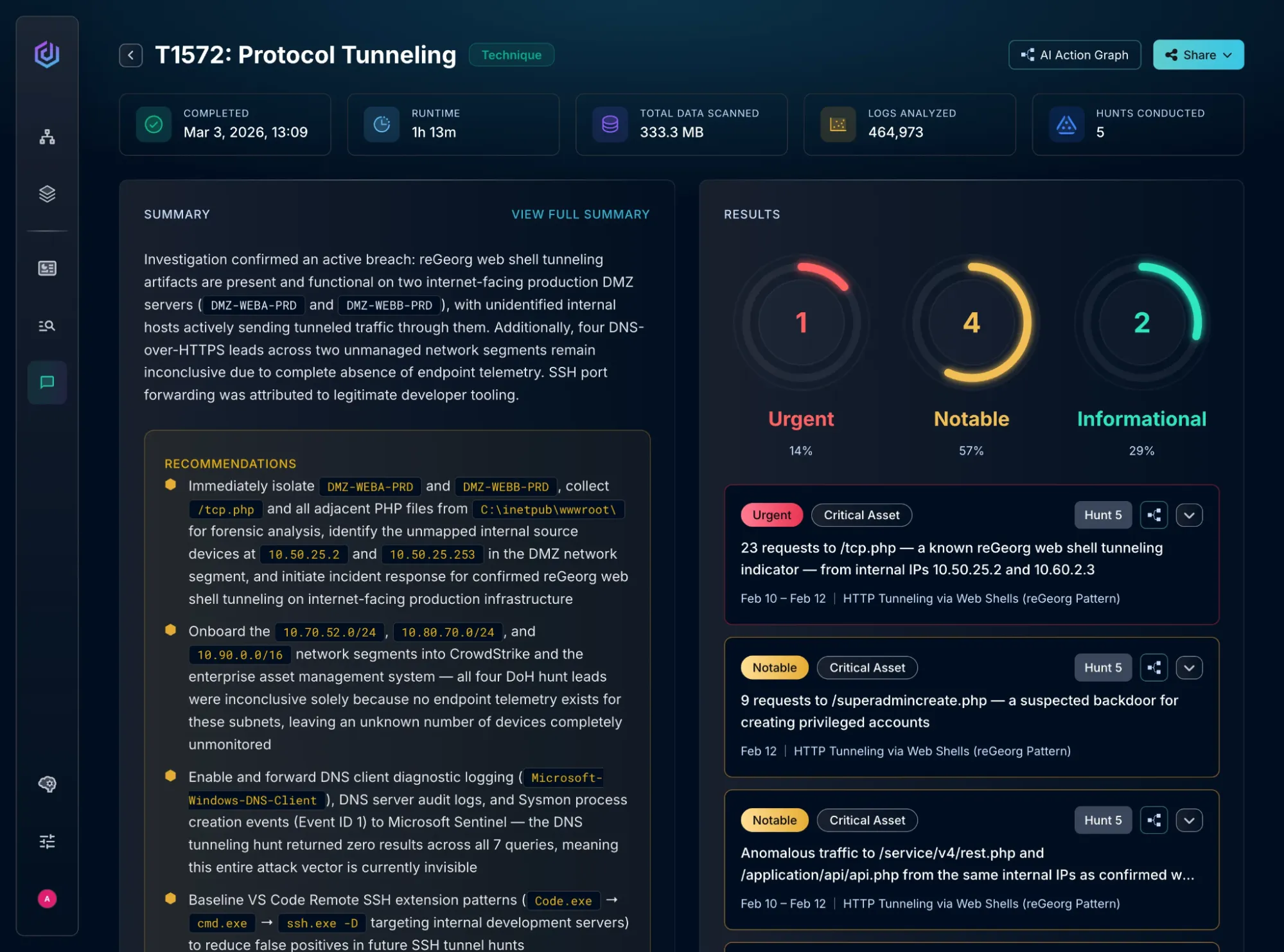
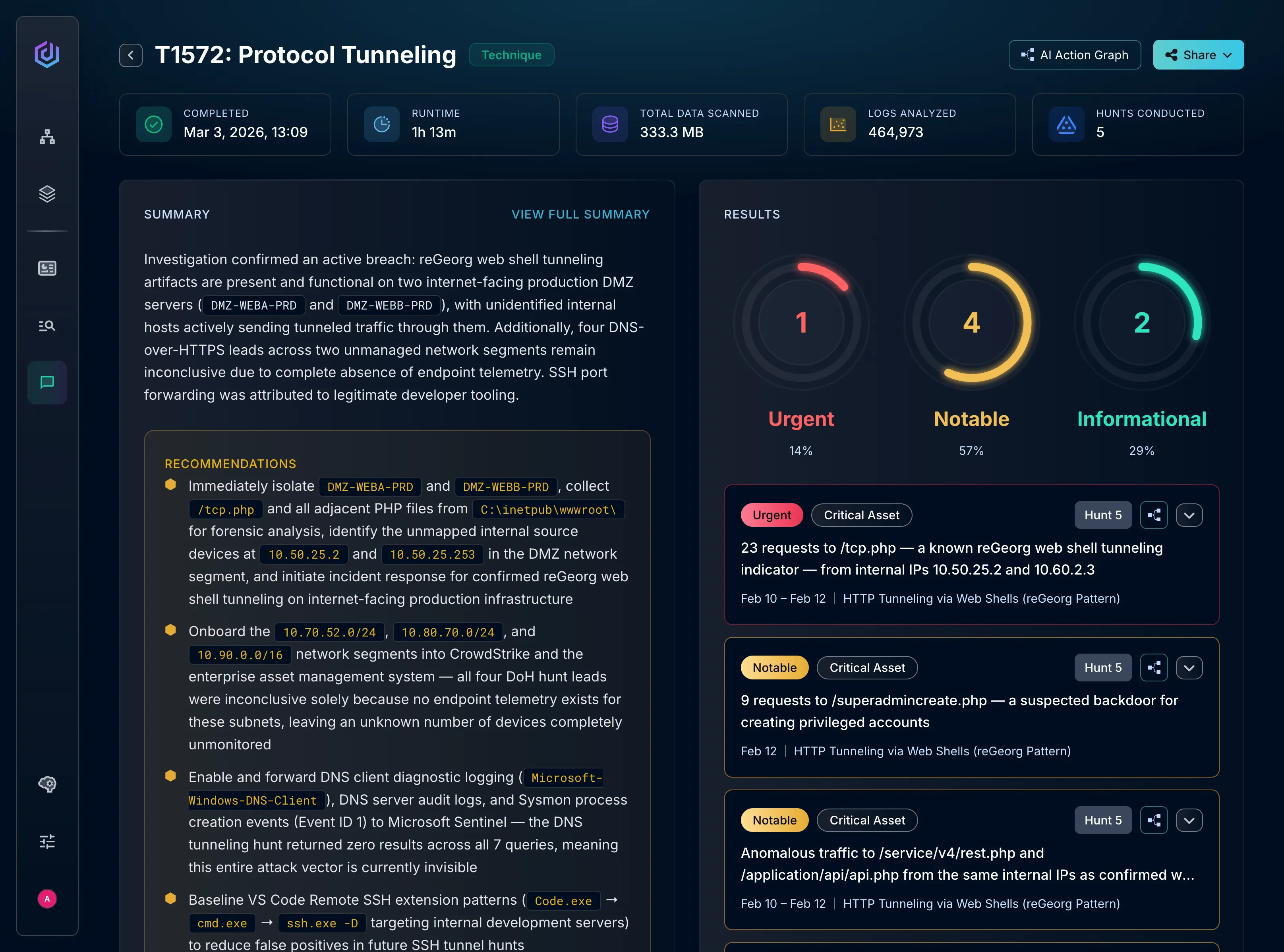
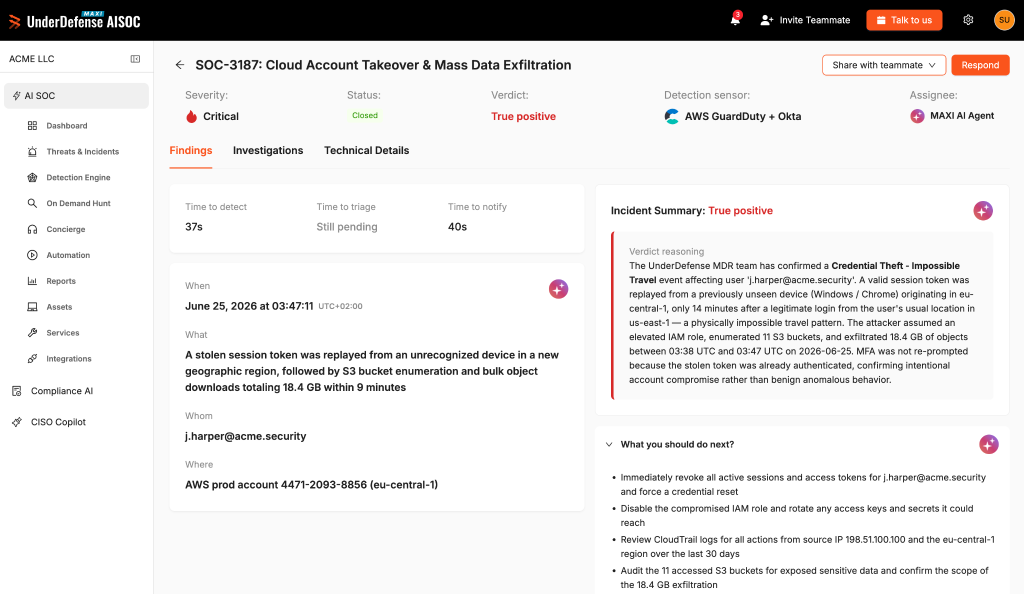
UnderDefense Agentic AI SOC layers AI verdicts on top of existing security investments rather than replacing them. Every alert gets a conclusion with evidence attached, and when context is missing, the AI asks the customer's team directly rather than escalating an ambiguous case. Senior analysts are reachable over Slack, Teams, or email for hands-on containment.
Key features include:
- No replacement project. The AI operates on top of tools already deployed and tested.
- A verdict on every alert, with evidence, so teams decide what to act on rather than what to look at.
- Fewer dead-end escalations, because the AI gathers missing context automatically.
- CISO Copilot answers plain-language questions about security posture without building a dashboard.
- Included IR retainer with a dedicated team of senior analysts, and no separate contract to negotiate mid-incident.
SOAR platforms
4. Palo Alto Networks Cortex XSOAR

Best for: large enterprises with mature automation teams.
Strengths: Extensive integration library, War Room case management, and years of SOAR maturity.
Things to consider: Steep learning curve and complex licensing.
Cortex XSOAR is one of the most established SOAR platforms, built around playbook-driven orchestration across a large integration ecosystem. Its War Room gives analysts a real-time collaborative investigation space alongside case management, and playbooks automate repetitive response steps across the security stack. Palo Alto has since layered Cortex AgentiX on top as its agentic evolution of XSOAR.
The tradeoff against 7AI is the fundamental SOAR one. XSOAR does exactly what its playbooks say, which makes it deterministic and auditable, and also means novel alerts with no matching playbook go back to a human.
Limitations reported by users on G2 and PeerSpot
- Setup and playbook complexity. Reviewers describe a steep learning curve and note that building playbooks often requires coding, which is difficult for junior analysts.
- Reporting depth. Users want more customization in reporting.
- Integration gaps outside the mainstream. Pre-built integrations cover market-leading products well, but regional or niche vendors may need custom work.
- Cost and licensing. Reviewers report the platform can be expensive and its licensing complex.
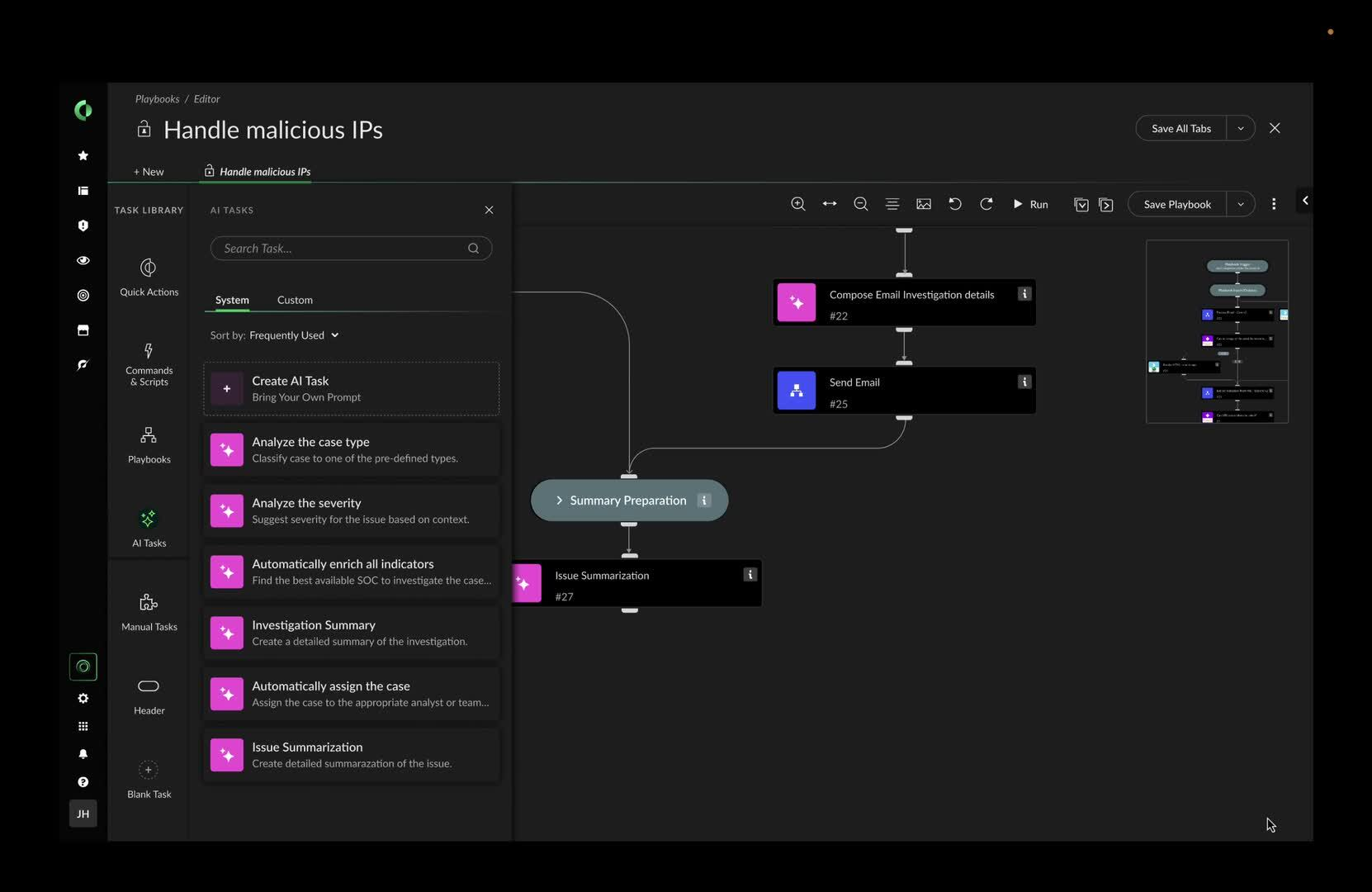
Source: Palo Alto Networks
5. Splunk SOAR
Best for: Splunk-centric SOCs that want to build custom playbooks.
Strengths: Visual playbook editor, deep Splunk Enterprise Security integration, and Python extensibility.
Things to consider: Expensive, dense interface, and thin agentic AI capability.
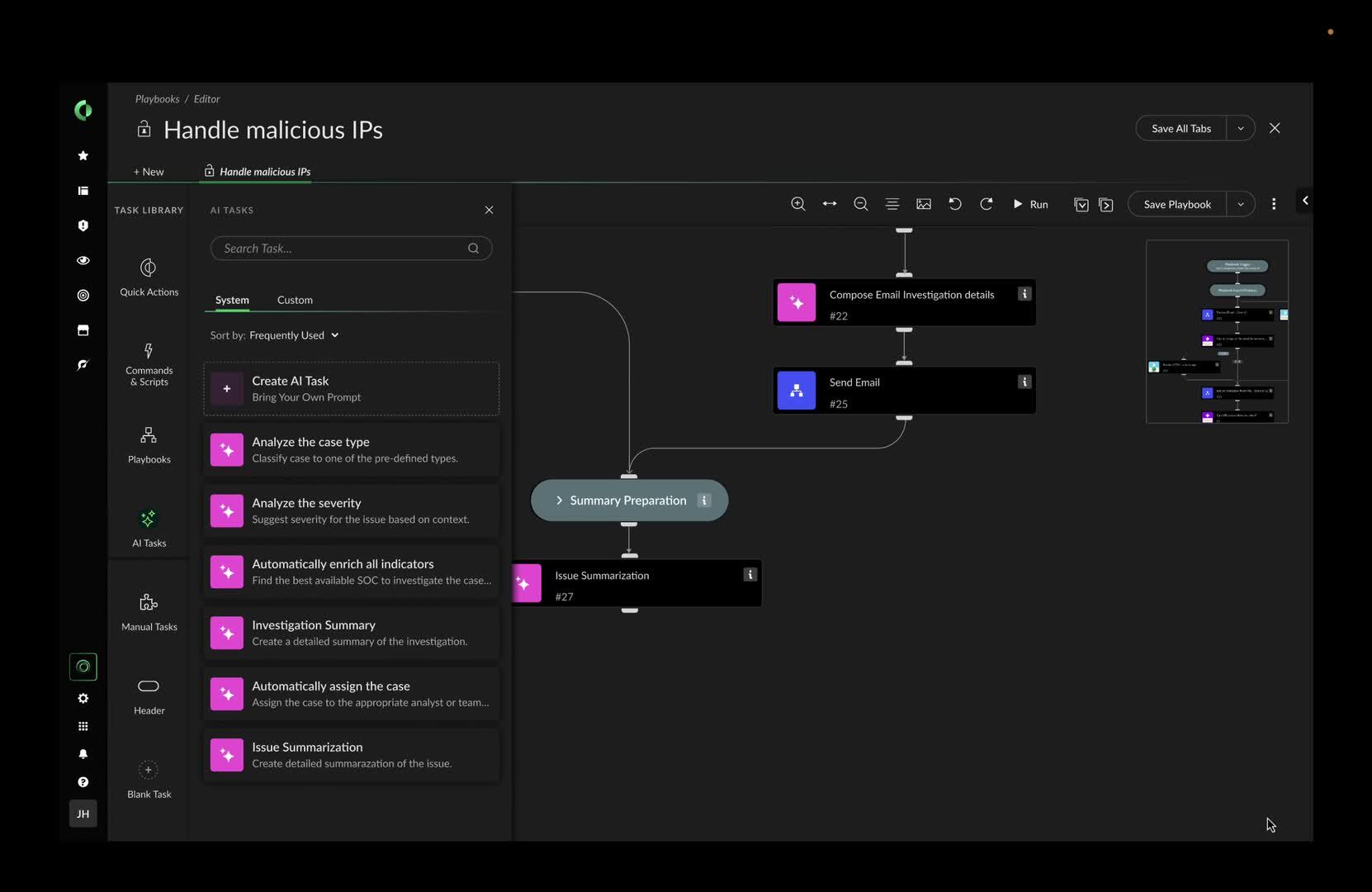
Splunk SOAR, which came to Splunk through the Phantom acquisition, automates repetitive response tasks through playbooks that run directly inside the Splunk Enterprise Security analyst queue. Its visual playbook editor is approachable for newer analysts while remaining scriptable in Python for power users, and it supports event and case management, integrated threat intelligence, and dashboards tracking mean time to detect and respond.
For teams already invested in Splunk, the appeal is obvious. For teams evaluating it against 7AI, the question is whether playbook coverage can keep pace with alert diversity.
Limitations reported by users on G2, Gartner Peer Insights, and TrustRadius
- High cost, which reviewers say puts it out of reach for smaller organizations and projects.
- Dense interface with a lot of information that is hard for beginners to process.
- Deployment is not plug and play. Reviewers describe substantial configuration to get API keys and connector authentication right across an existing stack.
- Limited agentic AI. Gartner reviewers specifically flag the absence of agentic capabilities relative to newer entrants.
- Debugging visibility. At MSSP scale, one reviewer noted log traces are not always intuitive when a playbook step fails.
6. Tines

Best for: teams building custom security and IT workflows.
Strengths: Flexible visual builder, vendor-agnostic integrations, and an AI copilot.
Things to consider: You build the workflows yourself, and cost scales.
Tines is a workflow automation platform used widely in security operations. Its Storyboard builder lets teams design deterministic and agentic workflows with little or no code, and it connects to any product with an API, including LLMs, MCP servers, and internal tools. Built-in case management tracks time-to-detect and time-to-respond with SLA tracking, and Workbench provides a conversational copilot for actions like looking up employee details or resetting accounts.
Tines supports human-led, deterministic, and agentic modes so teams can match the approach to the task, with governance and monitoring applied across the workflow.
Limitations reported by users on G2
- Learning curve for complex automation, with advanced functions described as hard to master.
- You build the structures. The platform supplies building blocks, which can be daunting without a clear automation strategy.
- Reporting depth focuses on time saved and is less detailed for tracking cases and outcomes.
- Cost for smaller teams grows as usage scales.

Source: Tines

XDR platforms
7. CrowdStrike Falcon XDR
Best for: Falcon customers who want unified telemetry and native response.
Strengths: Strong endpoint detection, a single lightweight agent, and one console across modules.
Things to consider: Value concentrates inside the Falcon ecosystem, and costs stack by module.
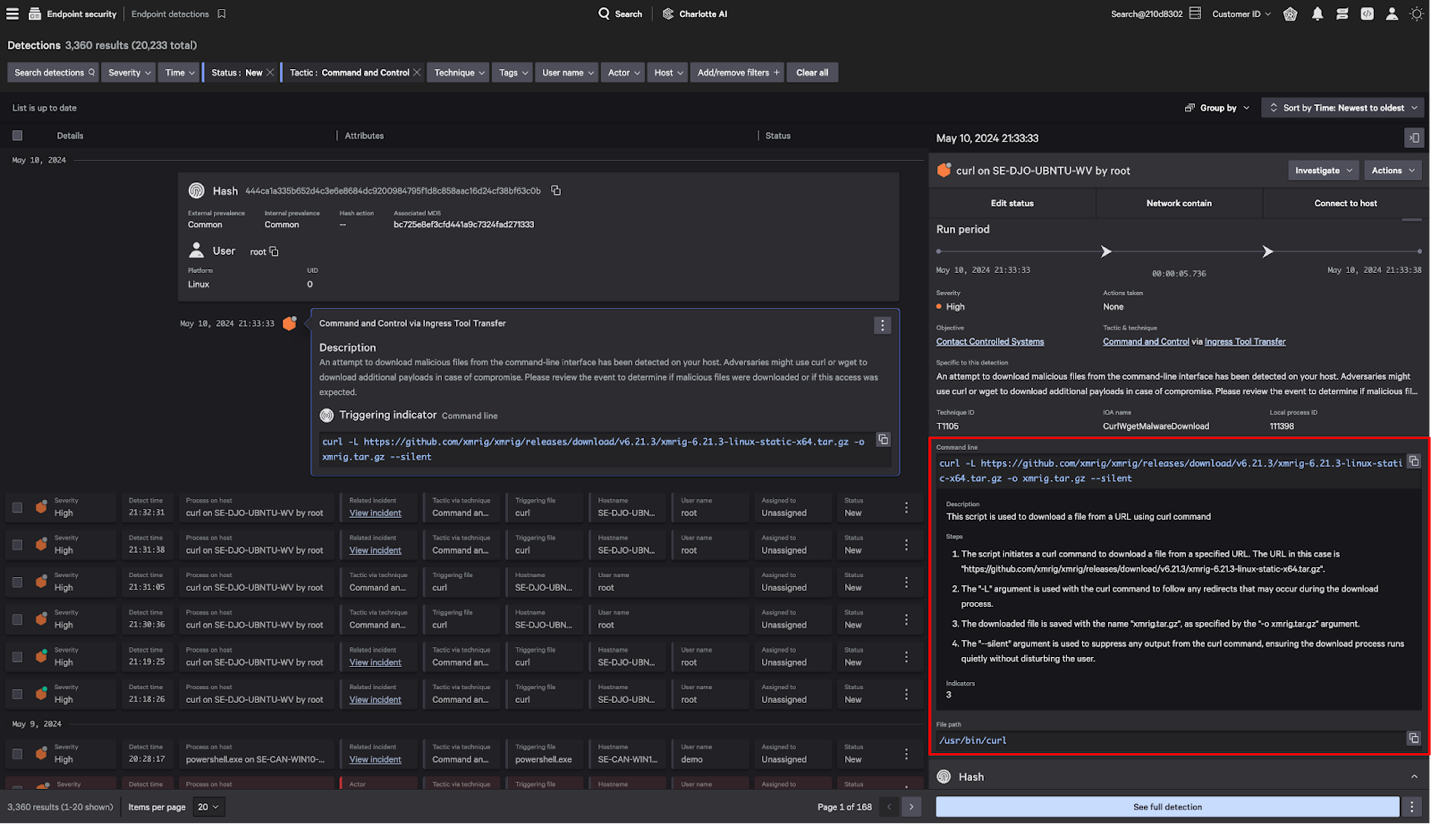
Falcon XDR extends CrowdStrike's endpoint detection into a unified detection and response layer, correlating endpoint, identity, cloud workload, and third-party telemetry in the Falcon console. Reviewers consistently credit the single lightweight agent architecture for fast deployment with low resource consumption, and the behavioral detection engine performs well against hands-on-keyboard activity across Windows, Linux, and macOS. CrowdStrike has layered Charlotte AI on top for detection triage, malware analysis, and agentic SOAR.
Falcon XDR and 7AI solve adjacent problems. Falcon generates and correlates high-quality detections. 7AI investigates alerts from Falcon and everything else in the stack, which is why the two often appear together rather than as substitutes.
Limitations reported by users on Gartner Peer Insights
- Ecosystem dependency. The strongest results come from running multiple Falcon modules, which increases cost and lock-in.
- Remediation gaps. Reviewers note that some detections lack corresponding remediation actions.
- Reporting depth. Reporting in several modules is described as limited compared to dedicated tools.
- Endpoint-centric depth. Some modules go deep on the endpoint and shallower elsewhere, with limited network-level action.
Source: CrowdStrike
8. Microsoft Defender XDR

Best for: Microsoft-first security and IT teams.
Strengths: Cross-domain incident correlation, KQL advanced hunting, and automated attack disruption.
Things to consider: Value is tied to Microsoft licensing, and users report slow automated remediation.
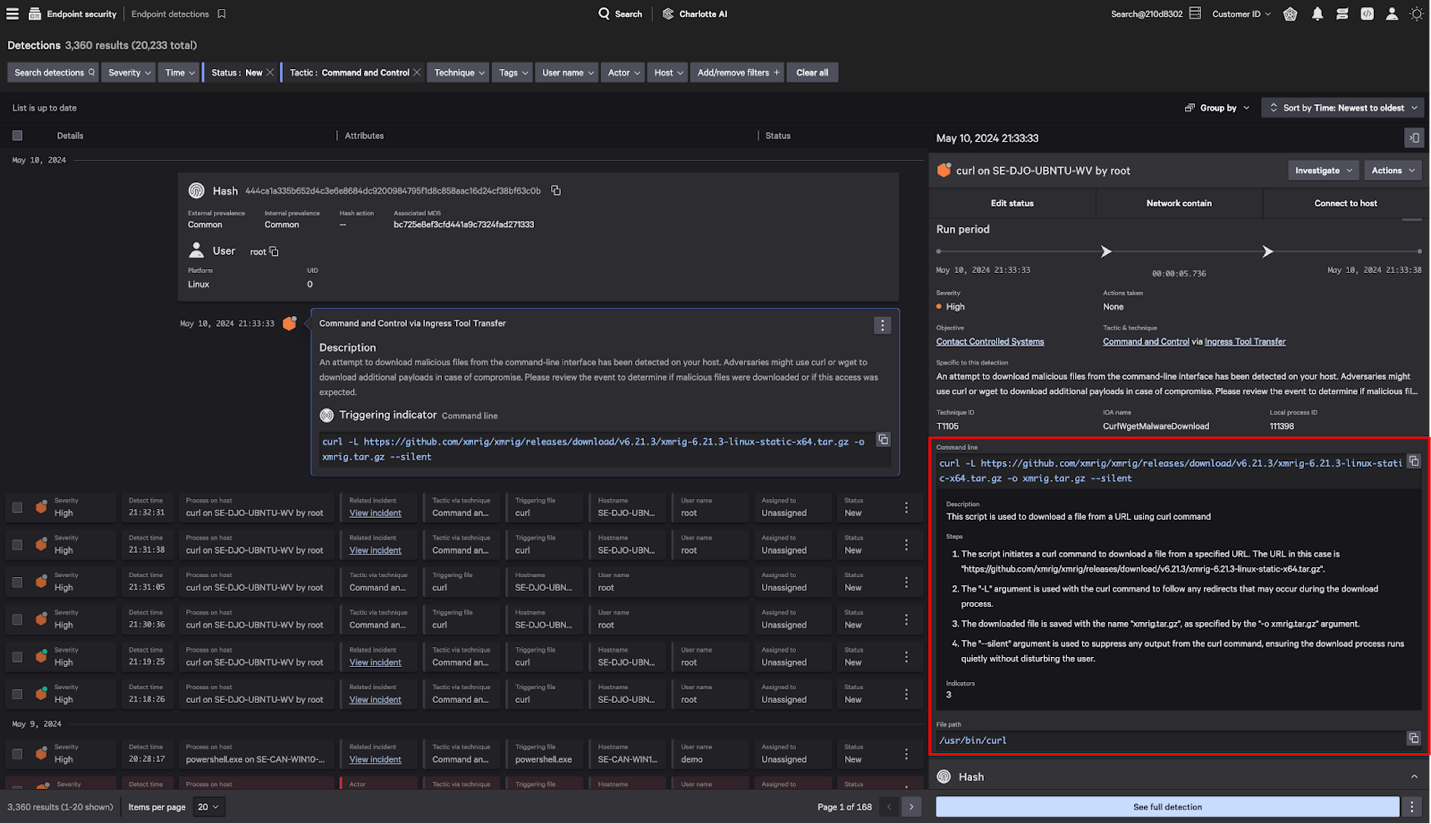
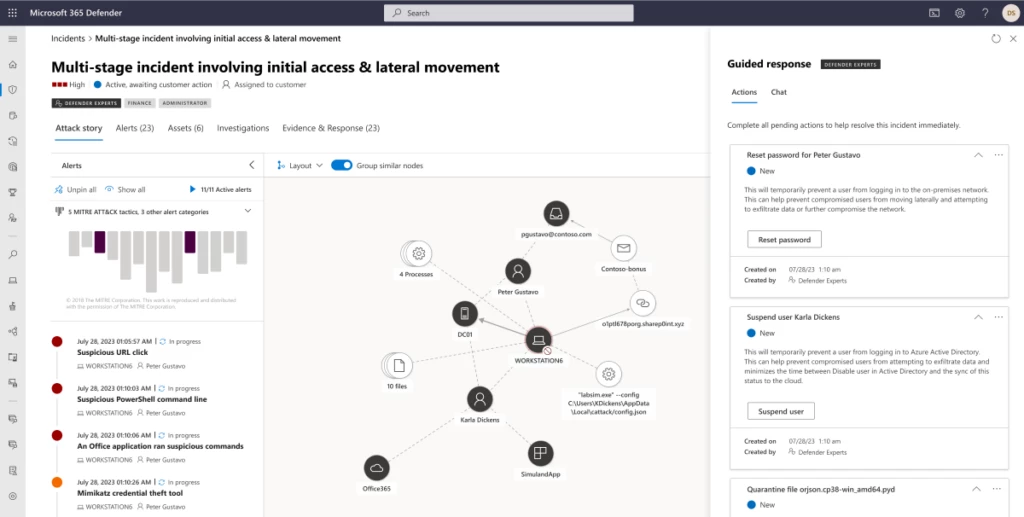
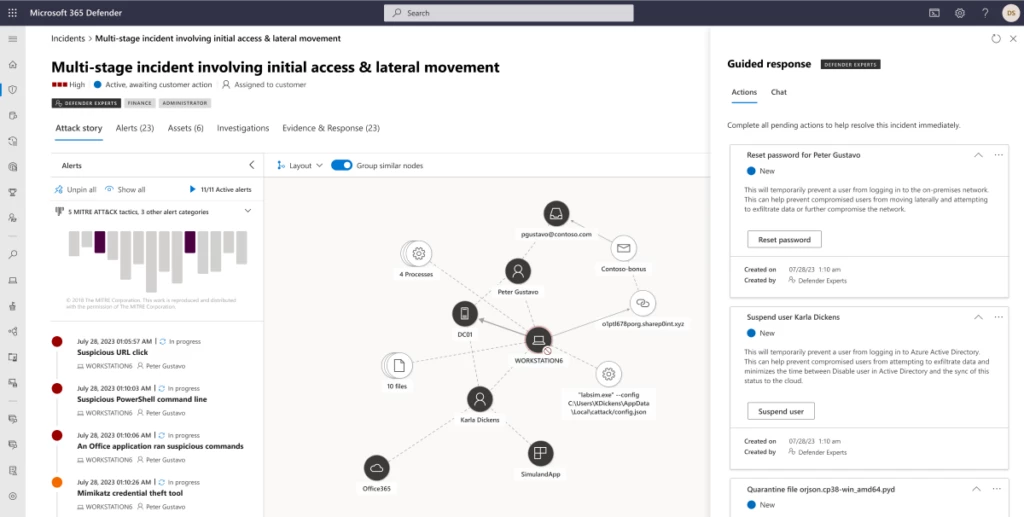
Defender XDR unifies signals across endpoints, identities, email, cloud apps, and SaaS into a single incident view in the Microsoft security portal. Users praise the cross-domain correlation, unified attack chain visibility, and advanced hunting with KQL, and for organizations already licensed for Microsoft 365 E5 the incremental cost is often minimal.
Limitations reported by users on G2, PeerSpot, and TrustRadius
- Slow automated response. One reviewer reported that automated investigation and remediation runs noticeably slower in the portal than doing the same work manually.
- Licensing complexity. SMB customers on Defender for Business need to move up to Defender for Endpoint to get XDR and automated investigation features.
- Limited flexibility outside Microsoft. Reviewers describe the platform as less useful in mixed or non-Microsoft environments.
- Advanced hunting customization. Users report difficulty customizing hunting queries for custom alerting and handling.
- Cost. Several reviewers cite high licensing cost relative to other XDR options.
Source: Microsoft
9. Palo Alto Networks Cortex XDR
Best for: teams that want causality-chain investigation across endpoint, network, and cloud.
Strengths: Root-cause analysis, behavioral analytics, and strong multi-source correlation.
Things to consider: Steep learning curve, and complexity that suits larger teams.
Cortex XDR correlates endpoint, network, and cloud telemetry into a single investigative view and reconstructs attack paths through incident timelines and causality-chain visualization. Reviewers highlight the behavioral analytics engine for catching living-off-the-land techniques and lateral movement that signature-based tools miss, and integration with XSOAR adds orchestration on top.
Cortex XDR rates 4.5 on G2 across 85 reviews and 4.6 on Gartner Peer Insights across 646 reviews in the endpoint protection market.
Limitations reported by users on G2
- Steep learning curve, particularly for new analysts.
- Complex management of the broader Cortex ecosystem.
- Feature gaps noted by some reviewers relative to expectations.
- Compatibility considerations in heterogeneous environments.
Conclusion
7AI has built one of the more complete agentic security platforms available, covering detection through response with real depth in threat hunting and context management. The explainability work is genuinely useful, and the ability to see an agent's mission, tool calls, and raw responses is more than most competitors offer.
The open questions are the ones any buyer should ask of a platform that launched in February 2025. How accurate are verdicts when the alert volume triples. What does an investigation actually cost when the pipeline grows. What happens when a determination requires forensic certainty rather than a well-reasoned inference from logs.
Those questions separate the platforms in this guide more than feature lists do. Teams that need evidence-backed verdicts on every alert, predictable cost regardless of volume, and forensic confirmation rather than probabilistic conclusions should test candidates against their own live alert stack. Nothing else reliably distinguishes marketing claims from production performance.
Related content: read our guide to AI SOC and the outsourced SOC.