
Prophet Security: Use Cases, Capabilities & Top 11 Alternatives
In this article

What Is Prophet Security?
Prophet Security is an agentic AI security operations platform that automates SOC workflows. Its core product, Prophet AI, acts as an AI SOC analyst that investigates security alerts, gathers relevant context, reasons through the evidence, and helps determine which alerts require human attention. The platform is built to reduce repetitive manual triage work while improving the speed and consistency of security investigations.
Rather than relying only on static playbooks or simple automation rules, Prophet Security uses AI agents to support the full security operations lifecycle. This includes alert triage, investigation, response support, threat hunting, and detection tuning. Prophet Security helps scale SOC capacity by allowing human analysts to focus on higher-value work such as complex incidents, proactive hunting, and security improvement initiatives.
Key capabilities of the Prophet Security platform include:
- Agentic AI SOC analyst: Performs end-to-end alert triage and investigation by collecting evidence, reasoning through findings, and prioritizing alerts for human analysts.
- Automated alert triage: Reviews incoming alerts, filters false positives, prioritizes genuine threats, and reduces repetitive manual investigation work.
- Investigation context and reasoning: Correlates telemetry, alerts, and related evidence into a coherent investigation narrative with transparent reasoning and risk assessment.
- Threat hunting assistance: Enables natural-language threat hunting across security data, helping analysts uncover suspicious activity beyond triggered alerts.
- Detection tuning: Identifies noisy or ineffective detections and supports continuous rule refinement to improve alert quality and reduce false positives.
This is part of a series of articles about SOC as a service
Prophet Security Use Cases
Organizations use Prophet Security to reduce manual SOC workload, investigate alerts more consistently, and help analysts focus on higher-value security work. Its AI agents support multiple stages of the security operations lifecycle, from initial alert triage through investigation, threat hunting, and ongoing detection improvement.
- Alert triage: Automatically reviews incoming security alerts, filters likely false positives, and prioritizes alerts that require analyst attention.
- Security investigations: Collects evidence from connected security tools, builds investigation timelines, and summarizes findings to speed analyst decisions.
- SOC workload reduction: Offloads repetitive Tier 1 investigation tasks so analysts can spend more time on complex incidents and proactive security work.
- Threat hunting: Supports natural-language threat hunting across security data to identify suspicious activity that may not have triggered existing alerts.
- Detection tuning: Helps identify noisy or ineffective detections and supports continuous refinement to improve alert quality over time.
- Incident response support: Provides investigation context and recommended next steps that help analysts validate incidents and coordinate response actions.
- Security operations scaling: Enables organizations to handle growing alert volumes without increasing SOC staffing at the same rate by automating repetitive workflows.
- Analyst knowledge sharing: Produces consistent investigation summaries and reasoning that help standardize triage quality across SOC teams.
Key Capabilities of Prophet Security
Agentic AI SOC Analyst
Prophet Security provides an agentic AI SOC analyst that works like an experienced security analyst across triage and investigation workflows. It can assess incoming alerts, collect supporting evidence, build an investigation path, and determine whether an alert is likely benign, suspicious, or high priority.
This capability helps SOC teams move beyond basic alert enrichment or rule-based automation. The AI analyst can reason through the available context, summarize findings, and surface the information human analysts need to make faster decisions. This is especially useful for teams that need to handle large volumes of alerts without increasing analyst headcount.
Automated Alert Triage
Prophet Security automates routine alert triage by reviewing security alerts across different severity levels and validating whether they require further investigation. The platform helps filter out false positives, prioritize meaningful threats, and reduce the manual effort typically required to review each alert one by one.
Automated triage is valuable because many SOC teams spend significant time on repetitive low-risk investigations. By offloading a large portion of this work to AI, Prophet Security helps reduce alert backlogs, shorten response times, and ensure that analysts spend more time on incidents that truly matter.
Investigation Context and Reasoning
Prophet Security gathers investigation context from alerts, security tools, telemetry, and related evidence to help analysts understand what happened and why it matters. Instead of presenting isolated alert data, the platform organizes relevant findings into a clearer investigation narrative.
The system is designed to support reasoning, not just data collection. It can help explain the logic behind an investigation, identify relationships between signals, and summarize the likely significance of an event. This makes it easier for analysts to validate conclusions, understand risk, and decide on next steps.
Threat Hunting Assistance
Prophet Security supports threat hunting by allowing analysts to explore alerts, contextual data, and threat intelligence using natural language. This makes threat hunting more accessible to a broader range of SOC users, including Tier 1 analysts who may not have deep query-language expertise or advanced hunting experience.
The platform can help analysts ask investigative questions, search across relevant security data, and uncover hidden patterns or suspicious activity. By turning threat hunting into a more guided and conversational workflow, Prophet Security helps SOC teams become more proactive rather than relying only on incoming alerts.
Detection Tuning
Prophet Security also supports continuous detection tuning, helping teams improve the quality and relevance of their security detections over time. Detection tuning is important because noisy, outdated, or poorly calibrated rules can overwhelm analysts with false positives and cause real threats to be missed.
By assisting with detection refinement, Prophet Security helps SOC teams reduce noise, improve alert fidelity, and strengthen overall detection coverage. This capability extends the platform beyond alert triage by helping organizations improve the upstream security logic that determines which alerts are generated in the first place.
Prophet Security Limitations
While Prophet Security can significantly reduce manual SOC workload, it is still an AI-driven security operations platform that depends on the quality of the data, detections, integrations, and governance around it. Organizations should evaluate these limitations before relying on it for high-impact security workflows.
Here are key limitations disclosed in the vendor’s official FAQ:
- Depends on existing security telemetry: Prophet AI investigates alerts by gathering context across the security stack, so its effectiveness depends on the availability, quality, and completeness of telemetry from tools such as SIEM, EDR, identity, cloud, email, and other security systems. If key data sources are missing, siloed, noisy, or poorly configured, investigations may be less accurate or incomplete.
- Still requires strong detections: Prophet Security can triage, investigate, and help tune detections, but it still needs meaningful alerts and detection logic to work from. If an organization has weak upstream detection coverage, poorly tuned rules, or blind spots in its security stack, the platform may not surface threats that were never detected in the first place.
- Human oversight is still important: Prophet Security is designed to augment analysts, not fully replace them. High-risk decisions, response actions, and incident conclusions should still be reviewed by human security teams, especially when actions could affect users, business systems, or production environments.
- Not a replacement for SOC strategy and process: The platform can accelerate triage and investigation, but it does not eliminate the need for incident response procedures, escalation paths, ownership models, detection engineering, and governance. Teams still need clear processes for validating findings, responding to confirmed incidents, and improving security operations over time.
- Integration scope may affect value: Prophet Security is most useful when connected to the tools and data sources that analysts already rely on. Organizations with fragmented environments, unsupported tools, limited API access, or inconsistent logging may need additional integration work before they can gain full value from the platform.
Notable Prophet Security Alternatives and Competitors
How we selected these platforms: We shortlisted AI SOC platforms based on autonomous alert triage and investigation, threat hunting, detection tuning, and automated response capabilities.
AI SOC Platforms at a Glance
The table below summarizes the key differences between the platforms covered in this article. We explore each one in more detail in the sections that follow.
| Category | Solution | Best For | Key Strengths | Things to Consider |
|---|---|---|---|---|
| AI-Native SOC Analysts | 1. Intezer | Forensic-depth triage of every alert | Forensic tooling plus AI, sub-minute triage, endpoint-based pricing | Requires mature telemetry; focused on 1,000+ employee orgs |
| AI-Native SOC Analysts | 2. Dropzone AI | Autonomous Tier 1 alert investigation | Pre-trained agents, 90+ integrations, fast deployment | Per-investigation pricing; young, growing company |
| AI-Native SOC Analysts | 3. UnderDefense Agentic AI SOC | Every alert verdicted on top of your existing stack | AI verdicts with evidence, 24/7 senior analysts, CISO Copilot, included IR retainer | Runs on your existing stack, so coverage depends on the tools you own |
| AI-Native SOC Analysts | 4. Qevlar AI | Consistent, hallucination-resistant triage | Graph orchestration, incident correlation, hunting | Malicious verdicts still need analyst review |
| AI-Native SOC Analysts | 5. Simbian | Coordinated multi-agent SecOps | SOC, hunt, pentest, NetSecOps agents, shared context | Opaque pricing; learning curve for teams |
| Agentic SOC from Established Platforms | 6. Microsoft Security Copilot | Microsoft-centric security and IT teams | Embedded agents across Defender, Entra, Intune, Purview | Best value in Microsoft stack; output needs review |
| Agentic SOC from Established Platforms | 7. CrowdStrike Charlotte AI | CrowdStrike Falcon platform users | Falcon-native agents, detection triage, agentic SOAR | Tied to Falcon; usage-based credits; verify output |
| Agentic SOC from Established Platforms | 8. Palo Alto Cortex AgentiX | Cortex XSIAM, XDR, and Cloud users | Agent library, 1,100+ integrations, SOAR maturity | Complex and costly; suited to larger enterprises |
| AI-Powered SOC Automation | 9. Torq | Agentic triage plus hyperautomation | AI agents across triage, investigation, response | Needs data-context tuning; case-mgmt bulk limits |
| AI-Powered SOC Automation | 10. Tines | Building custom security and IT workflows | Flexible builder, broad integrations, AI Workbench | You build the workflows; learning curve; premium cost |
| AI-Powered SOC Automation | 11. D3 Security Morpheus AI | AI SOC plus a full SOAR engine | Six capabilities, 800+ integrations, autonomy modes | Reporting and admin UI noted; newer autonomous layer |
AI-Native SOC Analyst Platforms
1. Intezer

Best for: SOC teams that want forensic-depth triage of every alert.
Strengths: Combines forensic tooling with AI for sub-minute triage.
Things to consider: Requires mature telemetry; focused on organizations with 1,000+ employees.
Intezer is an AI SOC platform that automatically triages and investigates security alerts across endpoint, identity, phishing, network, and cloud sources. It combines agentic AI reasoning with forensic techniques such as endpoint forensics, memory analysis, reverse engineering, network artifact analysis, and sandboxing. It connects to tools like CrowdStrike, SentinelOne, and Microsoft Defender to ingest alerts and produce evidence-based verdicts.
The platform investigates every alert, including low-severity ones, escalating a small fraction to analysts and auto-resolving false positives. Analysts can review or override escalated alerts, and Intezer incorporates their feedback into future triage. Pricing is tied to the number of endpoints rather than alert volume.
Key features include:
- Multi-source alert triage: Ingests and investigates alerts from endpoint, identity (Entra ID, Okta), reported phishing (Office 365, Proofpoint), network, SIEM, and cloud tools such as Wiz.
- Forensic investigation toolset: Collects and analyzes files, logs, command lines, and memory images, using reverse engineering, network artifact forensics, and sandboxing to reach verdicts.
- Automated response and remediation: Proposes and executes steps such as disabling users or isolating devices through API or webhook with human approval, and routes incidents to SOAR or ticketing tools.
- Human-in-the-loop review: Shows transparent triage logic and explanations, lets analysts review or override escalations, and learns from analyst feedback and in-house QA.
- Detection feedback loop: Feeds investigation outcomes back into detection engineering to identify noisy or ineffective alerts for tuning.
- Endpoint-based pricing: Ties cost to the number of endpoints rather than alert volume, so every alert can be investigated without volume fees.
Intezer is highly rated on Gartner Peer Insights. See what users have to say.
Limitations:
- Requires mature telemetry to work: Investigation quality depends on the customer's existing EDR/SIEM health. Organizations with immature tooling won't get full value out of the box.
- MITRE ATT&CK coverage has a realistic ceiling: Intezer benchmarks 60–70% as "top-tier" and flags anything higher as likely inflated. Some technique categories remain outside reliable coverage for any vendor.
- Focused on enterprise-size customers with a minimum of 1,000 employees.
Experience Intezer in action with a custom demo.

Source: Intezer
2. Dropzone AI

Best for: Teams that want autonomous Tier 1 alert investigation.
Strengths: Pre-trained agents, 90+ integrations, and one-hour deployment.
Things to consider: Per-investigation pricing; a young, growing company.
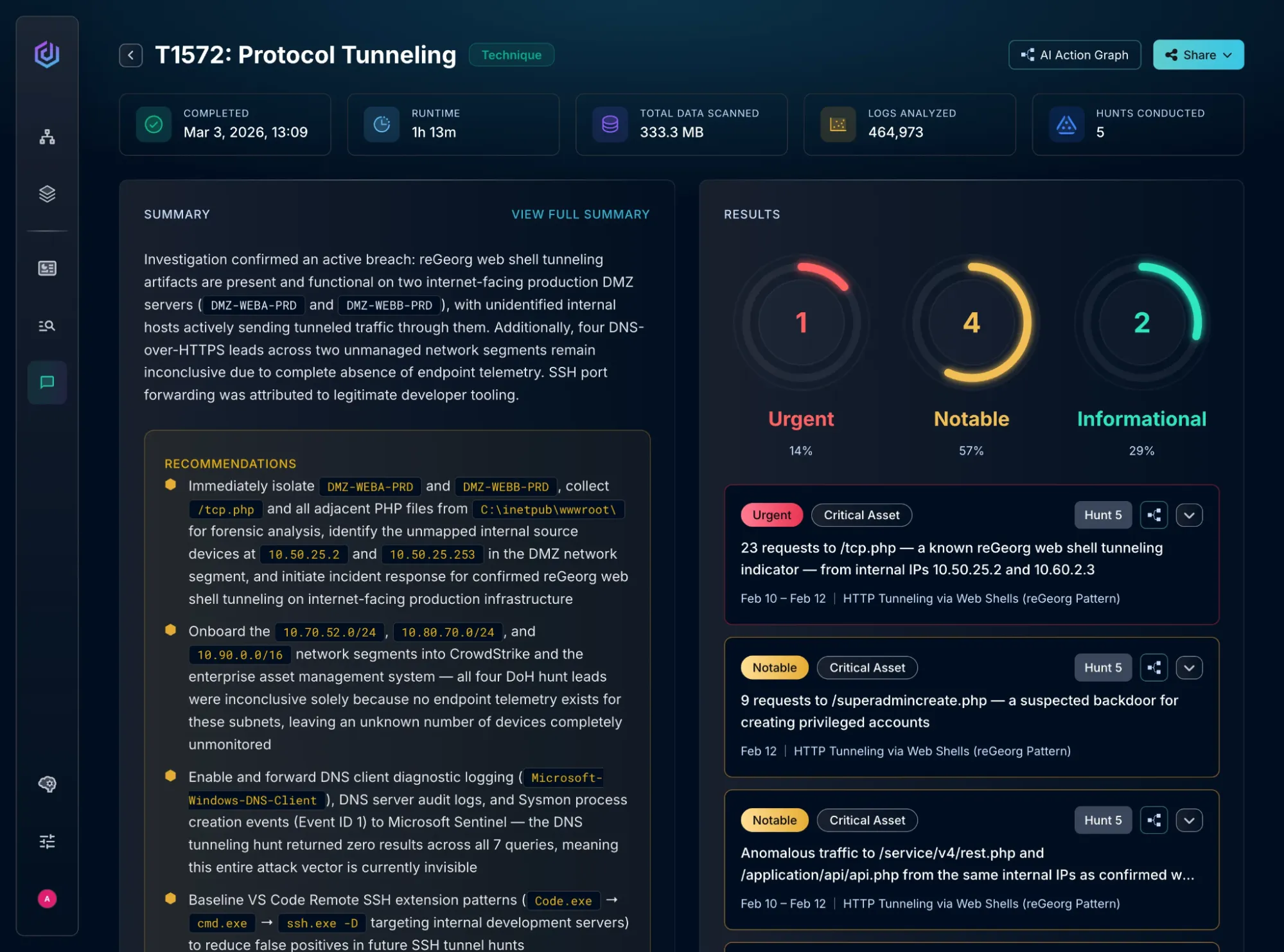
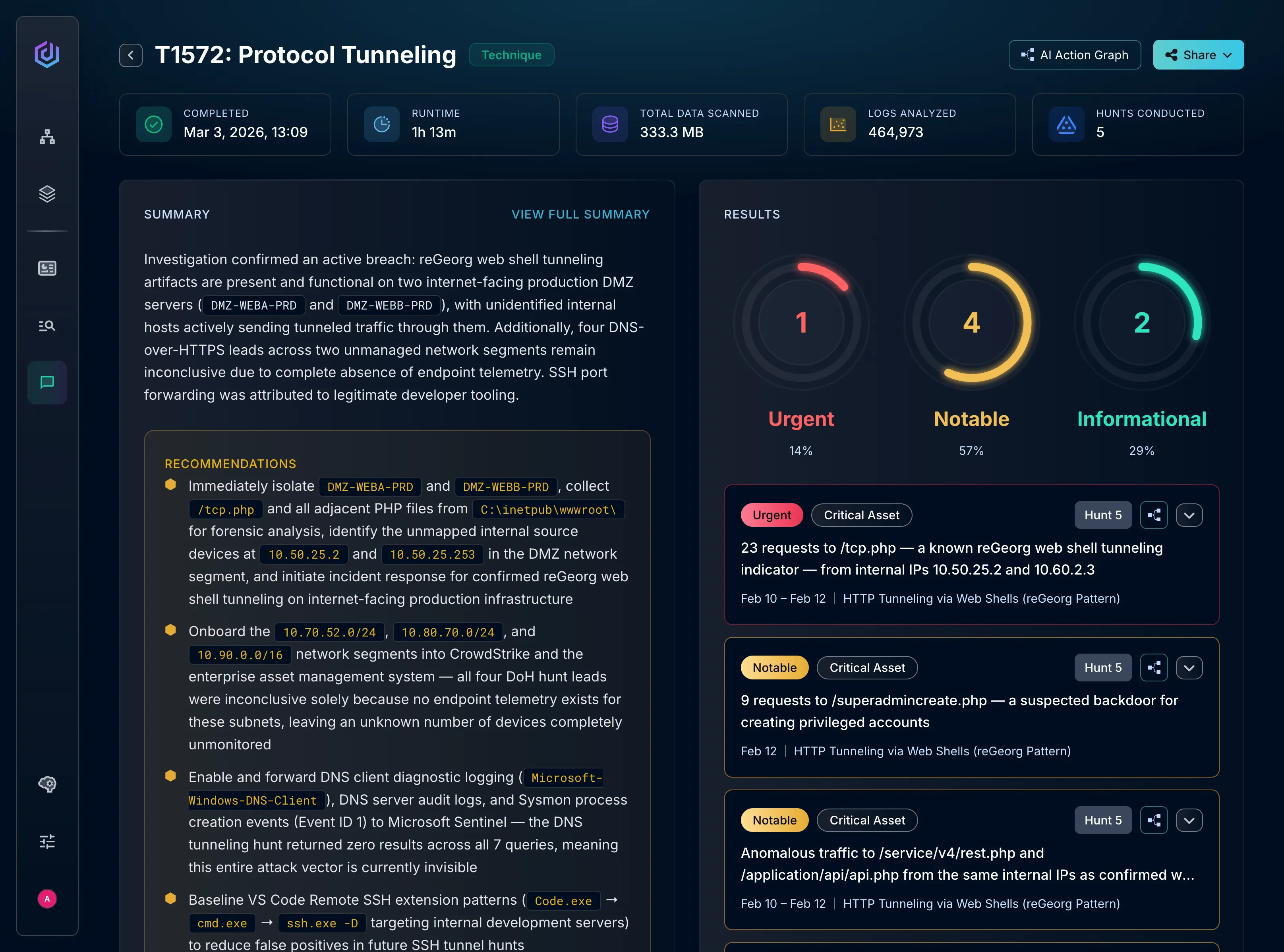
Dropzone AI provides an agentic SOC built around an AI SOC Analyst that autonomously investigates alerts across the full tool stack. It also offers an AI Threat Hunter and an AI Threat Intel Analyst that run hypothesis-driven hunts and turn emerging advisories into hunt packs. The agents investigate alerts, correlate data, and produce plain-English reports without requiring playbooks or code.
Dropzone is pre-trained on investigation techniques for common alert types and coachable to a specific environment in natural language. It connects to more than 90 tools across SIEM, EDR, cloud, identity, and email, querying them through APIs without log normalization, and can take containment actions such as blocking IPs or disabling accounts when threats are confirmed.
Key features include:
- AI SOC Analyst: Autonomously investigates alerts 24/7 across the tool stack and produces reports with a severity conclusion, executive summary, and evidence locker.
- AI Threat Hunter and Threat Intel Analyst: Runs federated, hypothesis-driven hunts across SIEM, EDR, and cloud, and builds hunt packs from new advisories.
- Natural-language coaching: Lets analysts direct agents in plain English and add context, with full attribution on each directive and no playbooks to build.
- Glass-box transparency: Displays every step, tool queried, and piece of reasoning for each investigation so analysts can audit conclusions.
- 90+ integrations: Connects through APIs to SIEM, EDR, cloud, identity, and email tools, and bundles threat intelligence subscriptions such as CrowdStrike Falcon Intelligence and GreyNoise.
- Automated response: Fires containment actions such as blocking malicious IPs and disabling compromised accounts when agents confirm a threat.
Limitations (as reported by users on Gartner Peer Insights):
- Per-investigation pricing: Usage-based pricing tied to the number of investigations can become costly and, per reviewers, may lead teams to limit which alerts they ingest.
- Young, growing company: Reviewers note it is a small and new company still expanding features and integrations, so some capabilities remain on the roadmap.
- Upfront tuning: Users report that some initial hand-holding and teaching is needed, and that investigation summaries are not regenerated after a conclusion changes.
- Data dependency: Effectiveness depends on the quality of the data and context available from connected sources.
Source: Dropzone AI
3. UnderDefense Agentic AI SOC
.jpg)
Best for: Teams that want every alert verdicted on top of their existing security stack.
Strengths: AI triage plus 24/7 senior analysts, CISO Copilot, and an included IR retainer.
Things to consider: Runs on your existing stack, so coverage depends on the tools you already own.
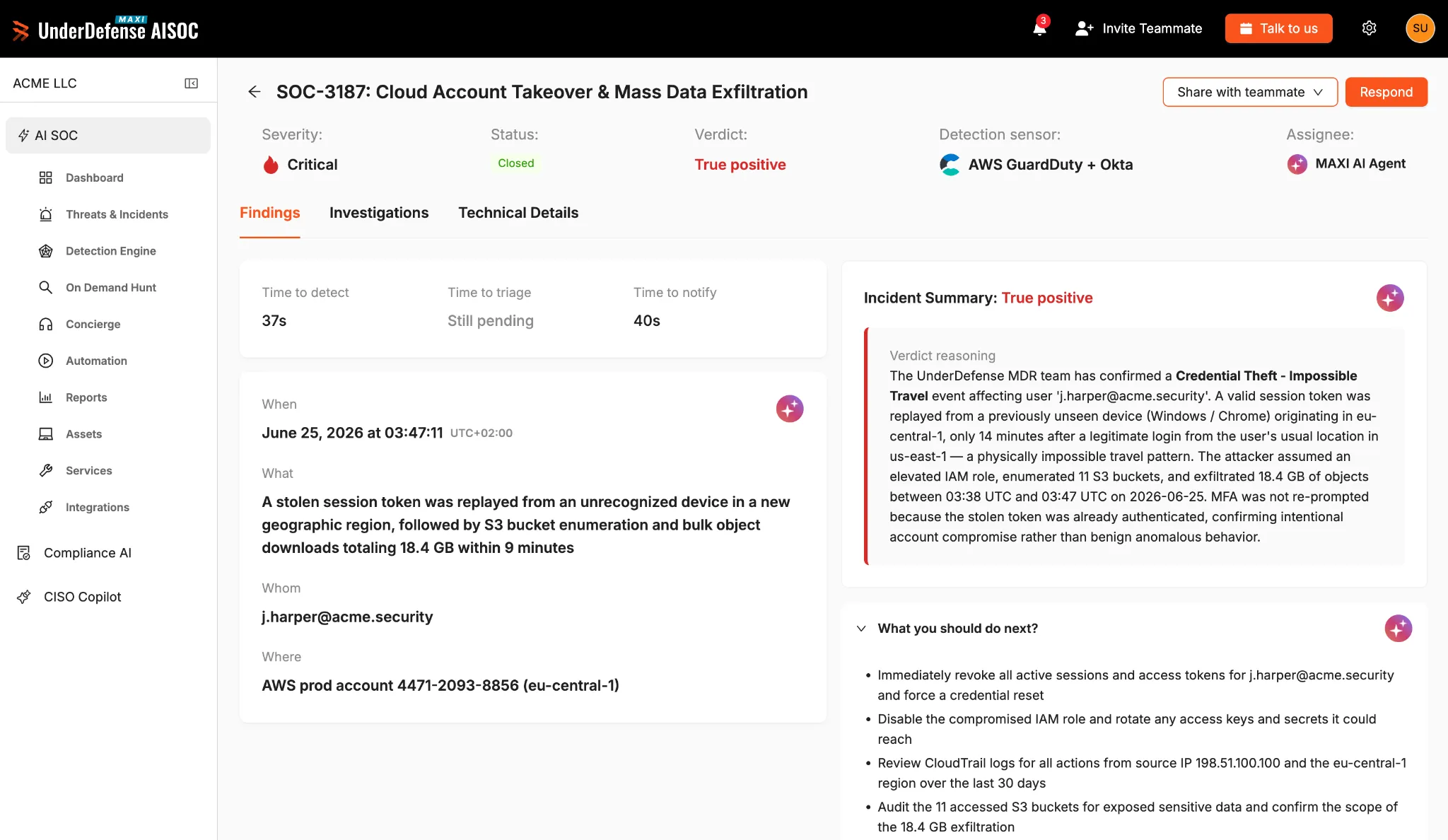
UnderDefense Agentic AI SOC runs on top of the security stack you already own. Every alert gets a verdict – nothing deprioritized, nothing missed. When context is missing, AI asks your team directly. When a breach needs humans on a keyboard, senior analysts are already there – reachable over Slack, Teams, or email, hunting threats across every environment, 24/7, with no handoff delays and no gaps in coverage.
Key features include:
- Your existing security investments stay intact: No replacement projects, no new procurement cycles. AI operates on top of what you already own and tested.
- Every alert gets a verdict, not a summary: Nothing slips through. AI delivers a conclusion with evidence – your team decides what to act on, not what to look at.
- Fewer escalations that go nowhere: AI resolves ambiguous alerts by gathering missing context automatically. Your analysts stop chasing and start deciding.
- CISO Copilot: Answers plain-language questions about security posture in seconds, without building a dashboard or opening a ticket.
- Included IR Retainer: A dedicated team of senior analysts steps in for hands-on containment, with no separate contract to negotiate during an incident.
Security operations at machine speed, with humans where it counts. That is not a roadmap item, it is how UnderDefense ships today.
4. Qevlar AI

Best for: SOCs that want consistent, hallucination-resistant triage.
Strengths: Graph-based orchestration, incident correlation, and hunting.
Things to consider: Malicious verdicts still route to an analyst for review.
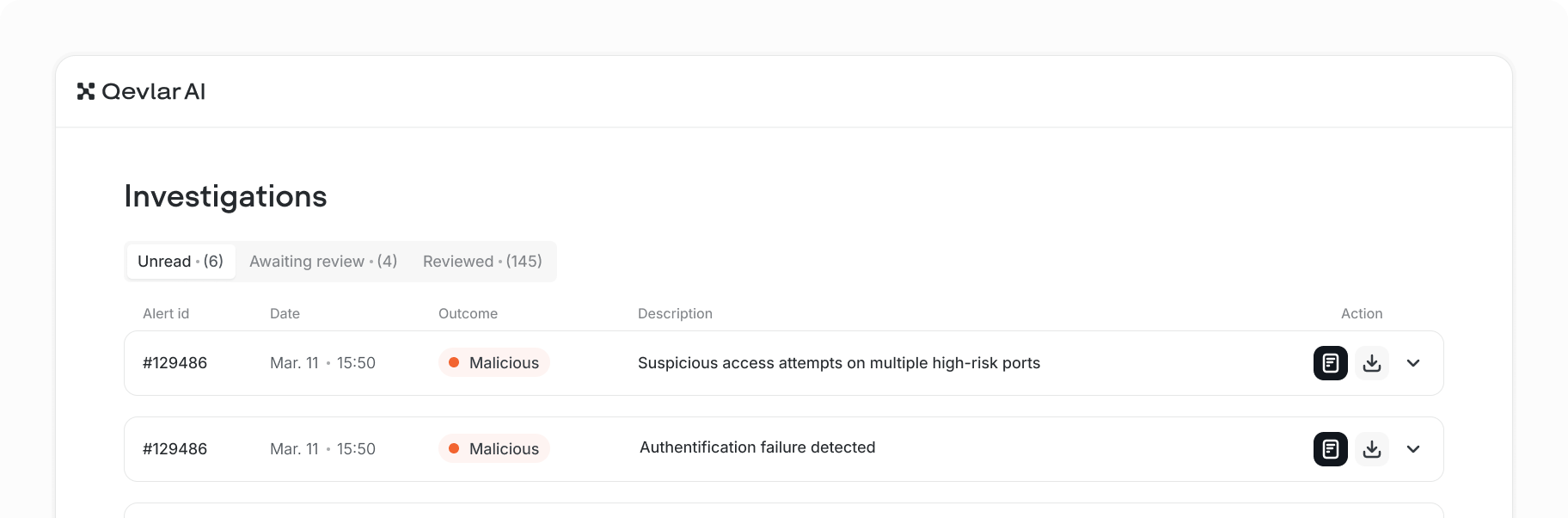
Qevlar AI is an AI SOC platform that autonomously investigates every alert and connects related activity into a single incident. When an alert fires, it pulls and enriches data from the security stack, correlates context, and reaches a benign or malicious verdict without predefined playbooks. It also covers response, threat hunting, detection engineering, and vulnerability prioritization.
Qevlar runs on a graph orchestrator that follows the same path for a given alert, which the vendor positions as a way to keep decisions consistent and auditable while limiting LLM use to narrow tasks such as enrichment and summarization. Analysts see every step and observable queried, can override any verdict, and Qevlar applies that context to future cases.
Key features include:
- Graph-based investigation: Uses a graph orchestrator to investigate each alert consistently, with LLMs used only for bounded tasks such as enrichment and summarization.
- Incident correlation: Connects related activity across the stack into a single incident and maps the blast radius rather than treating alerts in isolation.
- Response and containment: Drives next actions such as containment for malicious activity and tuning for false positives, following the team's procedures with analyst control.
- Continuous threat hunting: Hunts for emerging threats, attacker TTPs, and behavioral anomalies, and surfaces new context items for analysts to validate.
- SOC and vulnerability link: Shares an intelligence layer so confirmed exploitation raises vulnerable assets in the remediation queue.
- Transparent, overridable verdicts: Shows the full reasoning behind each verdict and lets analysts override and add context that carries into future investigations.
Limitations (based on publicly available sources):
- Analyst review still required: Malicious verdicts are routed to an analyst for validation, so the workflow keeps a human in the loop rather than fully closing incidents on its own.
- Works alongside SOAR: Qevlar handles investigation but relies on SOAR for orchestration and execution at scale, so it is an addition to, not a replacement for, those tools.
- Emerging vendor: As a relatively new platform, it has a shorter public track record than established SOC vendors.

Source: Qevlar AI
5. Simbian

Best for: Teams that want multiple coordinated SecOps agents.
Strengths: SOC, hunt, pentest, and NetSecOps agents share one context.
Things to consider: Pricing is not published; there is a learning curve.
Simbian is a self-improving SecOps platform whose AI agents span SOC, threat hunting, penetration testing, and network security operations, all reasoning against a shared Context Lake and reasoning engine. The AI SOC Agent investigates and responds to alerts, classifying each as a true or false positive with a severity level and a confidence rating, and produces response plans that can trigger automated actions.
The agents share findings, so a SOC detection can trigger a threat hunt or a pentest check, and analyst feedback and investigation outcomes feed back into the platform through a continuous learning loop. Simbian uses its own TrustedLLM technology, intended to resist prompt injection and reject hallucinated data, and can be deployed as SaaS or on-premises.
Key features include:
- Multi-agent architecture: Coordinates SOC, Threat Hunt, Pentest, and NetSecOps agents that share context and hand tasks to one another.
- AI SOC Agent: Investigates alerts on arrival, classifies true and false positives with severity and confidence, and generates response plans.
- Context Lake: Captures organizational knowledge, operational procedures, entity intelligence, and continuous learning from investigations and analyst feedback.
- Reasoning engine with continuous learning: Retrains against attack telemetry in a Cyber AI Gym so accuracy adapts over time without playbooks or rules.
- TrustedLLM technology: Built to resist prompt injection and model poisoning and to reject hallucinated data, without training on customer data.
- Flexible deployment: Works across more than 100 integrated tools and deploys as SaaS or an on-premises agent.
Limitations (based on publicly available sources):
- Opaque pricing: Pricing is not published and requires direct contact, which can slow initial evaluation.
- Integration effort: Connecting to complex existing security stacks may need dedicated technical resources despite plug-and-play claims.
- Learning curve: The autonomous, multi-agent approach can require adjustment for teams used to rule-based operations.

Source: Simbian
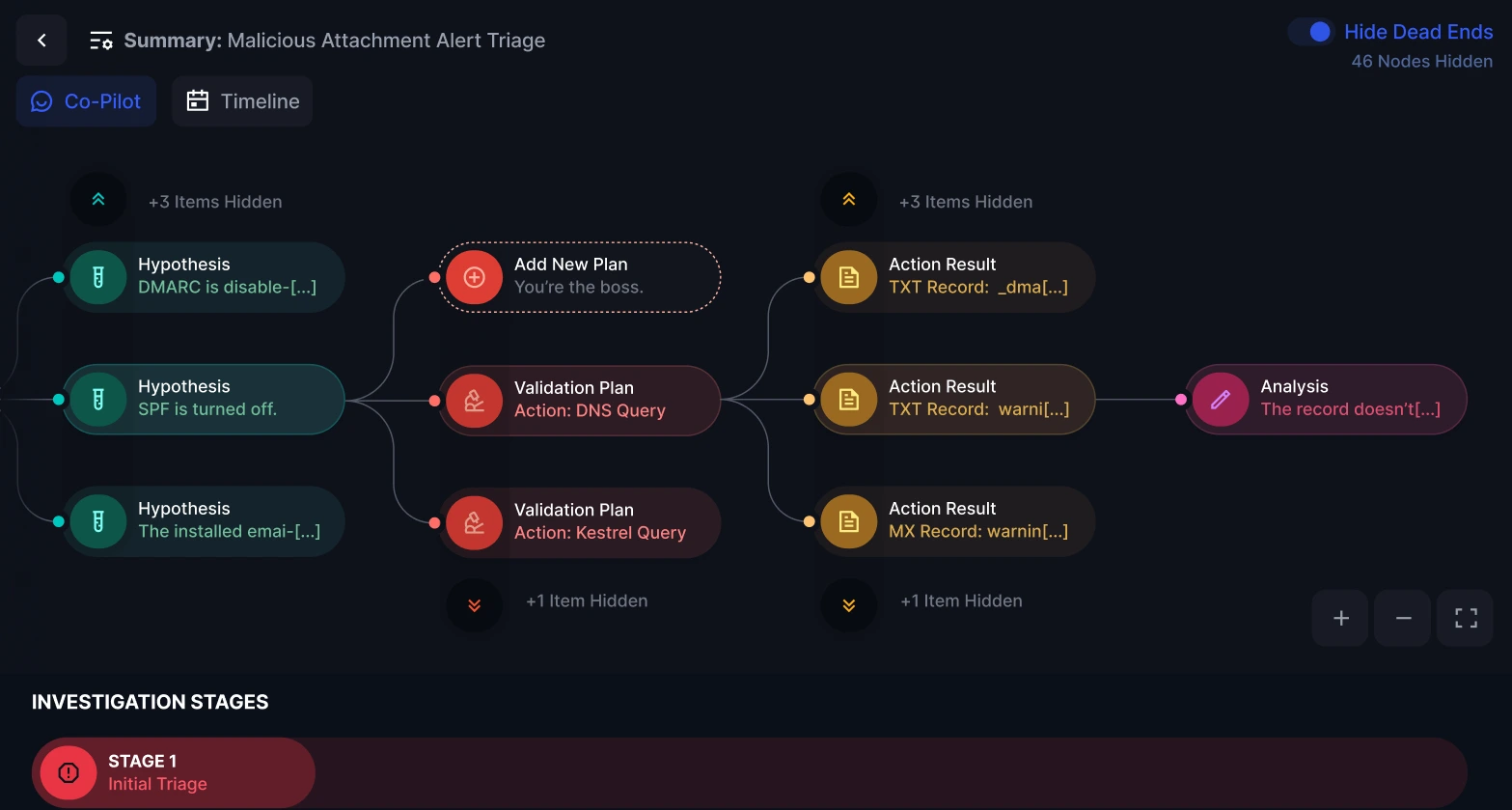
Agentic SOC in Established Security Platforms
6. Microsoft Security Copilot

Best for: Microsoft-centric security and IT teams.
Strengths: Agents embedded across Defender, Entra, Intune, and Purview.
Things to consider: Best value inside the Microsoft stack; verify output.
Microsoft Security Copilot brings agentic automation and AI-driven insights across Microsoft's security and IT products, including Defender, Sentinel, Entra, Intune, Purview, and Defender for Cloud. Security Copilot agents handle high-volume tasks such as phishing triage, alert triage, and vulnerability remediation, and they are embedded directly in the products analysts already use.
The platform uses natural language so analysts can triage incidents, generate or explain scripts, and produce stakeholder reports without mastering query languages. It supports embedded agents from Microsoft, partner-built agents, and community-built agents created without code, and it is billed through security compute units or included with Microsoft 365 E5.
Key features include:
- Embedded security agents: Provides ready-to-use agents for phishing triage, alert triage, and vulnerability remediation inside Microsoft Security products.
- Natural-language operations: Lets analysts triage incidents, write and reverse-engineer scripts, and extract telemetry through plain-language prompts.
- Investigation and remediation guidance: Summarizes complex alerts into actionable steps and provides step-by-step response guidance.
- Extensible agent model: Supports Microsoft, partner, and no-code community-built agents that adapt to workflows and learn from feedback.
- Broad Microsoft integration: Connects across Defender, Sentinel, Entra, Intune, Purview, and Defender for Cloud, and integrates with partner products.
- Stakeholder reporting: Generates concise reports tuned to the audience, summarizing environment context, open issues, and protective measures.
Limitations (based on publicly available sources):
- Occasional inaccuracy: As a generative AI assistant, it can produce plausible but sometimes inaccurate recommendations, so analysts should verify output before acting.
- Permission and data complexity: Data access and permission setup can be complex, and some teams override output rather than rely on it.
- Best value inside the Microsoft stack: Its strengths are tied to Microsoft products, so value is lower for organizations with mostly non-Microsoft tooling.
- Compute-unit cost planning: Usage is metered in security compute units, which requires capacity planning to control cost.

Source: Microsoft

7. CrowdStrike Charlotte AI
Best for: CrowdStrike Falcon platform users.
Strengths: Falcon-native agents, detection triage, and agentic SOAR.
Things to consider: Tied to Falcon; usage-based credits; verify output.
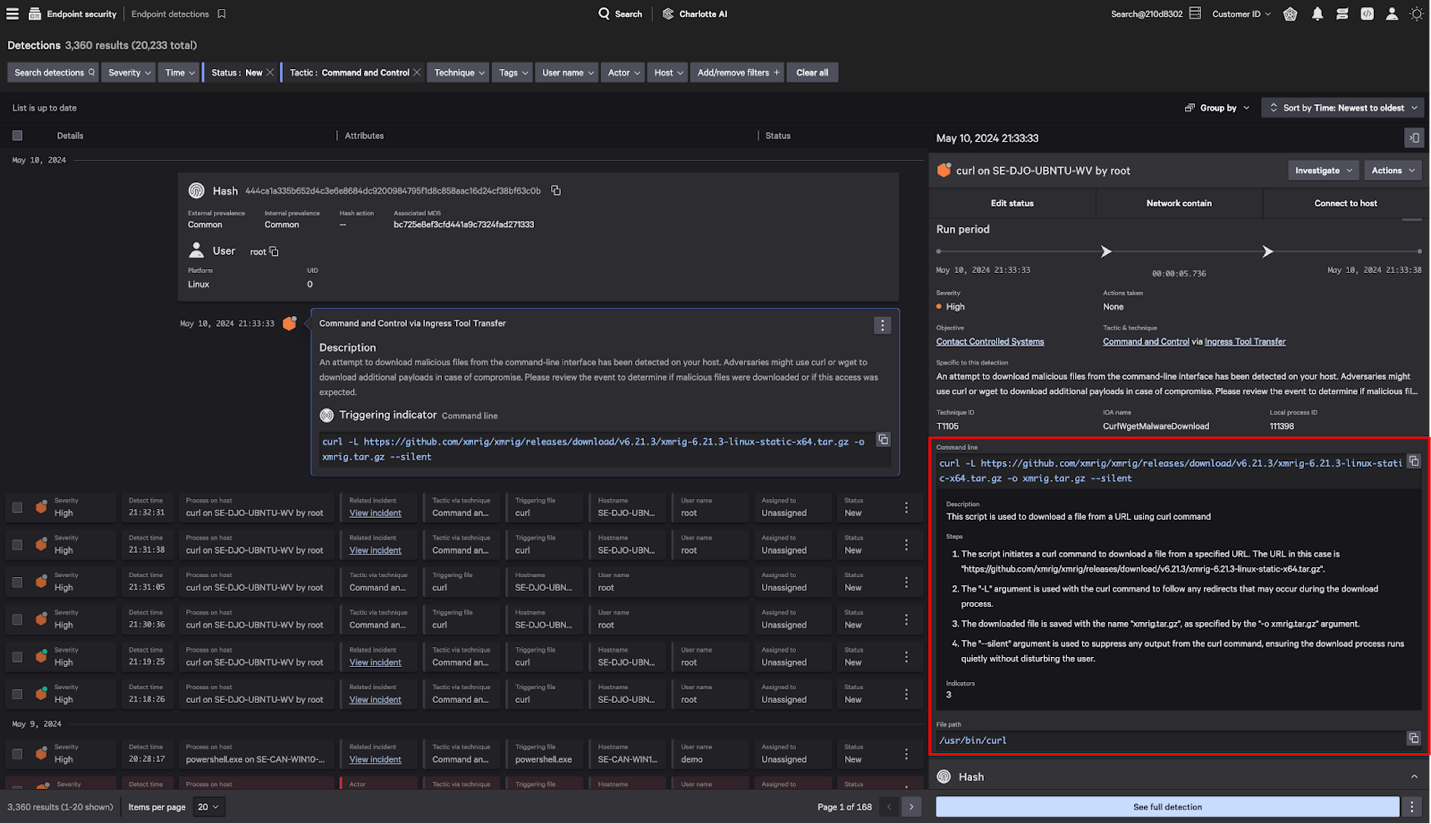
Charlotte AI is CrowdStrike's agentic AI security analyst, built on the Falcon platform. It triages detections, filters false positives, and surfaces what matters, and it supports investigations by combining analyst expertise with autonomous reasoning. It provides mission-ready agents for tasks such as detection triage, malware analysis, and threat hunting, along with embedded generative AI features across the Falcon console.
Analysts can query Falcon data in plain language, and Charlotte AI AgentWorks lets teams build and manage custom agents using natural language and no code. Charlotte Agentic SOAR orchestrates native, custom, and third-party agents across workflows, and the platform emphasizes governance with traceable answers, user-authorized actions, and validated data.
Key features include:
- Mission-ready agents: Offers out-of-the-box agents for detection triage, malware analysis, threat hunting, and other workflows, trained on Falcon Complete analyst decisions.
- Conversational Falcon queries: Lets analysts query Falcon modules in plain language and receive summaries, with shareable promptbooks for reuse.
- AgentWorks agent builder: Enables teams to build, test, and deploy custom agents using natural language without coding.
- Charlotte Agentic SOAR: Orchestrates native, custom, and third-party agents with structured logic and agentic reasoning under analyst command.
- Governance controls: Provides traceable answers, user-authorized actions, role alignment, and validation agents that review outputs.
- Falcon telemetry grounding: Inherits unified Falcon platform telemetry and shared context across security workflows.
Limitations (as reported by users on G2):
- Dependence on the Falcon platform: It is deeply integrated with Falcon, so organizations using other tools may find limited interoperability.
- Accuracy constraints: As a generative AI system, it can occasionally produce inaccurate responses, so users should verify outputs before acting.
- Features still maturing: Some modules are still in development, so parts of the experience require patience and roadmap tracking.
- Usage-based credits: Access is priced on usage limits and credits, which requires planning to manage cost.

Source: CrowdStrike
8. Palo Alto Cortex AgentiX

Best for: Palo Alto Cortex XSIAM, XDR, and Cloud users.
Strengths: Agent library, 1,100+ integrations, and SOAR maturity.
Things to consider: Complex and costly; suited to larger enterprises.
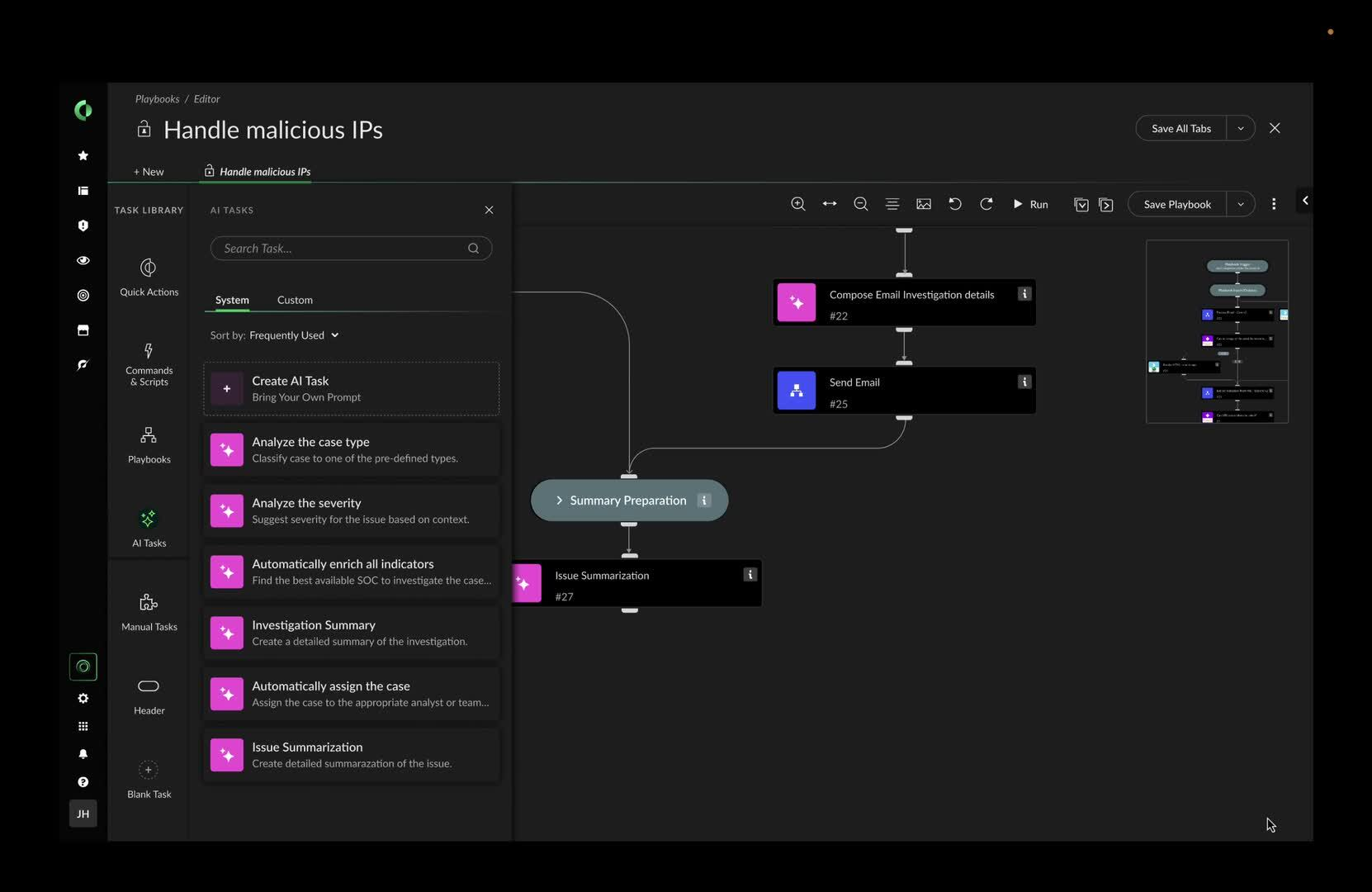
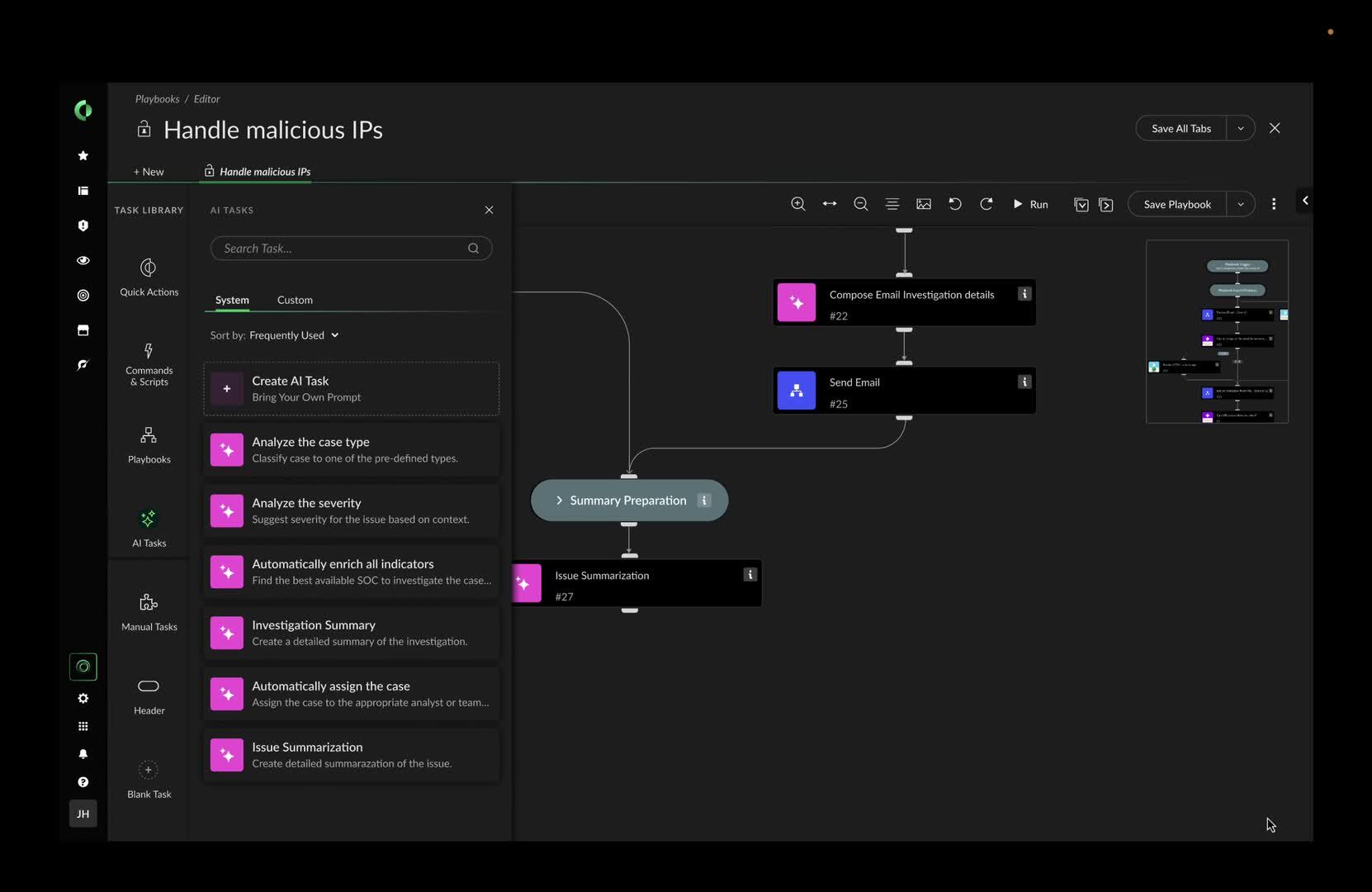
Cortex AgentiX is Palo Alto Networks' platform for building, deploying, and governing security AI agents, positioned as the next generation of Cortex XSOAR. Agents plan and carry out agentic workflows, and teams can choose from a library of ready-made agents or build custom, no-code versions. AgentiX powers the Cortex Agentic Assistant across Cortex XSIAM, Cortex XDR, and Cortex Cloud.
The platform keeps analysts in control, with agents bound by the same roles and permissions as staff, human-in-the-loop approval for impactful actions, and transparency into agent reasoning. A Case Investigation agent provides side-by-side triage support, an Automation Engineer agent builds code or scripts from natural-language prompts, and AI tasks can be embedded into deterministic playbooks.
Key features include:
- Agentic workflows: Deploys ready-made or custom no-code agents that plan and execute complex security workflows around the clock.
- Autonomy with guardrails: Binds agents to analyst roles and permissions, with human approval for impactful actions and visibility into reasoning.
- Case Investigation agent: Establishes case context and interprets data points side by side with analysts to speed triage.
- AI-powered automation: Uses an Automation Engineer agent to build code or scripts from natural-language prompts for agents or traditional playbooks.
- AI-driven playbooks: Embeds dynamic AI tasks into deterministic workflows so playbooks can use real-time data to decide the next move.
- Broad integration ecosystem: Provides more than 1,100 prebuilt integrations with native MCP support, and runs across Cortex XSIAM, XDR, and Cloud.
Limitations (as reported by users on G2):
- Setup complexity: Reviewers describe a steep learning curve and note it often requires skilled resources to configure properly.
- Cost: Users report the platform can be expensive and its licensing complex, which may not suit smaller organizations.
- Playbook building: Creating playbooks can involve coding, which reviewers note is difficult for junior analysts.
- Enterprise orientation: It is generally best suited to medium and large enterprises with mature security teams.
Note: Limitations refer to the broader Cortex platform of which AgentiX is the newest layer.
Source: Palo Alto Networks
AI-Powered SOC Automation
9. Torq

Best for: Teams that want agentic triage plus hyperautomation.
Strengths: AI agents across triage, investigation, and response.
Things to consider: Needs data-context tuning; case-management bulk limits.
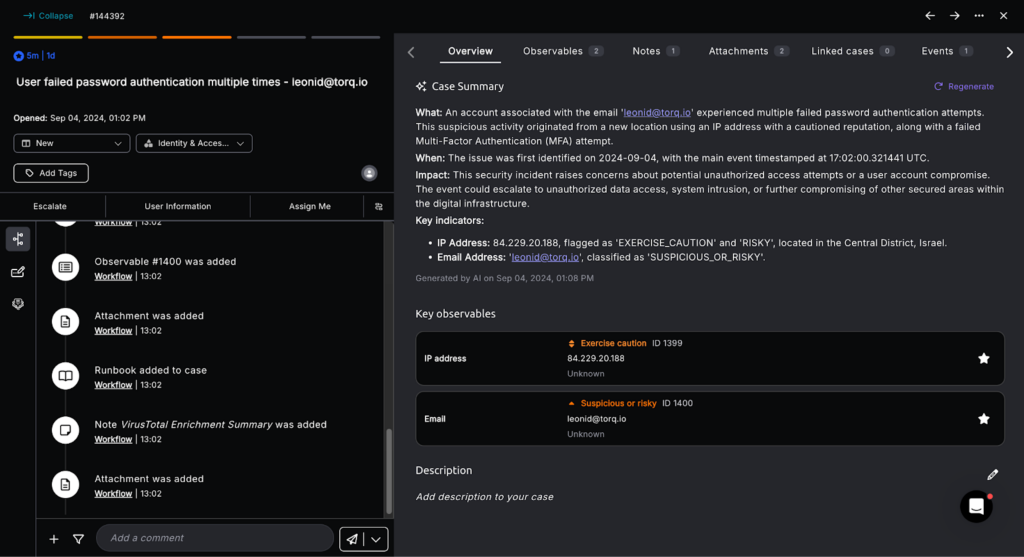
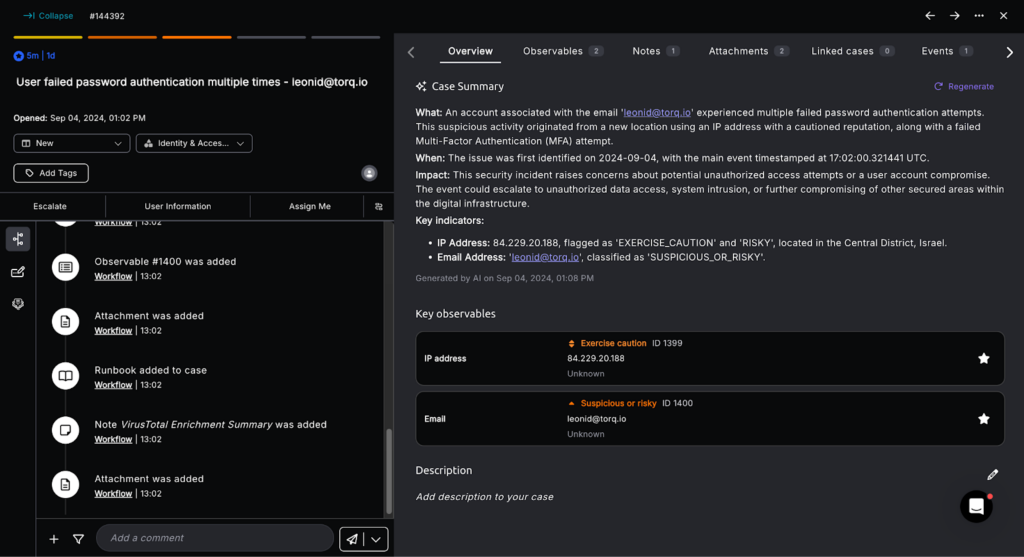
Torq is an AI SOC platform that uses agentic AI to triage, investigate, and respond to threats, built on a hyperautomation foundation. It de-duplicates events and filters false positives to produce prioritized verdicts with audit logs and manual override, and it autonomously creates, assigns, and manages cases from a single source of truth.
Specialized AI agents handle repetitive investigation tasks and record evidence, timelines, and recommended actions, while Socrates, a natural-language agent, drives response either autonomously or with human-on-the-loop oversight. A continuously updated context model grounds each agentic decision, capturing every verdict, exception, and override with its surrounding context.
Key features include:
- Agentic triage: De-duplicates and filters events to suppress noise and produces prioritized verdicts with transparent audit logs and a manual override option.
- Case management: Autonomously creates, assigns, and manages cases from a single source of truth.
- AI investigation agents: Orchestrates specialized agents that offload repetitive investigation tasks and record evidence, timelines, and recommended actions.
- Socrates response agent: Uses a natural-language agent to remediate threats autonomously or with human-on-the-loop oversight.
- Agentic threat hunting: Builds runbooks that access authorized data and tools, cross-reference historical cases, and summarize findings.
- Context graph and memory: Grounds decisions in a continuously updated model of the environment, capturing verdicts, exceptions, and overrides with context.
Limitations (based on publicly available sources):
- Data-context tuning: A reviewer noted that results depend on well-structured input, requiring fine-tuning of the data context provided to the AI to get meaningful output.
- Case-management bulk actions: The same reviewer found bulk operations in case management limited, with only a small number of items editable at once.
- Early-stage AI features: Early users encountered uncertainty about limits such as how many cases and clients could be handled while the AI capabilities were still maturing.
Source: Torq
10. Tines

Best for: Teams building custom security and IT workflows.
Strengths: Flexible builder, broad integrations, and an AI copilot.
Things to consider: You build the workflows; learning curve; premium cost.
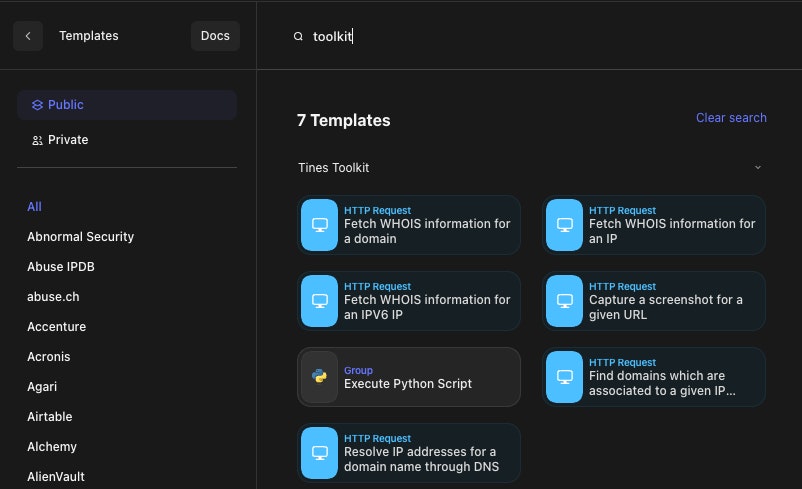
Tines is a workflow automation platform used widely in security operations to connect agents, teams, and tools. Its visual Storyboard builder lets teams design deterministic and agentic workflows without heavy coding, and it connects to any product that offers an API. Tines also includes case management and a universal AI copilot called Workbench for conversational actions such as looking up employee details or resetting accounts.
The platform supports human-led, deterministic, and agentic work, letting teams choose the right approach for a given task, from high-volume triage and routing to context-based decisions. Built with governance, guardrails, and monitoring across the workflow, Tines is used to automate SOC processes such as alert enrichment, ticketing, and incident response.
Key features include:
- Visual workflow builder: Uses the Storyboard builder to design deterministic and agentic workflows with little or no coding.
- Case management: Provides built-in case management with metrics such as time-to-detect and time-to-respond, plus SLA tracking.
- Workbench AI copilot: Offers a conversational copilot that can look up data and take actions such as resetting accounts across connected tools.
- Vendor-agnostic integration: Connects to any API-based product, including LLMs, MCP servers, and internal tools.
- Workflow flexibility: Supports human-led, deterministic, and agentic modes so teams can match the approach to the task.
- Governance and guardrails: Applies governance, guardrails, and monitoring across every surface of the workflow.
Limitations (as reported by users on G2):
- Learning curve: Reviewers report a challenging learning curve for complex automation, and that advanced functions can be hard to master.
- You build the workflows: The platform provides building blocks, so teams must create their own structures or playbooks, which can be daunting without a clear strategy.
- Reporting depth: Reporting focuses on metrics such as time saved and is noted as less detailed for tracking cases and outcomes.
- Cost for smaller teams: Users note pricing can feel expensive for smaller organizations as usage scales.

Source: Tines
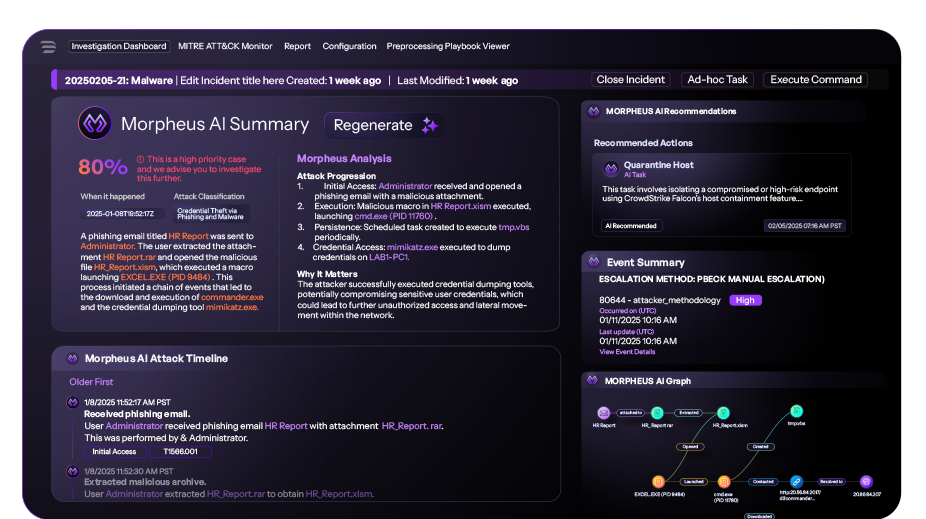
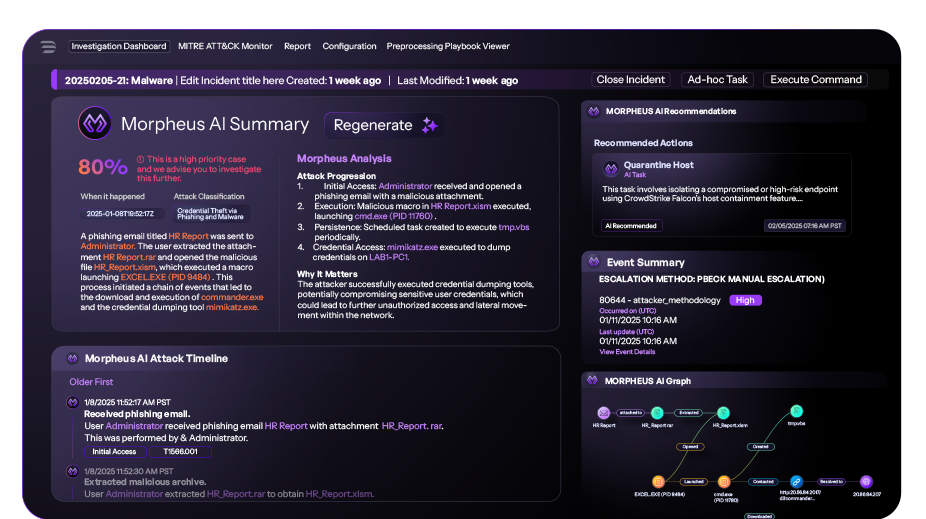
11. D3 Security Morpheus AI

Best for: Teams that want an AI SOC plus a full SOAR engine.
Strengths: Six capabilities, 800+ integrations, and configurable autonomy.
Things to consider: Reporting and admin UI noted; newer autonomous layer.
D3 Morpheus is an AI SOC platform for autonomous alert investigation and accountable response, built on D3 Security's SOAR heritage. It combines six coordinated capabilities, triage, investigation, response, self-healing integrations, agentic task, and autonomy modes, on one reasoning engine that produces a single audit trail per incident. It triages and investigates alerts to L2 depth and integrates with any SIEM, XDR, or security stack.
A Cybersecurity Triage Reasoning Graph handles alert triage, and Attack Path Discovery reconstructs the full attack timeline across connected tools, read-only by design. Response runs across more than 800 integrations with approval gates, four autonomy modes range from fully deterministic to end-to-end autonomous, and self-healing integrations detect vendor API changes and generate corrective code.
Key features include:
- Triage reasoning graph: Uses purpose-built reasoning to triage and L2-investigate the large majority of alerts within about two minutes, with no alerts silently closed.
- Attack Path Discovery: Reconstructs the full attack timeline across SIEM, EDR, identity, cloud, network, and email, backed by timestamped tool queries.
- Governed response: Executes actions such as blocking IPs, quarantining hosts, and disabling accounts across 800+ integrations, with approval gates by command-risk tier.
- Configurable autonomy modes: Offers four modes from deterministic to autonomous, configurable per workflow, tenant, or regulator on the same engine.
- Self-healing integrations: Detects vendor API changes and generates corrective code to keep connectors working.
- Unified audit trail: Produces one audit trail per incident across every capability and mode, mapped to frameworks such as SEC, NYDFS, HIPAA, NIS2, DORA, and the EU AI Act.
Limitations (as reported by users on PeerSpot):
- Reporting improvements: Reviewers note that custom reporting needs improvement and that MTTR and MTTD metrics require manual effort to surface in playbooks.
- Administrative interface: The administrative interface has been described as arcane and not well covered in documentation.
- Newer autonomous layer: While D3's SOAR is mature, Morpheus is the newer autonomous SOC layer, so its autonomous-SOC track record is shorter.
Source: D3 Security
Conclusion
AI SOC platforms like Prophet Security and its alternatives offer an effective way for security teams to scale by automating repetitive alert triage and investigation tasks using AI agents. By offloading these manual workflows, analysts can focus their expertise on high-value threats and proactive security initiatives. Organizations should consider their existing telemetry quality, integration needs, and requirements for human oversight when adopting this type of platform. An AI-driven approach to SOC workflows significantly improves operational efficiency and consistency across the security lifecycle.