
Intro to ARTEX
From time to time, we experience step changes within the defensive side of cybersecurity. In 2018, the big scare was a 400-line Python script named AutoSploit that let script kiddies find vulnerable machines using Shodan and automatically exploit them with Metasploit. Back then, it showed the importance of patching publicly accessible services and that relying on obscurity wasn’t a viable strategy. Now, over eight years later, we are facing something similar via LLM-powered penetration testing systems. AutoSploit used known vulnerabilities with public exploits, which showed the importance of timely patching. These LLM-powered systems don’t need a pre-written exploit. Instead, they operate more like a human operator. They can find other ways to compromise a machine, using credentials or even exploiting a 0-day vulnerability. One popular LLM-driven penetration framework is ARTEX.
ARTEX has already been around for a short time, but it has been used in compromises and attacks against many organizations. Recently, Barracuda Networks documented a breach within their own organization, starting with a lingering key given to a 3rd-party provider. The attacker used this single opening to escalate privileges within minutes. The attacker acquired new credentials, enabling an immediate jump to cloud accounts and then a data analytics system. From there, they got credentials to access and write to their code repositories. The attacker reached ten cloud accounts in 44 hours. They concluded that the attack was carried out using the LLM-driven penetration-testing framework called “ARTEX”
ARTEX was first published on GitHub in July 2026 by a developer using the handle “Autumn-27,” pitched as a tool for authorized penetration testing. After security vendors began linking it to real-world attacks, the developer pulled the repository on October 8, 2026, announcing that the ARTEX project would no longer be updated and would be converted to closed source. In theory, that should have ended public access. In practice, it made almost no difference.
On the same day the original disappeared, an English-translated copy appeared at BaaRai/ARTEX, describing itself as a fork of ARTEX by Autumn-27, an English translation of the Chinese source. As of November 24, 2026, that single copy had been forked more than 6,900 times and starred nearly 18,500 times. That works out to about 150 new forks a day on average, and on November 20 we measured roughly one new fork every two minutes. And this is just one copy among many: localized editions and rebranded variants are circulating too, including ScopeWeaver, an English and Korean localization with 880 forks of its own. Once a tool like this is public, it stays public.
ARTEX timeline of activity
Below is the known timeline of ARTEX activity. The latest entry is also the most alarming: on November 24, The New York Times reported that attackers had breached an unclassified open-source intelligence system used by the CIA and other US intelligence agencies, reportedly with the help of ARTEX. Officials say no classified information was affected, and ARTEX's role has not been officially confirmed.

ARTEX isn’t the first LLM-driven offensive security framework, and it isn’t the only one threat actors have adopted. Since early 2025, several open-source projects have wired large language models (LLMs) into ordinary penetration-testing tools, producing agents that can probe a target, try exploits, and adjust when something fails.
- HexStrike AI, open-sourced in July 2025. HexStrike uses the Model Context Protocol (MCP) to hook an LLM up to more than 150 existing security tools, so the agent can run Nmap or a vulnerability scanner without someone coordinating each step by hand. By September 2025, Check Point had seen threat actors talking about using it against freshly disclosed Citrix NetScaler vulnerabilities. Most of that was forum chatter and claims, though, not confirmed intrusions tied to a named group.
- PentAGI actually predates HexStrike (its GitHub repository was created on January 6, 2025) and leans much harder on autonomy. Specialized agents plan and run penetration-testing tasks in isolated Docker environments. Persistent memory and knowledge graphs mean an agent doesn’t forget what it found an hour ago; earlier findings feed into what it does next.
- Cairn is the one that has done real damage. It showed up in real intrusions in August and September 2026, and in November Palo Alto Networks Unit 42 disclosed that CL-STA-1238, a Chinese-speaking threat cluster, used a customized deployment in 25 operations against at least 19 organizations. Cairn works in a loop of reasoning and execution. Agents write confirmed findings and planned actions to a shared blackboard, and the plan changes as that picture fills in. Plenty of frameworks mainly sequence predefined tools. Cairn is organized around repeatedly observing the environment and deciding what to try next.
- CyberStrikeAI, whose repository dates to November 8, 2025, is written mostly in Go. It combines LLM orchestration with security tools, reusable workflows, evidence collection, and attack-chain analysis.
How does ARTEX’s footprint compare? We counted the other frameworks the same way, using each one’s own console favicon in Validin’s crawl data from June 1 to November 24, 2026. We found 2,317 PentAGI consoles, 1,055 CyberStrikeAI consoles, and 273 Cairn consoles, against 8,427 for ARTEX. In the final week of our data, more than four times as many ARTEX consoles were online (about 4,200) as PentAGI, CyberStrikeAI, and Cairn combined (about 800), even though ARTEX is the newest of the four. PentAGI and Cairn were already online before our data starts, so their totals are understated, and Cairn, the framework tied to the most confirmed damage, has very few consoles exposed at all. HexStrike AI can’t be counted this way: it runs as an API server with no web page for a crawler to see.
Threat actors
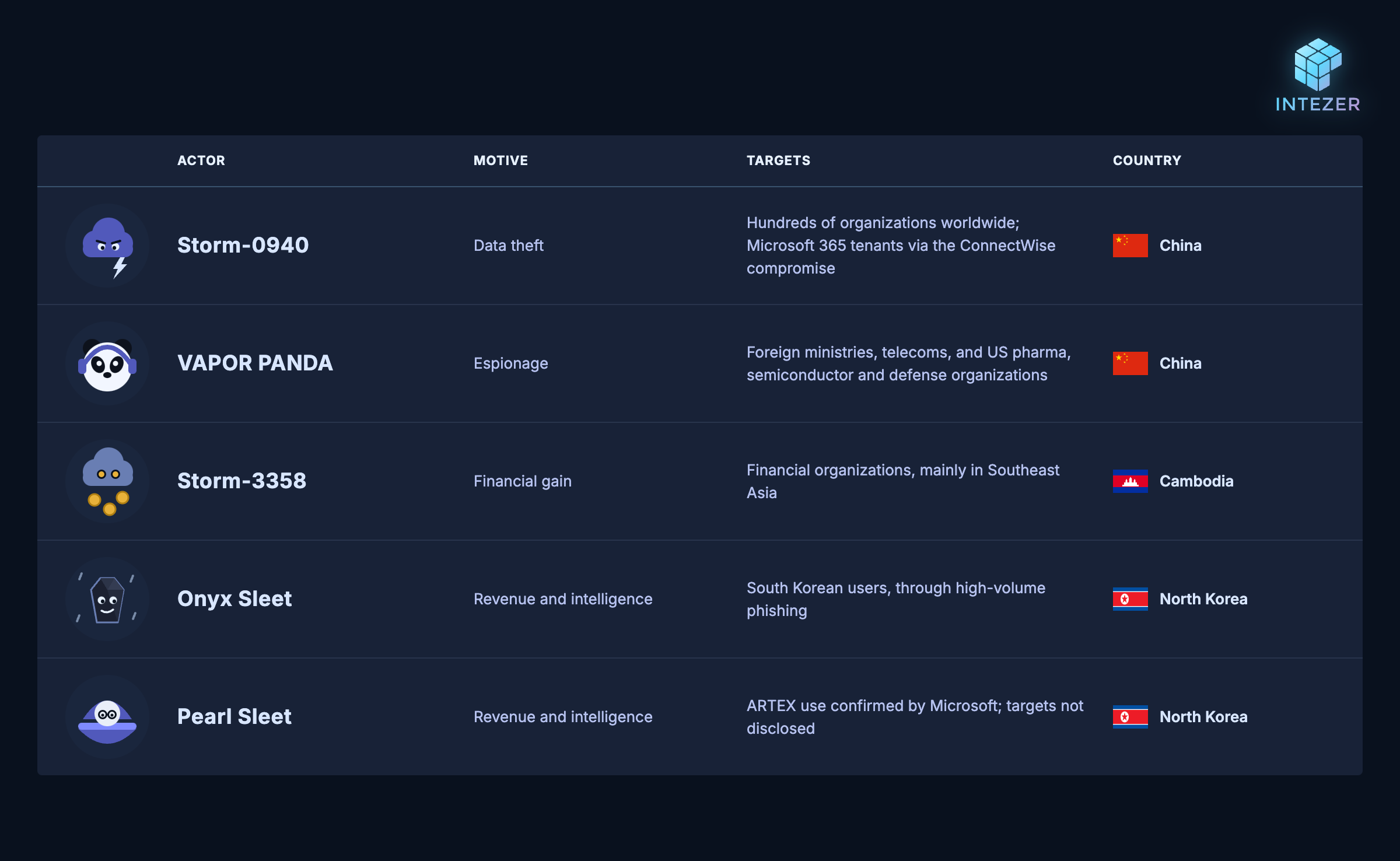
We already see different threat actors leveraging ARTEX as their orchestration platform for LLM-enabled attacks. We see not only financially motivated threat actors using these platforms, but also espionage-based actors adopting them. Generally, espionage-motivated groups prefer stealthier methods to maintain persistence longer. In contrast, financially motivated groups may put less effort into hiding because their goal is to reach the target as quickly as possible. Therefore, seeing espionage-based groups use platforms like ARTEX suggests they see value in these platforms.
Microsoft documented Storm-0940 (also tracked as UNC7228), a China state-aligned group, using ARTEX against hundreds of organizations across industries such as defense, government, technology, financial services, and manufacturing. One attack was the ConnectWise supply-chain compromise, where the actor used compromised application credentials to attempt authentication against more than 2,250 Microsoft 365 tenants by flooding them with 151,000 failed sign-in attempts. This highlights ARTEX’s behavior: using loud techniques such as password spraying and OAuth application abuse, rather than introducing a novel exploitation.
CrowdStrike reported that the China-nexus espionage group called VAPOR PANDA used ARTEX with DeepSeek and another commercial LLM to execute parallel intrusions against more than 200 organizations, including foreign ministries, defense contractors, semiconductor companies, and telecommunications providers. This matters because it shows an espionage actor pursuing strategic targets using ARTEX, not just opportunistic, financially motivated attackers.
The growing number of reports of more threat actors using ARTEX (and similar platforms) signals widespread adoption of LLM-based attack orchestrators. The challenge is real, and stakes are high.
The infrastructure
Threat actors must self-host the ARTEX console. It can be compiled into a single binary that can run on any server and only requires access to a PostgreSQL server. This makes ARTEX deployment straightforward. The “worker” that performs all actions runs in the same process as the console, and it doesn’t natively support tunneling traffic through an external proxy. This means OpSec falls on the console administrator. Given that ARTEX appeals to Script Kiddies, we expected plenty of OpSec failures with exposing the console publicly. By default, the console listens on port 8787, and that is where about three-quarters of the exposed consoles we found were sitting. Most of the rest were behind a reverse proxy on ports 443 or 80.

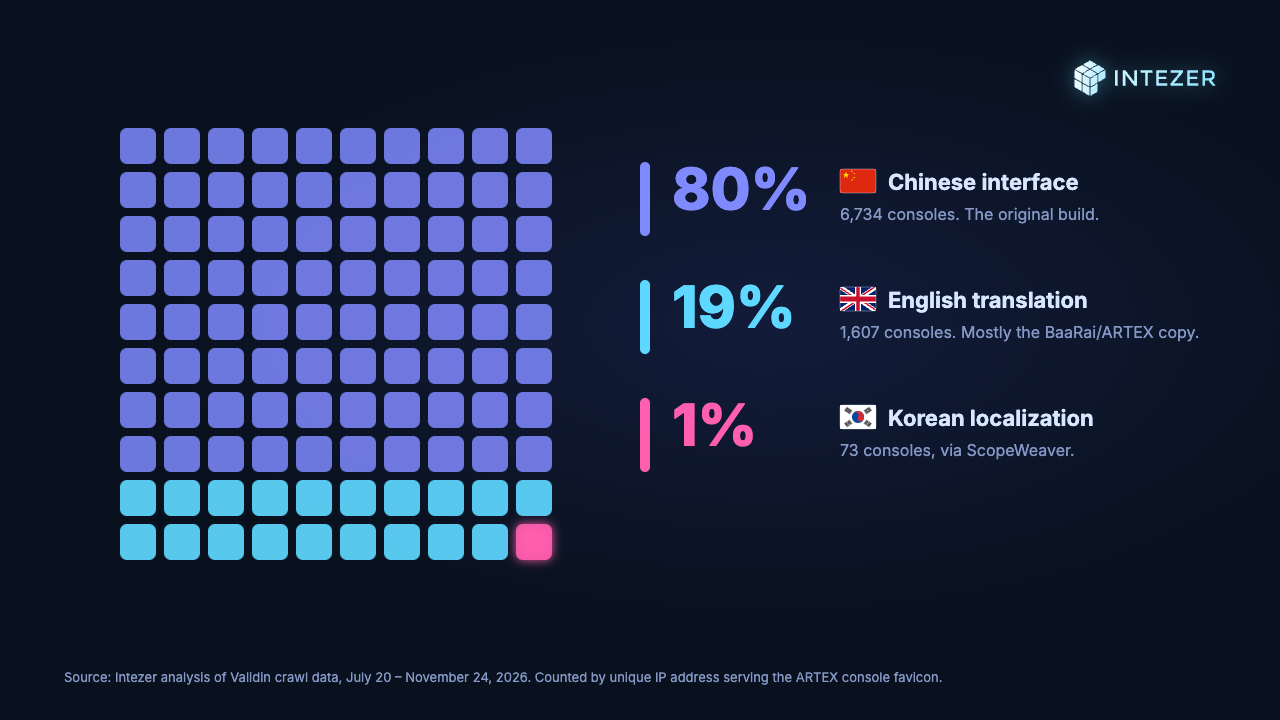
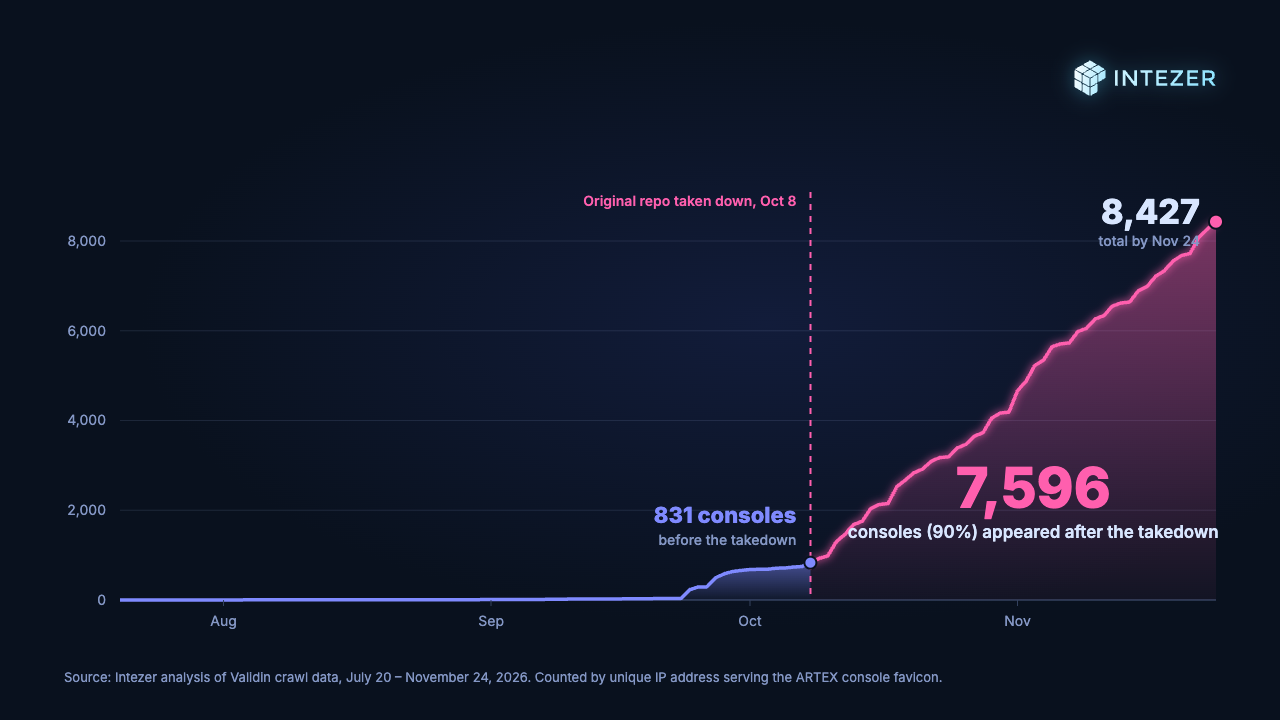
Console fingerprinting is pretty straightforward, because every ARTEX build, including the English translation and forks such as ScopeWeaver and ARTEX-Pro, ships the same favicon. Using Validin’s crawl history, we found 8,427 IP addresses serving an ARTEX console between late July and November 24, 2026, and about 4,200 of them were online in the final week of our data alone. Of the consoles with a readable title, 80% ran the Chinese-language interface, 19% the English translation, and about 1% a Korean localization. The title shows which build was deployed, not necessarily the operator’s language.
Four in five consoles ran the original Chinese build, and the English translation accounts for almost all the rest. A small Korean localization, delivered through the ScopeWeaver fork, makes up about 1%. Beyond that, people have renamed their copies in Chinese, English, Korean, and even French, from “Autonomous Pentest Agent” to “RedWolf”.
The takedown did nothing to slow this down. About 90% of these consoles first appeared after the original repository was pulled on October 8. New consoles went from fewer than 10 a week in August to between 900 and 1,300 a week after the takedown. Because we count IP addresses, a console that moves to a new server counts twice, and many of these consoles will belong to researchers and red teams rather than attackers. Still, the numbers show how far the tool has spread.
ARTEX also dwarfs the other AI hacking frameworks. Counting ARTEX and all its variants together, about 4,200 consoles were online in the final week of our data, more than four times as many as PentAGI, CyberStrikeAI, and Cairn combined.

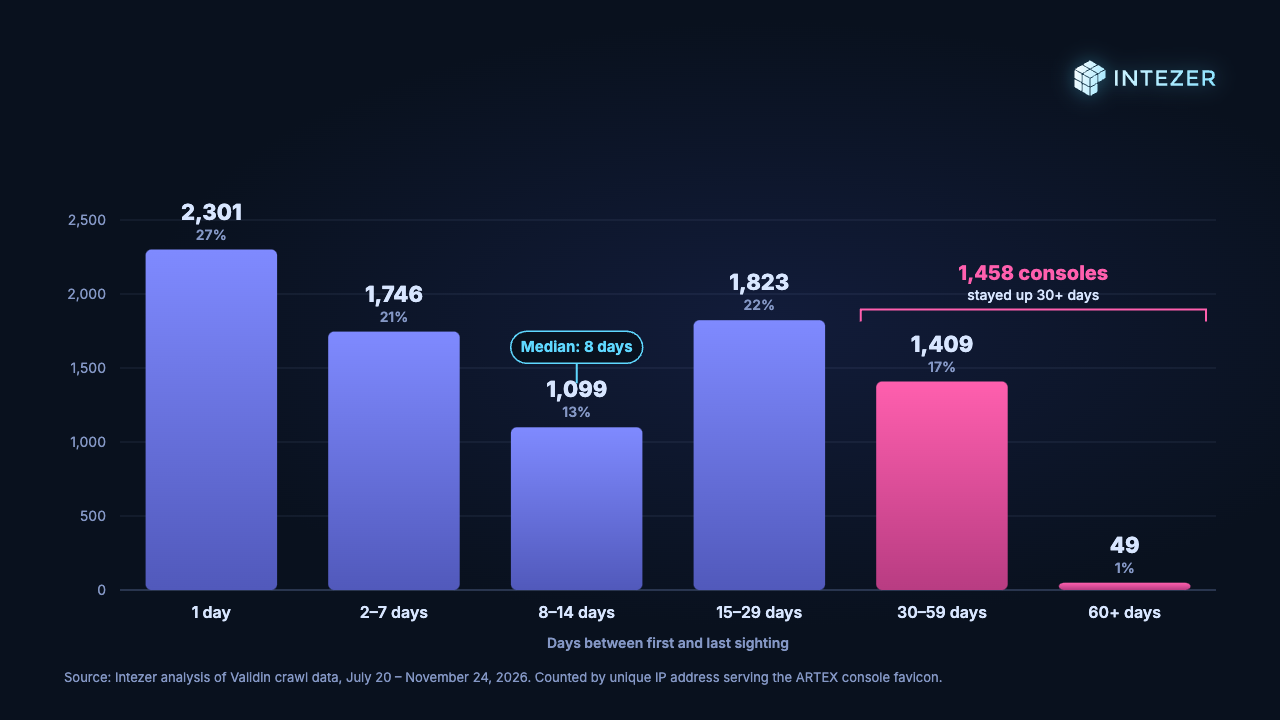
The figure below shows how long each console stayed publicly accessible. The largest single group, 27%, was seen only once, but the median console stayed up for 8 days, and 1,458 (17%) were reachable for 30 days or more. One long-lived server, 194.15.38[.]249, was reachable for 46 days. While this instance is using the English-translated build, we can attribute it to an operator based in China with medium confidence. Although this operator box has been live for some time, this IP address is not a reliable IOC. We expect all its attack traffic to go through a proxy, and it’s also confirmed that this IP address proxied its traffic while it hosted the ARTEX console.
What does this actually change?
ARTEX and similar frameworks aren’t doing anything groundbreaking. The novelty is using an LLM to drive the same tools attackers have used for years, such as Nmap, nuclei, curl, password sprayers, and web shells. As TrendAI put it, LLMs have increased attackers’ workforce, but the work still consists of looking for unlocked doors.
The attack lifecycle has not changed. A threat actor must start with reconnaissance and move to initial compromise to establish a foothold. While inside a compromised environment, the threat actor must escalate privileges, perform internal reconnaissance, move laterally, and maintain presence until they can complete the mission.
Defenders usually don’t detect the intrusion until after the initial compromise, once the threat actor has already established a foothold. This means defenders must detect and evict the threat actor during the loop where the threat actor moves within the network. The slower the threat actor moves in this loop, the more time defenders have. These LLM pentesting platforms allow threat actors to move through this loop much faster than any human can. Microsoft observed an agent go from finding leaked secrets on GitHub to exfiltrating data from Azure Key Vault in five minutes. Additionally, Storm-0940 reached privileged cloud access in under three hours. Barracuda’s attacker crossed about ten cloud accounts in 44 hours and had finished before anyone noticed.
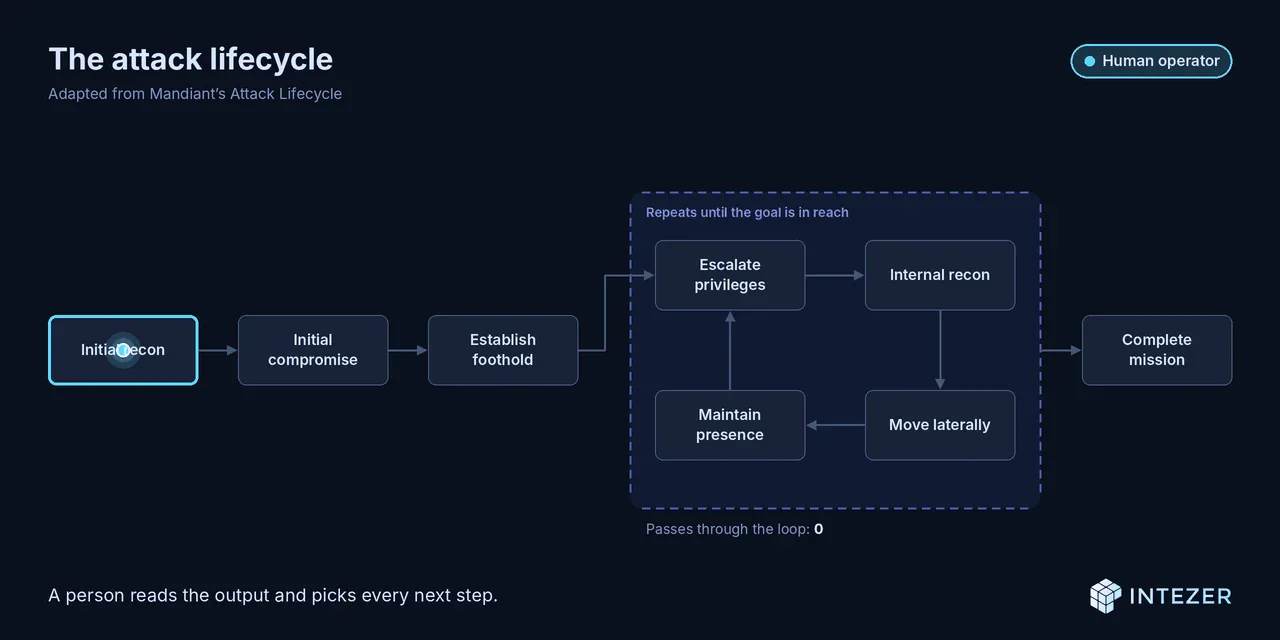
There are two benefits of using LLM-powered platforms like ARTEX. The first is that it lets unskilled threat actors (script kiddies) run attacks they otherwise wouldn’t know how to run. The other advantage is the speed. What they are not good at is doing it stealthily. That means its benefit is also its Achilles’ heel.
Its weakness? It’s really noisy.
ARTEX is fast, but it isn’t subtle. It works by trying everything, over and over, until something sticks. Storm-0940’s password spray alone produced more than 151,000 failed logons against just 327 accounts between October 10 and 14, all produced from the same IP address. Check Point found one ARTEX run against a crypto target that worked through 292 objectives and stole nothing. For every success, there’s a huge trail of failed attempts. Running down the street and checking every front door for an unlocked one, no matter how fast you are, should always raise someone’s suspicion.
That is good news. We have detection and prevention methods for most of the signals these frameworks produce. Many of these tools and methods have been around for decades. Fail2Ban is an open-source solution, first released in 2004, that blocks IP addresses after a determined number of failed authentication attempts. We do recognize that not every organization can run such a solution and that it is not a complete solution to the problem. We simply want to highlight that a two-decade-old product can still protect against these LLM-driven attacks. The general strategy against these attacks is good perimeter security. Know what you expose to the internet. Reduce the footprint if you can by, for example, restricting which IP addresses can connect to a service. Keep everything patched, and never use default or weak credentials. If you can, enforce MFA and use rate limits where possible. Use network segmentation and restrict credential use on perimeter devices to reduce the blast radius if a device gets compromised. None of this is new. What is new is how little slack you have if you skip it.
Self-sealing security
In the Second World War, a single bullet through a fuel tank could bring down an aircraft. A punctured tank leaked fuel, cut the plane’s range, and turned a minor hit into a fire. The fix wasn’t thicker armor, because you can’t stop every bullet. It was the self-sealing fuel tank. A layer of rubber inside the tank swelled when fuel soaked into it, closing the hole within moments. Planes that should have been lost made it home.
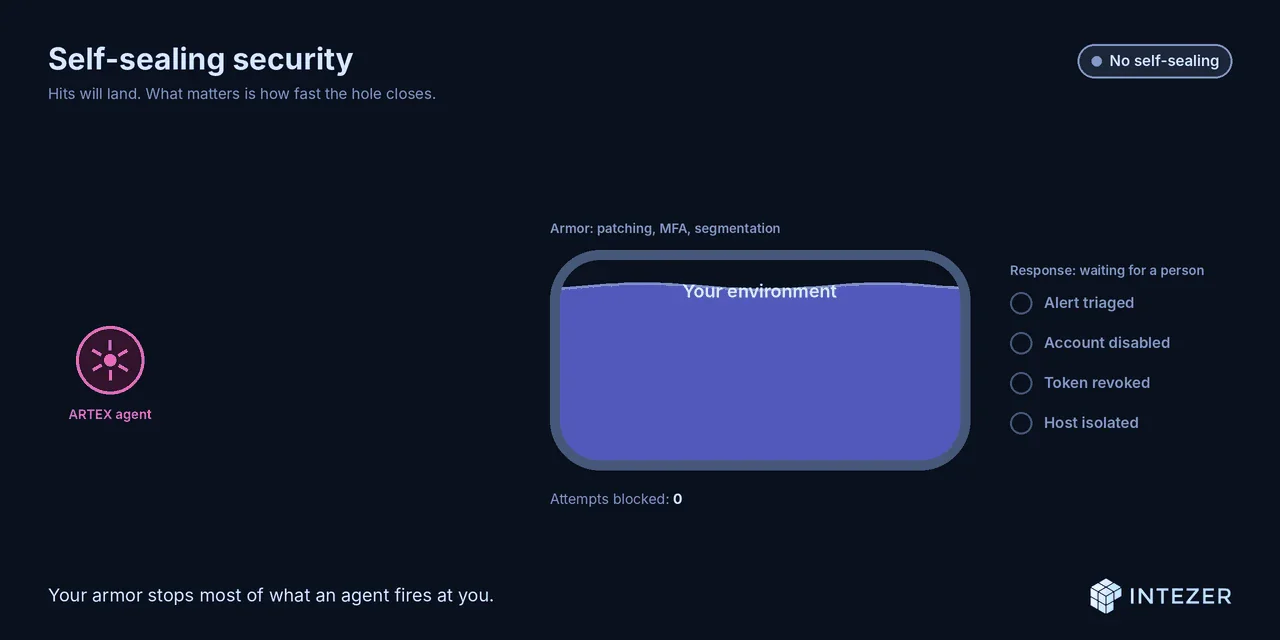
Defenders now face the same problem at machine speed. LLM-based frameworks like ARTEX fire attempts continuously, and across thousands of credentials, endpoints, and cloud accounts, some of them will land. Trying to stop every one is the thicker-armor approach. What matters is what happens in the minutes after a hit.
That’s the idea behind self-sealing security. When an attacker gets a foothold, the response has to start as fast as the attack does. Alerts get triaged automatically, compromised accounts are disabled, tokens are revoked, and hosts are isolated, without waiting for someone to read a ticket in the morning. Breaches still happen, but the hole closes before the attacker can work through the loop.
That’s the job of an AI SOC. A seal only works if it reacts as fast as the hit, and no human team can investigate every alert within minutes, around the clock. An AI SOC can. It investigates each alert the moment it fires, separates the real breach from the noise, and kicks off containment while a person would still be opening the ticket. Analysts stay in charge of the calls that need human judgment, but the hole starts closing right away.

The Intezer Research Team
In this article
Share article
Related Articles
Research
AI SOC
6 min
AI hacking has reached escape velocity
ARTEX puts AI-driven attacks in thousands of hands. Its speed is also its weakness, and self-sealing security can use that.

AI SOC
Threat Hunting
4 min
Agentic attacks run on a new operating model. Most SOCs don’t (yet).
If ARTEX hit your network tomorrow, your analysts would recognize every step of the attack. They just wouldn't get to any of it in time.
AI SOC
Incident Response
4 min
Google says AI attackers just crossed a threshold. We say the SOC has to cross it too.
Attackers now run intrusions with no human in the loop. The answer to autonomous offense is more than faster patching or another layer of AI detection. It is a SOC that investigates every signal those agents leave behind, at the depth needed to prove what happened.