
Best MDR with High Detection Fidelity: Top 14 in 2026
In this article

TL;DR: MDR detection fidelity measures how accurately an MDR service identifies real threats while filtering noise. Intezer leads with autonomous AI investigation; Red Canary, CrowdStrike Falcon Complete, and Sophos MDR are strong choices for high-fidelity detection across different environments.
What Is MDR Detection Fidelity?
MDR (Managed Detection and Response) detection fidelity refers to the accuracy and actionable quality of security alerts, distinguishing genuine, malicious threats from noisy, false positives. High-fidelity MDR reduces alert fatigue by leveraging human expertise, AI-driven analytics, and 24/7 monitoring to validate, prioritize, and contextually analyze threats, ensuring rapid, effective response.
Key aspects of high-fidelity MDR detection include:
- Contextual analysis and validation: Human analysts investigate raw telemetry and alerts (from EDR, NDR, etc.) to confirm true positives, minimizing false positives and providing actionable intelligence.
- Reduced noise: Quality MDR providers focus on high-fidelity, decision-ready alerts rather than raw alert volume, allowing security teams to focus on critical threats.
- Continuous tuning: MDR providers constantly update detection analytics, rulesets, and threat intelligence to identify evolving threats.
- Threat intelligence integration: Utilizing curated, global intelligence to detect early-stage and advanced persistent threats.
- Comprehensive coverage: Integrating data from endpoints, network, cloud, and identity systems to provide visibility across the entire attack surface.
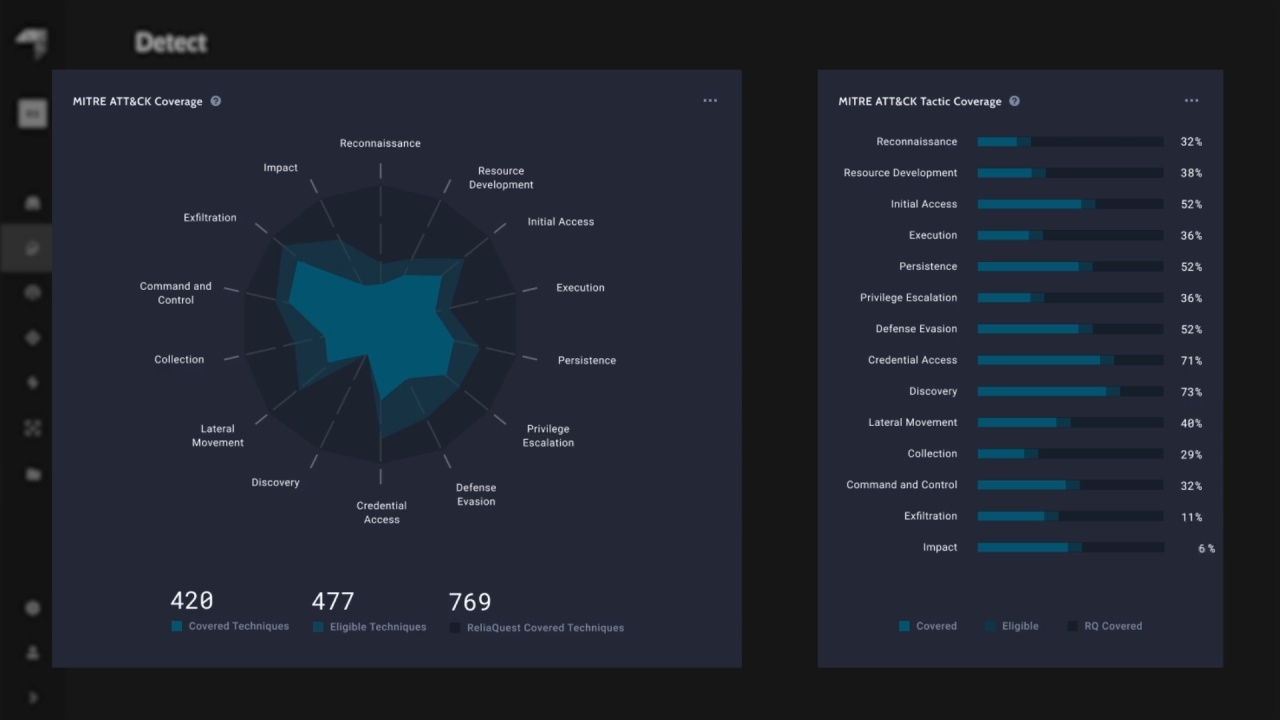
- MITRE ATT&CK mapping: High-fidelity detections are often mapped to the MITRE ATT&CK framework, ensuring alerts correspond to specific adversarial tactics, techniques, and procedures (TTPs).
This is part of a series of articles about MDR security
MDR Solutions At a Glance
The table below summarizes the key differences between the MDR solutions covered in this article. We explore each in more detail in the sections that follow.
| Solution | Category | Best For | Key Strengths | Things to Consider |
|---|---|---|---|---|
| Intezer | AI-Native MDR Platforms | Enterprise SOCs needing 100% alert coverage with autonomous AI investigation | ForensicAI-powered triage, 98% accuracy, closed-loop detection engineering | Focused on AI-led investigation; less suited for organizations wanting fully outsourced human analyst coverage |
| CrowdStrike Falcon Complete | AI-Native MDR Platforms | Organizations requiring agentic MDR with sub-minute containment across all attack surfaces | 1-minute MTTC, 2.7M detections resolved monthly, agentic AI with human oversight | Adds cost when adding modules; complexity for beginners |
| SentinelOne Wayfinder MDR | AI-Native MDR Platforms | Singularity Platform users wanting AI-driven MDR backed by Google Threat Intelligence | Google Threat Intelligence integration, $1M breach warranty, 100% MITRE detection | Best value when already on the Singularity Platform; tuning required to reduce false positives |
| Microsoft Defender Experts for XDR | AI-Native MDR Platforms | Microsoft-centric environments needing expert-managed XDR across the Defender suite | Deep Defender integration, 600+ analyst years experience, managed response with on-demand access | Limited to Microsoft Defender ecosystem; advanced features require E5 licensing |
| Red Canary | MDR with Human-Led Investigation | Teams prioritizing verified, high-confidence detections with a 99%+ true positive rate | 99%+ true positive rate, detection-as-code methodology, vendor-agnostic integrations | Limited custom detection creation; alert volume can be high in some environments |
| eSentire | MDR with Human-Led Investigation | Organizations needing multi-signal MDR with deep Microsoft ecosystem integration | 500+ integrations, multi-signal coverage (endpoint, network, cloud, identity), multi-year SOC expertise | Higher pricing compared to some competitors; response time on non-critical issues can be slower |
| Expel | MDR with Human-Led Investigation | Security teams prioritizing transparency, fast onboarding, and cross-product automation | 17-minute MTTR, Workbench transparency platform, 160+ API integrations | Threat hunting is an add-on, not included in base MDR; some customers prefer more hands-on guidance |
| ReliaQuest GreyMatter | MDR with Human-Led Investigation | Large enterprises managing fragmented security stacks needing unified agentic AI investigation | 400+ integrations, 5-minute containment, agentic AI with 200+ agent skills | High cost; initial log source configuration is complex and time-intensive |
| Sophos MDR | Broad-Coverage MDR Services | Organizations of any size wanting a fully managed, AI-assisted SOC with no incident response caps | 350+ integrations, AI resolves 52% of cases in 89 seconds, breach protection warranty | Initial setup and fine-tuning can be complex; deeper controls favor organizations fully in the Sophos ecosystem |
| Arctic Wolf | Broad-Coverage MDR Services | Teams wanting proactive MDR that focuses on reducing attack frequency, not just responding | Concierge Security Team model, Aurora Platform with 200+ integrations, open XDR architecture | Requires replacing existing SIEM; response ownership can fall back to internal teams per some reviews |
| Rapid7 MDR | Broad-Coverage MDR Services | Enterprises needing customizable MDR with built-in exposure management context | Exposure-aware MDR, unlimited DFIR included, custom detection engineering for enterprise | Cloud container/runtime coverage still maturing; pricing can be high for smaller organizations |
| Huntress Managed EDR | Broad-Coverage MDR Services | SMBs and MSPs needing accessible, affordable managed EDR with 24/7 human-assisted SOC | 8-minute MTTR, 24/7 AI-assisted SOC, easy MSP deployment, works alongside Microsoft Defender | Limited customization and reporting options compared to enterprise MDR platforms; Mac compatibility still maturing |
| Secureworks Taegis MDR | Broad-Coverage MDR Services | Organizations wanting open XDR-based MDR with deep threat intelligence built over 20+ years | 5 trillion events processed weekly, 24/7 live chat SOC access, open XDR platform | Alert noise can require manual tuning; complex to deploy in hybrid environments; product roadmap uncertainty following Sophos acquisition |
| Palo Alto Unit 42 MDR | Broad-Coverage MDR Services | Existing Palo Alto Networks customers wanting fully integrated MDR with Unit 42 threat intelligence | Unit 42 threat intelligence (500B daily events), Cortex XSIAM integration, 2x faster MTTD vs. average | Tightly coupled to the Palo Alto ecosystem; high total cost when stacking Cortex XDR, Data Lake, and MDR fees |
Why Detection Accuracy Is Central to MDR Performance
A key factor in evaluating MDR effectiveness is how accurately it detects real threats. Detection accuracy directly affects how security teams prioritize and respond to incidents, making it a central performance metric for MDR services:
- Reduces alert fatigue: High detection accuracy limits false positives. Analysts spend less time investigating harmless events and more time addressing real threats.
- Improves response time: When alerts are reliable, teams can act faster. There is less need for validation, which shortens the time from detection to containment.
- Minimizes missed threats: Accurate detection also reduces false negatives. This helps prevent real attacks from going unnoticed.
- Enhances resource efficiency: Security teams often operate with limited resources. Accurate alerts help allocate time and tools more effectively.
- Builds trust in the MDR service: Consistent, accurate detection increases confidence in the MDR provider. Teams are more likely to rely on alerts without second-guessing them.
- Supports better decision-making: High-quality detection data improves incident analysis and long-term security planning.
- Strengthens overall security posture: Accurate detection leads to faster remediation and fewer successful attacks.
Related content: Read our guide to how to choose MDR services
False Positives in MDR: What They Are and Why They Matter
False positives in MDR are alerts generated by security systems that incorrectly identify benign activity as malicious. These occur when detection rules, signatures, or algorithms are too sensitive or lack sufficient context, causing normal user or system behavior to be flagged as suspicious. While caution is important, excessive false positives can overwhelm analysts and obscure genuine threats.
The impact of false positives extends beyond wasted time. High rates of false alarms can desensitize security teams, leading to alert fatigue and causing real incidents to be overlooked or dismissed. Over time, this erodes trust in the MDR service and may prompt organizations to ignore or disable certain alerts. Effective MDR solutions must minimize false positives without sacrificing the ability to detect true threats.
Low-Quality vs. High-Quality MDR Alerts
Low-quality MDR alerts are characterized by a lack of actionable information, limited context, and a high likelihood of being false positives. These alerts may be triggered by broad detection rules or incomplete data, requiring analysts to spend additional time investigating and validating each event. The result is an inefficient workflow where the signal-to-noise ratio favors noise, leading to frustration and missed threats.
High-quality MDR alerts are precise, context-rich, and actionable. They provide sufficient information, such as the nature of the threat, affected assets, and recommended response steps, enabling analysts to assess the severity and relevance of each incident. High-quality alerts result from detection logic, contextual analysis, and continuous tuning, which improve SOC performance and security outcomes.
Key Aspects of High-Fidelity MDR Detection
Contextual Analysis and Validation
The contextual analysis process involves correlating raw security events with additional information such as user behavior, asset value, and historical activity. By examining events within their broader context, MDR solutions can differentiate between legitimate activity and potential threats with greater accuracy.
For example, an unusual login may be flagged, but contextual data, such as known travel schedules or recent password changes, can help determine if the alert is a true positive. Validation involves human analysts who review suspicious events before escalating them as confirmed incidents. This human-in-the-loop approach ensures that only vetted, high-confidence alerts reach the organization’s response teams.
Reduced Noise
Reduced noise in MDR refers to minimizing irrelevant or low-value alerts. This is achieved through filtering, machine learning, and ongoing refinement of detection rules. By prioritizing quality over quantity, MDR solutions help security teams focus on genuine threats that require action, while avoiding distractions from benign events.
Noise reduction also involves tuning the system to the organization’s environment and risk profile. Generic detection often leads to excessive noise, whereas tailored configurations ensure that relevant threats are surfaced. The result is a more efficient SOC and improved analyst productivity.
Continuous Tuning
Continuous tuning is the process of updating and refining detection logic to adapt to evolving threats and changes in the organization’s environment. As attackers develop new tactics, techniques, and procedures (TTPs), MDR services adjust detection rules, models, and thresholds to maintain fidelity. This process ensures that the system remains effective against known and emerging threats.
Continuous tuning also incorporates feedback from analysts and incident response teams, who identify which alerts are valuable and which are not. By incorporating this feedback, MDR providers reduce false positives and negatives and improve detection accuracy. Without continuous tuning, MDR solutions become outdated over time.
Threat Intelligence Integration
Threat intelligence integration improves detection fidelity by incorporating current information about adversaries, indicators of compromise (IOCs), and attack campaigns. This intelligence enables MDR systems to detect threats specific to the organization’s industry, region, or technology stack. By using real-world data, detection logic becomes more precise and adaptive.
Integration of threat intelligence also supports proactive threat hunting and alert enrichment. When an alert is correlated with external intelligence, analysts can assess its relevance and potential impact more quickly. This improves detection accuracy and supports faster response actions.
Comprehensive Coverage
Comprehensive coverage in MDR means monitoring endpoints, networks, cloud environments, and user activity. High-fidelity detection requires visibility across relevant assets and data flows, as attackers can exploit gaps in coverage to evade detection. This ensures that threats are identified regardless of where they originate or how they move within the organization.
Achieving comprehensive coverage involves integrating telemetry from multiple sources and normalizing data for analysis. A unified data set improves event correlation and helps identify complex attack patterns, reducing blind spots and strengthening detection effectiveness.
MITRE ATT&CK Mapping
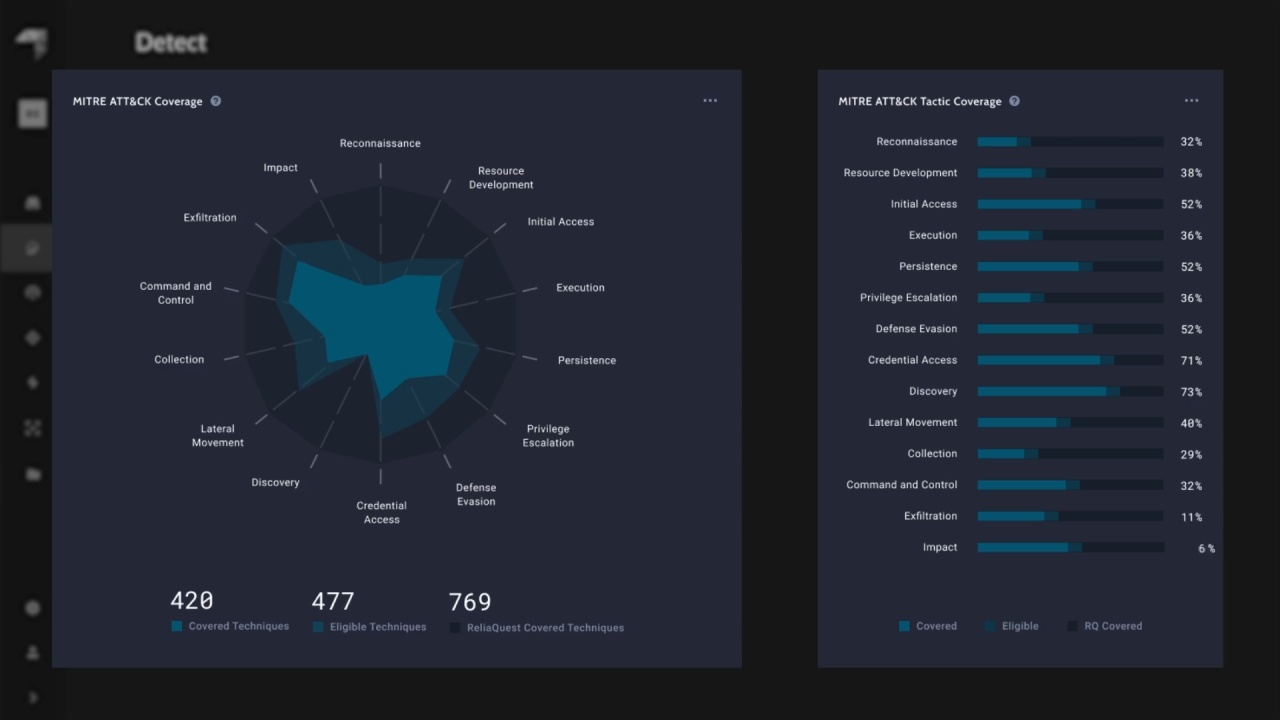
MITRE ATT&CK mapping aligns detection logic and alerts with the ATT&CK framework’s catalog of adversary tactics, techniques, and procedures. This mapping provides a standardized way to assess detection capabilities and coverage against a range of threats. MDR services that use ATT&CK mapping can show which attack techniques are detectable and where gaps exist.
ATT&CK mapping also supports targeted threat hunting and incident response. When an alert is tied to a defined ATT&CK technique, analysts can determine the nature of the threat and apply appropriate countermeasures. This structured approach keeps detection aligned with real-world attacker behaviors and industry practices.
Related content: Read our guide to MDR solutions with machine learning
Key Metrics for Measuring MDR Detection Fidelity
Detection Performance Metrics
Detection fidelity is evaluated through measurable indicators. The following metrics focus on how well the MDR service identifies true threats and filters out noise at the detection layer:
- True positive rate (TPR): Percentage of real threats correctly detected.
- False positive rate (FPR): Percentage of benign events incorrectly flagged as threats.
- False negative rate (FNR): Percentage of missed threats.
- Precision (positive predictive value): Proportion of alerts that are malicious.
- Detection latency: Time between threat occurrence and detection.
- Coverage across attack techniques: Measured against frameworks like MITRE ATT&CK.
- Alert confidence scoring accuracy: Alignment between severity or confidence levels and actual risk.
SOC Efficiency Metrics
SOC efficiency metrics focus on how detection quality affects analyst workflows and operations:
- Alert-to-incident ratio: Number of alerts required to produce one confirmed incident.
- Mean time to triage (MTTT): Time required to assess an alert.
- Mean time to respond (MTTR): Time from detection to containment.
- Analyst time per alert: Average effort spent investigating each alert.
- Escalation rate: Percentage of alerts escalated for deeper investigation.
- Alert backlog volume: Number of unprocessed alerts.
- Automation effectiveness: Portion of alerts resolved without manual intervention.
Outcome-Based MDR Metrics
Outcome-based metrics measure the real-world impact of detection fidelity:
- Incident confirmation rate: Percentage of alerts that become validated incidents.
- Attack dwell time: Time attackers remain undetected in the environment.
- Breach rate: Number of successful attacks over time.
- Missed incident rate: Incidents discovered outside the MDR workflow.
- Response success rate: Percentage of incidents contained without escalation or damage.
- Business impact reduction: Measured in downtime, data loss, or financial cost avoided.
- Customer-reported vs. MDR-detected incidents: Ratio of externally reported issues to internally detected ones.
Notable MDR Solutions for Detection Fidelity
How we selected these solutions: We shortlisted MDR solutions based on detection accuracy capabilities, threat investigation methodology, alert fidelity management, telemetry coverage breadth, and presence across major analyst reports and industry review platforms.
AI-Native MDR Platforms
1. Intezer

Best for: Enterprise SOCs requiring 100% alert coverage with autonomous AI investigation at forensic depth.
Strengths: ForensicAI-powered triage across all alert types; closed-loop detection engineering; 98% accuracy rate.
Things to consider: Focused primarily on augmenting internal SOC teams with AI; less suited to organizations that want traditional fully-outsourced MDR with dedicated human analyst teams.
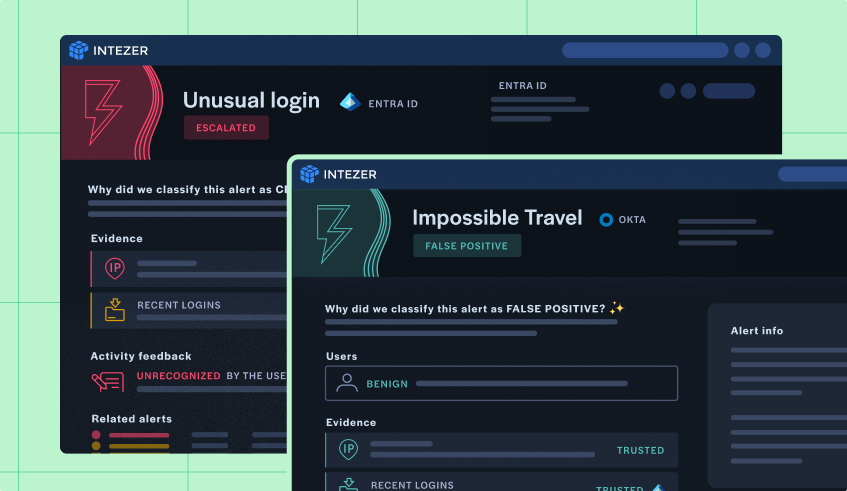
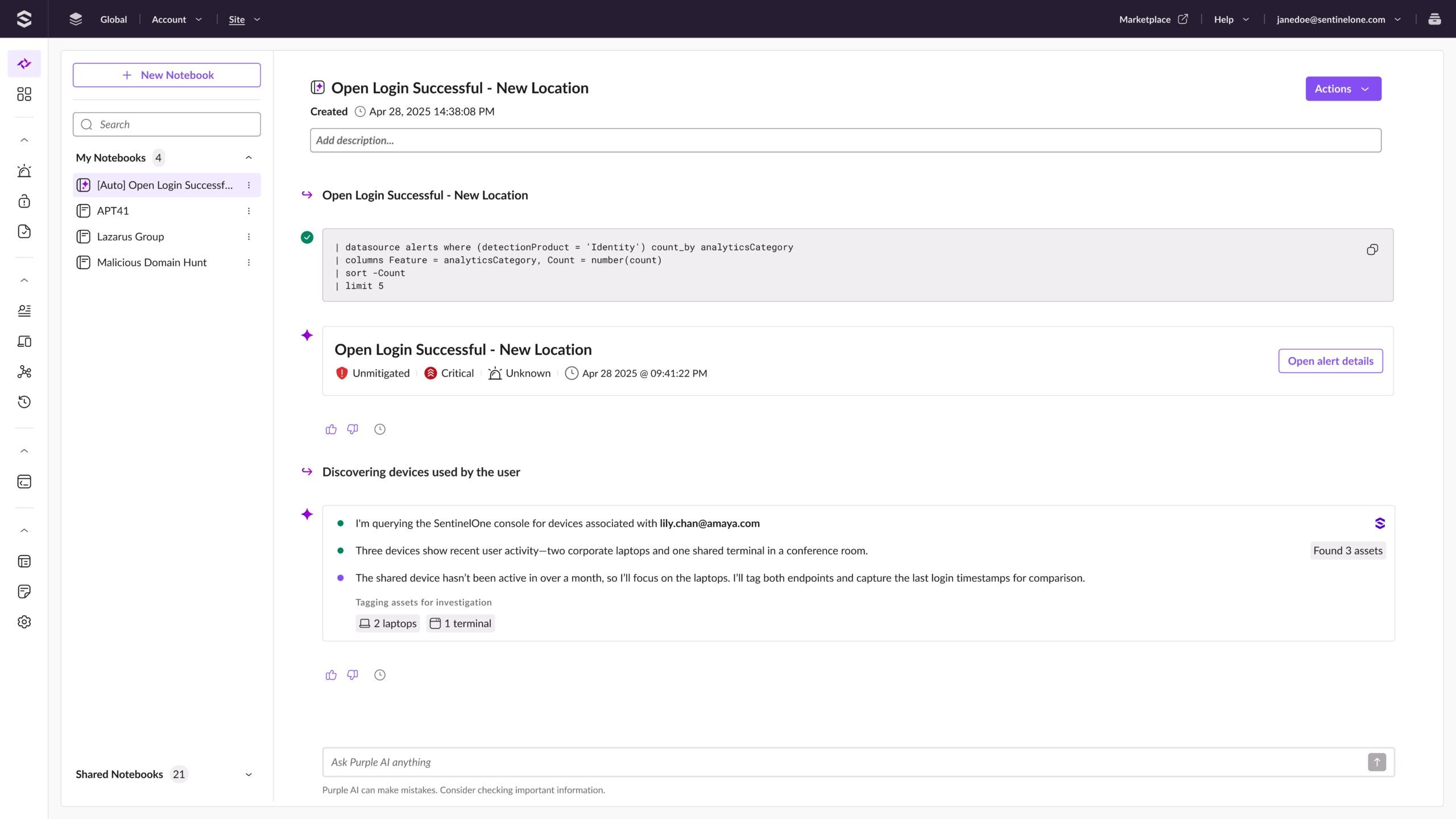
Intezer is an AI SOC platform that automates the complete alert triage process, acting as an extension of an internal security team. Powered by ForensicAI, the platform investigates every alert at forensic depth, collecting evidence from endpoint memory, files, URLs, and behavioral indicators, and escalates only confirmed threats requiring human action. Across enterprise deployments, Intezer resolves roughly 98% of alerts autonomously, with an average escalation rate of 2% and a triage time of under five minutes.
Key features include:
- Autonomous forensic investigation: The platform conducts multi-artifact investigations across endpoint memory, file analysis, URL scanning, and behavioral signals for each alert, producing a detailed verdict with evidence and recommended remediation steps, without waiting for an analyst to begin.
- Closed-loop detection engineering: Investigation outcomes are automatically fed back into SIEM and EDR detection rule refinement, continuously improving signal quality and reducing false positives over time. This contrasts with traditional MDR models where detection rules are managed separately from investigation workflows.
- Multi-source alert coverage: Intezer connects to endpoints, SIEMs, SOAR platforms, email security pipelines, cloud workload monitors, and identity tools simultaneously, providing unified alert coverage regardless of where a threat originates.
- On-demand expert access: Customers can access Intezer's security researchers and analysts directly for complex investigations, high-severity incidents, or guidance on emerging threats, without fixed escalation tiers or additional service contracts.
- MSP and enterprise deployment models: The platform is available for internal enterprise SOC teams and as an embedded capability for managed service providers (MSSPs), with deployment and integration completed within hours.
Limitations:
- Requires mature telemetry to work. Investigation quality depends on the customer’s existing EDR/SIEM health. Organizations with immature tooling won’t get full value out of the box.
- MITRE ATT&CK coverage has a realistic ceiling with Intezer benchmarking 60–70% as “top-tier” and flags anything higher as likely inflated. Some technique categories remain outside reliable coverage for any vendor.
- Focused on enterprise-size customers with a minimum of 1,000 employees.
Source: Intezer
2. CrowdStrike Falcon Complete Next-Gen MDR

Best for: Organizations requiring agentic MDR with sub-minute containment and elite analyst oversight across endpoint, cloud, identity, and third-party data.
Strengths: 1-minute median time to contain; agentic AI combined with human analyst validation; 2.7 million detections resolved monthly.
Things to consider: Pricing increases as modules are added; advanced features and the broader Falcon platform can feel overwhelming for teams new to the product.
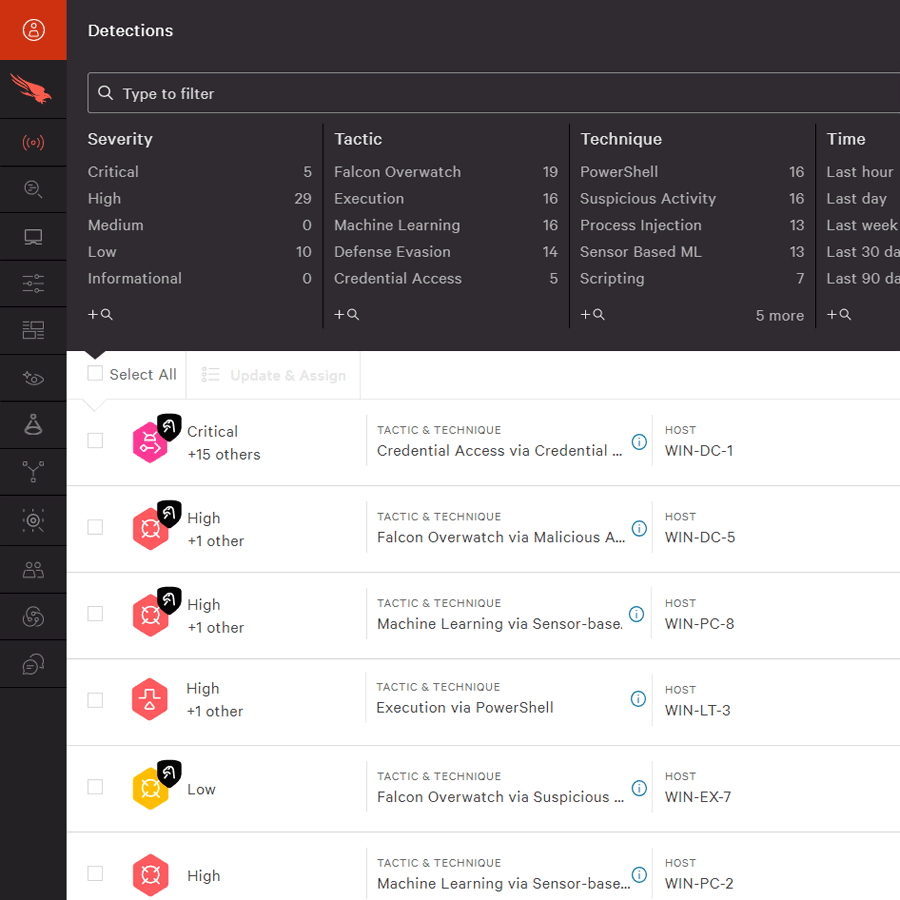
CrowdStrike Falcon Complete Next-Gen MDR is a fully managed detection and response service built on the Falcon platform, combining deterministic automation, adaptive AI agents, and 24/7 human analyst oversight. The service operates across endpoints, identity systems, cloud workloads, and third-party data ingested through Falcon Next-Gen SIEM. CrowdStrike's global follow-the-sun model means analysts and AI agents are active continuously, with the AI layer handling routine response actions, while human analysts validate decisions.
Key features include:
- Agentic MDR workflow: Falcon Complete combines three layers of response: Deterministic automation for proven, repeatable actions; adaptive AI agents that learn from new signals and collaborate across workflows; and human experts who validate outcomes and manage complex remediations in real time.
- Cross-domain threat visibility: The service ingests telemetry from endpoints, cloud workloads, identity systems, and third-party tools via Falcon Next-Gen SIEM, providing correlated detection across the full attack surface rather than individual domains.
- Elite threat intelligence integration: CrowdStrike's Adversary Overwatch threat hunters apply frontline intelligence from global adversary tracking to proactively identify threat actor behaviors that automated detection alone may miss. This intelligence continuously updates detection logic and containment playbooks.
- Falcon Complete Hub: A centralized visibility layer within the MDR service that gives security teams and leadership unified insight into MDR operations, active investigations, and performance metrics, enabling teams to track what the service is doing without needing to navigate the full Falcon console.
- Surgical remediation: Beyond detection and containment, CrowdStrike analysts provide hands-on remediation actions, including file removal, registry key restoration, and endpoint isolation, with the goal of restoring normal operations after a breach without further damage.
Limitations (as reported by users on G2):
- Pricing structure: The modular pricing model means costs can rise significantly as organizations add capabilities, which is a concern particularly for mid-sized organizations or those needing multiple Falcon modules simultaneously.
- Complexity for new users: Advanced features and the breadth of the Falcon platform can be difficult to navigate for teams without prior CrowdStrike experience, requiring a learning investment before teams fully leverage the platform.
- Onboarding time: Initial setup and user onboarding can take longer than expected, and offboarding users from the console also requires a multi-step process that some administrators find cumbersome.
Source: CrowdStrike
3. SentinelOne Wayfinder MDR

Best for: Organizations on the Singularity Platform wanting AI-driven MDR with Google Threat Intelligence and expert-led threat hunting.
Strengths: Google Threat Intelligence integration; $1M breach warranty for undetected breaches; 100% detection in MITRE ATT&CK evaluations.
Things to consider: Maximum value for teams already running the Singularity Platform; initial tuning period may be needed to reduce false positives in some environments.
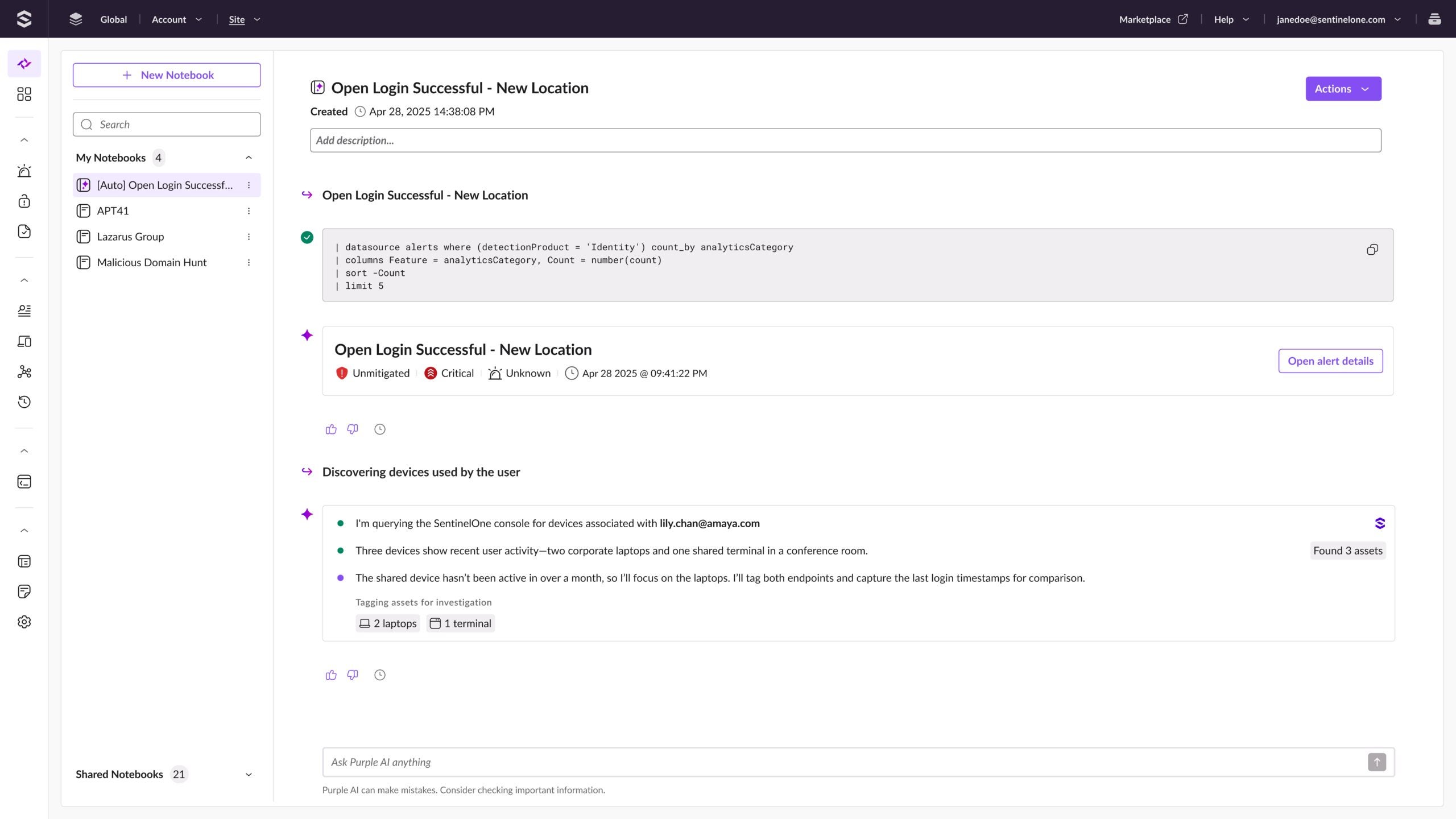
SentinelOne Wayfinder MDR is a 24/7/365 managed detection and response service operating natively on the Singularity Platform. It combines curated threat intelligence from both SentinelOne and Google Threat Intelligence with expert human analysts and AI-driven automation to deliver detection, investigation, containment, and remediation.
Key features include:
- Google Threat Intelligence integration: Wayfinder's threat hunting and detection are powered by the combined intelligence of SentinelOne's proprietary telemetry and Google Threat Intelligence, enabling detection of emerging adversary infrastructure and newly identified indicators of compromise ahead of broad public disclosure.
- AI-driven alerting and triage with curated intelligence: MDR Essentials combines AI-powered alert prioritization with curated intelligence feeds to reduce noise and surface high-confidence threats, delivering rapid containment without requiring customers to expand internal teams.
- Dedicated Threat Advisors (Elite tier): MDR Elite customers receive assigned Threat Advisors who provide tailored operational guidance, threat briefings, and emerging threat updates aligned to the customer's environment and risk profile, available on demand rather than on a scheduled basis only.
- Singularity Platform integration: The MDR service operates natively within the Singularity Platform, eliminating the fragmented workflows that can occur when an MDR layer is grafted onto a different underlying technology. Response actions, hunting queries, and forensic analysis all occur within the same console.
- Incident Readiness and Response: Wayfinder MDR Elite customers can access DFIR retainers covering compromise assessments, breach readiness exercises, and 24/7 emergency response, allowing the same partner managing their MDR to handle active incident response without needing to onboard a separate IR firm.
Limitations (as reported by users on Gartner Peer Insights):
- False positive tuning period: Some users note an initial period during which the detection engine can be overly aggressive, flagging legitimate business applications and developer tools as suspicious, requiring configuration adjustments and exception management before alert quality stabilizes.
- Platform dependency: The MDR service is tightly coupled to the Singularity Platform, which means organizations not already running SentinelOne as their endpoint and XDR platform face a more significant migration before the service becomes operational.
- Support consistency: While overall support ratings are high, some reviewers note variability in communication frequency, with regular check-ins reported as quarterly rather than more frequent for standard tier customers.
Source: SentinelOne
4. Microsoft Defender Experts for XDR

Best for: Microsoft-centric organizations needing expert-managed XDR across the full Defender suite with on-demand analyst access.
Strengths: Native integration across all Microsoft Defender products; 600+ analyst years of combined experience; managed response available 24/7 via live chat.
Things to consider: Coverage is limited to the Microsoft Defender ecosystem; advanced response capabilities require E5 licensing; most beneficial for organizations already standardized on Microsoft security tools.
Microsoft Defender Experts for XDR is a managed extended detection and response service delivered by Microsoft's own security analysts on top of the Microsoft Defender XDR platform. The service covers the full range of Defender products, including Defender for Endpoint, Defender for Office 365, Defender for Identity, Defender for Cloud Apps, and, with the Defender Experts for Servers add-on, Microsoft Defender for Cloud.
Key features include:
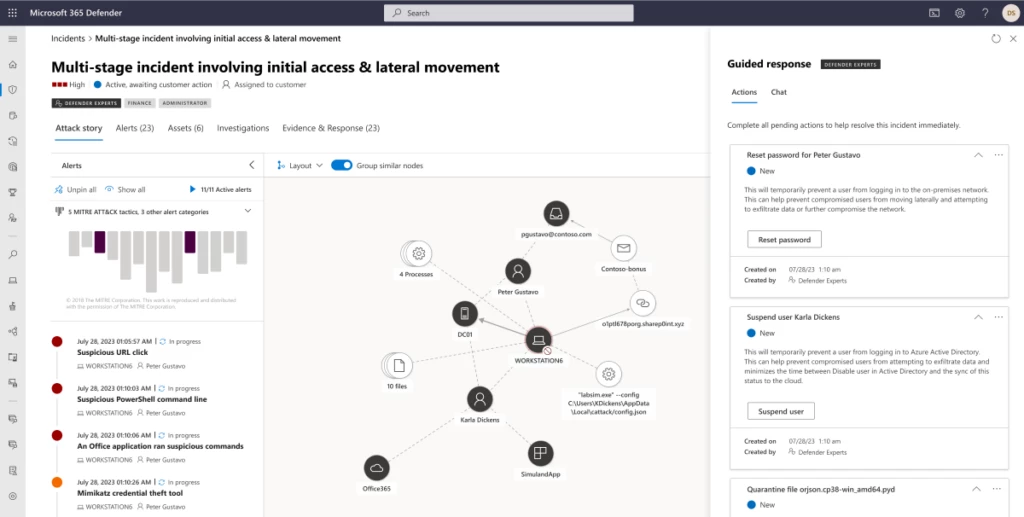
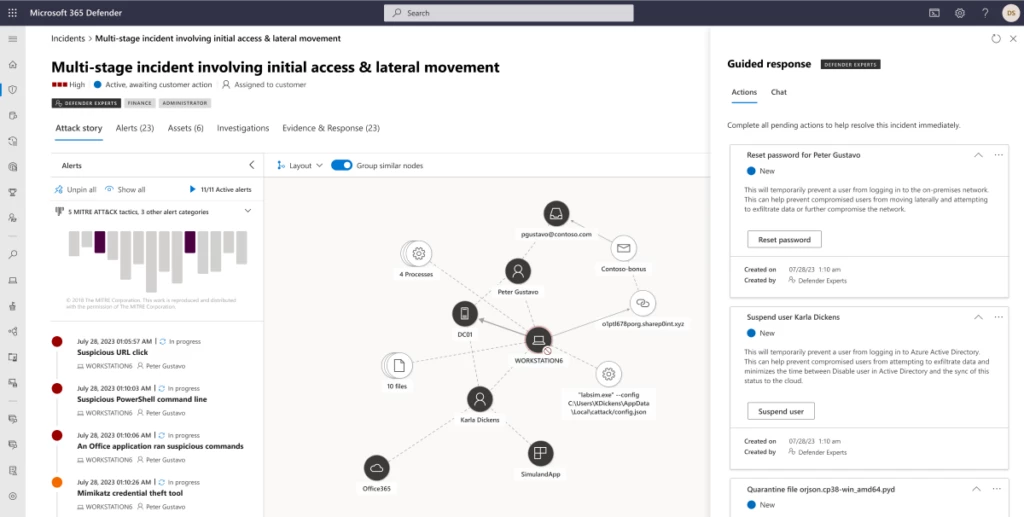
- Managed incident queue: Microsoft's expert analysts take over the Defender XDR incident queue, performing triage and investigation on behalf of the customer's SOC, and provide detailed step-by-step response guidance for each confirmed incident, or execute response actions directly when pre-authorized by the customer.
- Proactive threat hunting: The service includes continuous threat hunting across the customer's Microsoft environment using Microsoft's global threat intelligence, searching for patterns and behaviors that automated detection rules may not flag, with findings reported through the Defender portal.
- Designated service delivery engineer: Each customer receives a designated engineer who provides ongoing recommendations to strengthen security posture, helps maximize the value of the Defender Experts service, and serves as a technical liaison for questions about specific incidents or the Microsoft security stack.
- Unified portal experience: All analyst activity, investigation notes, managed response actions, and hunting findings are visible in the Defender portal, giving SOC teams complete transparency into what the service is doing and why, eliminating the black-box dynamic of many third-party MDR services.
- Agentic AI assistance: The service integrates automation and agentic AI to accelerate triage and investigation workflows, scaling analyst capacity beyond what purely human-staffed operations can achieve while keeping analysts accountable for all material response decisions.
Limitations (as reported by users on G2):
- Ecosystem dependency: The service is limited to Microsoft Defender products and does not extend detection and response to third-party EDR, SIEM, or cloud security tools outside the Microsoft stack, which can be a significant constraint for organizations with heterogeneous environments.
- E5 licensing requirement: Full access to advanced response capabilities and the complete range of Defender Experts features requires Microsoft 365 E5 or equivalent licensing, which adds cost for organizations currently on lower license tiers.
- Steep learning curve: Users describe the Microsoft Defender console as requiring significant IT expertise to navigate effectively, with some settings scattered across multiple portals and configuration depth that can be challenging for administrators new to the platform.
Source: Microsoft
MDR with Human-Led Investigation
5. Red Canary MDR

Best for: Security teams that need verified, high-confidence detections across endpoints, identity, cloud, and network with a 99%+ true positive rate.
Strengths: 99%+ true positive rate; detection-as-code methodology for scalable, auditable detection logic; vendor-agnostic integration with a broad range of security tools.
Things to consider: Limited capability for customers to create fully custom detection rules within the platform; alert volume can be elevated in certain environments even after tuning.
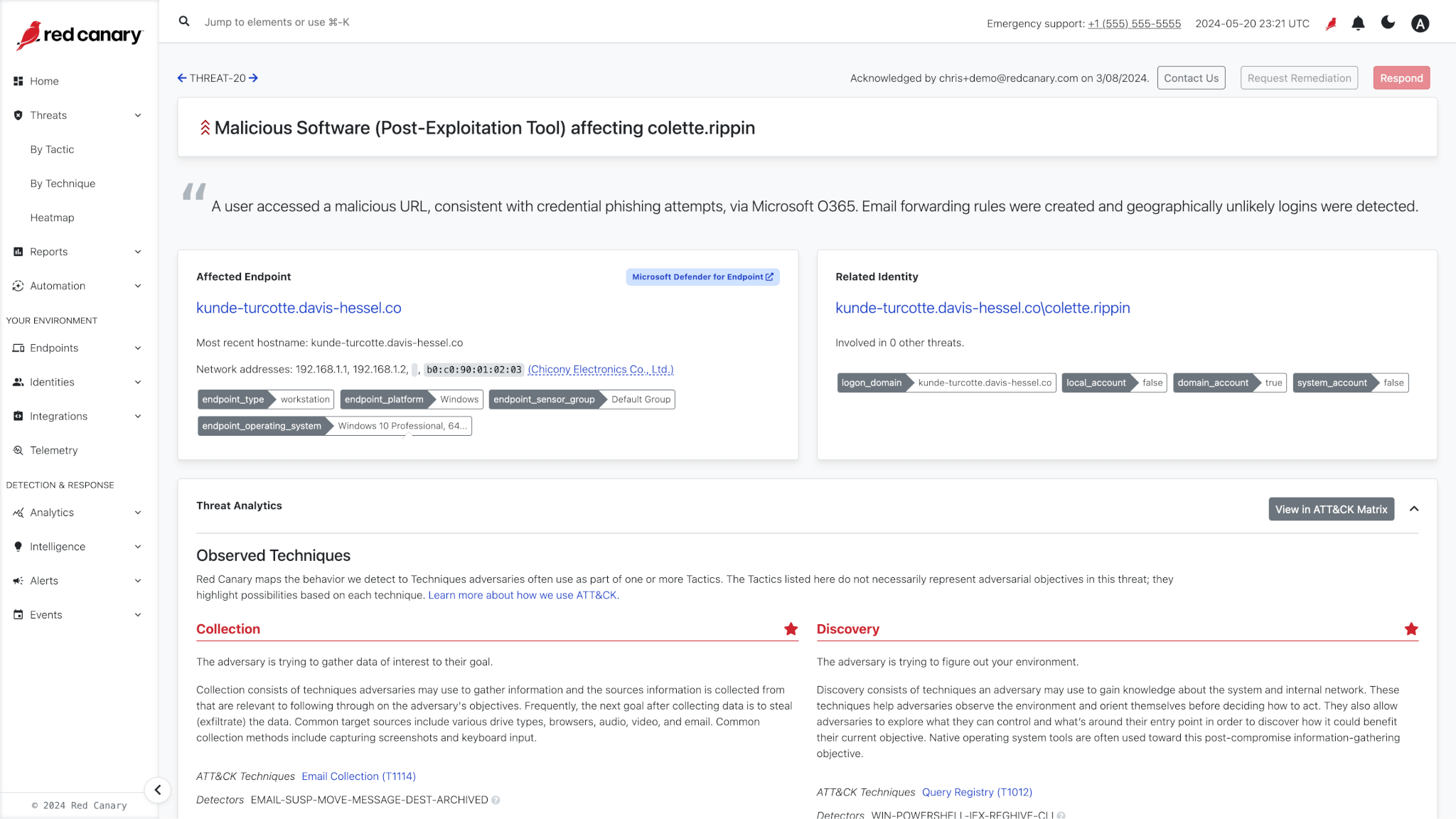
Red Canary MDR is a managed detection and response service that combines a proprietary security operations platform with 24/7 expert analysts and detection engineers. The service analyzes telemetry from across the customer's environment (endpoints, identity systems, cloud infrastructure, email, and network) and surfaces only confirmed threats with full context and recommended remediation actions. Red Canary's detection approach is built on Detection-as-Code, a methodology in which all detection logic is written as code.
Key features include:
- Detection-as-Code methodology: Red Canary engineers build and maintain all detection logic as structured code rather than informal rules, enabling version control, automated testing, and performance tracking for every detection. Alerts are only generated when the detection passes validation, contributing to the service's high true positive rate.
- Cross-product telemetry correlation: The platform ingests and correlates telemetry from multiple security tools (endpoints, cloud environments, identity providers, email, and network) into a unified threat timeline. This enables detection of multi-stage attacks that span across tools, which individual point solutions would likely miss.
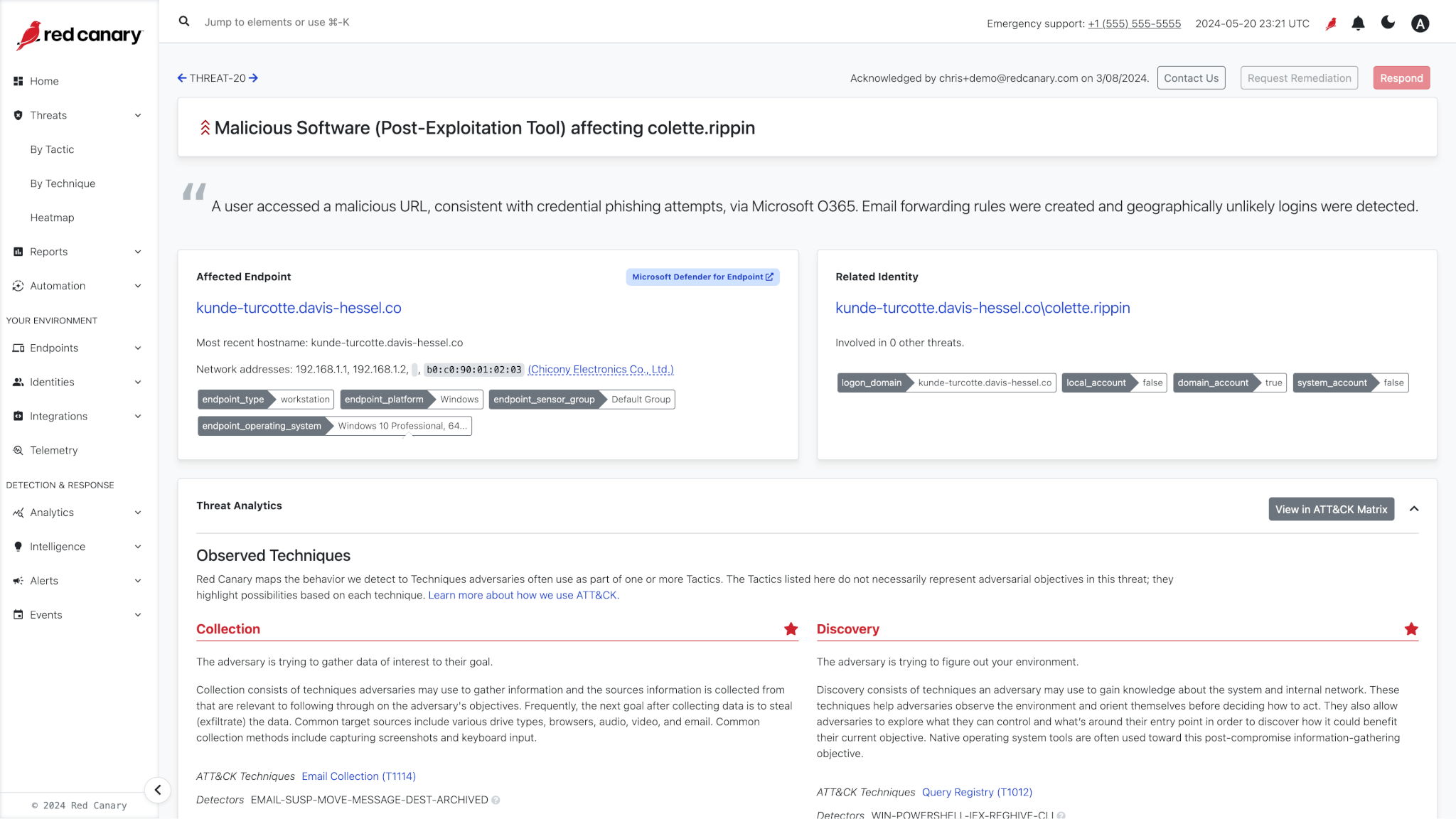
- Actionable threat reporting: Every confirmed threat notification includes the nature of the threat, affected assets, the evidence supporting the detection, and recommended response steps. Customers receive the same contextual narrative regardless of time of day or analyst on duty.
- Automated response playbooks: Red Canary's platform supports configurable automated response workflows that integrate with incident management tools, collaboration platforms, and security products. When a threat is confirmed, playbooks can automatically initiate containment, ticketing, or team notifications without manual intervention.
- Threat intelligence integration: Red Canary's detection engineers incorporate intelligence from the company's annual Threat Detection Report, based on analysis of real attack data across thousands of customer environments, into ongoing detection updates, ensuring detection coverage keeps pace with evolving attacker techniques.
Limitations (as reported by users on G2):
- Custom detection limitations: Users note that the platform does not currently allow customers to write their own custom detection rules within the Red Canary portal, which can be a constraint for teams that want to supplement Red Canary's detections with rules specific to their environment.
- SIEM integration complexity: Some customers with existing Splunk or other SIEM platforms have noted that ingesting Red Canary alerts into their SIEM requires custom API scripts, as native bidirectional SIEM integrations are not available for all platforms.
- Response time variance on complex cases: On rare occasions, the time between an event occurring and Red Canary raising an alert has taken longer than expected, particularly for unusual or multi-stage attack patterns that do not match standard detection signatures.
Source: Red Canary
6. eSentire MDR

Best for: Organizations needing multi-signal MDR with deep Microsoft ecosystem integration and a broad integration catalog spanning 500+ technologies.
Strengths: 500+ integrations across endpoint, network, cloud, identity, and SaaS; multi-signal telemetry correlation into single investigation cases; proactive Atlas AI-powered threat detection.
Things to consider: Pricing is on the higher end compared to many MDR competitors; some users report limited transparency in how SOC investigations are documented and communicated back to customers.
eSentire MDR is a fully managed detection and response service operating across endpoint, network, log, cloud, identity, and SaaS data sources simultaneously. The service uses a multi-signal approach, ingesting and correlating telemetry from across the customer's technology stack, rather than focusing on a single data domain. eSentire's Atlas AI platform processes incoming signals and applies behavioral analytics to identify patterns indicative of attack activity, with findings escalated to human analysts for validation and response.
Key features include:
- Multi-signal MDR architecture: eSentire ingests telemetry from endpoint security products, network sensors, identity providers, cloud workloads, SaaS applications, and log sources simultaneously. Signals are correlated across all sources into unified investigation cases, giving analysts a complete picture of activity rather than isolated alerts from individual tools.
- Atlas AI platform: eSentire's proprietary AI platform processes security telemetry at machine speed, applying behavioral baselines and cross-signal analytics to surface high-fidelity threats that would be difficult to identify by analyzing any single data source in isolation.
- Open XDR architecture with 500+ integrations: The service connects to virtually any security technology the customer already runs via API integrations, supporting heterogeneous environments without requiring migration to eSentire-specific technology.
- Meridian entity intelligence: eSentire's Meridian platform builds a continuously updated understanding of the customer's environment, mapping identities, assets, access relationships, and communication patterns, so every investigation is grounded in accurate environmental context rather than relying solely on alert-level data.
- 24/7 expert investigation and response: eSentire's global SOC analysts investigate, triage, and respond to confirmed threats around the clock, with containment actions (host isolation, credential revocation, network blocking) executed on behalf of the customer based on pre-authorized response playbooks.
Limitations (as reported by users on G2):
- Pricing: Multiple users describe eSentire as one of the more expensive MDR providers, which can make it less accessible for mid-market organizations with constrained security budgets.
- SOC transparency gaps: Some reviewers note limited visibility into the details of investigations, including what the SOC investigated, why a case was resolved, and what specific evidence led to a verdict, making it difficult for internal security teams to learn from eSentire's findings or validate decision rationale.
- Staff continuity: A subset of users has raised concerns about analyst turnover within the SOC, noting that frequent changes in assigned personnel can affect continuity and familiarity with the customer's specific environment.
7. Expel MDR

Best for: Security teams that prioritize full operational transparency, fast API-based onboarding, and cross-product detection across cloud, identity, endpoint, and SaaS.
Strengths: 17-minute critical alert MTTR; Workbench platform provides complete visibility into every analyst action; Forrester Wave Leader with 5/5 in 15 of 21 criteria.
Things to consider: Threat hunting is an add-on and not included in the base MDR service; some customers who already have enterprise IR tools find the expectation to use Expel's Workbench adds workflow friction.
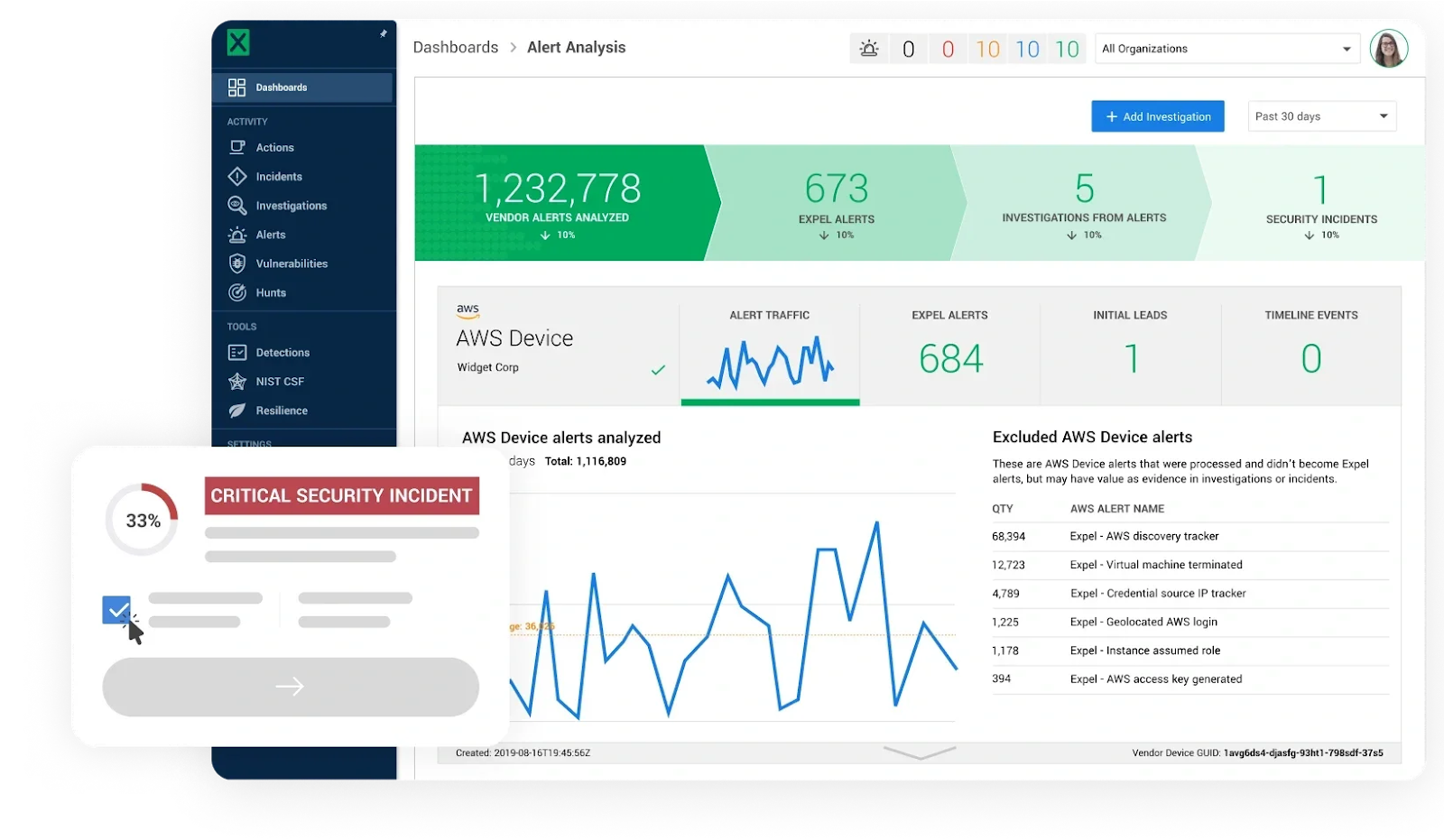
Expel MDR is a managed detection and response service that combines 24/7 SOC analyst coverage with an AI-driven platform, Expel Workbench, designed to give customers complete transparency into every aspect of the service. Rather than operating as a black box, Expel shows customers exactly what analysts see, what actions were taken, and why decisions were made, viewable in the Workbench dashboard in real time.
Key features include:
- Expel Workbench transparency platform: Every analyst investigation, triage decision, alert disposition, and communication is logged and visible to customers in real time through the Workbench dashboard. Customers can see the evidence behind each decision, follow along with active investigations, and interact with analysts directly through the same interface.
- Cross-product correlation: Expel connects to security tools already in the customer's stack via APIs, without requiring agent replacement, and correlates signals across all ingested sources. This enables detection of attack patterns that span cloud, endpoint, identity, and email, rather than surfacing isolated alerts from individual tools.
- Configurable automated remediation: Customers can configure Workbench to automatically execute specific response actions (such as account suspension, device isolation, or email quarantine) when defined threat conditions are met. Automation actions are fully configurable, and customers retain control over which actions require human approval.
- AI-assisted investigation (Ruxie): Ruxie, Expel's AI automation capability, handles repetitive triage tasks, such as enriching alerts with threat intelligence, applying suppression logic for known benign patterns, and categorizing alert types, freeing analysts to focus on genuine investigations rather than routine processing.
- Detection engineering partnership: Expel analysts and detection engineers work with customers to identify logging blind spots, configuration gaps, and opportunities to improve detection coverage over time. This is delivered through ongoing recommendations rather than as a separate engagement, helping customers mature their security program as a byproduct of the MDR relationship.
Limitations (as reported by users on Gartner Peer Insights):
- Threat hunting as an add-on: Proactive threat hunting is not included in the base Expel MDR service and requires a separate add-on purchase, which can be a differentiating gap compared to competitors who bundle hunting into their core MDR offering.
- Workbench dependency: Customers with existing enterprise tools for incident tracking and case management report some friction from Expel's preference that investigations flow through Workbench, requiring additional effort to integrate Workbench data into their existing IR workflows.
- Onboarding self-service model: Some customers note that certain parts of onboarding and integration setup are intentionally self-guided, and teams that expected fully concierge onboarding may need to be proactive in requesting additional live support during initial deployment.
Source: Expel
8. ReliaQuest GreyMatter

Best for: Large enterprises managing complex, fragmented security stacks that need unified agentic AI investigation and containment across multi-cloud and hybrid environments.
Strengths: 400+ integrations with detection-at-source architecture; 5-minute threat containment target; agentic AI with 200+ agent skills across the investigation lifecycle.
Things to consider: High cost that may be prohibitive for smaller organizations; initial log source configuration and integration setup is a significant project; customization of detection rules requires working through the ReliaQuest team.
ReliaQuest GreyMatter is an agentic AI security operations platform designed to unify fragmented security tools and provide centralized detection, investigation, and response across enterprise environments. The platform uses a Universal Translator to normalize telemetry from over 400 integrated security technologies into a single data layer, enabling detection at the source rather than aggregating alerts into a central SIEM.
Key features include:
- Detection-at-source architecture: Rather than forwarding all telemetry to a central SIEM for correlation, GreyMatter applies detection logic directly at each connected data source through the Universal Translator. This approach reduces data movement costs and latency while enabling higher-fidelity detection in each environment's native telemetry.
- Agentic AI investigation: GreyMatter's AI operates through specialized agent personas, for detection, investigation, threat hunting, containment, and response, each equipped with specific tools and decision-making logic. Agents act autonomously within defined parameters, with humans retaining oversight and approval authority for high-impact actions.
- 400+ integrations with open XDR architecture: GreyMatter connects via bidirectional API to virtually any security product in the customer's environment, covering endpoint, cloud, network, identity, email, and business applications. Integration data flows in both directions, allowing the platform to trigger response actions in connected tools rather than requiring manual analyst intervention.
- Continuous detection validation: GreyMatter includes a Verify module that continuously tests the customer's detection coverage by simulating attack scenarios against the connected environment, surfacing gaps in detection logic or telemetry collection before an attacker can exploit them.
- Pre-packaged threat hunts: The platform ships with a library of pre-built threat hunt packages aligned to current threat actor techniques, which can be run manually or automated on a schedule, reducing the expertise barrier for organizations that want proactive hunting without dedicated hunt team resources.
Limitations (as reported by users on Gartner Peer Insights):
- High cost barrier: Multiple reviewers note that ReliaQuest GreyMatter carries a price point that makes it difficult or impossible for smaller organizations to afford, positioning it as an enterprise-grade solution that SMBs and mid-market teams may be priced out of.
- Complex initial configuration: Connecting all log sources and data integrations at deployment is described as a significant project, requiring hours of effort and multiple working sessions with ReliaQuest engineers to ensure each integration is properly configured and tuned.
- Custom detection limitations: Users note that creating or modifying custom detection rules requires working through the ReliaQuest team rather than self-serving within the platform, which can slow iteration on detection logic for customers that prefer more direct control.
Source: ReliaQuest
Broad-Coverage MDR Services
9. Sophos MDR

Best for: Organizations of any size wanting a fully managed, AI-assisted agentic SOC with no caps on incident response, broad third-party integrations, and a breach protection warranty.
Strengths: 350+ third-party integrations; AI resolves 52% of cases end-to-end in an average of 89 seconds; breach protection warranty included; highest Gartner Peer Insights review count among MDR vendors.
Things to consider: Initial setup and fine-tuning can be complex for teams new to MDR; deeper controls and automation features are most accessible for organizations within the broader Sophos product ecosystem.
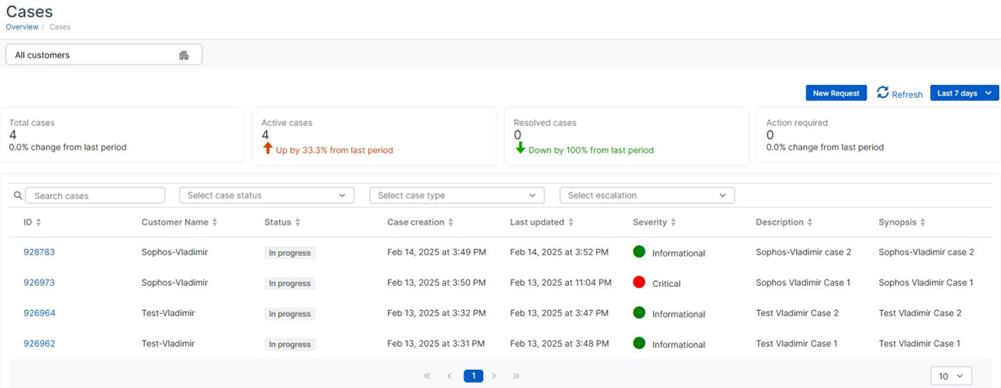
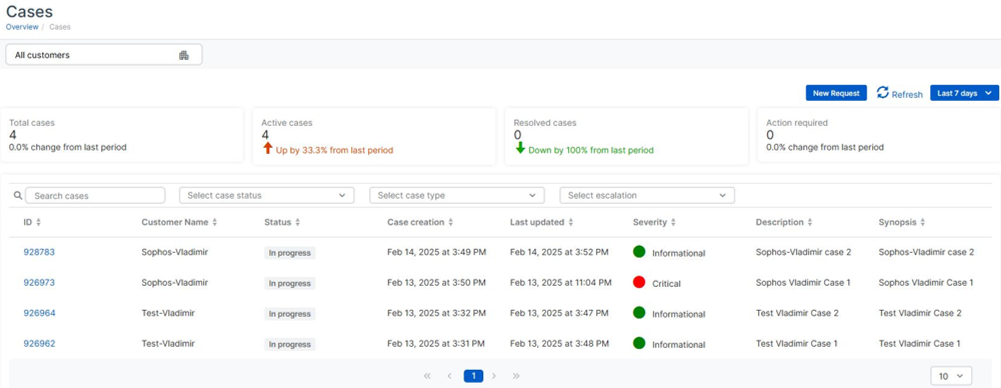
Sophos MDR is a fully managed 24/7 detection and response service that acts as an agentic SOC. The service combines AI-driven investigation and automated response with human analyst oversight, with the AI layer resolving 52% of security cases end-to-end at an average of 89 seconds from alert to automated response. Human Sophos analysts supervise the AI, govern its decisions, and focus their attention on cases requiring contextual judgment or full incident response.
Key features include:
- Agentic SOC model: Sophos MDR's AI resolves more than half of security cases without human intervention, operating at machine speed. Sophos analysts supervise the AI's outputs and own the outcomes of every investigation, ensuring accountability is retained even as automation scales capacity.
- Flexible service tiers: The service is available in two tiers: MDR Essentials, where Sophos contains threats and escalates for customer-led remediation, and MDR Complete, where Sophos executes full incident response including remediation on the customer's behalf. Organizations can adjust the tier based on their internal team's capacity and desired level of outsourcing.
- 350+ third-party integrations: Sophos MDR ingests telemetry from security products outside the Sophos portfolio, including competing endpoint, firewall, identity, cloud, and email security tools, via a broad integration marketplace. This allows deployment in environments with existing vendor commitments without replacing installed tooling.
- Breach protection warranty: Sophos MDR includes a financial warranty that covers losses if a breach occurs in a covered environment and goes undetected by the service. The warranty provides organizations with financial certainty in the event of a service failure, beyond the standard service-level agreements most MDR vendors offer.
- Concierge escalation model: When Sophos MDR analysts identify an active incident, they contact designated security contacts within the customer organization through phone, email, or the Sophos Central console to coordinate response, with escalation paths configurable based on the customer's preferred communication channels and response authority.
Limitations (as reported by users on G2):
- Setup complexity: Some users describe the initial configuration and fine-tuning of Sophos MDR as complex, particularly for teams that are new to MDR services or are deploying in hybrid environments with multiple security tools from different vendors.
- Sophos ecosystem bias: Users note that deeper controls, tighter automation, and the most seamless workflows are available primarily to organizations running Sophos endpoint or XDR products as their primary security platform, meaning organizations heavily invested in competing tools may not access the full depth of the service.
- Pricing: Several users flag pricing as a concern, particularly for small organizations, with a subset describing the cost as the primary limitation rather than any product functionality gap.
Source: Sophos
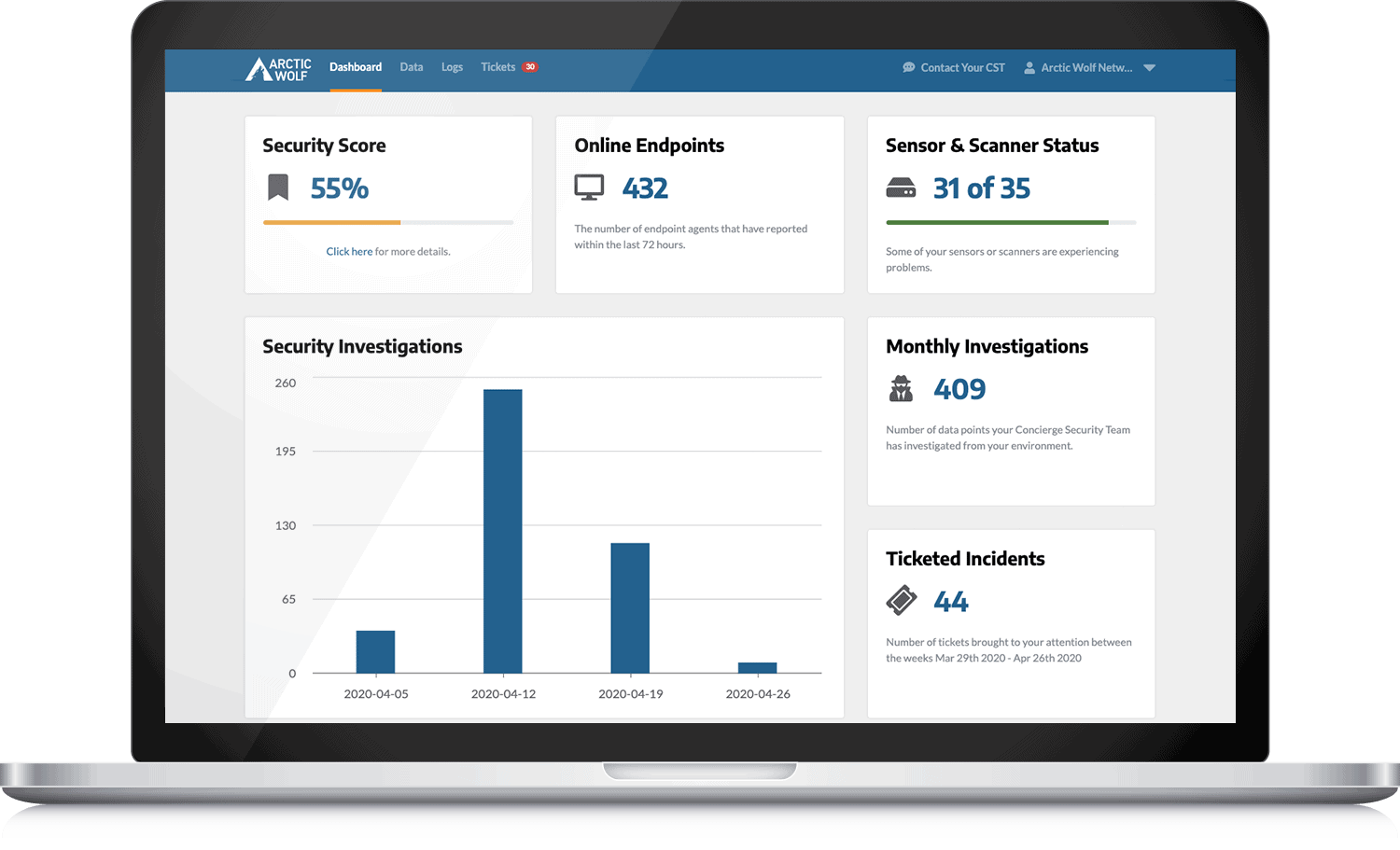
10. Arctic Wolf Managed Detection and Response

Best for: Organizations wanting a proactive MDR partner that reduces attack frequency and severity rather than purely reacting to alerts, with a dedicated Concierge Security Team model.
Strengths: Concierge Security Team assigned to each customer; Aurora Superintelligence Platform with open XDR and 200+ integrations; proactive SPiDR security posture reviews.
Things to consider: Arctic Wolf's architecture requires replacing or bypassing existing SIEM investments; some users report that response actions are escalated to the customer team rather than executed directly by Arctic Wolf.
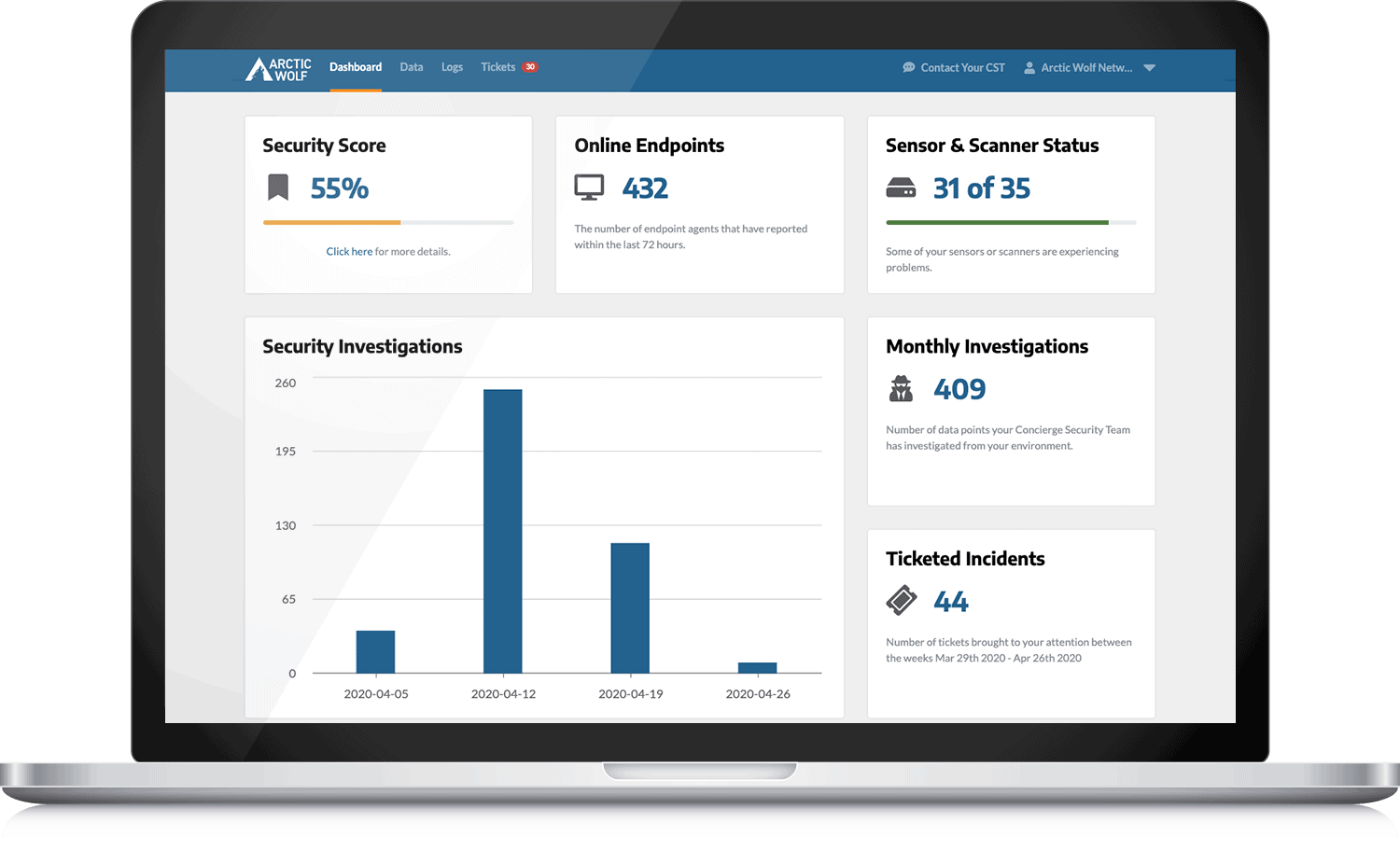
Arctic Wolf MDR is a fully managed detection and response service delivered through the Aurora Superintelligence Platform, an open XDR architecture that ingests security telemetry from endpoints, networks, cloud environments, and identity systems. Rather than following the traditional Tier 1/2/3 SOC model, Arctic Wolf rebuilt its SOC architecture with AI conducting parallel investigations across trillions of events and human security engineers guiding the decisions that require contextual judgment.
Key features include:
- Concierge Security Team model: Each Arctic Wolf customer is served by a dedicated CST rather than a shared, rotation-based SOC. The CST learns the customer's environment, business context, and risk tolerance over time, delivering a level of environmental familiarity that pooled analyst models may not match at scale.
- Proactive Security Posture Reviews (SPiDRs): The CST regularly conducts Security Posture in-Depth Reviews: Structured assessments that identify hardening gaps, misconfigurations, and exposure points in the customer's environment. In 2025, Arctic Wolf completed over 74,000 SPiDRs across its customer base, averaging more than 200 per day.
- Aurora Superintelligence Platform: The underlying platform ingests telemetry from internal and external networks, endpoints, cloud environments, and identity systems, enriched with threat feeds, OSINT data, CVE information, and account takeover indicators. AI processes this data at scale to surface threats that behavioral anomalies and correlation rules alone would not identify.
- Open XDR architecture: Arctic Wolf supports over 200 third-party integrations, allowing the platform to ingest telemetry from the security tools organizations already operate, without requiring migration to Arctic Wolf-specific endpoint agents or network sensors as a prerequisite.
- Threat intelligence from 10,000+ customers: Arctic Wolf's SOC draws on detection insights and threat data aggregated from over 10,000 global customers, enabling the platform to recognize patterns emerging across its network before they reach individual customer environments.
Limitations (as reported by users on publicly available sources):
- SIEM replacement requirement: Arctic Wolf's architecture aggregates and normalizes telemetry into its own platform, which effectively requires organizations to replace or bypass their existing SIEM. Teams with mature Splunk or other SIEM investments (including custom correlation rules and extensive tuning) may find the migration disruptive.
- Response ownership ambiguity: Multiple independent reviews describe Arctic Wolf as a strong detection service that generates alerts and creates tickets, but note that investigation completion and remediation often requires customer team action rather than being fully executed by Arctic Wolf analysts.
- Open-source tool stack: Some evaluators note that a portion of Arctic Wolf's underlying detection technology is built on open-source tools (including OSSEC and Zeek), which are publicly available, a consideration for buyers assessing the proprietary differentiation of the platform.
Source: Arctic Wolf
11. Rapid7 MDR

Best for: Enterprises needing customizable MDR with built-in vulnerability and exposure management context informing every investigation, with unlimited incident response included.
Strengths: Exposure-aware MDR that correlates vulnerability risk with active detections; unlimited DFIR included; dedicated program advisors providing strategic guidance alongside SOC coverage.
Things to consider: Cloud container and runtime monitoring coverage is still maturing; SOC transparency for case resolution rationale is an area some customers would like improved; pricing is higher than average for smaller organizations.
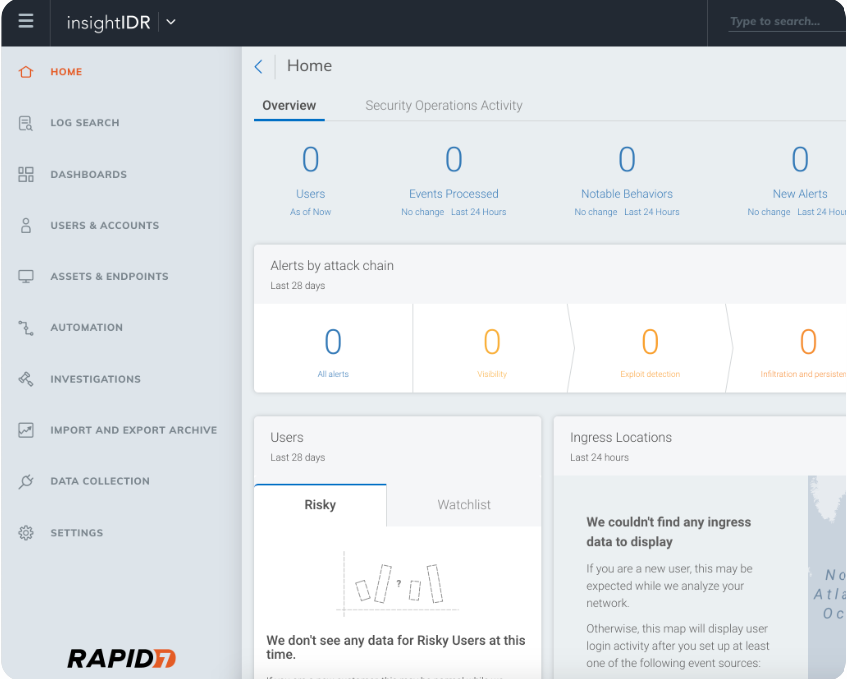
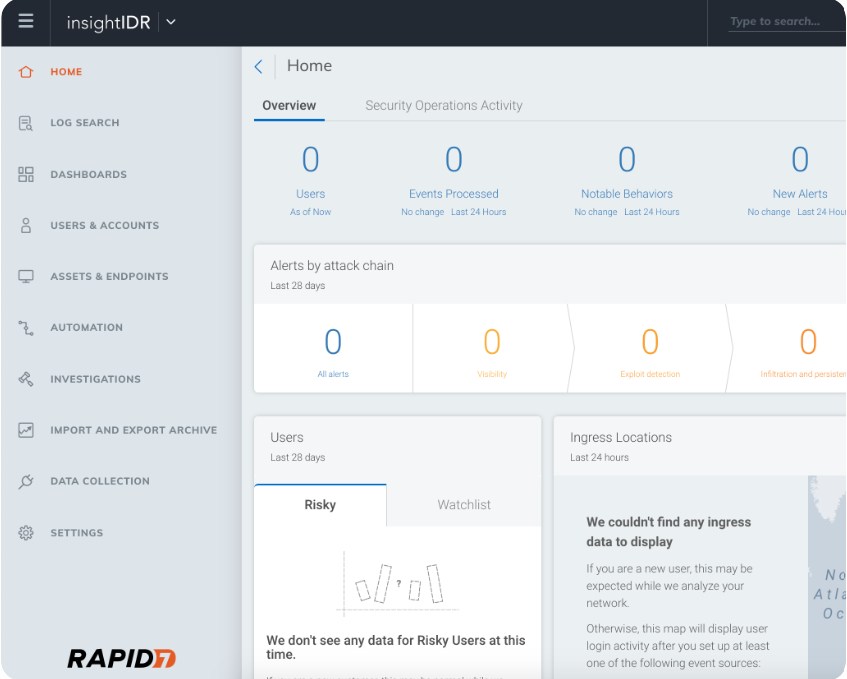
Rapid7 MDR is a managed detection and response service that integrates exposure management directly into the investigation workflow rather than treating detection and vulnerability management as separate programs. Unlike MDR providers that focus exclusively on active threat signals, Rapid7 correlates incoming alerts with vulnerability and asset risk data from InsightVM and InsightCloudSec to surface attack paths and prioritize response based on the actual business impact of each threat, not just its severity in isolation.
Key features include:
- Exposure-aware detection: Rapid7's MDR correlates incoming threat signals with vulnerability data and asset risk context from InsightVM and InsightCloudSec, enabling analysts to prioritize response based on which threats are most likely to cause business impact given the organization's specific vulnerability posture, rather than triaging by alert severity alone.
- Unlimited incident response: The service includes unlimited access to Rapid7's SOC for incident response support, with no per-incident caps or additional fees for DFIR engagement. Customers can initiate full incident response conversations with Rapid7 analysts whenever needed, without worrying about billable hour accumulation.
- Custom detection engineering (Enterprise tier): MDR for Enterprise customers work with Rapid7's detection engineers to develop custom detection logic aligned to their specific threat model, proprietary applications, and business workflows, addressing visibility gaps that standard integration libraries leave unaddressed in complex enterprise environments.
- AI-enhanced SOC: Rapid7 uses AI to scale triage and investigation capacity, applying automated enrichment, pattern recognition, and recommended response paths to help human analysts focus their attention on validation and complex decision-making rather than routine processing.
- Dedicated program advisors: Each MDR customer is assigned a dedicated advisor who provides strategic guidance on security program maturity, hardening recommendations, and emerging threat trends, functioning as an extension of internal security leadership rather than a purely operational support contact.
Limitations (as reported by users on Gartner Peer Insights):
- Cloud container coverage gaps: Users note that Rapid7 MDR's support for containers and runtime cloud monitoring is still developing compared to its endpoint and network detection capabilities, which can leave visibility gaps in organizations with significant container-based workload deployments.
- SOC case resolution transparency: Some reviewers describe instances where SOC analysts closed incidents without providing sufficient explanation or context, making it difficult for internal security teams to understand the investigation rationale or build institutional knowledge from Rapid7's findings.
- Pricing accessibility: Multiple sources describe Rapid7's pricing as on the higher end for the MDR market, which can be a barrier for smaller organizations that need full MDR coverage but have limited security budget.
Source: Rapid7
12. Huntress Managed EDR

Best for: SMBs and MSPs needing accessible, affordable managed endpoint detection and response with 24/7 human-assisted SOC and an 8-minute median time to respond.
Strengths: 8-minute MTTR; 24/7 AI-assisted SOC backed by human analysts; works alongside Microsoft Defender at no additional cost; purpose-built for SMB and MSP deployment models.
Things to consider: Reporting and customization options are more limited than enterprise MDR platforms; Mac compatibility has historically lagged Windows support; cloud MDR capabilities are still developing.
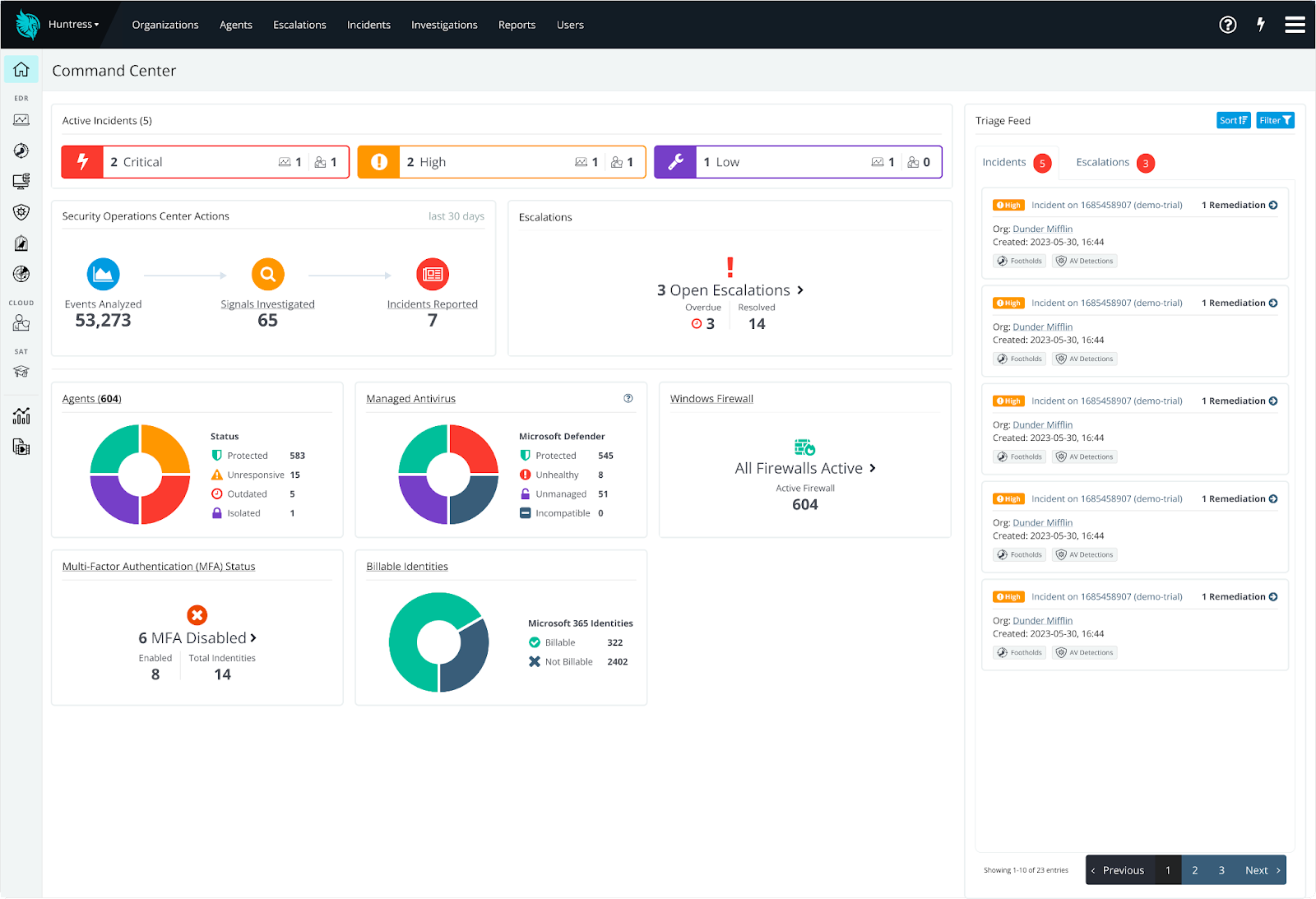
Huntress Managed EDR is a managed endpoint detection and response service that pairs a lightweight endpoint agent with a 24/7 AI-assisted SOC staffed by human analysts. The service is designed specifically for SMBs and the MSPs that serve them, with a focus on enterprise-grade detection made accessible at a predictable price point without requiring dedicated internal security expertise to operate. Huntress deploys alongside Microsoft Defender and can manage Defender Antivirus for customers at no additional cost.
Key features include:
- Persistent foothold detection: Huntress focuses specifically on identifying adversaries who have already established a presence within the environment (persistent footholds, living-off-the-land techniques, and lateral movement patterns) rather than relying solely on malware signatures that may not detect techniques attackers use after initial access.
- Process insights behavioral analysis: The platform applies behavioral analysis to process activity, identifying suspicious patterns based on attacker techniques rather than specific known tools. This approach is designed to detect threats that change their tooling between engagements but maintain consistent behavioral patterns.
- Microsoft Defender management: Huntress integrates directly with Microsoft Defender Antivirus and Defender for Endpoint, managing detection rules and monitoring Defender alerts on behalf of customers. This allows organizations to get managed SOC coverage for their Microsoft security investment without additional licensing or agent deployment complexity.
- Managed ITDR for Microsoft 365: Huntress Managed ITDR monitors Microsoft 365 identities 24/7 for indicators of compromise (including suspicious login behavior, session hijacking, unauthorized app permissions, and email rule manipulation) with the same analyst-reviewed alert workflow as the endpoint product.
- MSP-native deployment model: Huntress is built for MSP partners, with a multi-tenant management portal, PSA integrations (ConnectWise, Autotask), simple per-endpoint pricing, and deployment via RMM tools, allowing MSPs to stand up managed security coverage for multiple clients without building dedicated security operations infrastructure.
Limitations (as reported by users on G2):
- Limited reporting and customization: G2 reviewers with more than 11 mentions note that Huntress provides fewer reporting customization options and less flexibility to tailor dashboards and alert logic compared to enterprise MDR platforms, making it feel less advanced for teams with sophisticated reporting requirements.
- Mac compatibility maturity: Multiple users note that Mac agent support has historically lagged behind Windows coverage, with compatibility improvements taking longer to roll out than some customers expected, though Huntress has been transparent about timelines.
- Cloud MDR in early stages: Huntress's Cloud MDR response capability is described by users as still in its early stages, with functionality expected to expand but not yet at the breadth or maturity of its endpoint coverage.
Source: Huntress
13. Secureworks Taegis MDR

Best for: Organizations wanting open XDR-based MDR backed by 20+ years of threat intelligence and 24/7 live-chat SOC access with 90-second analyst response times.
Strengths: Processes 5 trillion events weekly across thousands of environments; 24/7 SOC live chat accessible within 90 seconds; Taegis open XDR platform with broad third-party integration support.
Things to consider: Initial deployment in hybrid environments can be complex; alert noise may require manual tuning to reach optimal signal quality; product roadmap uncertainty following the Secureworks acquisition by Sophos.
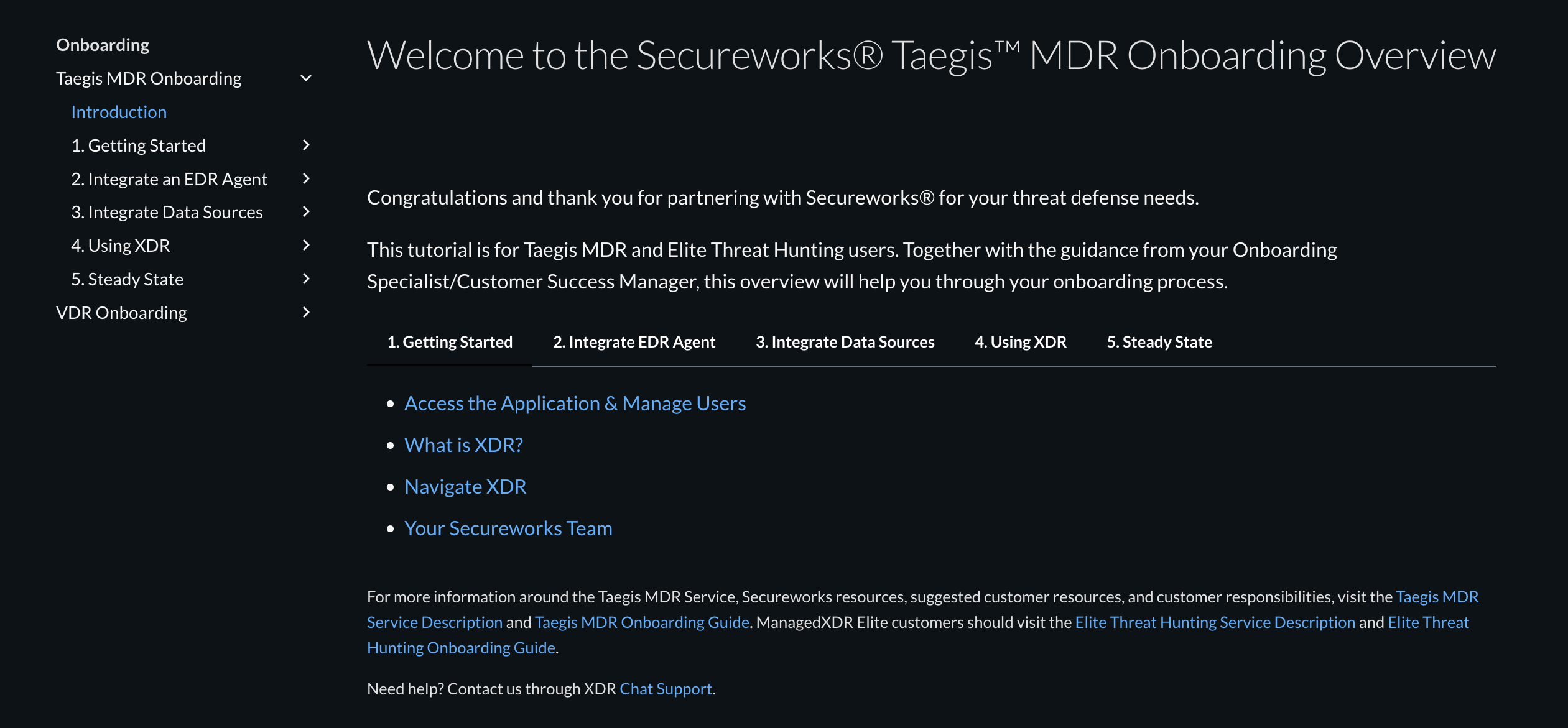
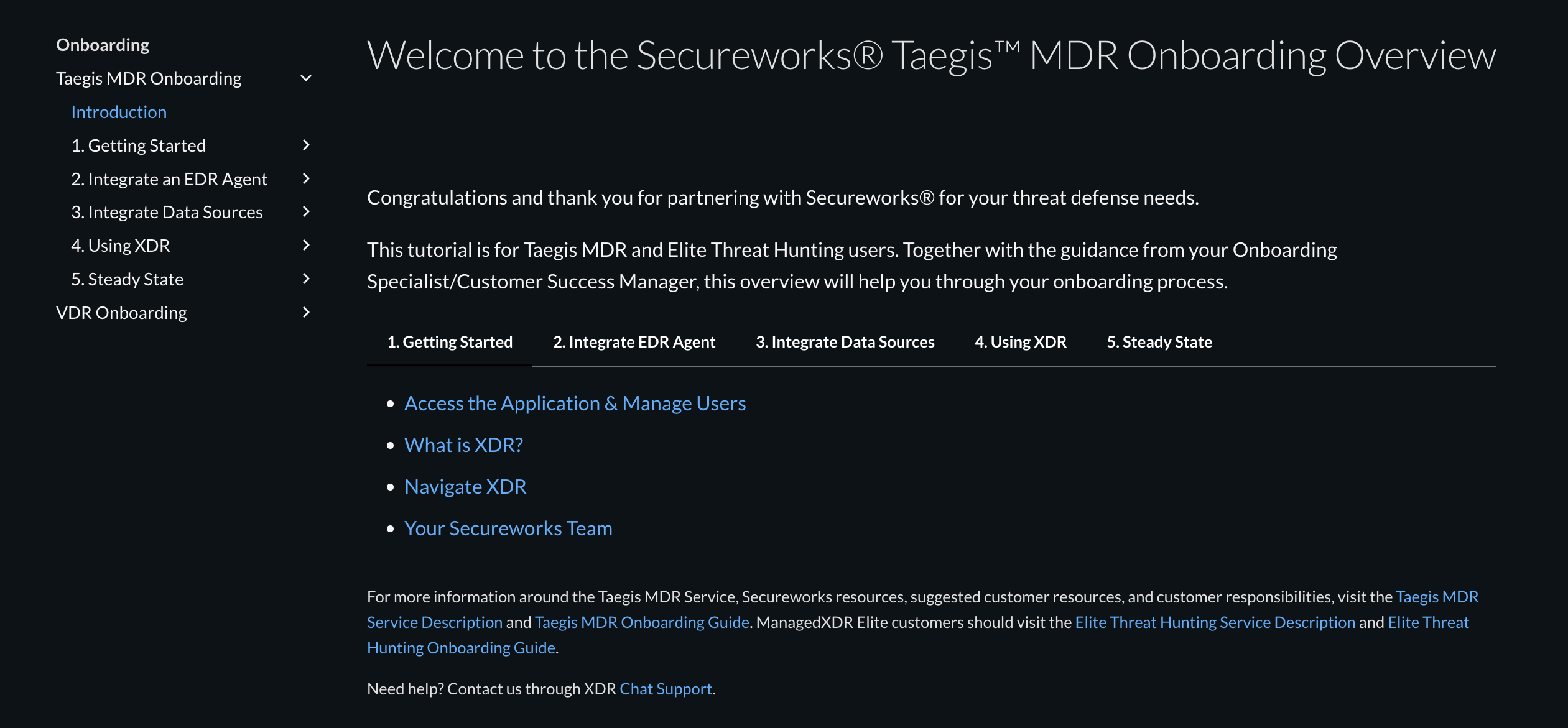
Secureworks Taegis MDR is a fully managed cybersecurity service delivered on top of the Taegis XDR platform, a cloud-native open XDR system that Secureworks has built over more than two decades. The service provides 24/7 monitoring, detection, investigation, and response across endpoint, network, cloud, identity, and OT environments, integrating telemetry from hundreds of security tools without requiring customers to replace their existing investments.
Key features include:
- Taegis XDR open platform: The Taegis platform is built as an open XDR system that avoids vendor lock-in by integrating with security tools across all categories, including competing endpoint, firewall, identity, and cloud security products. Customers retain their existing security investments while adding managed coverage through Taegis.
- Advanced analytics and machine learning: Taegis applies ML models trained on 20+ years of incident response data and 5 trillion weekly events to detect stealthy threats (including fileless malware, lateral movement, and credential abuse) that rule-based detection systems may not surface. High-confidence threats are automatically prioritized for analyst attention.
- Shared console with SOC analysts: Customers operate in the same Taegis console used by Secureworks SOC analysts, with full visibility into detections, case investigations, and analyst notes. The live chat feature connects customers directly to analysts within 90 seconds without needing to log a separate support ticket.
- Proactive threat hunting: Secureworks conducts monthly threat hunts across each customer's environment, searching for indicators of compromise from current incident response engagements and emerging threat research. Hunting findings are reported as cases within Taegis and communicated to the customer.
- Custom use case development: Taegis MDR Plus customers can work with Secureworks engineers to develop custom detection use cases tailored to their specific environment, industry risk profile, and proprietary applications, extending coverage beyond the standard integration library.
Limitations (as reported by users on G2):
- Alert noise in some environments: Users note that alert volumes can be high without manual tuning, requiring additional time investment to adjust suppression rules and detection thresholds before the signal-to-noise ratio reaches a useful level, particularly in complex hybrid environments.
- Hybrid deployment complexity: Initial setup in mixed on-premises and cloud environments is described as more involved than expected, requiring patience and effort to normalize data sources and integrate all event streams correctly.
- Product roadmap uncertainty: Following Sophos's acquisition of Secureworks in 2024, some reviewers note reduced visibility into the long-term roadmap of the Taegis platform and concern about how the product will evolve as integration with the Sophos portfolio progresses.
Source: Secureworks
14. Palo Alto Unit 42 MDR (Cortex XSIAM)

Best for: Existing Palo Alto Networks customers wanting fully integrated MDR with Unit 42 threat intelligence and continuous SOC engineering through Cortex XSIAM.
Strengths: Unit 42 threat intelligence from 500 billion daily events; 2x faster MTTD vs. average MITRE evaluation participants; Cortex XSIAM SOAR, SIEM, XDR, and ASM capabilities in a single platform.
Things to consider: Tightly coupled to the Palo Alto ecosystem; total cost is high when stacking Cortex XDR licensing, Data Lake storage, and MDR service fees; complex UI with a steep learning curve.
Palo Alto Unit 42 MDR, delivered through Cortex XSIAM, is a managed detection and response service run by Unit 42, Palo Alto Networks' threat intelligence and incident response team. The service operates natively on Cortex XSIAM, a unified SecOps platform that consolidates SIEM, SOAR, XDR, and attack surface management (ASM) capabilities into a single data lake–backed system. Unit 42 analysts and engineers manage the customer's XSIAM deployment end to end, handling threat detection, investigation, and response.
Key features include:
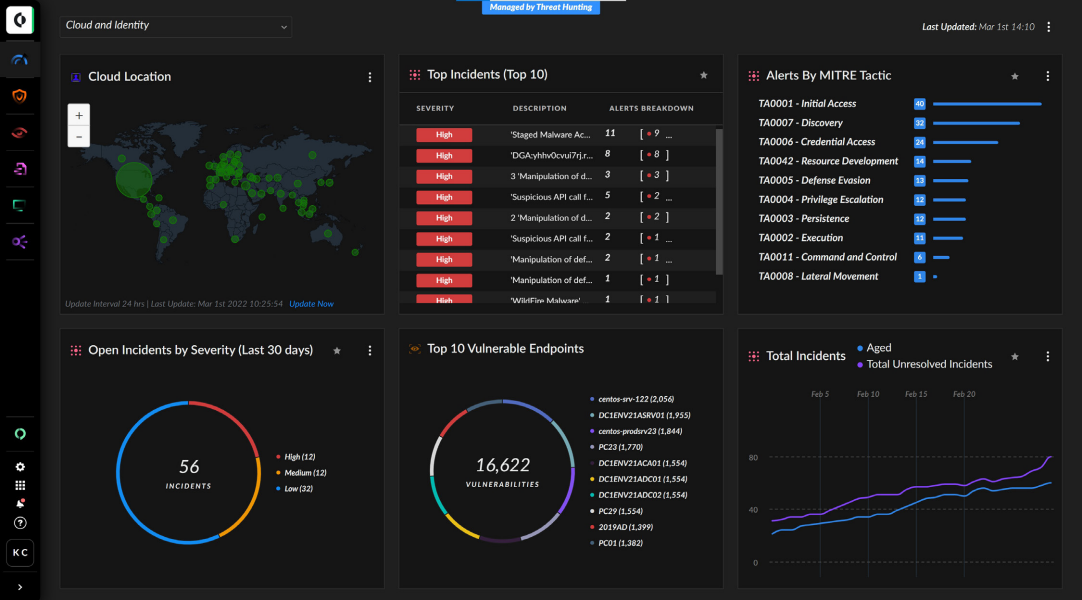
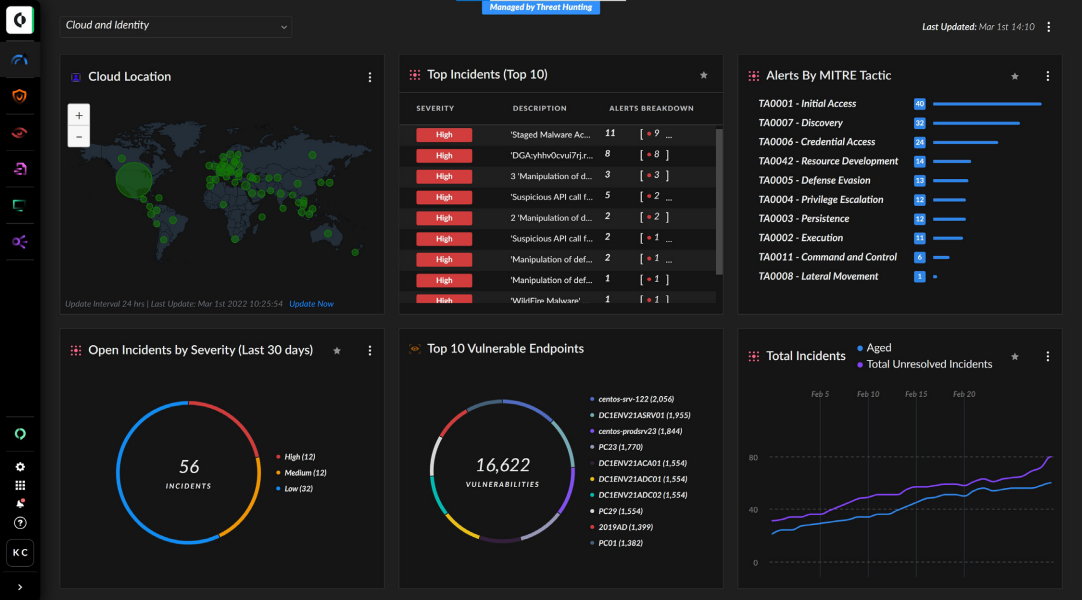
- Cortex XSIAM unified platform: Unit 42 MDR is built on Cortex XSIAM, which consolidates security data from endpoints, network, cloud, identity, and third-party tools into a single data lake. SIEM correlation, SOAR automation, XDR detection, and ASM are delivered through a single console.
- Unit 42 threat intelligence (500B daily events): Unit 42 analysts apply intelligence from one of the world's largest threat intelligence datasets, including telemetry from Palo Alto Networks' global firewall, endpoint, and cloud security deployments, to proactively identify attacker infrastructure, emerging techniques, and campaign indicators relevant to the customer's industry and technology stack.
- Continuous SOC engineering: Unit 42 Managed XSIAM includes ongoing SOC engineering as part of the service: analysts continuously refine data mappings, build new correlation rules, develop custom playbooks, and create high-fidelity detectors tailored to the customer's unique data sources, treating the SOC's detection logic as a living system rather than a static configuration.
- Managed threat hunting: The service includes proactive threat hunting by Unit 42 analysts, who conduct hypothesis-driven and lead-based hunts across the customer environment using intelligence from ongoing incident response engagements and Unit 42 research. Hunting findings are reported as prioritized incidents with recommended remediation actions.
- XSIAM AgentiX automation: Cortex XSIAM includes AgentiX, an agentic AI framework trained on over 1.2 billion real-world playbook executions. Unit 42 MDR deploys AI agents within the customer environment to automate routine investigation steps, correlation tasks, and playbook execution, reducing manual analyst workload while maintaining human oversight over response decisions.
Limitations (as reported by users on Gartner Peer Insights):
- High total cost: Palo Alto's pricing model stacks Cortex XDR licensing, Data Lake storage fees, and the Unit 42 MDR service charge on top of one another. Gartner reviewers have reported renewal price increases of up to 225%, and the total cost can significantly exceed that of comparable MDR services from other vendors.
- Complex user interface: Multiple users describe the Cortex XSIAM console as feature-rich but difficult to navigate, particularly for teams new to the platform. The interface density and the breadth of configuration options require significant time investment before analysts can use it efficiently.
- Ecosystem lock-in: Unit 42 MDR is designed for organizations running Cortex XDR or XSIAM as their primary security platform. Organizations not already invested in the Palo Alto ecosystem face a significant migration before the MDR service can be fully operational.
Source: Palo Alto Networks
MDR Evaluation Criteria for Detection Fidelity
Here are some important points to consider when choosing an MDR service.
Telemetry Coverage
Telemetry coverage defines the breadth and depth of data collected across the environment. High-fidelity detection depends on ingesting signals from endpoints, networks, identity systems, cloud workloads, and applications. Gaps in telemetry create blind spots where threats can operate undetected.
Effective MDR services normalize and correlate data from these sources to build a unified view of activity. They also ensure data quality, including consistent timestamps, enriched metadata, and minimal loss during ingestion. Strong coverage enables better correlation and improves detection accuracy. Mature providers prioritize log completeness and retention.
Detection Engineering Maturity
Detection engineering maturity reflects how well the MDR provider designs, tests, and maintains detection logic. Mature programs use structured methods to develop rules, including hypothesis-driven detection, adversary emulation, and validation against real attack scenarios. They maintain version control, testing pipelines, and performance tracking for each detection.
This ensures that rules remain effective and do not introduce unnecessary noise. Changes are tested before deployment to avoid breaking existing coverage. In advanced environments, detection engineering is treated as a continuous lifecycle. Metrics such as false positive rate, detection gaps, and rule performance drive improvements and support stable detection outcomes.
Human Analyst Validation
Human analyst validation adds a layer of quality control to automated detections. Skilled analysts review alerts, correlate additional context, and confirm whether activity is malicious before escalation. This process reduces false positives and improves alert quality. It also allows for nuanced judgment that automated systems may miss, such as distinguishing between unusual but legitimate behavior and early-stage attacks.
Analysts can enrich alerts with business context. Well-implemented validation workflows balance speed and accuracy. Analysts follow defined triage procedures and use supporting tools to investigate efficiently, improving fidelity without slowing response times.
False Positive Management
False positive management focuses on reducing incorrect alerts without weakening detection coverage. This involves continuous tuning of rules, analyst feedback loops, and suppression logic for known benign patterns. Effective MDR providers track false positive rates at the rule level and prioritize improvements where noise is highest.
They tailor detections to the customer environment, avoiding generic thresholds that generate excessive alerts. Over time, consistent false positive management leads to a stable signal-to-noise ratio. Fewer unnecessary alerts allow analysts to maintain focus and automated workflows to operate with greater confidence.
Response Quality
Response quality measures how actionable MDR outputs are once a threat is detected. High-fidelity detection should produce clear, prioritized alerts that include context, impact assessment, and recommended actions. Strong MDR services guide or execute response steps such as containment, isolation, or remediation.
These actions are supported by playbooks that standardize how threats are handled. Response quality depends on clarity and consistency. Poorly explained alerts or vague recommendations slow remediation. Precise guidance and structured incident reports enable faster, more reliable outcomes and reinforce the value of accurate detection.