
Agentic AI Tools for Reducing SOC Analyst Workload
In this article

TL;DR: Agentic AI tools plan and carry out SOC work such as triage, investigation and response with limited human input. Intezer is best for forensic-depth triage of every alert, Dropzone AI for auditable end-to-end investigations, Microsoft Security Copilot for Microsoft-centric SOCs, and Google Security Operations for SIEM-native agents.
What Are Agentic AI Tools for SOC Teams?
Agentic AI tools reduce Security Operations Center (SOC) analyst workload by autonomously handling alert triage, deep-dive investigations, and initial threat remediation using goal-directed reasoning. Unlike traditional automation, which follows predefined workflows, an AI agent can evaluate the current situation, choose actions, use security tools, and adjust its approach based on the results.
Key ways agentic AI reduces workload:
- Autonomous alert triage and prioritization: Evaluates alert context and risk to rank incidents and route high-priority cases to analysts.
- Automated alert enrichment: Collects user, asset, threat intelligence, vulnerability, and historical activity data without manual lookups.
- Cross-tool data collection and correlation: Pulls telemetry from multiple security systems and connects related events into a single investigation.
- Automated incident investigation: Chooses and executes investigation steps dynamically as new evidence is discovered.
- False positive identification and closure: Recognizes known benign patterns and closes or recommends closure for high-confidence false positives.
- Automated case summarization and documentation: Produces timelines, evidence summaries, investigation notes, and response records automatically.
- Automated detection engineering: Suggests, tests, and refines detection logic based on incident findings, false positives, and historical telemetry.
This is part of a series of articles about AI SOC
Agentic AI Tools at a Glance
The table below summarizes the main differences between the tools covered in this section. Each one is explored in more detail underneath.
| Category | Solution | Best For | Key Strengths | Things to Consider |
|---|---|---|---|---|
| AI SOC analyst platforms | Intezer | SOCs that need forensic-depth triage across 100% of alerts | Deterministic forensics with agentic AI; endpoint-based pricing | Dense interface; free tier is capped for evaluation |
| AI SOC analyst platforms | Dropzone AI | Teams wanting auditable end-to-end investigations without playbooks | 90+ integrations, glass-box reasoning, auto-containment actions | Tuning period at rollout; coverage limited to supported alert types |
| AI SOC analyst platforms | Prophet Security | SOCs wanting triage, threat hunting and detection engineering together | Parallel investigation of all alerts, backtested automation changes | Value depends on how many of your tools are connected |
| AI SOC analyst platforms | Exaforce | Cloud and SaaS heavy environments looking to replace SIEM and SOAR | Four Exabots plus multi-model AI over a unified data platform | Some integrations still on the roadmap; cloud and SaaS focused |
| Agentic AI in security operations platforms | Microsoft Security Copilot | Organizations standardized on the Microsoft security stack | Agents embedded across Defender, Entra, Intune and Purview | Costly at scale; coverage strongest inside Microsoft tools |
| Agentic AI in security operations platforms | CrowdStrike Charlotte AI | Falcon customers building an agentic SOC on existing data | Detection triage, agentic SOAR and no-code agent building | Requires Falcon; metered credits cap monthly agent usage |
| Agentic AI in security operations platforms | Palo Alto Networks Cortex AgentiX | Cortex and XSOAR users moving from static playbooks to AI agents | 1,100+ integrations, MCP support, granular autonomy controls | Steep learning curve carried over from XSOAR deployments |
| Agentic AI in security operations platforms | Google Security Operations | Teams that want agentic triage built into their SIEM and SOAR | Gemini agents over SIEM, SOAR and Mandiant threat intelligence | Long implementations, high cost and limited customization |
Related content: Read our guide on how to choose AI SOC solutions.
Why Are SOC Teams Adopting Agentic AI Tools?
Growing Alert Volumes
SOC teams receive alerts from endpoints, cloud services, identity systems, networks, email platforms, and security applications. As organizations add users, workloads, and detection rules, alert volumes can grow faster than the analyst team responsible for reviewing them. Many alerts also require several enrichment steps before an analyst can determine whether they represent a real threat.
Agentic AI tools can perform much of this initial workautomatically. An agent can collect related logs, check indicators against threat intelligence, examine recent user or endpoint activity, and compare the event with previous incidents. It can then prioritize the alert based on the available evidence rather than relying only on the original detection severity.
Agents can also correlate alertsthat appear to be part of the same incident. For example, suspicious authentication, endpoint execution, and cloud activity might generate separate alerts across different tools. Connecting them into one investigation reduces duplicate work and gives analysts a clearer view of the attack.
Analyst Burnout and Alert Fatigue
SOC analysts often repeat the same investigation steps across hundreds of alerts. They may need to copy IP addresses or hashesbetween tools, search logs, check asset information, review user activity, and document their findings. Much of this work is necessary, but it consumes time that could be spent investigating complex or high-risk incidents.
Large numbers of false positives and low-priority alerts also contribute to alert fatigue. When analysts repeatedly investigate activity that turns out to be benign, maintaining consistent attention becomes difficult. Important signals can be overlooked when they appear among large volumes of routine notifications.
Agentic AI can reduce this workloadby handling repetitive investigation and enrichment tasks. It can assemble evidence, summarize relevant events, explain why an alert appears suspicious or benign, and prepare a case for analyst review. Analysts can then focus on decisions that require security expertise, business context, or judgment.
Increasing Investigation Complexity
Modern attacks rarely remain within a single security system. An attacker might compromise an identity, access a SaaS application, execute code on an endpoint, and move into cloud infrastructure. Investigating this sequence requires analysts to correlate information from identity providers, endpoint detection and response tools, SIEM platforms, cloud logs, and threat intelligence services.
Traditional automation works well when the required steps are known in advance. It is less effective when each investigation develops differently. A fixed workflow might query the same sources for every alert even when the evidence indicates that a different investigation path is needed.
Agentic AIcan select its next steps based on findings gathered during the investigation. If an agent discovers an unfamiliar process, for example, it can retrieve process ancestry, inspect associated files, check network connections, and search other endpoints for the same behavior. This ability to adjust the investigation path can help SOC teams handle incidents that do not fit predefined playbooks.
How Do Agentic AI Tools Reduce SOC Analyst Workload?
1. Autonomous Alert Triage and Prioritization
Agentic AI tools can evaluate incoming alerts before they reach an analyst. Instead of relying only on the severity assigned by a detection rule, an agent can consider factors such as:
- Asset criticality
- User privileges
- Observed behavior
- Threat intelligence
- Related alerts
The agent can then assign a priority or route the alert to the appropriate queue. High-confidence threats can be escalated immediately, while lower-risk events can undergo additional automated analysis. This reduces the time analysts spend manually sorting alerts and helps direct attention toward incidents with greater potential impact.
Related content: Read our article about the autonomous SOC.
2. Automated Alert Enrichment
Most alerts contain only part of the information needed to make a decision. Analysts commonly need to retrieve additional data before determining whether an alert is suspicious. This includes details about:
- Users
- Devices
- IP addresses
- Domains
- File hashes
- Vulnerabilities
- Previous security activity
An agent can collect this context automatically from internal and external sources. For example, it can check whether an IP address has a malicious reputation, identify the owner of an affected endpoint, retrieve recent authentication events, and determine whether a file hash has appeared elsewhere in the environment.
Automating enrichment removes repetitive searches and gives analysts a more complete alert when they begin their review.
3. Cross-Tool Data Collection and Correlation
SOC investigations often require data from SIEM, EDR, identity, cloud security, email security, vulnerability management, and threat intelligence tools. Analysts may otherwise need to switch between consoles and manually connect events using:
- Timestamps
- Usernames
- Hosts
- Indicators
Agentic AI can query these systems through APIs and other integrations. It can correlate the returned data to identify relationships that are not visible in the original alert. For example, an agent investigating a suspicious login could retrieve the user's authentication history, inspect activity on the associated endpoint, check subsequent cloud actions, and search for the source IP across other accounts. This creates a broader incident view without requiring the analyst to perform each query manually.
4. Automated Incident Investigation
Agentic AI can execute multi-step investigations rather than automating only individual queries. The agent starts with an alert or hypothesis, collects evidence, evaluates the results, and determines which investigation step should follow. The process can change as new evidence appears. If an endpoint alert reveals a suspicious PowerShell command, for example, the agent might:
- Inspect the process tree
- Retrieve network connections
- Analyze downloaded files
- Search for similar commands on other systems
This reduces the manual effort required to follow investigation paths. Analysts can review the evidence and conclusions while retaining control over decisions that require business context or carry significant operational risk.
5. False Positive Identification and Closure
A large portion of SOC workload can come from alerts caused by legitimate administrative activity, expected software behavior, or detection rules that are too broad. Investigating the same benign patterns repeatedly consumes analyst time. Agentic AI can compare an alert with:
- Historical cases
- Environmental context
- Allowlists
- Supporting telemetry
When the available evidence meets defined criteria for benign activity, the agent can classify the alert as a likely false positive. Organizations can configure agents to close high-confidence false positives automatically or require analyst approval. The agent can also record the evidence behind the decision, making automated closure easier to audit and review.
6. Automated Case Summarization and Documentation
Incident documentation requires analysts to convert raw logs and investigation notes into a clear record of what happened. This can include:
- Affected systems
- Relevant indicators
- Investigation steps
- Evidence
- Conclusions
- Response actions
Agentic AI can generate these summaries from the investigation data it has collected. It can build a timeline, describe the relationship between events, record queries and actions, and prepare case notes in a consistent format. This reduces administrative work during and after investigations. Structured documentation can also make shift handoffs, incident reviews, audits, and escalation to other security teams more efficient.
7. Automated Detection Engineering
Detection engineering requires ongoing work to create, test, and maintain rules as attacker behavior and infrastructure change. Analysts must also investigate noisy detections and determine why rules generate false positives or miss relevant activity. Agentic AI can assist by analyzing incident data and suggesting new detection logic based on observed attacker techniques. It can also:
- Identify common characteristics of false positives
- Recommend rule adjustments
- Translate detection logic between supported query languages
- Generate test cases
More advanced workflows can validate proposed rules against historical telemetry before deployment. Human detection engineers can review the resulting coverage, performance, and false-positive rate before approving changes, reducing repetitive engineering work without allowing an agent to modify production detections unchecked.
Notable Agentic AI Tools for Reducing SOC Analyst Workload
How we selected these tools: We shortlisted agentic AI tools for security operations based on autonomous alert triage, cross-tool investigation, evidence-based verdicts, response automation, and the controls teams have over analyst oversight.
AI SOC Analyst Platforms
These tools sit on top of an existing detection stack and take over triage and investigation work that Tier 1 and Tier 2 analysts would otherwise do by hand.
1. Intezer

Best for: SOCs that need forensic-depth triage across 100% of alerts
Strengths: Deterministic forensics with agentic AI; endpoint-based pricing
Things to consider: Dense interface; free tier is capped for evaluation
Intezer AI SOC combines agentic AI reasoning with deterministic forensic analysis, including endpoint forensics, reverse engineering, network artifact analysis and sandboxing. It triages every alert that arrives, including low-severity ones, and escalates fewer than 2% for human review.
Alerts can come from endpoint, identity, phishing, network, cloud and SIEM sources. Each investigation writes its verdict back into detection engineering, so triage results feed rule coverage and MITRE ATT&CK gap analysis rather than ending at the ticket.
Key features include:
- Evidence collection across the stack: Pulls SIEM logs, EDR logs, files and processes, memory images and network artifacts, queries CMDB and calendar data for organizational context, and can contact the end user for confirmation.
- Forensic analysis engine: Runs correlation, LLM reasoning, sandboxing, reverse engineering, script and code analysis, live memory forensics and network forensics on collected evidence.
- Alert grouping into attack stories: Groups alerts that belong to the same incident so a multi-stage attack is presented as one investigation instead of separate tickets.
- Identity and phishing triage: Queries Entra ID, Okta and JumpCloud for identity alerts, and connects to Office 365 and Proofpoint to parse raw email data, scan attachments and analyze URLs before returning a verdict with priority and classification.
- Continuous detection engineering: Maps SIEM and EDR coverage against MITRE ATT&CK, identifies gaps, and curates, builds, tests and deploys behavioral rules, with quarterly posture and MITRE reports.
- SOAR Replacement:With native Workflows, customers can create their own custom workflows for full response and remediation, all based on the forensic triage and investigation that Intezer performs on 100% of all alerts ingested, including low-severity ones.
- Org Brain context memory: Learns from years of past cases and tickets, users and roles, devices, procedures and exceptions, fetches live context mid-investigation, and records every verdict.
- Extensibility and analyst access: Supports custom agents, chained workflows with approvals, and per-alert-type triage logic, with built-in case management and access through MCP from tools such as ChatGPT, Cursor and Claude.
Intezer is highly rated on Gartner Peer Insights. See what users have to say.
Limitations:
- Requires mature telemetry to work. Investigation quality depends on the customer’s existing EDR/SIEM health. Organizations with immature tooling won’t get full value out of the box.
- MITRE ATT&CK coverage has a realistic ceiling with Intezer benchmarking 60–70% as “top-tier” and flags anything higher as likely inflated. Some technique categories remain outside reliable coverage for any vendor.
- Focused on enterprise-size customers with a minimum of 1,000 employees.
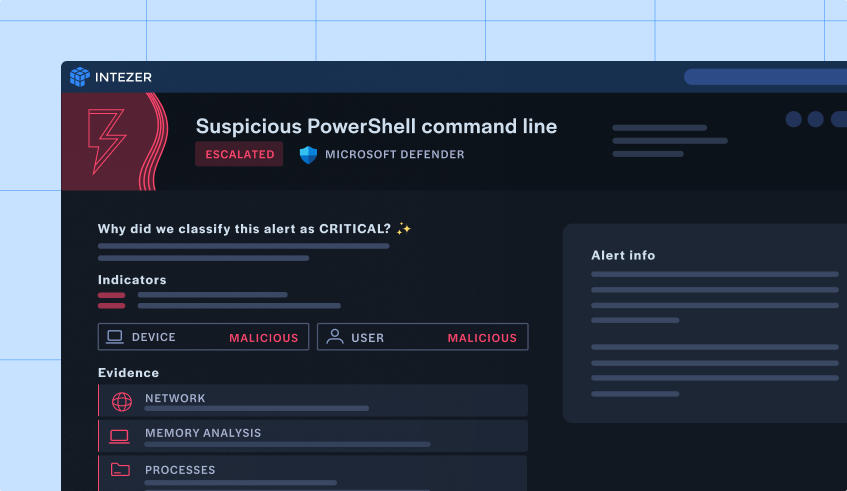
Source: Intezer
2. Dropzone AI
Best for: Teams wanting auditable end-to-end investigations without playbooks
Strengths: 90+ integrations, glass-box reasoning, auto-containment actions
Things to consider: Tuning period at rollout; coverage limited to supported alert types
Dropzone AI runs an AI SOC Analyst that investigates alerts end to end and shows its reasoning, alongside an AI Threat Hunter and an AI Threat Intel Analyst. Supported alert types cover phishing, endpoint, network, cloud, identity and insider threat.
Each investigation moves through collect, investigate, conclude, contain and adapt stages. The platform connects to existing tools through more than 90 integrations without requiring data migration or log normalization.
Key features include:
- End-to-end alert investigation: Agents gather evidence across connected tools, weigh findings against organizational context, and produce a conclusion such as benign or malicious with supporting detail in plain English.
- Glass-box audit trail: Records every question asked, every tool queried and every finding generated, giving compliance and governance teams a full trace behind each verdict.
- Context memory: Stores details about the environment, learning both from analyst input and on its own, so subsequent investigations account for known users, permissions and expected activity.
- Auto-containment actions: Fires containment steps such as blocking malicious IPs and disabling compromised accounts once an agent confirms a threat.
- Custom investigation strategies: Lets teams set their own investigation approaches, outcome rules and context entries so agents follow the organization's process.
- Built-in investigation chatbot: Analysts can ask follow-up questions and run ad-hoc investigations from within the platform rather than switching to another console.
- Broad SIEM and EDR coverage: Integrates with tools including Splunk, Microsoft Sentinel, Exabeam, IBM QRadar, Elasticsearch, Google Security Operations, CrowdStrike, Microsoft Defender, SentinelOne, AWS, Azure, Google Cloud and Wiz.
- EU data residency option: Offers an EU-resident deployment for organizations with regional data handling requirements.
Limitations (based on publicly available sources):
- Tuning period after deployment: Reviewers note that fine-tuning takes time before the platform matches expectations, and that refining verdict accuracy is an ongoing effort.
- Coverage bounded by supported alert types: The agent handles a defined list of alert categories, so signals outside those types fall back to analysts.
- Integration-dependent scope: Investigations draw only on connected systems, so environments with tools outside the supported integration list need additional work.
- Limited independent review coverage: Public feedback is concentrated on a small number of verified reviews, which makes it harder to compare experiences across many deployments.
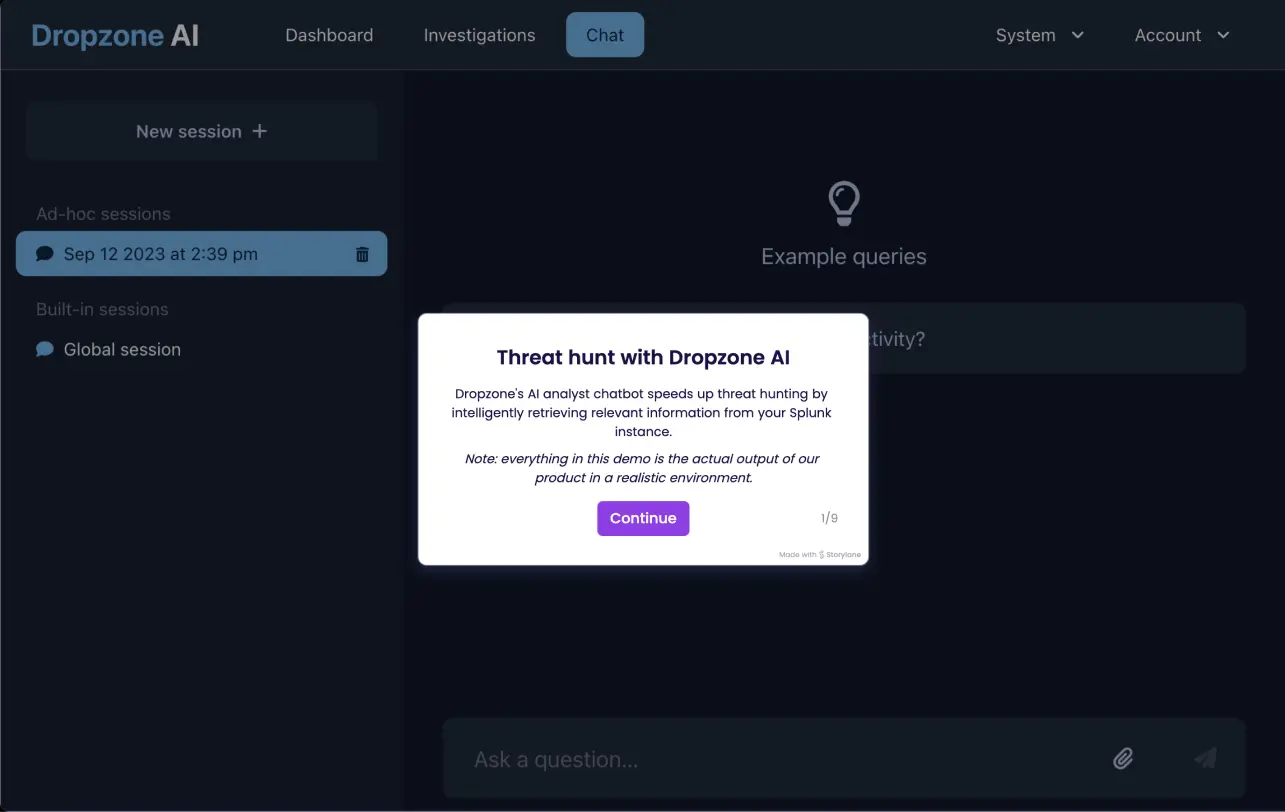
Source: Dropzone AI

3. Prophet Security
Best for: SOCs wanting triage, threat hunting and detection engineering together
Strengths: Parallel investigation of all alerts, backtested automation changes
Things to consider: Value depends on how many of your tools are connected
Prophet AI SOC Analyst runs a dynamically planned investigation on every alert at every severity the moment it arrives. It summarizes the alert, extracts artifacts, plans the questions an analyst would ask, and runs them across SIEM, EDR, identity, cloud and email tools.
Investigations run in parallel, so processing time stays consistent whether the queue holds 50 alerts or 2,000. The wider platform also includes an AI Threat Hunter, an AI Detection Engineer and a human-staffed review service.
Key features include:
- Dynamically planned investigations: Builds an investigation plan per alert rather than following a fixed playbook, then executes the queries across connected data sources.
- Documented reasoning: Records every question asked, every query run and every reasoning step so analysts can verify how a determination was reached.
- Alert-to-incident grouping: Consolidates related investigations into a single incident, so a campaign that produced dozens of tickets reads as one case.
- Scoped auto remediation: Executes permissioned response actions from notifications through to quarantining a machine, with a preview before execution and backtesting against historical data.
- Configurable autonomy: Investigates autonomously from the start but only performs actions the team has approved, with scope widened as the track record builds.
- Plain-language guidance: Teams teach playbooks, policies and preferences at the organization level, on a full investigation, or on a single investigation step.
- Correctable learning entries: Each learned entry shows its source and can be edited, and changes are previewed and backtested against past investigations before taking effect.
- 200+ integrations and workflow delivery: Connects to SIEMs, security data lakes, threat intelligence feeds and case management tools, with results delivered in-product and through Slack, Teams or webhooks with per-channel scope control.
Limitations (based on publicly available sources):
- Approval-gated response: Actions that change access or contain a host default to human approval, so containment speed depends on how much autonomy the team grants.
- Integration-dependent depth: Investigation quality reflects the number of connected data sources, so partially integrated environments see narrower context.
- Ongoing teaching required: Policies, playbooks and preferences must be supplied and maintained for the agent to align with local process.
- Human review still needed: Escalated determinations and higher-risk decisions remain with analysts rather than being closed autonomously.
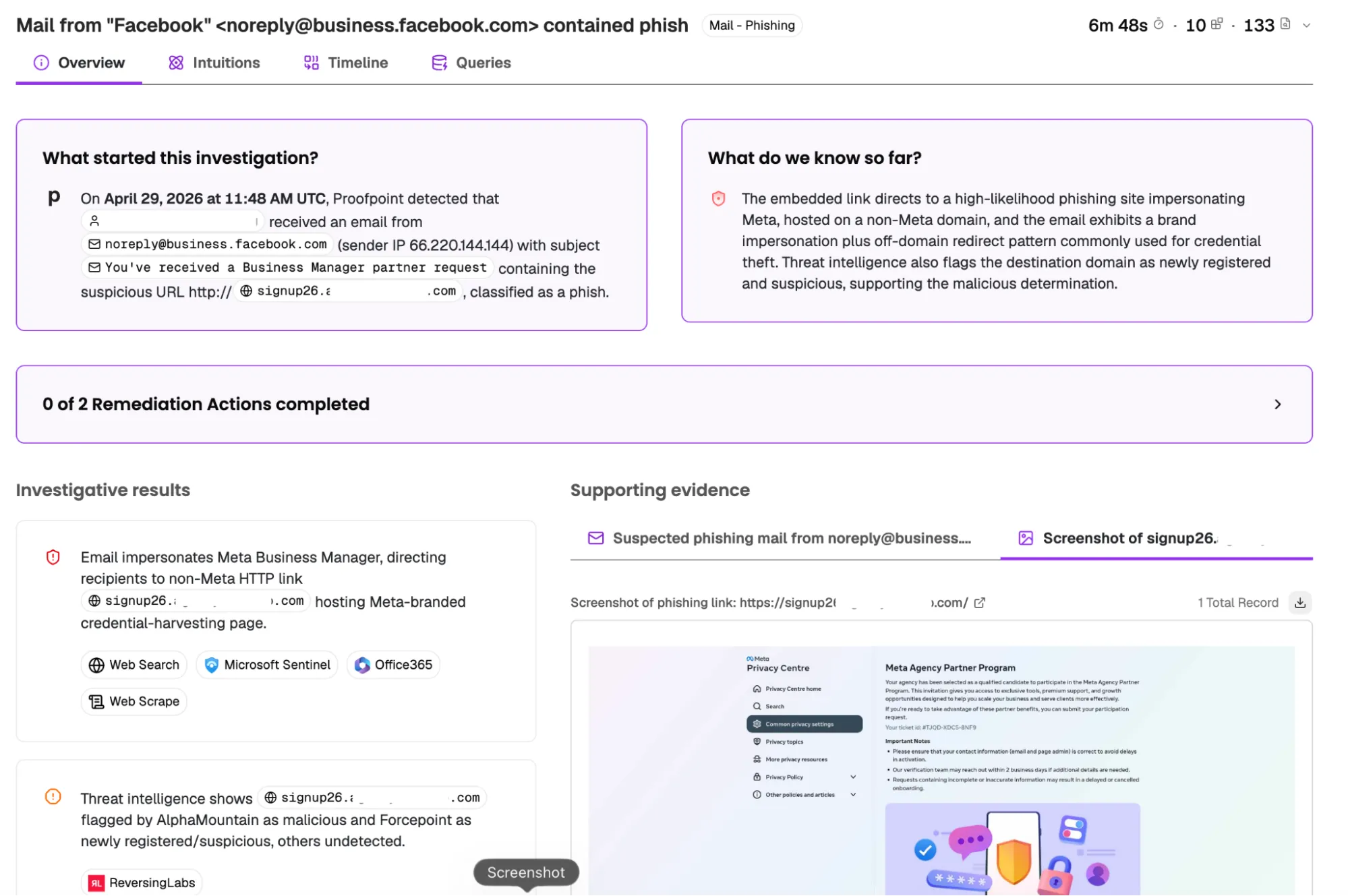
Source: Prophet Security
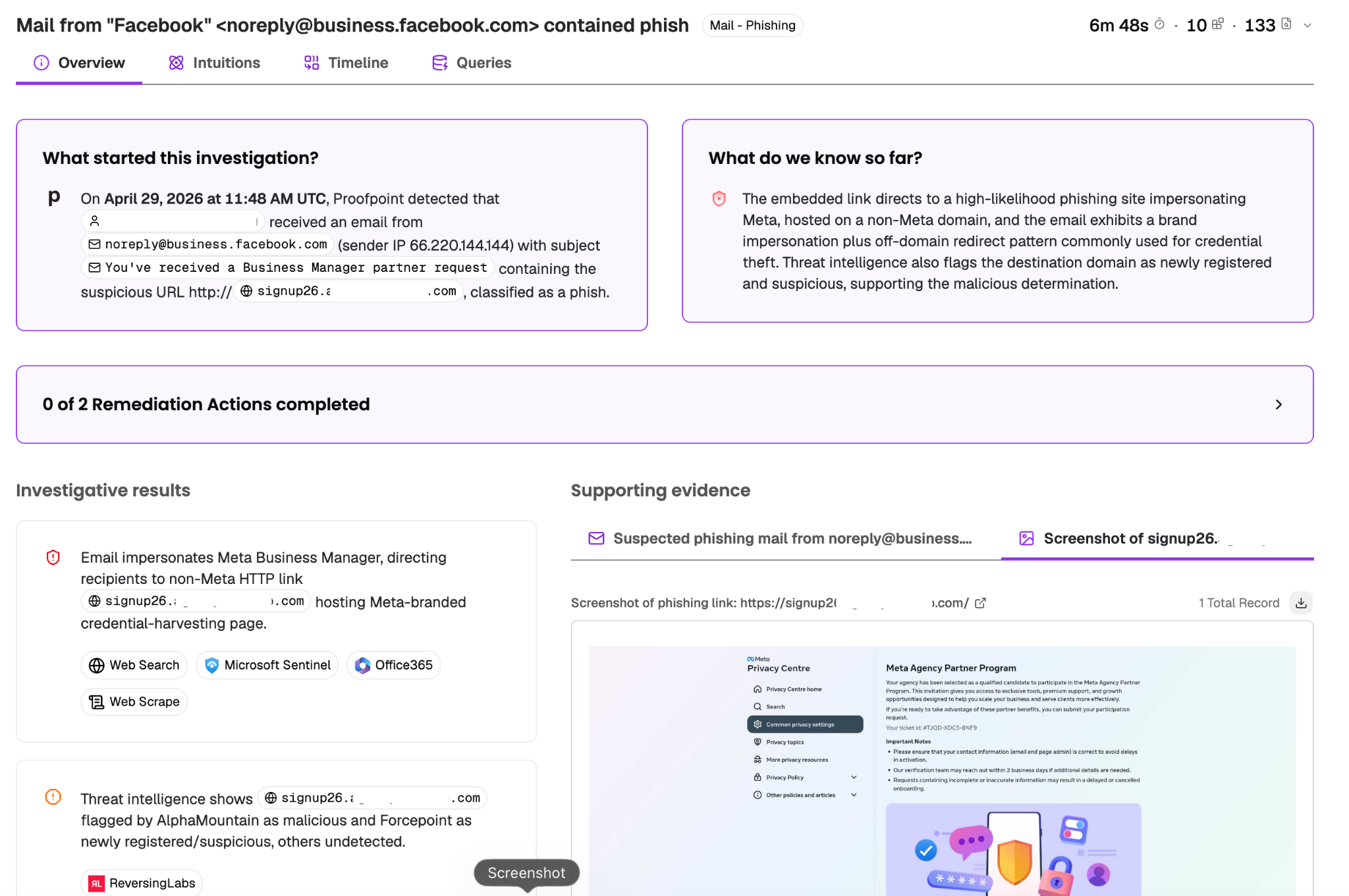
4. Exaforce

Best for: Cloud and SaaS heavy environments looking to replace SIEM and SOAR
Strengths: Four Exabots plus multi-model AI over a unified data platform
Things to consider: Some integrations still on the roadmap; cloud and SaaS focused
Exaforce runs four agents, called Exabots, across detection, triage, investigation and response, all working from a shared real-time view of the environment. A multi-model AI engine combines data semantics, behavioral baselining, machine learning and large language models.
The platform includes its own data layer that ingests and normalizes cloud and SaaS telemetry, positioned as a SIEM replacement. Teams can run it themselves or have Exaforce operate it as an MDR service.
Key features include:
- Exabot Triage: Autonomously investigates alerts from SIEM, EDR, phishing tools and Exaforce's own detections, classifying each as false positive, benign or needing investigation across Tier 1 to Tier 3 depth.
- Exabot Detect: Monitors IaaS and SaaS environments including AWS, Okta, OpenAI and GitHub, correlating behavioral baselines with contextual intelligence to surface attacks that rule-based and UEBA detection miss.
- Exabot Investigate: Provides a visual, BI-style interface and natural language search so analysts can pivot across events, identities, devices and cloud resources without writing SQL or SIEM query syntax.
- Exabot Respond: Runs multi-step response workflows such as user verification, device containment and access revocation, with built-in error handling and retries.
- Multi-model AI engine: Separates data relationships, anomaly detection and expert reasoning into dedicated models rather than relying on a single LLM for every decision.
- Real-time data platform: Deduplicates, transforms and correlates high-volume telemetry, with tiered storage that keeps recent data immediately searchable and retains full history for audits.
- Broad source ingestion: Pulls logs, alerts, configuration, code and identity data from more than 100 sources, including services such as GitHub and Google Workspace that many platforms leave out.
Limitations (based on publicly available sources):
- Integration gaps: Reviewers have noted missing connectors for some widely used platforms, and a large portion of the published integration list is marked as coming soon.
- Permissions management: Users have cited permissions handling and out-of-the-box support for additional data sources as areas needing work.
- Cloud and SaaS orientation: Detection coverage is weighted toward IaaS and SaaS environments, which may leave on-premises estates less well served.
- Scope of adoption: Using the data platform as a SIEM replacement is a larger migration project than layering triage over an existing SIEM.
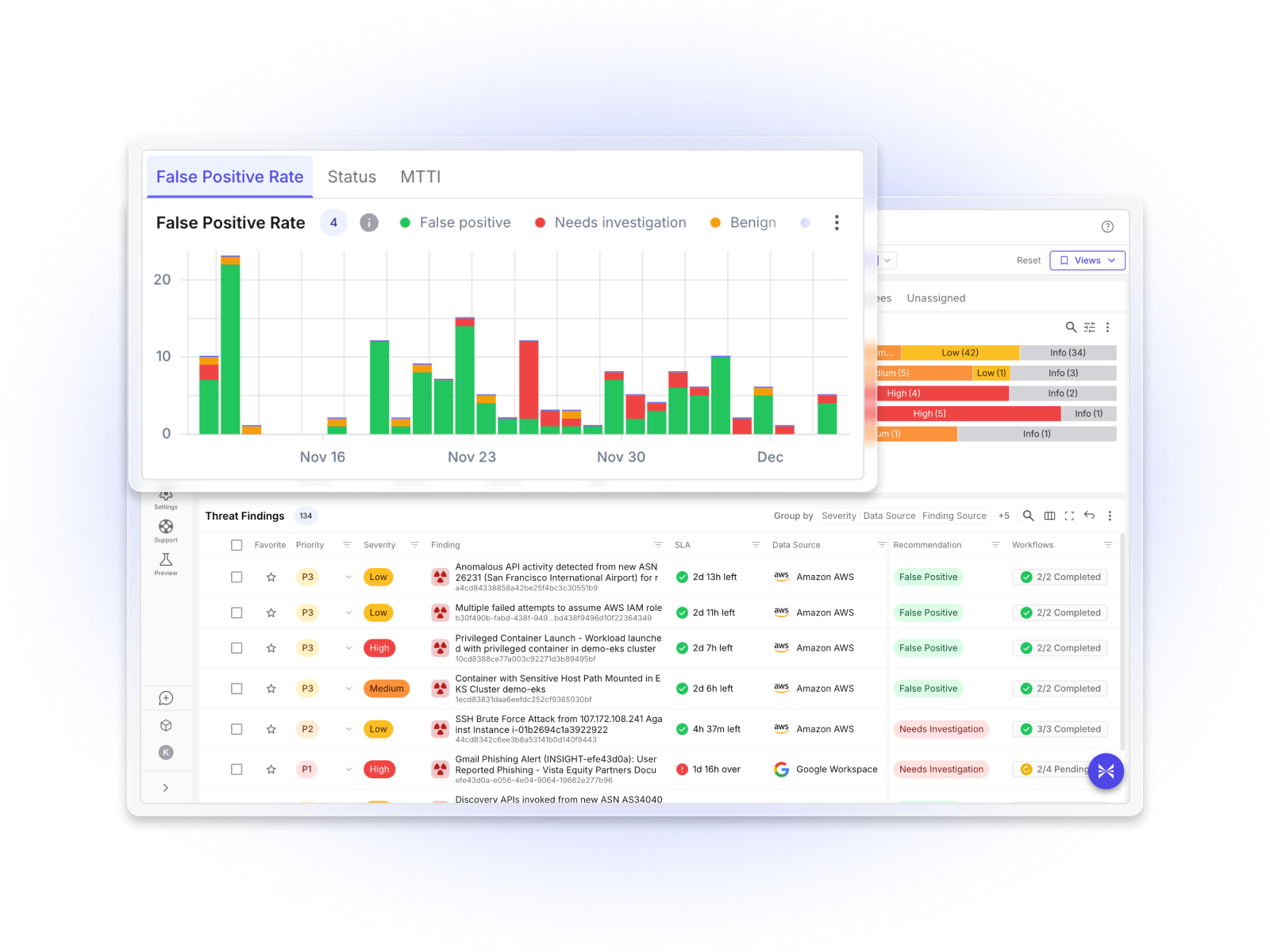
Source: Exaforce
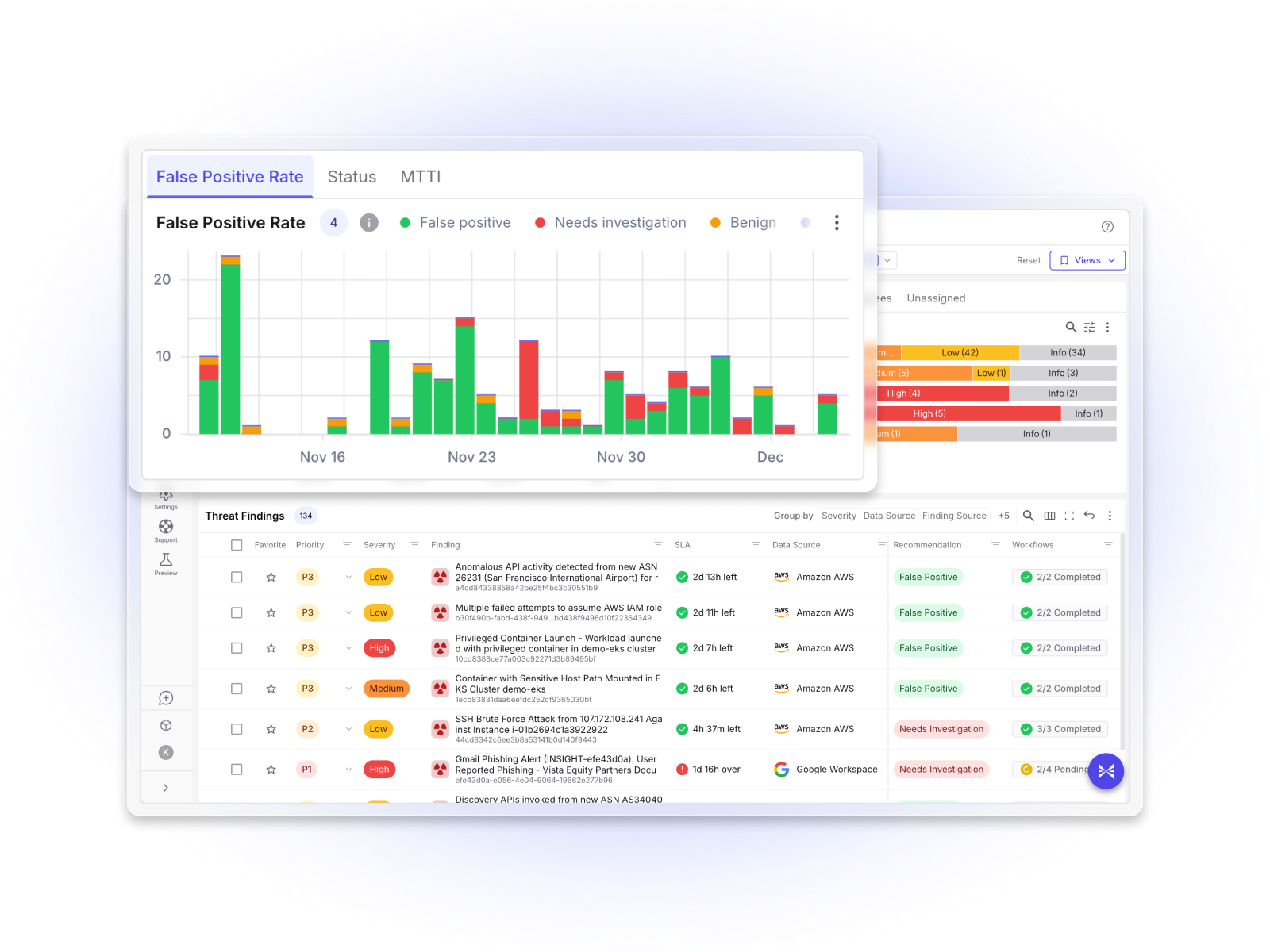
Agentic AI in Security Operations Platforms
These are agentic capabilities delivered inside broader detection, response and SIEM platforms, drawing on telemetry the vendor already collects.
5. Microsoft Security Copilot

Best for: Organizations standardized on the Microsoft security stack
Strengths: Agents embedded across Defender, Entra, Intune and Purview
Things to consider: Costly at scale; coverage strongest inside Microsoft tools
Microsoft Security Copilot delivers agentic automation inside Microsoft Defender, Entra, Intune and Purview rather than as a separate console. Agents handle high-volume security tasks, learn from analyst feedback and adapt to existing workflows.
The service can be used through embedded agents supplied by Microsoft, agents built by partners, or agents the security team builds itself. Capacity is provisioned through Security Compute Units, with an allotment included for Microsoft 365 E5 and E7 customers.
Key features include:
- Embedded triage agents: Ready-to-use agents handle tasks such as phishing triage, alert triage and vulnerability remediation directly inside the Microsoft security products where the alerts appear.
- Custom agent building: Teams build their own agents for tailored workflows without writing code, and can also deploy agents published by Microsoft partners.
- Investigation and remediation guidance: Condenses complex alerts into actionable summaries and supplies step-by-step response guidance for the analyst working the case.
- Script generation and reverse engineering: Translates natural language into query-language scripts and explains malware scripts, so team members can run technical tasks without deep scripting knowledge.
- Stakeholder reporting: Produces reports covering incident context, open issues and protective measures, adjusted to the tone and language of the intended audience.
- Promptbooks and embedded skills: Packages repeatable prompt sequences that analysts can run against security data instead of assembling queries each time.
- Cross-product integration: Works across Microsoft Sentinel, Defender, Defender for Cloud, Intune, Entra and Purview, and connects to partner products through plugins.
Limitations (as reported by users on G2):
- Cost at scale: Reviewers consistently describe the usage-based pricing as expensive relative to competing options, particularly during periods of heavy demand.
- Microsoft-centric coverage: Teams running third-party security tools alongside Microsoft products report that questions are best answered for the Microsoft portion of the stack.
- Inconsistent results: Some users report answers that do not match the intent of the request, costing time to re-run or verify.
- Data handling considerations: Because sensitive security data is processed by the service, reviewers raise access control and data protection as points to work through.
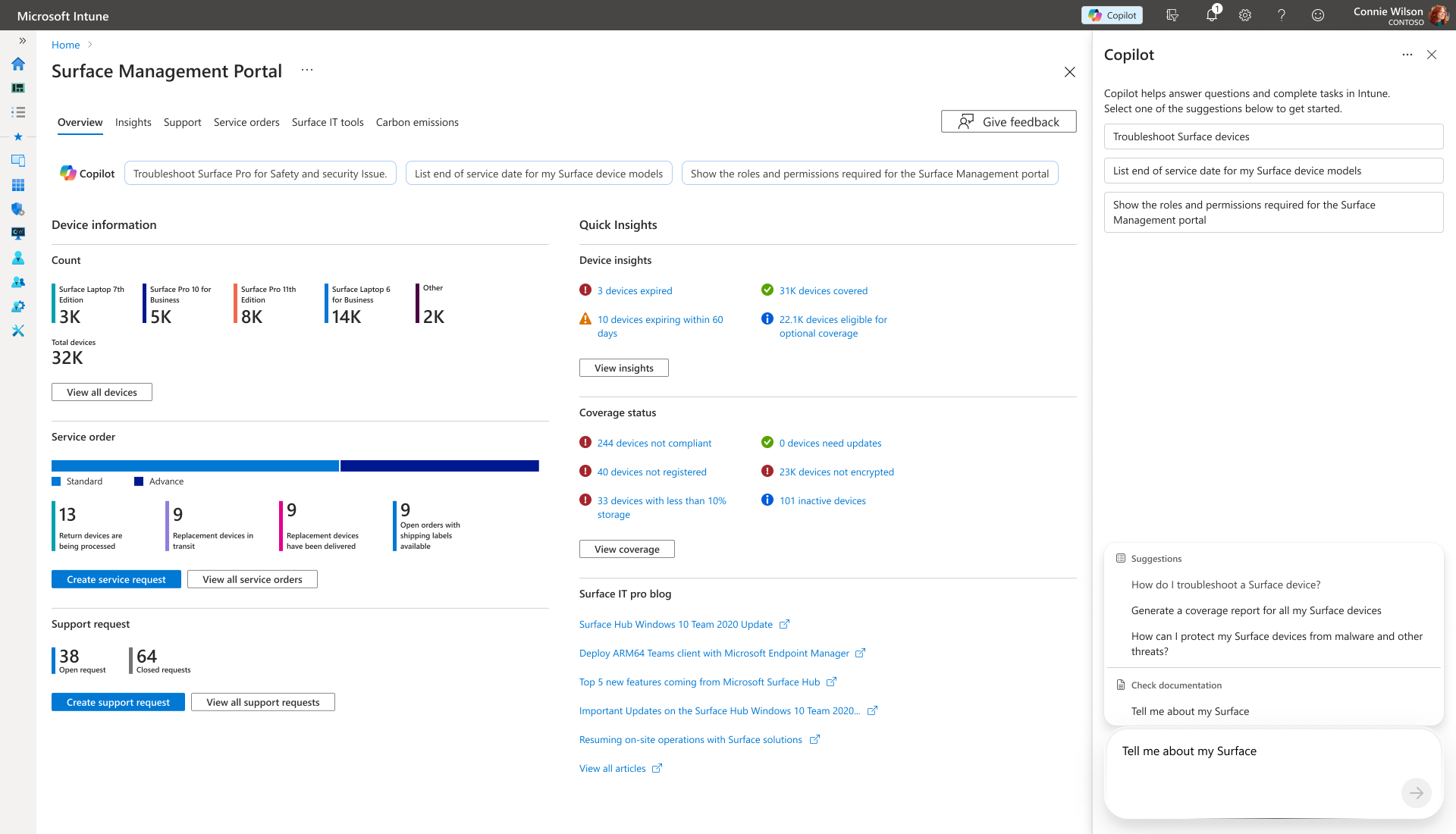
Source: Microsoft

6. CrowdStrike Charlotte AI
Best for: Falcon customers building an agentic SOC on existing data
Strengths: Detection triage, agentic SOAR and no-code agent building
Things to consider: Requires Falcon; metered credits cap monthly agent usage
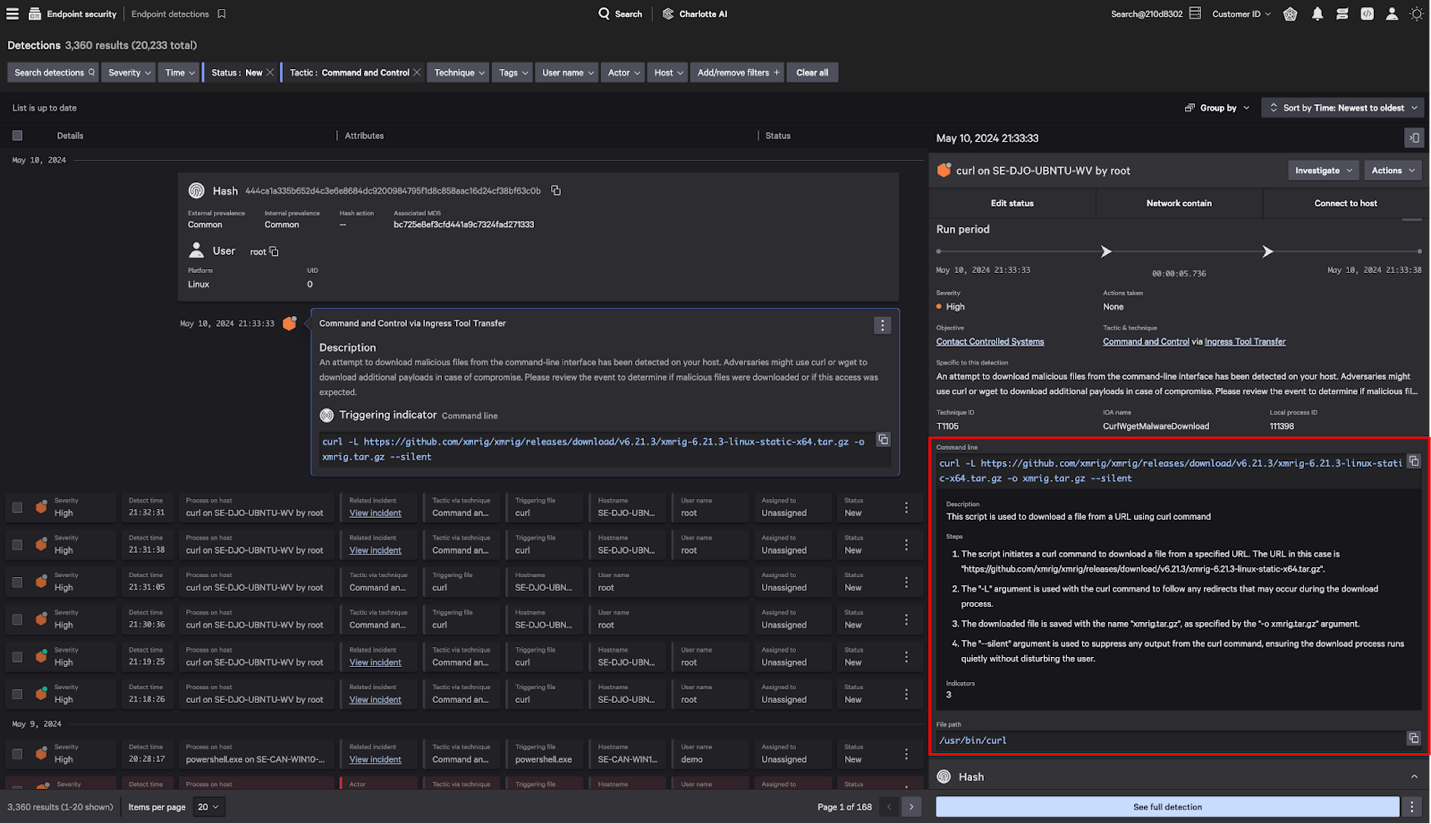
Charlotte AI is CrowdStrike's agentic layer across the Falcon platform, combining AI reasoning with the platform's security telemetry. It triages detections, filters false positives and surfaces the ones that need analyst attention.
Beyond triage, it supports collaborative investigations, custom agent creation through AgentWorks, and orchestration through Charlotte Agentic SOAR. CrowdStrike reports 3x faster time to respond and a 70% reduction in manual effort during investigations.
Key features include:
- Automated detection triage: Classifies incoming detections and filters false positives using models trained on decisions made by CrowdStrike's own analysts.
- Collaborative investigation canvas: Fuses analyst expertise with autonomous reasoning in a workspace where analysts guide investigations in real time, inject context and set priorities.
- AgentWorks no-code agent builder: Teams define an agent's mission, select a model, set input and output structure and specify authorized actions through a natural language interface without writing code.
- Charlotte Agentic SOAR: Orchestrates CrowdStrike agents, custom agents and third-party agents through a visual workflow builder that combines structured automation logic with agentic reasoning.
- Built-in agent guardrails: Agents ship with audit logs, role-based policies, credit caps and version controls so teams retain control over what each agent may do.
- Governance certification and traceability: Holds ISO 42001 certification for AI governance, with traceable answers, user-authorized actions and decisions aligned to the operator's role.
- Ecosystem reach: Coordinates agent-to-agent and human-AI collaboration across security workflows spanning the Falcon platform and connected tools.
Limitations (based on publicly available sources):
- Falcon platform dependency: Charlotte AI requires Falcon Insight or Falcon Prevent, and organizations running other security tools see limited interoperability.
- Credit-metered usage: Access is licensed by monthly credits sized to sensor count, credits do not carry over, and once the monthly cap is reached the service stops accepting new tasks until more are licensed.
- Output verification needed: As with other generative systems, responses can be inaccurate, so analysts are expected to check conclusions before acting on them.
- Limited fit for unusual workflows: Coverage is strongest for common security tasks, with less flexibility for highly customized or unconventional use cases.
- Role-restricted access: Use is gated behind a specific Charlotte AI role that administrators must grant to each user.

Source: CrowdStrike
7. Palo Alto Networks Cortex AgentiX

Best for: Cortex and XSOAR users moving from static playbooks to AI agents
Strengths: 1,100+ integrations, MCP support, granular autonomy controls
Things to consider: Steep learning curve carried over from XSOAR deployments
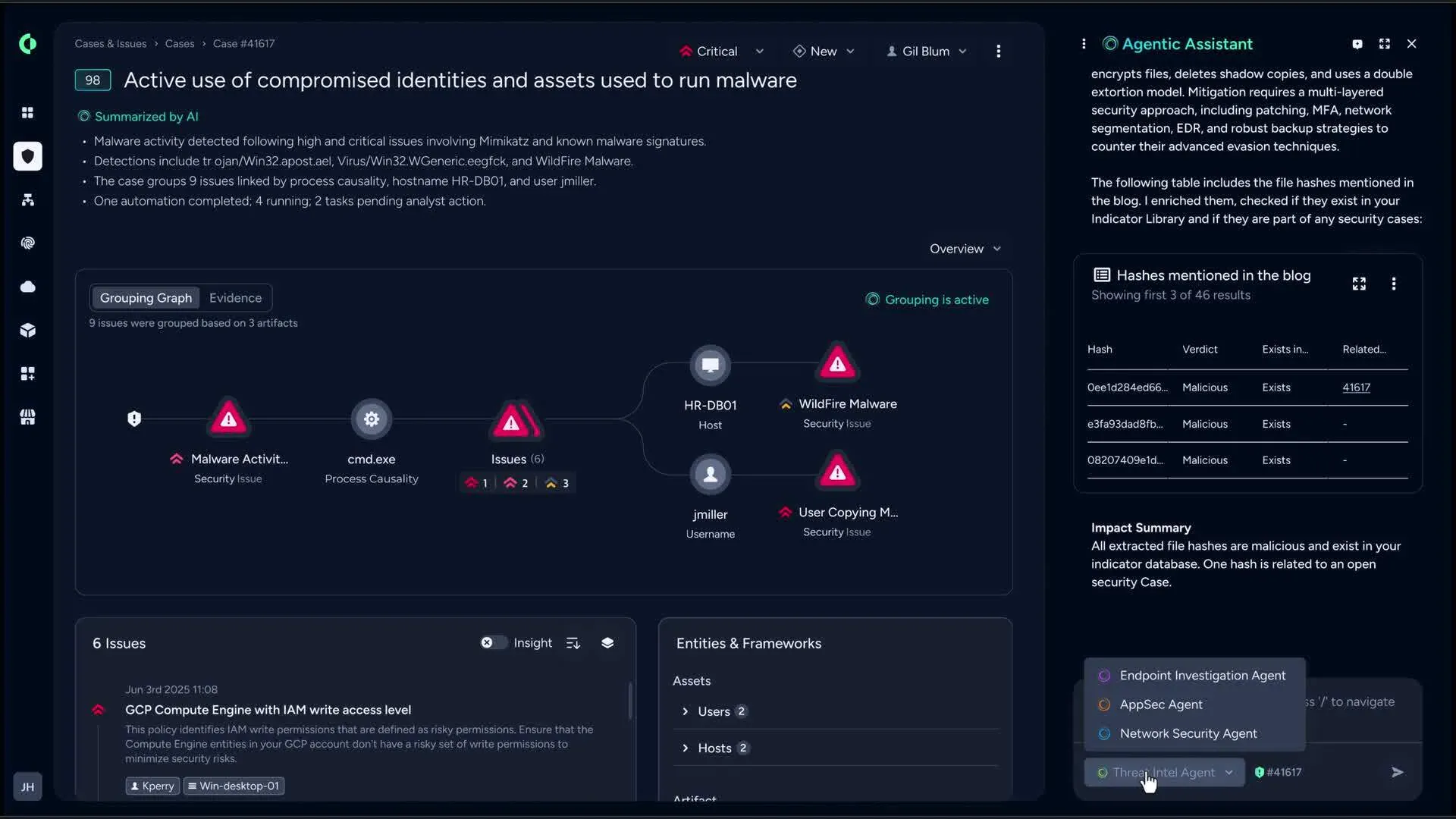
Cortex AgentiX is the next generation of Cortex XSOAR and provides a platform for building, deploying and governing AI agents across security operations. Agents plan and carry out complex workflows, and can be prompted in real time or triggered autonomously.
Teams choose from a library of specialized agents or build their own without code. AgentiX also powers the Cortex Agentic Assistant across Cortex XSIAM, Cortex XDR and Cortex Cloud, and Palo Alto Networks reports over 1,000 Cortex customers have enabled it.
Key features include:
- Prebuilt and custom agents: Provides a library of specialized agents for common security workflows plus a no-code builder for agents grounded in the organization's own context and policies.
- Autonomy controls: Teams define when agents act independently and when high-impact actions require approval, with agents bound by the same roles and permissions as human analysts.
- Reasoning transparency: Exposes each step of an agent's reasoning process, supporting review of how a conclusion or action was reached.
- Agents inside existing workflows: Analysts can call a specialized agent at any stage of detection and response rather than handing the whole case to automation.
- AI prompts within playbooks: Prebuilt prompts or prompts written in natural language can be dropped into playbooks to summarize raw logs, normalize data and analyze threats.
- Integration breadth and MCP support: Ships with over 1,100 prebuilt integrations, native Model Context Protocol support for assigning external MCP server tools to agents, and a Cortex MCP Server for querying Cortex data from another LLM.
- Cross-product coverage: Deploys and controls agents across Cortex XSIAM, Cortex XDR and Cortex Cloud through a single agentic assistant.
Limitations (as reported by users on G2, covering the Cortex XSOAR platform that AgentiX succeeds):
- Steep learning curve: Reviewers describe needing considerable time and effort to become proficient, with configuration cited as complex for new users.
- Reporting depth: Users report that reporting features need improvement and ask for more customization options.
- Time investment: Building and maintaining automation is described as time-consuming, with the platform leaning toward a do-it-yourself model.
- Dashboard navigation: Some reviewers note that more research is required to navigate the console than with competing products.
Source: Palo Alto Networks
8. Google Security Operations

Best for: Teams that want agentic triage built into their SIEM and SOAR
Strengths: Gemini agents over SIEM, SOAR and Mandiant threat intelligence
Things to consider: Long implementations, high cost and limited customization
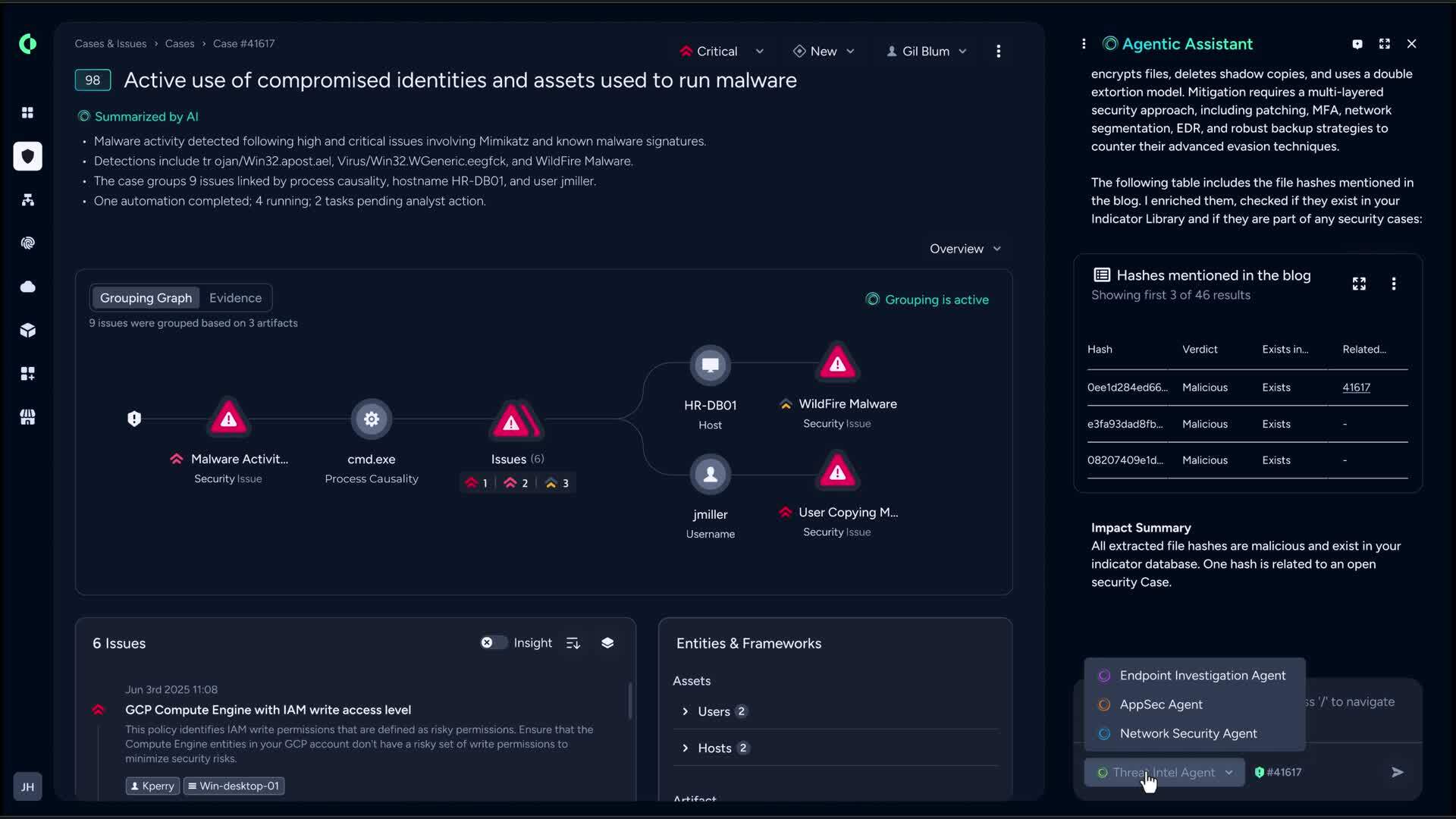
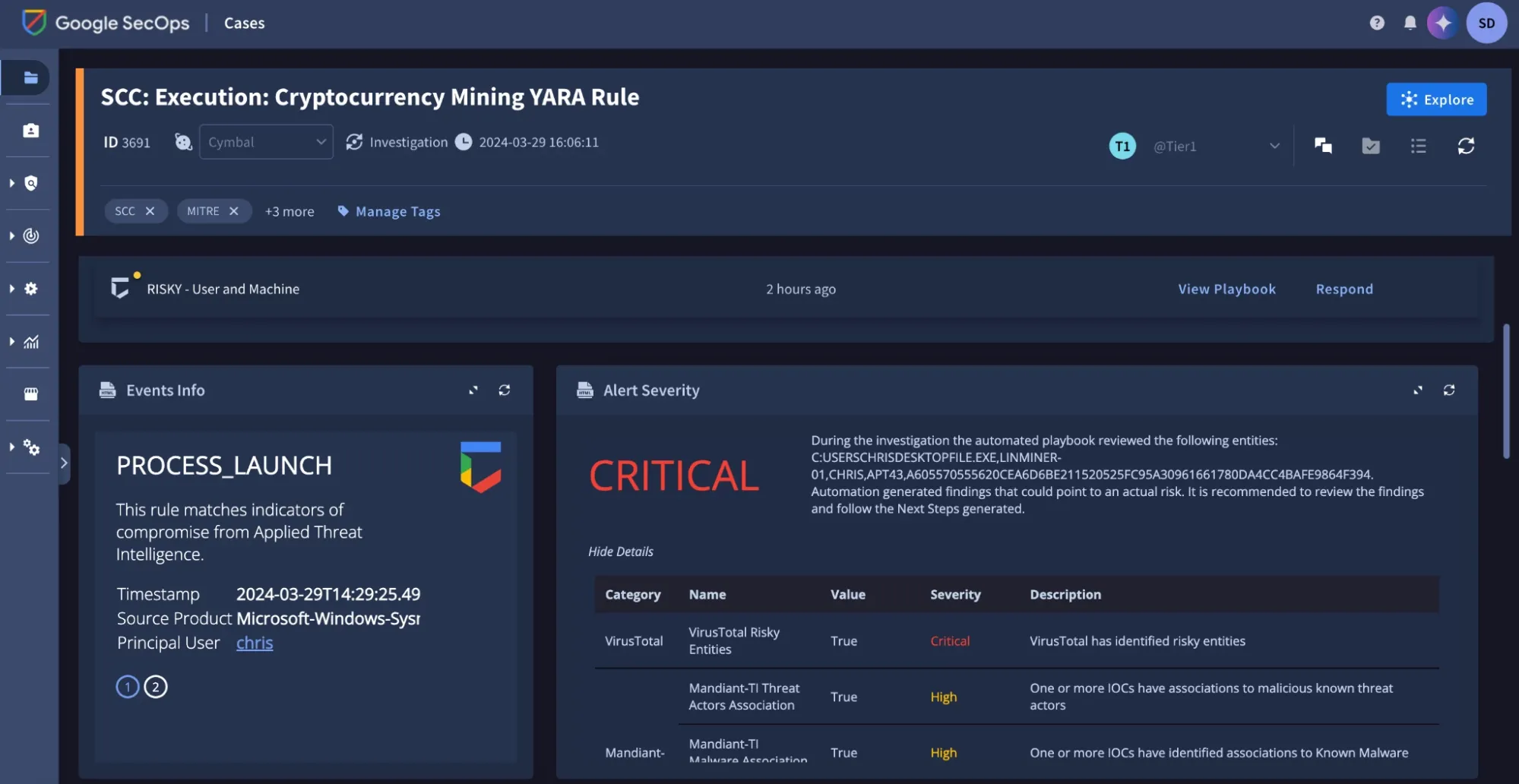
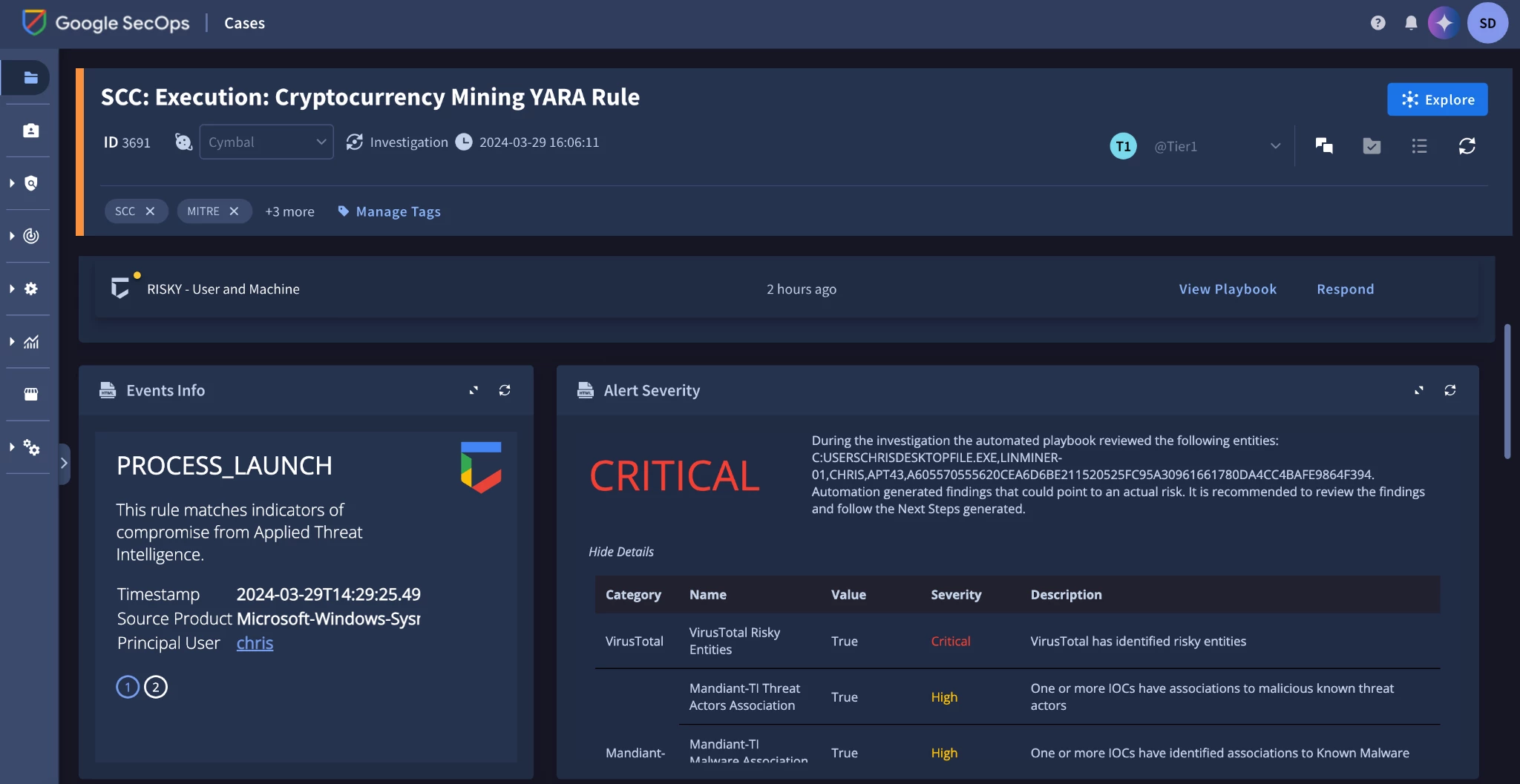
Google Security Operations combines SIEM, SOAR and threat intelligence in one platform, with Gemini-native agents handling workflows including alert triage, threat hunting and detection engineering. Agents draw on Mandiant intelligence and frontline incident response insights.
The Triage and Investigation agent gathers evidence, runs analyses such as decoding obfuscated scripts, correlates signals across tools and returns a verdict with an explanation. Google reports it reduces a typical 30-minute manual analysis to around 60 seconds.
Key features include:
- Alert triage and investigation agent: Investigates alerts autonomously, assembling evidence and correlating signals so analysts review finished investigations rather than raw alerts.
- Third-party tool access through MCP: Model Context Protocol support lets agents connect to tools across the wider IT and security environment, enabling multi-vendor workflows and natural language queries against diverse sources.
- Curated and custom detections: Ships with detections built and maintained by Google threat researchers, and supports custom rule authoring in the YARA-L language.
- Natural language search and detection creation: Gemini generates the underlying queries from plain language, presents the mapped syntax, and can create detections and playbooks the same way.
- Investigation workspace: Provides threat-centric case management, context-rich alert graphing, automatic entity stitching, AI-generated case summaries and response recommendations.
- SOAR orchestration: Builds playbooks that automate common response actions across more than 300 integrated tools, with an auto-documenting case wall for team collaboration.
- Data pipeline management: Routes, filters, redacts and transforms security telemetry before it lands, with over 700 parsers and 12 months of hot data retention included.
- Applied threat intelligence: Higher tiers add full Google Threat Intelligence access, covering Mandiant, VirusTotal and Google sources, with prioritization of indicator matches based on the customer's environment.
Limitations (as reported by users on G2):
- Cost: Reviewers repeatedly describe the platform as expensive for their organizations.
- Setup complexity and time: Configuration is described as complex, with reviewers reporting an average implementation time of around five months.
- Learning curve: Users report that the platform takes longer to learn than comparable tools, and that documentation support is uneven.
- Limited customization: Several reviewers find customization options restrictive for environments with less common security requirements.
- Support responsiveness: Slower support responses are cited as affecting how quickly issues get resolved.
- Cloud data handling: Because data is held in the cloud, some reviewers raise privacy and residency as considerations for their environment.
Source: Google
Conclusion
Agentic AI can reduce SOC workload by taking over repetitive triage, enrichment, investigation, documentation, and selected response tasks that would otherwise consume analyst time. The strongest deployments combine broad access to security telemetry with dynamic investigation, evidence-backed decisions, configurable autonomy, and clear audit trails. Teams should keep human oversight for uncertain or high-impact actions while gradually expanding automation where agents demonstrate reliable results.