
Top 8 AI-Powered SOC Systems with Real-Time Threat Analysis in 2026
In this article

TL;DR: AI-powered SOC platforms use machine learning and agentic AI to correlate security telemetry in real time, triaging alerts and driving response at machine speed. Best for forensic-depth triage: Intezer. For auditable investigation: Prophet AI. For platform consolidation: Cortex XSIAM. For Microsoft-centric SOCs: Microsoft Sentinel.
What Is an AI-Powered Security Operations Center?
An AI-powered Security Operations Center (SOC) uses artificial intelligence, machine learning, and agentic workflows to automate real-time threat detection, alert triage, and incident response. Unlike traditional SOCs, which rely heavily on manual processes and human analysts, AI-driven SOCs automate many routine tasks and rapidly process vast quantities of data from multiple sources.
How AI SOCs enable real-time threat analysis:
- Continuous security data collection: Continuously ingests telemetry from endpoints, networks, cloud services, identities, and security tools to maintain current visibility.
- Data normalization and correlation: Standardizes events from different sources and links related activity to reveal multi-stage attacks.
- Behavioral and anomaly detection: Learns normal user and system behavior and flags deviations that may indicate compromise or misuse.
- AI-based risk scoring: Prioritizes alerts using threat severity, asset criticality, user context, and exploitability to focus analysts on the highest-risk incidents.
- Automated response recommendations: Suggests or triggers actions such as isolating endpoints, disabling accounts, or blocking malicious traffic based on incident context.
AI-Powered SOC Platforms at a Glance
The table below summarizes the key differences between the platforms covered in this guide, including who each one suits, where it is strongest, and what to weigh before committing. Each platform is explored in more detail in the sections that follow.
| Category | Solution | Best For | Key Strengths | Things to Consider |
|---|---|---|---|---|
| Autonomous AI SOC analyst platforms | Intezer AI SOC | Enterprises needing forensic-depth triage on 100% of alerts | Built-in forensics, sub-minute triage, endpoint-based pricing | Dense interface and limited free-tier scanning |
| Autonomous AI SOC analyst platforms | Dropzone AI SOC Analyst | SOC teams offloading tier-1 triage across an existing stack | 90+ integrations, full audit trail, no playbooks required | Volume-based pricing and a tuning period at onboarding |
| Autonomous AI SOC analyst platforms | Prophet AI SOC Analyst | Teams wanting auditable investigation on every alert severity | Dynamic investigation plans, backtested actions, 200+ integrations | Small independent review base and no public pricing |
| Autonomous AI SOC analyst platforms | Radiant Security | SOCs wanting triage plus log management in one platform | Broad alert-type coverage, one-click response, bundled logging | No public pricing and cloud-only delivery |
| AI-driven SIEM and XDR platforms | Microsoft Sentinel and Defender | Microsoft-centric SOCs unifying SIEM, XDR, and AI agents | Sentinel data lake, security graph, embedded Security Copilot | Ingestion costs and configuration effort at scale |
| AI-driven SIEM and XDR platforms | Palo Alto Networks Cortex XSIAM | SOCs consolidating SIEM, SOAR, EDR, and NDR on one platform | 2,900+ ML models, incident stitching, agentic response | Premium pricing and heavy data onboarding effort |
| AI-driven SIEM and XDR platforms | CrowdStrike Falcon Next-Gen SIEM | Endpoint-first SOCs building an agentic workflow on Falcon | 150x faster search, Charlotte AI agents, single-sensor data | Premium pricing and third-party onboarding effort |
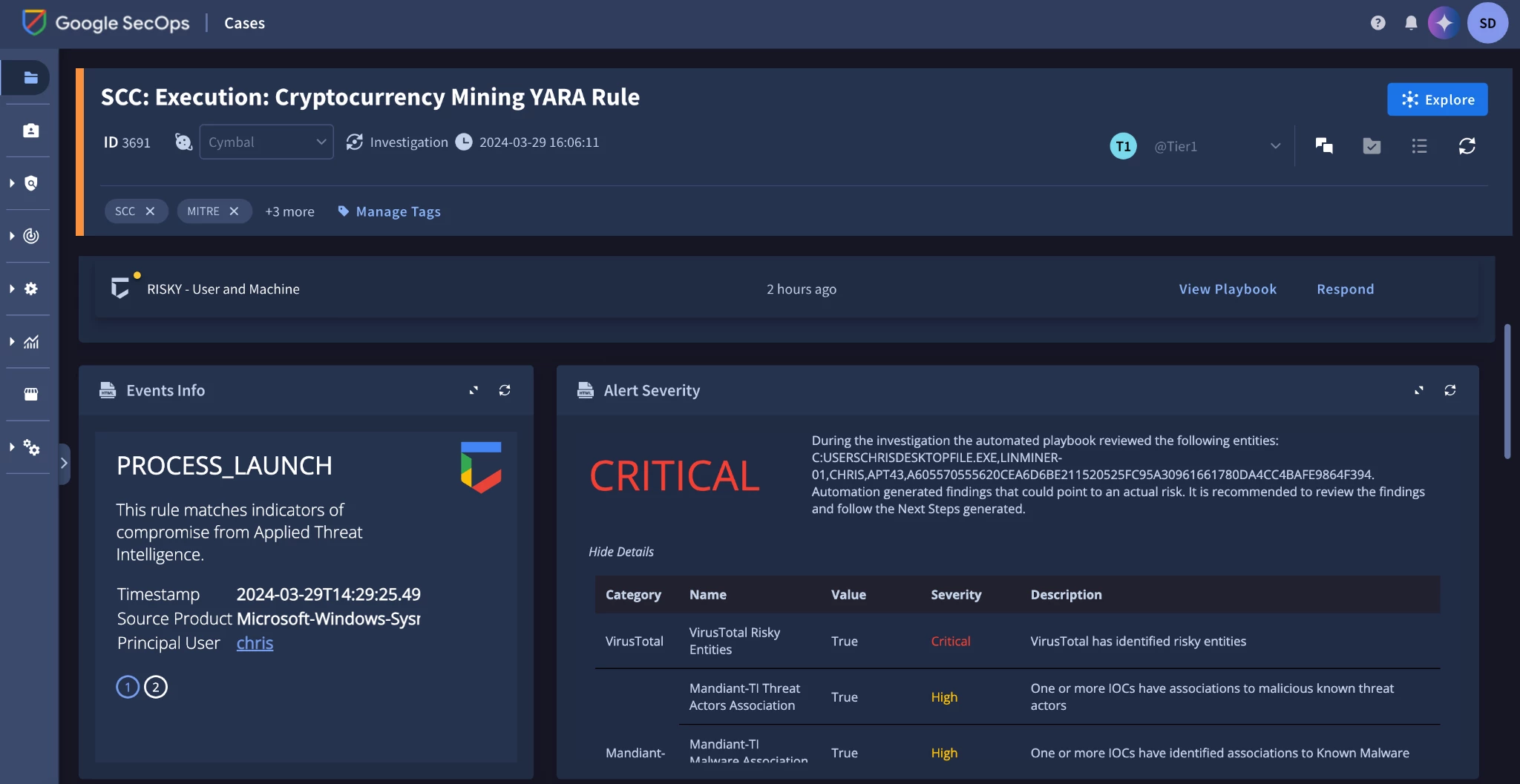
| AI-driven SIEM and XDR platforms | Google Security Operations | Teams wanting Gemini-native agents and Mandiant intelligence | Agentic triage, curated detections, 300+ SOAR integrations | Steep learning curve and limited customization |
Related content: For a wider view of the market, read our guide to the top AI SOC platforms.
How Real-Time Threat Analysis Works
1. Continuous Security Data Collection
Continuous security data collection ensures that security systems are fed with up-to-date, comprehensive information. This process involves gathering data from a wide range of sources, including:
- Firewalls
- Intrusion detection systems
- Endpoints
- Cloud services
- User activity logs
The collection is not limited to periodic snapshots but operates on a real-time or near-real-time basis, allowing the SOC to maintain a current picture of the organization’s security posture at all times. This constant inflow of data enables the SOC to detect threats as they arise rather than after the fact. It also provides the raw material necessary for AI algorithms to learn and adapt to changing patterns of behavior within the network.
2. Data Normalization and Correlation
Data normalization is the process of transforming disparate security data into a standard, consistent format, making it possible to analyze information from different sources together. In an enterprise environment, logs and events often come from various systems that record details differently. Normalization ensures that fields such as timestamps, IP addresses, and user IDs are aligned across datasets, allowing AI models and analysts to accurately interpret and compare events.
Correlation is the next step, where normalized data from multiple sources is analyzed in context to uncover relationships and patterns that may indicate a coordinated attack or advanced threat. The SOC can identify incidents that might otherwise go unnoticed if each data point were viewed in isolation, correlating events such as:
- Failed logins
- Unusual network traffic
- Suspicious file access
Effective normalization and correlation are essential for reducing noise, increasing detection accuracy, and providing actionable insights to security teams.
3. Behavioral and Anomaly Detection
Behavioral and anomaly detection leverages AI and machine learning to identify deviations from established patterns of user and system activity. Instead of relying solely on predefined rules or known signatures, these systems learn what constitutes normal behavior within an organization’s environment over time. When an activity deviates significantly (such as a user accessing sensitive data at an unusual hour or a device communicating with unfamiliar external servers) the SOC is alerted to a potential threat.
This approach is particularly effective for detecting threats that may bypass traditional defenses, such as:
- Zero-day attacks
- Insider threats
- Sophisticated adversaries
By continuously updating their understanding of normal behavior, AI-powered SOCs can adapt to changing environments and evolving threats. The result is a more dynamic and proactive security posture, where suspicious activities are flagged for investigation even if they do not match known attack patterns.
Related content: Read our article about the five pillars of AI threat detection.
4. AI-Based Risk Scoring
AI-based risk scoring is a method where each detected threat or security event is assigned a score that reflects its potential impact and likelihood of being malicious. This scoring process uses machine learning models trained on:
- Historical incident data
- Threat intelligence feeds
- Contextual factors such as asset value and network segment
The risk score helps security teams prioritize incidents, focusing attention on the most critical threats and reducing the time spent on low-risk or false-positive alerts. Effective risk scoring considers multiple dimensions, such as the type of asset involved, the method of attack, the user’s typical behavior, and the presence of known vulnerabilities. This contextual approach enables more accurate triage and decision-making, ensuring that resources are allocated efficiently.
5. Automated Response Recommendations
Automated response recommendations leverage AI to suggest or initiate actions in response to detected threats. These recommendations are based on the severity and context of each incident, as determined by real-time analysis and risk scoring. For example, if a compromised account is detected, the system might recommend:
- Disabling the account
- Initiating a password reset
- Isolating the affected device from the network
Such automation accelerates the incident response process and minimizes the window of exposure. In addition to suggesting actions, some AI-powered SOCs can execute predefined responses automatically for certain types of threats, such as blocking malicious IP addresses or quarantining infected endpoints. This reduces the burden on human analysts and ensures a rapid, consistent response to common attack scenarios.
Key Use Cases for AI SOCs with Real-Time AI Threat Analysis
Automated Alert Triage
Automated alert triage uses AI to sift through the vast number of security alerts generated by modern IT environments, filtering out false positives and prioritizing genuine threats. Traditional SOCs often struggle with alert overload, causing critical incidents to be overlooked or addressed too late. AI models can quickly analyze alerts in context, cross-referencing threat intelligence, asset value, and historical data to determine which incidents require immediate attention.
By automating this process, organizations significantly reduce the time spent on manual alert review and increase the efficiency of their security operations. Automated triage ensures that high-risk threats are escalated to analysts promptly, while routine or low-risk alerts are handled automatically or deprioritized. This targeted approach enables SOC teams to focus their expertise on investigating and responding to the most pressing security challenges.
Ransomware Detection and Containment
Ransomware detection and containment is a critical use case for AI-powered SOCs, given the prevalence and impact of these attacks. AI systems can identify early indicators of ransomware activity, such as unusual file encryption patterns, unexpected process behavior, or spikes in disk activity. By correlating these signals across endpoints and network devices, the SOC can detect ransomware campaigns in their initial stages, often before significant damage occurs.
Once ransomware is detected, AI-driven SOCs can automatically initiate containment measures, such as isolating affected systems, blocking malicious processes, or disabling compromised accounts. These rapid actions limit the spread of ransomware and reduce recovery time.
Account Takeover Detection
Account takeover detection relies on AI to identify suspicious account activity that could indicate compromised credentials. By monitoring login patterns, device fingerprints, geographic locations, and access times, AI-powered SOCs can detect anomalies such as logins from unusual locations or devices, rapid password changes, or access to sensitive resources outside normal business hours. These deviations are quickly flagged for further investigation.
AI models continuously learn and adapt to evolving attacker tactics, making them effective at detecting both brute-force attacks and more subtle credential misuse. Early detection of account takeovers allows organizations to take swift action, such as enforcing multi-factor authentication or resetting credentials, to prevent data breaches and limit unauthorized access to critical systems.
Cloud and SaaS Threat Detection
Cloud and SaaS threat detection uses AI to monitor activity across cloud infrastructure and software-as-a-service applications for signs of malicious behavior. Modern organizations rely on multiple cloud platforms, making it difficult to maintain consistent visibility with manual monitoring alone. AI analyzes authentication events, API activity, configuration changes, data access patterns, and user behavior to identify suspicious actions, such as impossible travel logins, privilege escalation, or unauthorized data downloads.
AI-powered SOCs also detect cloud-specific risks, including exposed storage buckets, excessive permissions, and unusual service account activity. By correlating events across cloud providers and on-premises systems, the SOC can identify attacks that span multiple environments. This unified visibility helps security teams respond quickly to cloud threats while reducing blind spots in hybrid and multi-cloud deployments.
Proactive Threat Hunting
Proactive threat hunting uses AI to search for hidden threats that have bypassed preventive security controls. Instead of waiting for alerts, AI continuously analyzes historical and real-time telemetry to uncover subtle indicators of compromise, such as low-volume command-and-control traffic, lateral movement, or persistence techniques. This allows analysts to investigate suspicious activity before it develops into a major security incident.
AI also improves the efficiency of threat hunting by generating hypotheses, identifying related events, and highlighting systems or users that warrant closer inspection. Security teams can focus on validating high-confidence findings rather than manually reviewing large volumes of logs. This approach shortens the time attackers remain undetected and strengthens the organization's ability to identify advanced and previously unknown threats.
Related content: Read our article about AI in threat intelligence.
Notable AI-Powered SOC Platforms with Real-Time Threat Analysis
How we selected these platforms: We shortlisted AI-powered SOC platforms based on continuous telemetry collection and correlation, behavioral and anomaly detection, AI-driven alert triage and risk scoring, automated response execution, and depth of integration with existing security tooling.
Autonomous AI SOC Analyst Platforms
1. Intezer AI SOC

Best for: Enterprises needing forensic-depth triage on 100% of alerts
Strengths: Built-in forensics, sub-minute triage, endpoint-based pricing
Things to consider: Dense interface and limited free-tier scanning
Intezer AI SOC ingests alerts from endpoint, identity, phishing, network, and cloud sources and investigates each one before it reaches a human. It pairs agentic AI reasoning with deterministic forensic tooling, including endpoint forensics, memory scanning, reverse engineering, network artifact analysis, and sandboxing.
The platform runs triage across 100% of alerts and escalates fewer than 2% for human review, at a stated 98% verdict accuracy. Escalations arrive with recommended remediation actions that analysts can review or trigger automatically, and every triage decision is documented so it can be inspected or overridden.
Key features include:
- Forensic evidence collection: Automatically gathers files, logs, command lines, and memory images from EDR, SIEM, and identity provider sources, then analyzes them as part of each investigation rather than enriching the alert alone.
- Bi-directional security tool integrations: Native connections to CrowdStrike, SentinelOne, Microsoft Defender, Office 365, Proofpoint, Wiz, SIEMs, asset management, ticketing, and SOAR platforms, built for the depth required by forensic investigation.
- Identity alert triage: Queries Entra ID and Okta data, checks findings against threat intelligence, contacts users directly for feedback, and proposes or executes the next steps.
- Reported phishing resolution: Parses raw email data, scans attachments, and analyzes URLs to detect common phishing tactics, returning a verdict with priority, classification, and context.
- Network and cloud alert correlation: Analyzes IPs and URLs, correlates alerts to identify patterns, reviews environment context, resolves false positives, and auto-remediates where relevant.
- Human-in-the-loop controls: Transparent triage logic with written explanations, analyst review and override of escalated alerts, continuous improvement from user feedback, and 24/7 access to Intezer's own analysts.
- Deterministic-first processing: Handles most alerts without resource-intensive LLM processing, with pricing tied to organizational size such as endpoint count rather than alert volume.
Intezer is highly rated on Gartner Peer Insights. See what users have to say.
Limitations:
- Requires mature telemetry to work. Investigation quality depends on the customer’s existing EDR/SIEM health. Organizations with immature tooling won’t get full value out of the box.
- MITRE ATT&CK coverage has a realistic ceiling with Intezer benchmarking 60–70% as “top-tier” and flags anything higher as likely inflated. Some technique categories remain outside reliable coverage for any vendor.
- Focused on enterprise-size customers with a minimum of 1,000 employees.
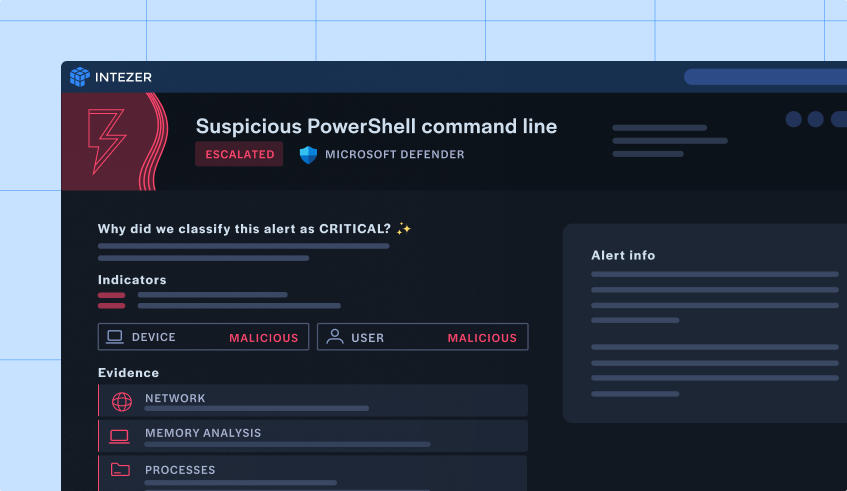
Source: Intezer
2. Dropzone AI SOC Analyst
Best for: SOC teams offloading tier-1 triage across an existing stack
Strengths: 90+ integrations, full audit trail, no playbooks required
Things to consider: Volume-based pricing and a tuning period at onboarding
Dropzone AI runs an AI SOC Analyst that investigates security alerts end to end and shows its reasoning alongside each verdict. It covers phishing, endpoint, network, cloud, identity, and insider threat alert types, and the vendor reports deployment at more than 300 organizations.
The agent operates without playbooks or code, connecting to existing tools through API integrations rather than migrating data or normalizing logs. Teams set custom investigation strategies, outcome rules, and context memory, and the platform records every question asked and every finding produced.
Key features include:
- End-to-end autonomous investigation: AI agents collect the alert, investigate, conclude, and contain where warranted, then update context memory based on what the investigation established.
- Glass-box audit trail: Each investigation records the questions asked, the tools queried, and the findings generated, producing a complete record for compliance and governance review.
- 90+ native integrations: Connects to SIEM, EDR, cloud, identity, email, and DLP tools including Splunk, Microsoft Sentinel, CrowdStrike, Cortex XSIAM, Wiz, Proofpoint, and Google Security Operations, with no data migration required.
- Automatic containment actions: When agents confirm a threat, containment fires immediately, including blocking malicious IPs and disabling compromised accounts.
- Context memory: Learns environment-specific details through analyst input and on its own, then applies that knowledge to subsequent investigations.
- Built-in investigation chatbot: Analysts ask follow-up questions and run ad hoc investigations inside the platform rather than switching to other consoles.
- Additional agents: AI Threat Hunter runs hypothesis-driven hunts across SIEM, EDR, and cloud, and AI Threat Intel Analyst reads new advisories and produces ready-to-run hunt packs.
Limitations (based on publicly available sources):
- Entry cost and volume pricing: Published pricing starts at $36,000 per year for 4,000 investigations, with cost tied to investigation volume rather than seats.
- Tuning period: Reviewers on Gartner Peer Insights, where no ratings fall below four stars, note that fine-tuning takes time before coverage gaps are closed.
- Newer agent coverage: The threat hunting and threat intelligence agents shipped after the core SOC analyst, so their maturity is worth verifying against current availability.
- Broad API access: The platform requires read access into SIEM, EDR, cloud, and identity systems, which some organizations will need to review before deployment.
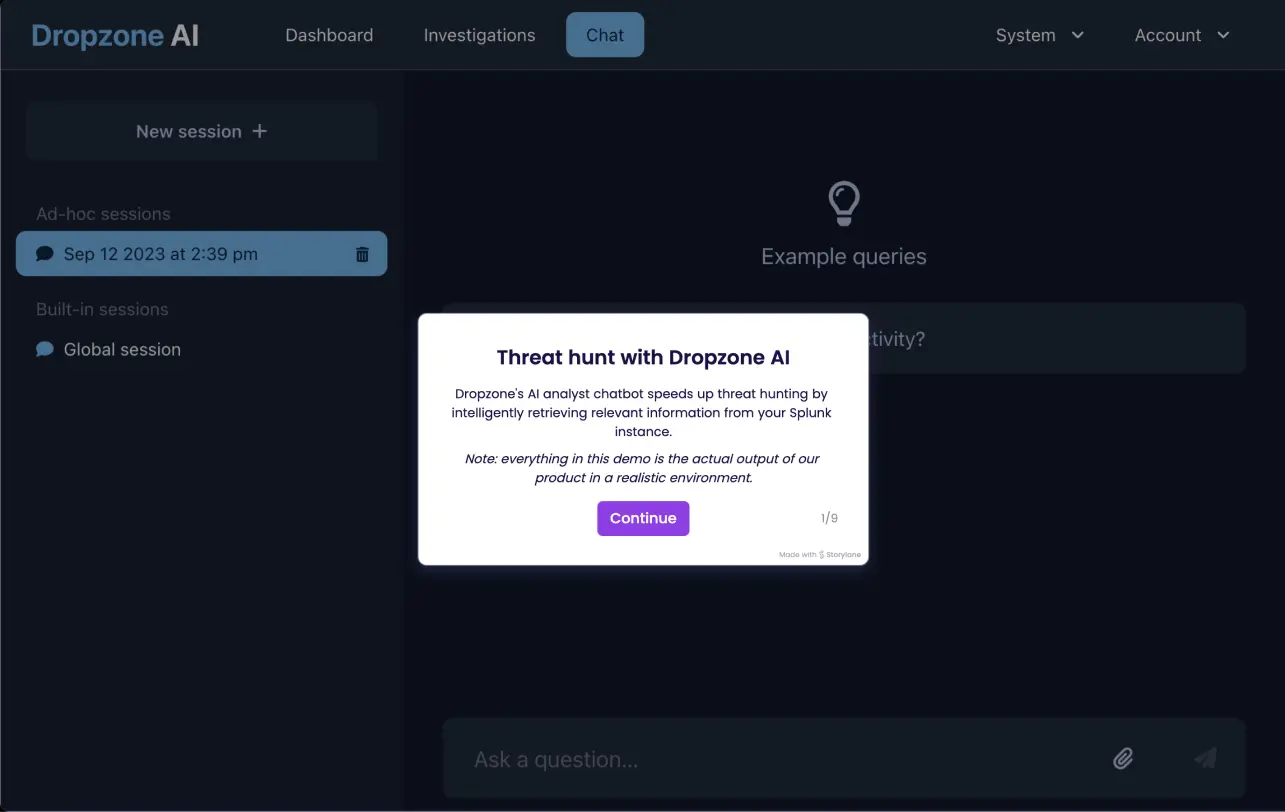
Source: Dropzone AI

3. Prophet AI SOC Analyst
Best for: Teams wanting auditable investigation on every alert severity
Strengths: Dynamic investigation plans, backtested actions, 200+ integrations
Things to consider: Small independent review base and no public pricing
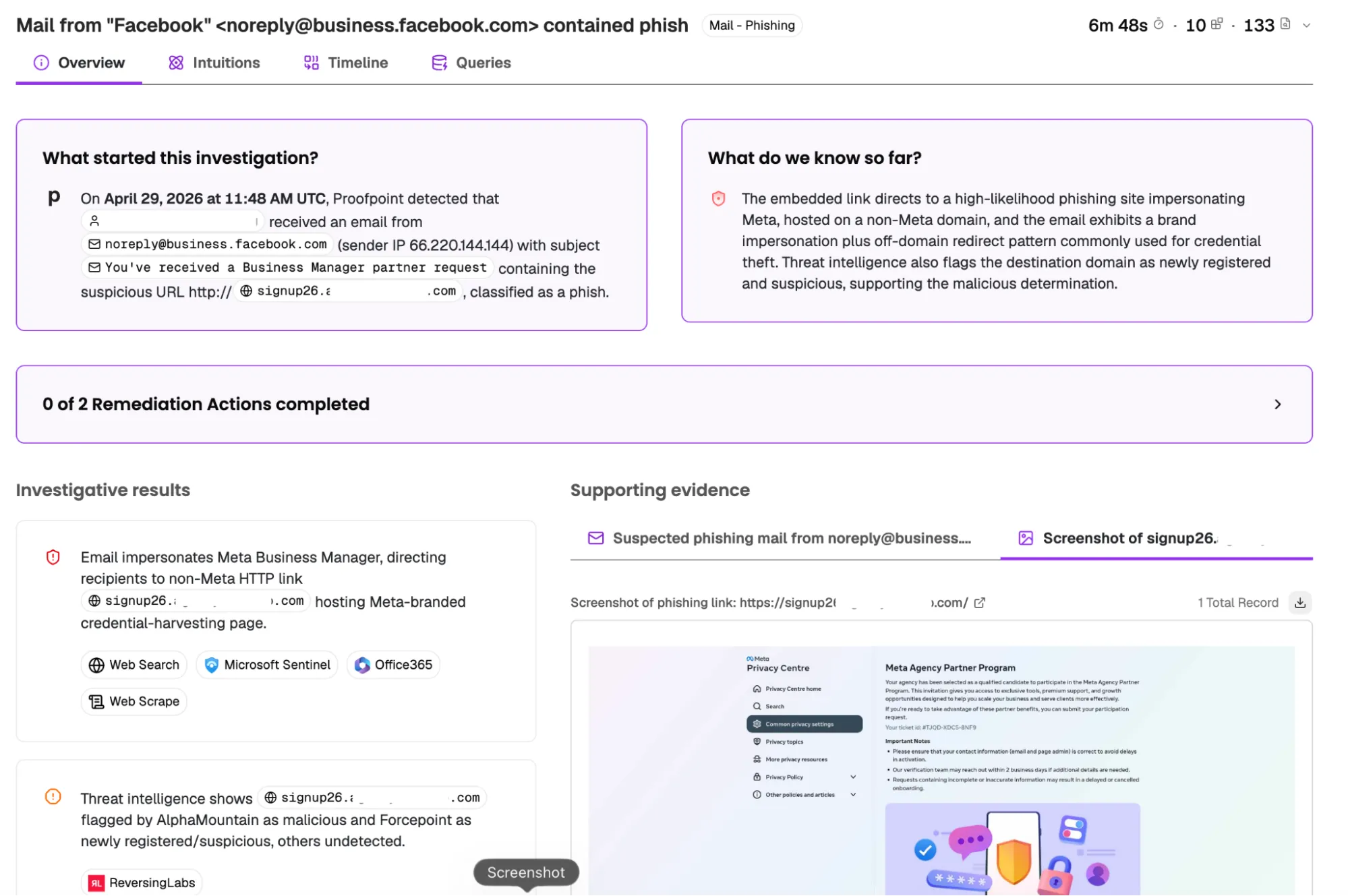
Prophet AI SOC Analyst investigates alerts the way a senior analyst would. It summarizes the alert, extracts the artifacts, plans the questions an expert would ask, and then runs those queries across SIEM, EDR, identity, cloud, and email tools.
Investigations begin the moment an alert arrives and run in parallel, so investigation time stays flat whether the day brings 50 alerts or 2,000. Every question asked, query run, and reasoning step is documented, and related investigations are grouped into one incident rather than dozens of separate tickets.
Key features include:
- Dynamically planned investigations: Runs a full investigation on 100% of alerts at every severity, building the question set per alert instead of following a fixed playbook.
- Scoped auto-remediation: Permissioned response actions ranging from notifications through quarantining a machine, previewed before they run and backtested against the organization's own history.
- Configurable autonomy: Investigates autonomously from day one but executes only actions the team has approved, with scope widened as the track record justifies it.
- Plain-language guidance: Teams teach playbooks, policies, and preferences organization-wide, on a full investigation, or on a single step, with every entry's source visible and correctable.
- Alert-to-incident grouping: Related investigations are consolidated so a campaign reads as one story, and full investigations with evidence are pushed into existing case management tools.
- 200+ out-of-the-box integrations: Connects to security tools, SIEMs and security data lakes, threat intelligence feeds, and collaboration or case management systems, with per-channel control over scope and frequency.
- Adjacent agents: AI Threat Hunter surfaces hidden adversaries, AI Detection Engineer maps detection coverage against gaps, and Prophet AI Watchtower adds a 24x7x365 human-in-the-loop service.
Limitations (based on publicly available sources):
- Thin independent validation: Fewer than ten verified ratings exist on Gartner Peer Insights and none on G2 or PeerSpot, leaving limited third-party evidence to evaluate.
- No published pricing: Prophet uses a subscription model quoted per organization, so cost modeling requires a sales conversation.
- Early-stage vendor: The company was founded in 2023 and remains venture-funded at roughly 30 to 40 employees, which warrants standard vendor diligence.
- Configuration effort for autonomy: Response actions run only within approved scope, so teams must invest in defining guardrails before automation delivers full value.
Source: Prophet Security
4. Radiant Security

Best for: SOCs wanting triage plus log management in one platform
Strengths: Broad alert-type coverage, one-click response, bundled logging
Things to consider: No public pricing and cloud-only delivery
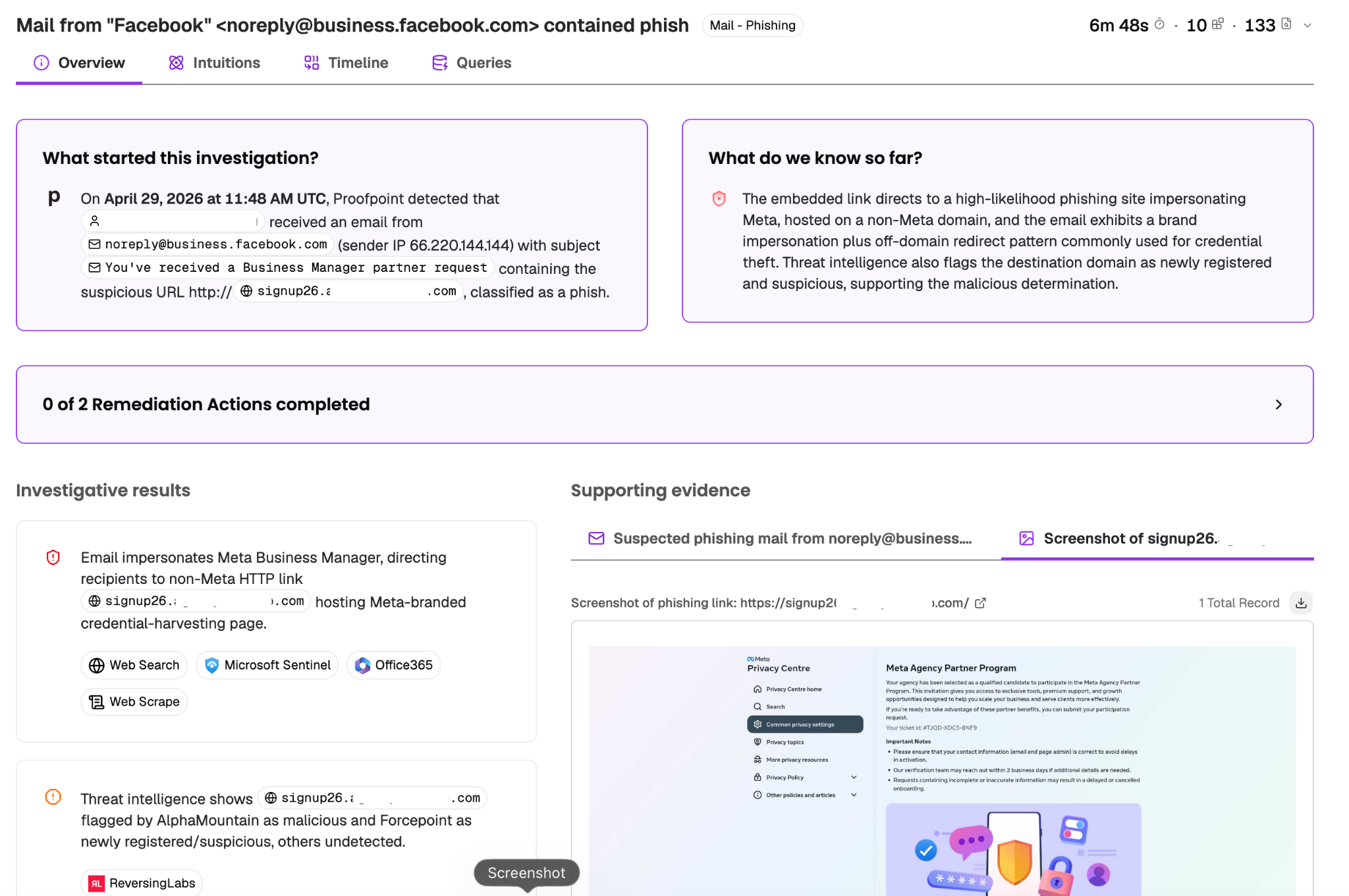
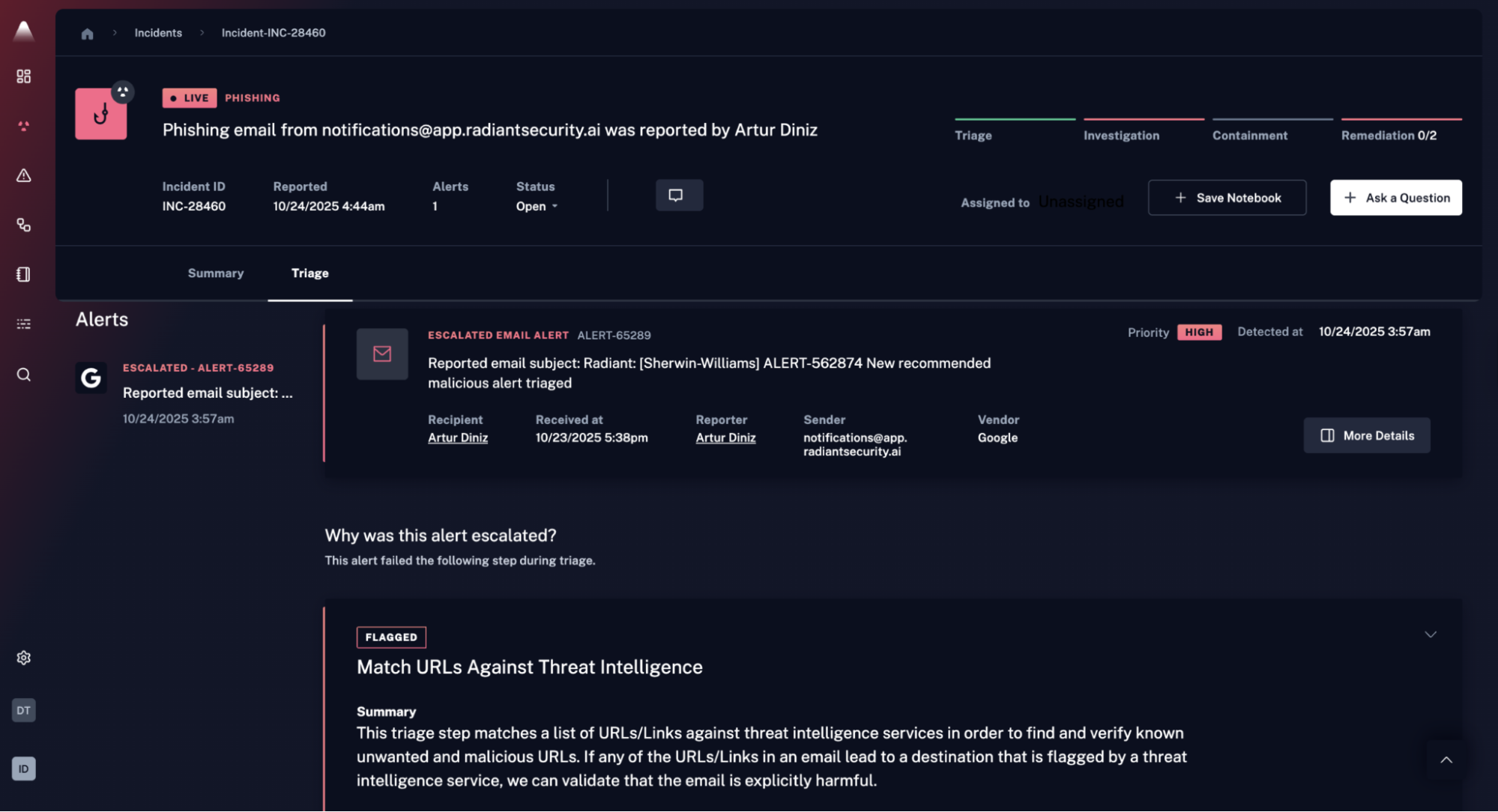
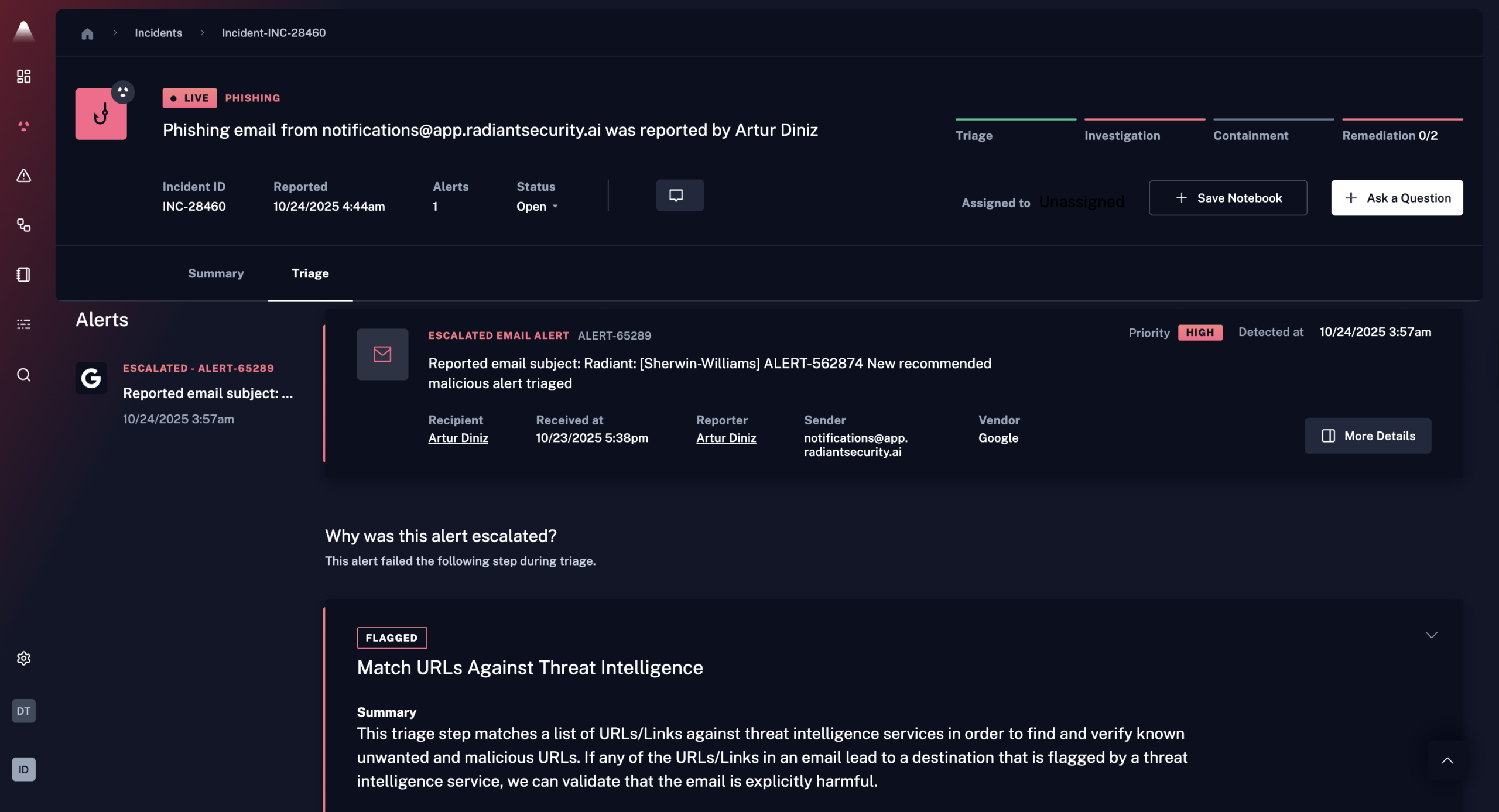
Radiant Security combines AI triage, integrated response, and log management in a single platform. Rather than relying on pre-defined logic and fixed triage questions, its AI dynamically builds and executes triage logic for each alert, which is how it handles rare and custom alert types alongside common ones.
The vendor reports elimination of up to 98% of false positives, leaving analysts one to three high-fidelity alerts per day. Every AI conclusion carries the reasoning behind it, and analysts can trace any claim back to the raw data it came from before acting on it.
Key features include:
- Full-spectrum alert triage: Handles structured and unstructured alerts across email, endpoint, identity, network, cloud, insider threat, SIEM, WAF, DLP, OT/IoT, dark web, and supply chain sources.
- Five-step investigation process: Follows an understand, enrich, plan, execute, conclude flow, interpreting the raw alert to determine the threat type and whether it has been seen before.
- Case-level response execution: Auto-generated remediation steps for every escalated incident, executed in one click across multiple alerts or fully automated, without building playbooks.
- Integrated log management: Unlimited ingestion, real-time search, and retention with data held in the customer's own cloud archive, positioned as a way to reduce dependency on a separate SIEM.
- Transparent AI reasoning: Full context at every step of the triage decision, so analysts can verify how a verdict was reached before executing a response.
- Guardrails and policies: Teams shape AI behavior through guardrails, policies, and exclusions rather than retraining models when new threat patterns appear.
- 100+ API connectors: Integrations across the existing security stack feed triage and response without replacing detection tooling.
Limitations (based on publicly available sources):
- No published pricing: The vendor describes a flat-rate subscription, but figures require a sales conversation.
- Sparse review coverage: Only a handful of verified reviews exist across Gartner Peer Insights and G2, so independent validation is limited.
- Cloud-only delivery: The platform is cloud-hosted SaaS with no self-hosted option, which affects data residency and log storage planning.
- Early-stage vendor profile: Founded in 2021 with disclosed funding in the $15M range, warranting the diligence usually applied to emerging vendors.
Source: Radiant Security
AI-Driven SIEM and XDR Platforms
5. Microsoft Sentinel and Microsoft Defender

Best for: Microsoft-centric SOCs unifying SIEM, XDR, and AI agents
Strengths: Sentinel data lake, security graph, embedded Security Copilot
Things to consider: Ingestion costs and configuration effort at scale
Microsoft's unified SecOps approach brings Microsoft Sentinel, Microsoft Defender XDR, Microsoft Security Exposure Management, and Microsoft Security Copilot together in the Microsoft Defender portal. Security data is centralized in a cloud-native Sentinel data lake that feeds detection, investigation, and response across environments.
The Sentinel platform layer turns telemetry into security graphs and standardizes how AI agents access that data. Embedded agents automate tasks, hunt continuously, and orchestrate workflows, while Defender XDR handles automatic attack disruption across endpoints, identities, email, and applications.
Key features include:
- Cloud-native data lake: Centralizes security data with tiered analytics and data lake storage, enabling AI-powered hunting across years of security data without traditional SIEM retention costs.
- Graph-powered context: Sentinel graph brings posture, activity, threat intelligence, identity, and device data into one view to analyze relationships and prioritize response.
- Model Context Protocol server: Translates natural language into executable tasks and provides the layer that lets agents discover, invoke, and interact with each other.
- Security Copilot in the SOC: Summarizes incidents, generates Kusto Query Language queries, and recommends next steps inside the unified investigation experience.
- Threat intelligence at scale: Microsoft tracks more than 78 trillion signals daily, with third-party feed support through STIX/TAXII and enriched detection context.
- 350+ native connectors: Enterprise-wide visibility across multicloud and multiplatform environments, plus no-code custom integrations through the codeless connector framework.
- SOC optimization recommendations: AI-driven guidance that automates best practices and surfaces where detection coverage or ingestion cost can be adjusted.
Limitations (as reported by users on G2):
- Cost management at volume: Reviewers report that ingestion and retention charges climb with data usage and are difficult to control, and that the platform is hard to justify at lower data volumes.
- Data onboarding overhead: Users describe needing separate data collection rules and separate tables for each log type, which adds ongoing administrative work.
- Setup and configuration time: Several reviewers note that initial configuration is time-consuming, particularly for teams new to SIEM tooling or to Azure services.
- Interface learning curve: Navigation is described as challenging for new users, with features taking time to understand.
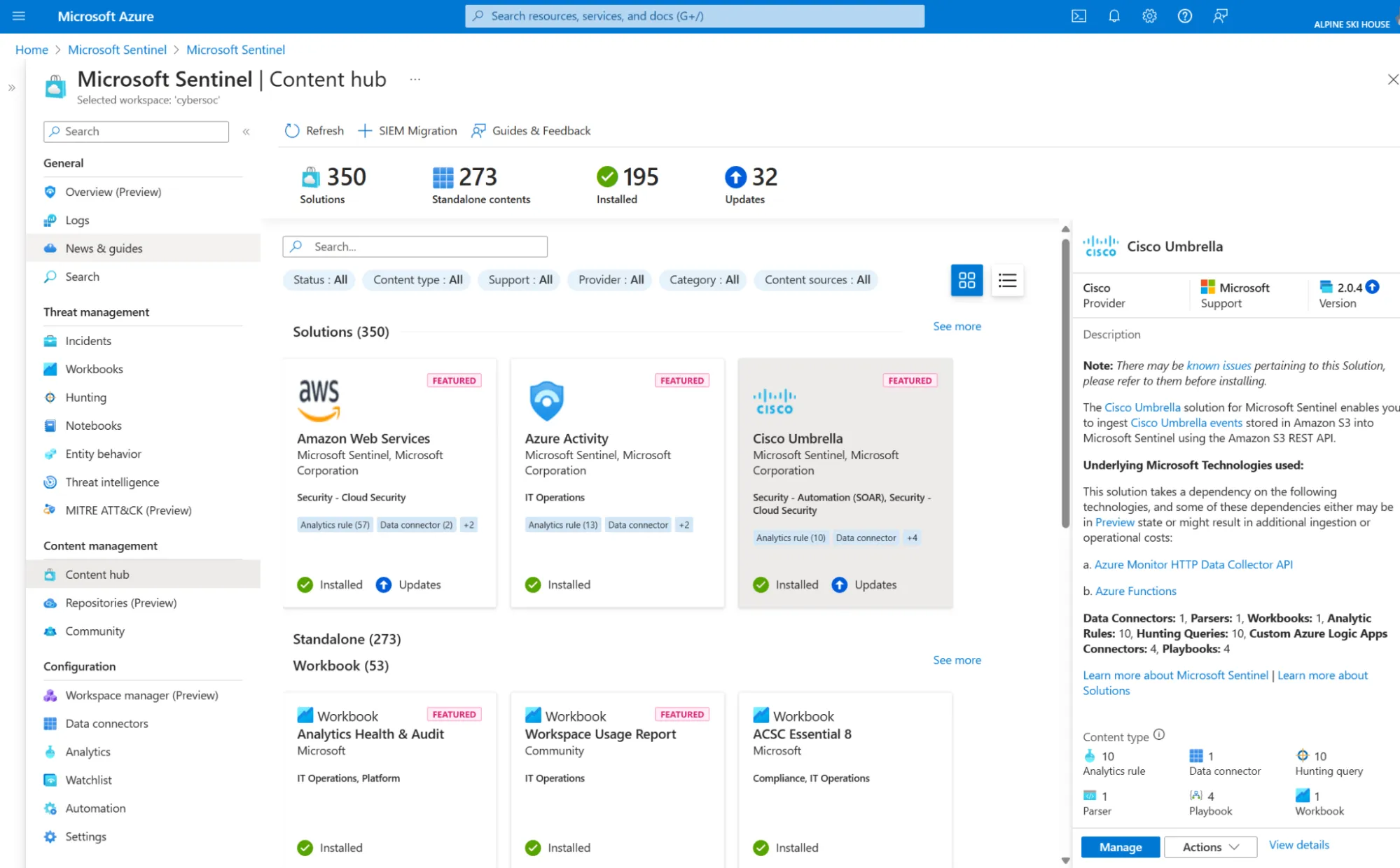
Source: Microsoft
6. Palo Alto Networks Cortex XSIAM

Best for: SOCs consolidating SIEM, SOAR, EDR, and NDR on one platform
Strengths: 2,900+ ML models, incident stitching, agentic response
Things to consider: Premium pricing and heavy data onboarding effort
Cortex XSIAM unifies SIEM, SOAR, EDR, NDR, and CDR functions on the Cortex extended data lake, with email security, exposure management, threat intelligence, and ITDR layered on top. It ingests raw logs and telemetry and correlates them into a small number of prioritized cases rather than a flood of individual alerts.
Detection is built on triple the EDR telemetry plus enriched firewall logs, with 2,900+ machine learning models and 13,300+ detections applied to that data. Cortex AgentiX provides the agentic layer, where AI agents plan, reason, and act within enterprise-grade guardrails under analyst control.
Key features include:
- Unified data lake ingestion: Cortex XDL centralizes endpoint, network, identity, cloud, and exposure data from any source through an open ecosystem, removing the need for separate correlation across tools.
- Analytics-based detection: 2,900+ machine learning models and 13,300+ continuously updated detections identify advanced attacks across the ingested telemetry.
- Automatic incident stitching: AI groups thousands of alerts into a handful of prioritized cases and presents the full attack story, including root cause, in one view.
- Agentic AI response: Cortex AgentiX commands an AI agent workforce that plans, reasons, and acts, with enterprise-grade guardrails keeping analysts in control of the outcome.
- Proactive security functions: Cortex Exposure Management prioritizes vulnerabilities with active weaponized exploits and no compensating controls, and Advanced Email Security extends coverage to the inbox.
- Managed service options: Unit 42 managed threat hunting, managed detection and response, and Managed XSIAM provide 24/7 expert coverage on the same platform.
- Attack surface and threat intelligence: Native attack surface management and integrated threat intelligence feed detection and drive continuous vulnerability discovery.
Limitations (as reported by users on G2):
- Licensing cost: Reviewers describe per-GB ingestion plus compute charges as among the priciest on the market, with smaller organizations often priced out.
- Data onboarding complexity: Users report messy source formats, custom mapping requirements, and limited built-in validation, making onboarding slower than expected for a unified platform.
- Steep learning curve: The XQL query language and the breadth of combined SIEM, SOAR, and automation features take time to master, especially for analysts arriving from other platforms.
- Ecosystem dependence: Several reviewers say value drops when an organization is not fully committed to the wider Palo Alto stack, and mixing in third-party tools is harder.
- Interface responsiveness: Some users report slow query execution in the UI and duplicated account provisioning steps even with single sign-on configured.
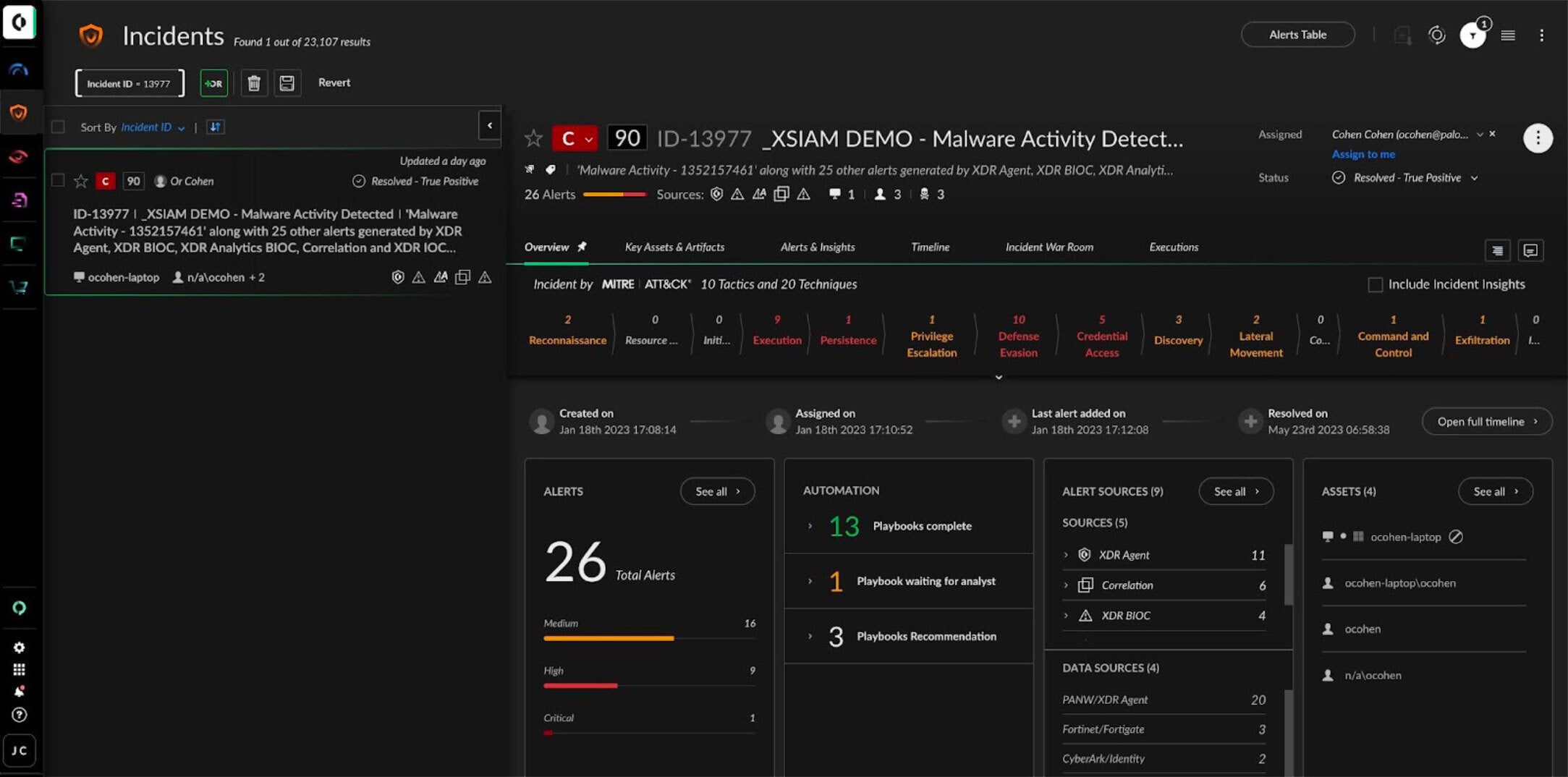
Source: Palo Alto Networks
7. CrowdStrike Falcon Next-Gen SIEM
Best for: Endpoint-first SOCs building an agentic workflow on Falcon
Strengths: 150x faster search, Charlotte AI agents, single-sensor data
Things to consider: Premium pricing and third-party onboarding effort
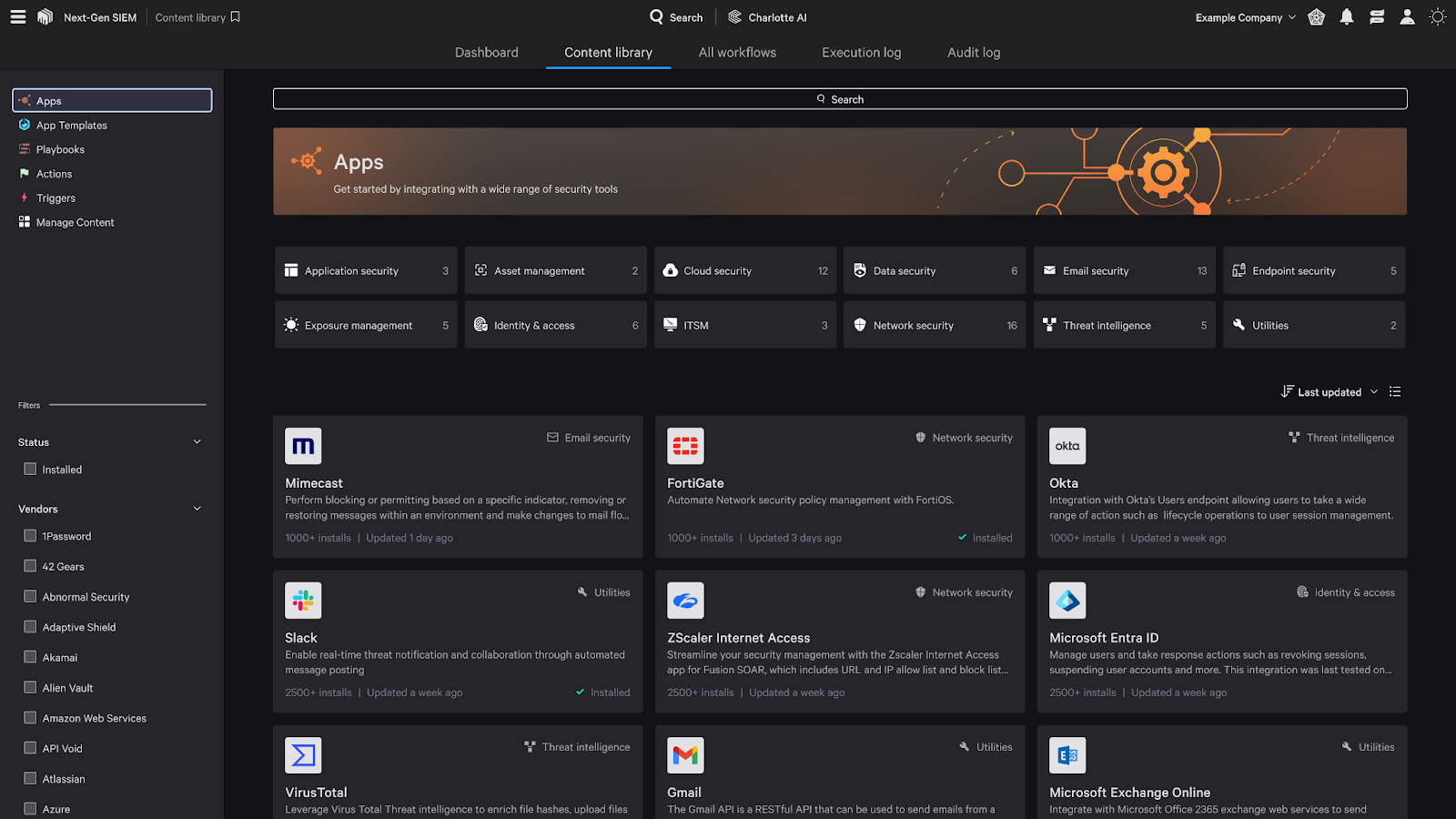
Falcon Next-Gen SIEM sits at the center of CrowdStrike's agentic SOC, correlating signals across domains, enriching data in real time, and driving automated investigation and response. Its index-free architecture supports search at petabyte scale, and Falcon Onum pipelines deliver clean, real-time data into the platform.
Charlotte AI supplies the agent layer, with out-of-the-box agents for repetitive work such as triage and malware analysis, and AgentWorks for building custom agents. Charlotte Agentic SOAR combines Falcon Fusion SOAR, case management, and Charlotte AI so agents coordinate under analyst-defined intent and guardrails.
Key features include:
- Single-sensor data architecture: Collects telemetry once and reuses it across endpoint, cloud, identity, and SIEM modules, with Falcon Onum pipelines handling streaming and storage optimization.
- Index-free search at scale: Real-time search across petabyte-scale datasets, with federated search reaching data wherever it lives across the environment.
- Charlotte AI agents: Mission-ready agents for triage and malware analysis, alongside correlation rule generation, search analysis, workflow generation, and data transformation agents.
- Charlotte Agentic SOAR: Multi-agent orchestration built on Falcon Fusion SOAR, where analysts set intent and guardrails in natural language and agents collaborate, reason, and act.
- Unified case management: Native case management tracks ownership, resolution times, and performance metrics, with a visual graph of attack activity, asset relationships, and threat context.
- Human-AI feedback loop: Continuous validation from Falcon Complete MDR analysts feeds Charlotte AI, which CrowdStrike reports at 98% triage accuracy against expert decisions.
- Governance controls: Charlotte AI is ISO 42001-certified, with agent actions that are explainable, auditable, and bounded by role-based access and defined autonomy limits.
- Third-party EDR support: Falcon Next-Gen SIEM for Third-Party EDR extends AI-native operations to other endpoint tools, starting with Microsoft Defender.
Limitations (as reported by users on G2):
- Premium pricing and licensing complexity: Reviewers place the platform at the top end of the market and describe ingestion-driven licensing as difficult to plan for upfront.
- Query language ramp-up: Analysts moving from Splunk or Microsoft Sentinel report a real adjustment period before they can write efficient, complex queries confidently.
- Third-party data onboarding: Getting logs from diverse network devices, legacy systems, and niche security tools normalized and ingested still takes considerable manual effort.
- Documentation gaps: Users describe documentation as limited and largely in-product, with little community reference material to fall back on.
- Customization limits: Some reviewers note a narrower command set, no option to create custom query commands, and report templates that need work before meeting audit requirements.
Source: CrowdStrike
8. Google Security Operations

Best for: Teams wanting Gemini-native agents and Mandiant intelligence
Strengths: Agentic triage, curated detections, 300+ SOAR integrations
Things to consider: Steep learning curve and limited customization
Google Security Operations, formerly Chronicle, unifies SIEM, SOAR, and applied threat intelligence, ingesting telemetry from on-premises environments and all major cloud providers. Its agentic layer runs on Gemini and is trained on real-world intelligence and insights from Mandiant investigations.
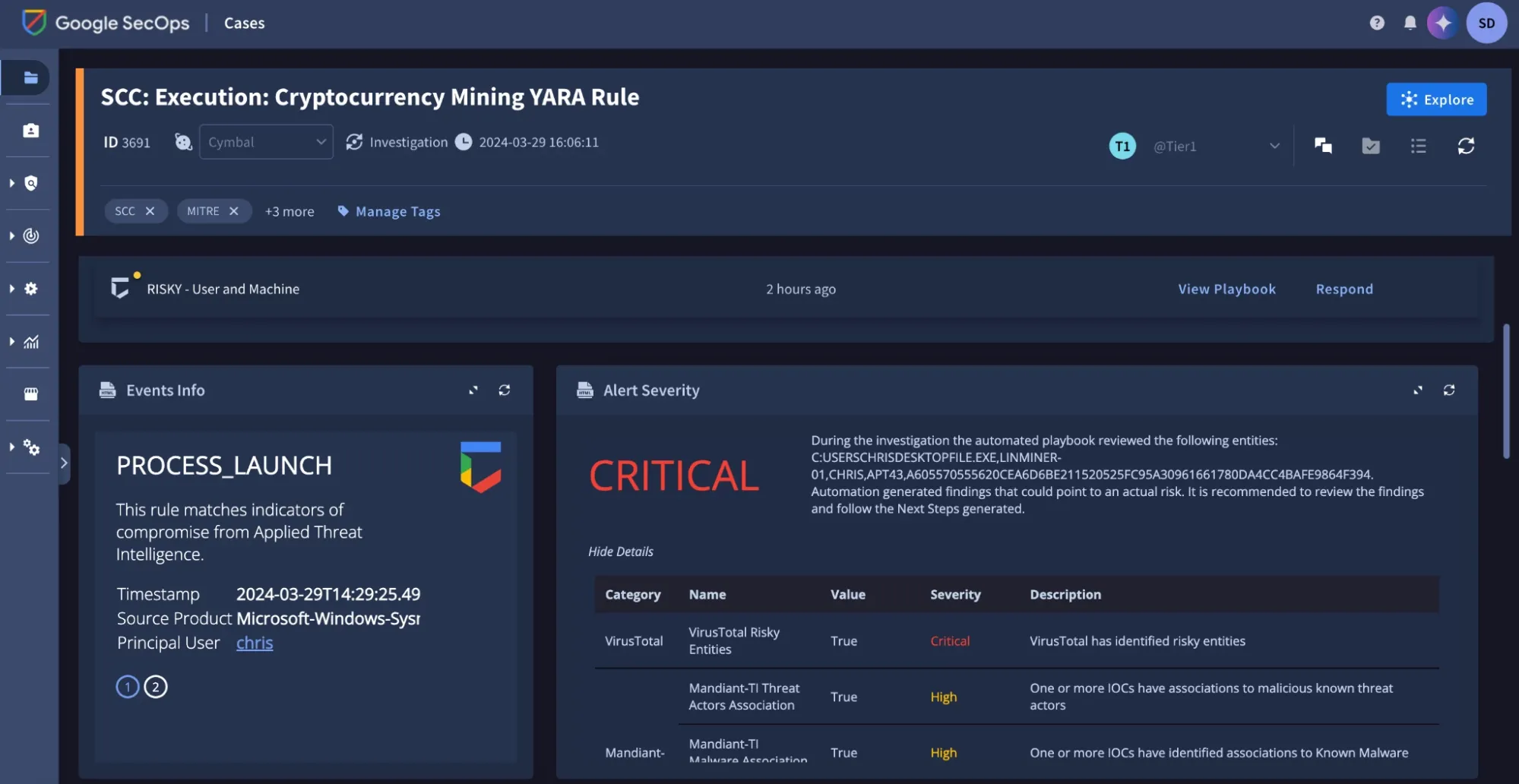
A connected set of agents handles alert triage, threat hunting, and detection engineering. Google states the Triage and Investigation agent reduces a typical 30-minute manual analysis to about 60 seconds, and agentic automation pairs dynamic agents with deterministic enterprise playbooks so analysts retain control of high-impact actions.
Key features include:
- Triage and Investigation agent: Autonomously investigates alerts, enriches them with threat intelligence, and returns a verdict with a full explanation, automating decision-making, alert closure, and remediation flows.
- Detection Engineering agent: Continuously analyzes the organization's threat profile to create, test, and generate detection rules, validating new rules with synthetic events before an exploit lands.
- Threat Hunting agent: Proactively searches for novel attack patterns and stealthy behaviors that bypass traditional defenses, using intelligence from Mandiant, VirusTotal, and Google.
- Curated detections and YARA-L: Detections built and maintained by Google threat researchers, plus custom rule authoring in YARA-L and Gemini-generated detections from natural language.
- Applied threat intelligence: Google Threat Intelligence including data gathered from active Mandiant incident response engagements, with machine-learning prioritization of IoC matches per environment.
- Native SOAR: Playbook automation across 300+ integrations, threat-centric case management, an auto-documenting case wall, and AI-assisted playbook creation.
- Ingestion and retention: 700+ parsers, data pipeline management for routing, filtering, redaction, and transformation, and 12 months of hot data retention included.
Limitations (as reported by users on G2):
- Configuration and learning curve: Reviewers describe setup and configuration as complex and note the platform takes longer to learn than comparable tools.
- Limited customization: Users report that customization options constrain adaptability for organizations with less common security requirements.
- Cost: Several reviewers flag pricing as a barrier, with some noting increases after the platform moved under Google.
- Documentation and support: Users cite gaps in documentation and delays in receiving assistance when bugs or issues arise.
- Cloud-only data handling: Because data resides in the cloud, some reviewers raise privacy and data residency considerations during evaluation.
Source: Google
Conclusion
AI-powered SOC platforms help security teams move from alert-heavy, reactive workflows toward continuous, context-aware threat analysis. The strongest platforms combine real-time telemetry, behavioral detection, automated investigation, risk-based prioritization, and controlled response while preserving analyst oversight. Organizations should evaluate how well a platform integrates with their existing security stack, explains its decisions, supports human escalation, and scales across hybrid environments without creating new operational complexity.