
Traditional SOC Automation vs. Agentic AI-Driven SecOps: Top Solutions Compared
In this article

TL;DR: Agentic AI security operations replace fixed playbooks with agents that plan investigations, gather evidence and act within defined limits. Intezer is best for teams wanting forensic-depth triage of every alert, UnderDefense MAXI for agentic triage backed by human-verified response, Microsoft Security Copilot Microsoft-centric SOCs, and Torq automation-led case closure.
What Are Traditional SOC Automation and Agentic AI-Driven Security Operations?
Traditional Security Operations Center (SOC) automation executes rigid, rule-based scripts, while agentic AI-driven security operations use autonomous models to reason, plan multi-step workflows, and adapt in real time.
Traditional SOC automation uses predefined rules, workflows, and playbooks to perform repetitive security tasks. Common examples include enriching alerts with threat intelligence, blocking known malicious IP addresses, creating tickets, and isolating endpoints. Security orchestration, automation, and response (SOAR) platforms often coordinate these actions across multiple security tools.
Agentic AI-driven security operations use AI agents that can pursue security objectives through multiple reasoning and action steps. Instead of following only a fixed playbook, an agent can examine an alert, gather context from connected systems, form and test hypotheses, select appropriate tools, and adjust its investigation as new evidence appears.
Core differences:
- Rules-based automation vs. goal-driven autonomy: Traditional automation executes predefined rules, while agents choose actions dynamically to achieve a security objective.
- Predefined playbooks vs. dynamic investigation plans: Traditional workflows follow fixed sequences, while agents build and revise investigation plans as evidence changes.
- Deterministic workflows vs. adaptive reasoning: Traditional automation follows predictable branches, while agents interpret ambiguous evidence and adjust their reasoning.
- Manual alert analysis vs. autonomous alert triage: Traditional SOCs still rely on analysts for many alert decisions, while agents can investigate and prioritize alerts before human review.
- Static enrichment vs. context-aware investigation: Traditional automation performs predefined lookups, while agents select additional queries based on evidence collected during the investigation.
- Tool-specific automation vs. cross-tool orchestration: Traditional workflows explicitly connect specific tools, while agents dynamically select connected systems according to investigation needs.
- Human-led decisions vs. AI-driven recommendations and actions: Traditional SOCs reserve judgment for analysts, while agents can recommend or execute approved actions based on collected evidence.
- Scripted remediation vs. autonomous remediation: Traditional automation maps known conditions to fixed responses, while agents select and verify remediation based on incident context.
- Reactive operations vs. proactive threat hunting: Traditional automation usually starts with an alert, while agents can proactively investigate hypotheses and weak signals across telemetry.
- Limited learning vs. continuous contextual adaptation: Traditional automation changes through manual updates, while agents can use feedback, memory, and updated organizational context in future investigations.
This is part of a series of articles about AI SOC
Agentic AI Security Operations Platforms and Traditional SOC Automation Platforms Compared
The table below summarizes the key differences between the platforms covered in this section, including what each is suited to and where users report friction. We explore each one in more detail below.
| Category | Solution | Best For | Key Strengths | Things to Consider |
|---|---|---|---|---|
| AI-Native Agentic SOC Platforms | Intezer | Forensic-depth triage on every alert, around the clock | Deterministic forensics plus agentic AI, detection engineering loop | Dense interface, some capabilities in higher tiers |
| AI-Native Agentic SOC Platforms | UnderDefense MAXI | Teams wanting agentic triage backed by human-verified response | Vendor-agnostic SIEM/XDR overlay, 2-minute triage, concierge human verification | Newer platform with a thinner independent review base; MDR-style delivery model may not suit teams wanting pure self-service software |
| AI-Native Agentic SOC Platforms | Prophet Security | Triage, hunting and detection tuning in one platform | Multiple coordinated agents with auditable investigation plans | Relies on upstream tools for detection, no SIEM function |
| AI-Native Agentic SOC Platforms | Exaforce | Cloud and SaaS-heavy SOCs replacing SIEM and MDR spend | Multi-model AI, natural language data exploration, four Exabots | Data source coverage expanding, dense and sometimes slow UI |
| Established Platforms Adding Agentic Capabilities | Microsoft Security Copilot | Teams standardized on Defender, Entra, Intune and Purview | Agents embedded in existing consoles, capacity included in E5 and E7 | Consumption pricing, weaker coverage outside Microsoft |
| Established Platforms Adding Agentic Capabilities | CrowdStrike Charlotte AI | Falcon platform users adding agentic triage and response | No-code agent building, bounded autonomy, ISO 42001 governance | Credit-based consumption, some modules still maturing |
| Established Platforms Adding Agentic Capabilities | Palo Alto Networks Cortex XSIAM | Consolidating SIEM, SOAR and EDR onto one platform | Unified data layer, 13,300+ detections, AgentiX response agents | High cost, licensing complexity, mixed support experiences |
| Established Platforms Adding Agentic Capabilities | Torq | SOCs that need automation and case closure, not just triage | 300 integrations, HyperAgents, Socrates agent orchestration | AI output depends on context, UI and reporting maturing |
Traditional SOC Automation vs. Agentic AI-Driven Security Operations
1. Rules-Based Automation vs. Goal-Driven Autonomy
Rules-based automation depends on explicit logic such as “if condition X occurs, perform action Y.” A SOC might automatically enrich a malware alert, check the file hash against threat intelligence, and open a ticket when its reputation score exceeds a threshold. Engineers must define these conditions and actions before execution. This model provides predictable behavior and is relatively easy to test. However, it struggles when the correct action depends on information that was not anticipated when the rule was written. Adding more exceptions and branches can also make automation difficult to maintain.
Goal-driven agents receive an objective rather than a complete sequence of instructions. For example, an agent might be asked to determine whether suspicious account activity represents account compromise. It can decide which logs, tools, and queries are needed to answer that question. The agent still operates within defined boundaries. Organizations can restrict accessible systems, permitted actions, investigation duration, or approval requirements. Goal-driven autonomy therefore does not require giving an AI system unrestricted control over the environment.
2. Predefined Playbooks vs. Dynamic Investigation Plans
Traditional playbooks specify the sequence of investigation and response steps in advance. A phishing playbook might extract URLs, check domain reputation, search for matching emails, inspect attachments, and create a case. Conditional branches determine what happens when specific results are returned. Playbooks are effective for common incidents because they capture established procedures. The problem appears when an investigation takes an unexpected path. Teams must add new branches or send the case to an analyst when the playbook cannot handle the situation.
Agentic AI can create a plan based on the initial alert and modify it during the investigation. If a suspicious login comes from a known corporate VPN, for example, the agent might reduce the importance of the source IP and examine device identity, authentication history, and post-login activity instead. Dynamic planning also allows investigations to stop when enough evidence has been collected. The agent does not necessarily need to execute every possible check. This can reduce unnecessary queries while allowing deeper investigation when evidence remains ambiguous.
3. Deterministic Workflows vs. Adaptive Reasoning
Deterministic workflows execute logic defined by rules, scripts, and workflow branches. Given the same inputs and system state, they generally follow the same path. This predictability helps with testing, compliance, troubleshooting, and audit requirements. Their weakness is handling ambiguity. A workflow cannot independently decide that an unexpected process relationship changes the meaning of an endpoint alert unless developers have encoded that possibility into its logic.
Agentic AI uses reasoning to interpret relationships between observations. It can compare competing explanations, request additional evidence, and revise its assessment when new information becomes available. An apparently malicious PowerShell command, for example, might be treated differently after the agent establishes that it was launched by an approved management system. Adaptive reasoning introduces additional governance requirements. Organizations need controls for permissions, validation, logging, confidence thresholds, and human escalation because an agent's path may not be identical for every investigation.
4. Manual Alert Analysis vs. Autonomous Alert Triage
Traditional automation can reduce alert volume through suppression, correlation, deduplication, and severity rules. However, analysts frequently still need to open alerts, review telemetry, search related events, and determine whether the activity is benign or malicious. This manual work consumes significant analyst time, particularly when many alerts are false positives. Analysts may repeatedly perform the same searches across endpoint, identity, network, and cloud systems before reaching a conclusion.
Autonomous triage allows an AI agent to perform these investigative steps before human review. It can gather related events, identify affected users and assets, establish a timeline, compare activity with normal behavior, and assess whether the available evidence supports escalation. The result can be a case containing the alert, supporting evidence, investigation steps, and a recommended disposition. Analysts can then focus on uncertain or high-impact cases instead of manually assembling context for every alert.
Related content: Read our article about AI SOC software for reducing alert fatigue.
5. Static Enrichment vs. Context-Aware Investigation
Static enrichment attaches predefined information to an alert. An IP address might always be checked against reputation services, while a file hash might always be submitted to malware databases. These actions provide useful context but do not determine whether additional information is needed. The same enrichment workflow may run even when some results have little relevance to the incident. Conversely, important evidence can be missed if the required lookup was not included when the workflow was designed.
Context-aware investigation selects queries according to the evidence already collected. After detecting an unusual executable, an agent might inspect its parent process, signer, file origin, network connections, persistence mechanisms, and execution on other endpoints. Each result can determine the next query. This creates an investigation chain rather than a fixed enrichment checklist and can help the SOC collect evidence that is specific to the incident.
6. Tool-Specific Automation vs. Cross-Tool Orchestration
Many traditional automations are built around a specific security product. A SIEM rule creates an alert, an endpoint platform provides host information, and a SOAR playbook calls predefined APIs to connect the systems. Every integration and data transformation must be configured. Cross-tool workflows can become complex as the security stack grows. API changes, authentication requirements, incompatible schemas, and product-specific identifiers can increase maintenance work.
Agentic AI can use multiple connected tools according to the investigation's needs. It might start with a SIEM alert, query an identity provider, inspect endpoint activity, search cloud audit logs, consult threat intelligence, and then update the incident record. This does not eliminate integration work. Tools still need reliable interfaces, permissions, and normalized outputs. The difference is that the sequence of tool calls can be selected dynamically instead of being fully encoded in a workflow.
7. Human-Led Decisions vs. AI-Driven Recommendations and Actions
Traditional SOC automation commonly leaves judgment-intensive decisions to analysts. Automation collects data and performs routine steps, while humans decide whether an account should be disabled, an endpoint isolated, or an incident escalated. This model provides direct human oversight but can slow response when analysts have large queues. Delays are especially important for attacks where an adversary can move laterally or steal data within minutes.
Agentic AI can evaluate evidence and recommend a response with supporting reasons. For a suspected compromised account, it might recommend terminating sessions, resetting credentials, and reviewing recent privilege changes. Organizations can assign different approval requirements to different actions. Low-risk steps may run automatically, while actions with significant business impact require analyst confirmation. This allows autonomy to be adjusted according to risk rather than applied uniformly.
8. Scripted Remediation vs. Autonomous Remediation
Scripted remediation connects a known condition to a known response. For example, a confirmed malicious hash might trigger a script that quarantines the file and blocks the hash across managed endpoints. The approach works when remediation is predictable. It is less suitable when the correct response depends on asset criticality, user role, business operations, or evidence collected during the incident.
Autonomous remediation allows an agent to select actions based on these conditions. It might isolate a standard employee workstation immediately but recommend a narrower containment measure for a production server where full isolation could interrupt a critical service. An agent can also verify whether remediation succeeded. It can check whether a process stopped, persistence was removed, sessions were revoked, or malicious network activity continued. Failed remediation can trigger another approved action or escalation to an analyst.
Related content: Read our article about the autonomous SOC and how far automation can be taken.
9. Reactive Operations vs. Proactive Threat Hunting
Traditional SOC automation is commonly triggered by alerts, detections, or other predefined events. This makes it primarily reactive: a security control first identifies suspicious activity, and automation then helps investigate or respond. Threat hunting can identify activity that existing detections miss, but it usually requires analysts to create hypotheses, write queries, review results, and pivot between data sources. Limited analyst capacity can restrict how frequently these hunts occur.
Agentic AI can automate parts of this process. An agent can investigate a hypothesis such as whether recently disclosed attacker techniques appear in the organization's telemetry. It can translate the hypothesis into searches, examine results, and pivot when suspicious activity is found. Proactive agents can also investigate weak signals that do not individually justify an alert. For example, unusual authentication, a new scheduled task, and uncommon outbound traffic might become significant when examined together.
10. Limited Learning vs. Continuous Contextual Adaptation
Traditional automation does not change unless someone modifies its rules, scripts, thresholds, or playbooks. If analysts repeatedly discover the same exception, engineers must explicitly update the automation to account for it. This makes behavior controlled and predictable, but improvement can be slow. Knowledge discovered during investigations may remain in tickets or analyst notes instead of influencing future workflows.
Agentic systems can use richer context during execution. They can reference investigation history, asset information, security policies, threat intelligence, previous tool results, and other approved organizational knowledge when deciding what to do next. Contextual adaptation should not be confused with automatic model training. An AI model does not necessarily update its parameters after each incident. Persistent improvement typically depends on mechanisms such as retrieval, memory, analyst feedback, updated knowledge bases, or periodic model changes..
Notable Agentic AI Security Operations Platforms and Traditional SOC Automation Solutions
How we selected these platforms: We shortlisted security operations platforms based on their ability to triage and investigate alerts autonomously, plan investigations dynamically rather than follow fixed playbooks, act across connected security tools, and apply governance controls such as approvals, audit trails and bounded autonomy.
AI-Native Agentic SOC Platforms
1. Intezer

Best for: SOCs that need forensic-depth triage on every alert, around the clock
Strengths: Deterministic forensics plus agentic AI, and a detection engineering loop
Things to consider: Dense interface, and some capabilities sit in higher pricing tiers
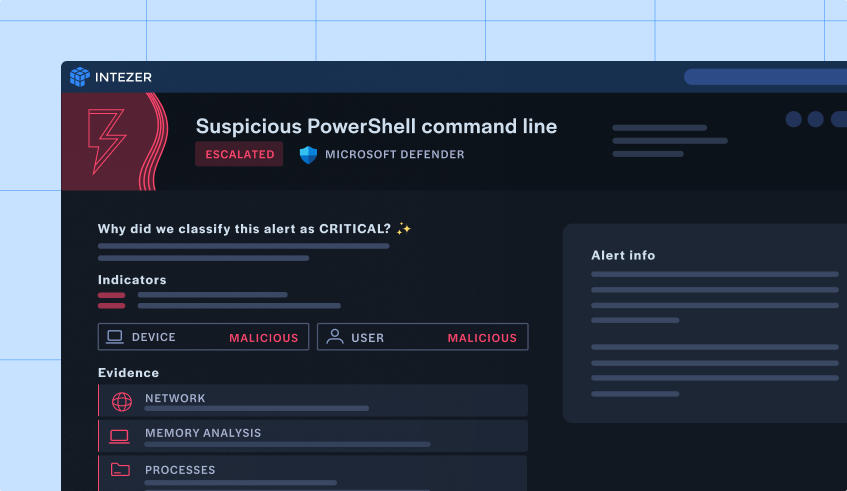
Intezer combines forensic analysis techniques with agentic AI reasoning to triage alerts from endpoint, identity, phishing, network, cloud and SIEM sources. The platform investigates 100% of incoming alerts, including low-severity ones, and escalates fewer than 2% for human review.
Rather than running a fixed enrichment sequence, Intezer collects evidence, analyzes it at forensic depth, groups related alerts into a single attack story, and issues a verdict. Verdicts then feed back into detection engineering, and response actions run according to policies the security team defines.
Key features include:
- Evidence collection across sources: Pulls SIEM and EDR logs, files, processes, command lines, memory images and network artifacts, and can query end users directly for context on activity attributed to them.
- Forensic analysis engine: Applies sandboxing, reverse engineering, script and code analysis, live memory forensics and network forensics alongside correlation and LLM reasoning to reach a verdict.
- Alert grouping into attack stories: Groups alerts that belong to the same incident so analysts review one case rather than a series of disconnected detections.
- Continuous detection engineering: Maps SIEM and EDR detection coverage against MITRE ATT&CK, identifies gaps using threat intelligence and investigation verdicts, and builds, tests and deploys behavioral rules.
- Policy-driven response: Executes escalation, notification, user deactivation, IOC blocking, machine isolation and custom webhook actions according to the rules each organization sets.
- Organizational context memory: Draws on past cases and tickets, user roles, assets, procedures and documented exceptions, and writes each new verdict back for use in later investigations.
- Extensibility without a separate SOAR: Supports custom agents, chained workflows with approvals, and per-alert-type triage logic, with built-in case management or integration with an existing system.
- Bi-directional integrations: Connects to EDR platforms including CrowdStrike, SentinelOne and Microsoft Defender, identity providers such as Entra ID, Okta and JumpCloud, email tools including Office 365 and Proofpoint, and cloud tools such as Wiz.
Intezer is highly rated on Gartner Peer Insights. See what users have to say.
Limitations:
- Requires mature telemetry to work. Investigation quality depends on the customer’s existing EDR/SIEM health. Organizations with immature tooling won’t get full value out of the box.
- MITRE ATT&CK coverage has a realistic ceiling with Intezer benchmarking 60–70% as “top-tier” and flags anything higher as likely inflated. Some technique categories remain outside reliable coverage for any vendor.
- Focused on enterprise-size customers with a minimum of 1,000 employees.
Source: Intezer
2. UnderDefense MAXI

Best for: Teams wanting agentic AI triage backed by human-verified response, without replacing their existing SIEM/XDR
Strengths: Vendor-agnostic overlay on existing security stacks, 2-minute alert-to-triage, concierge-style human verification
Things to consider: Newer platform with a thinner independent review base; MDR-style delivery model may not suit teams wanting pure self-service software
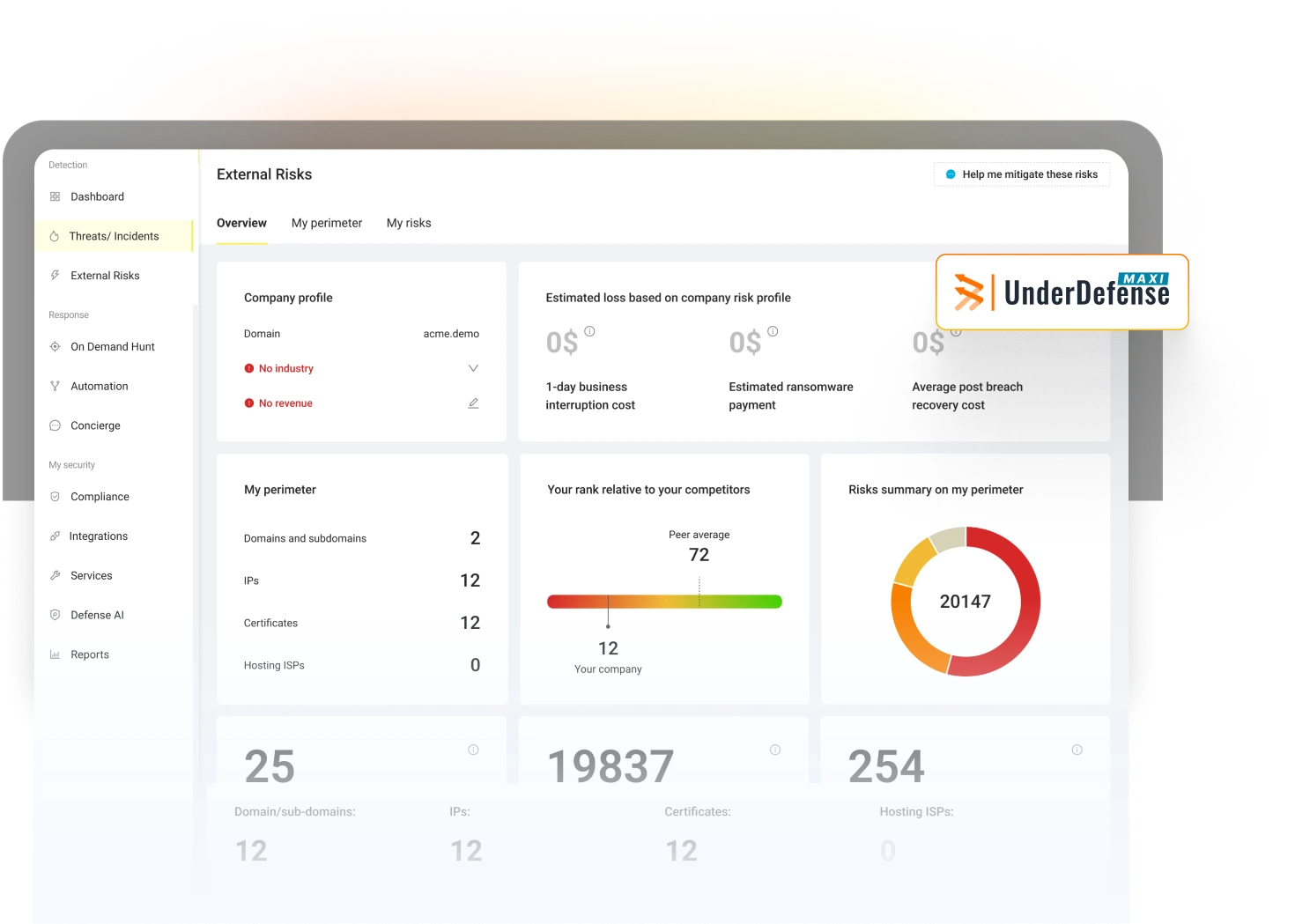
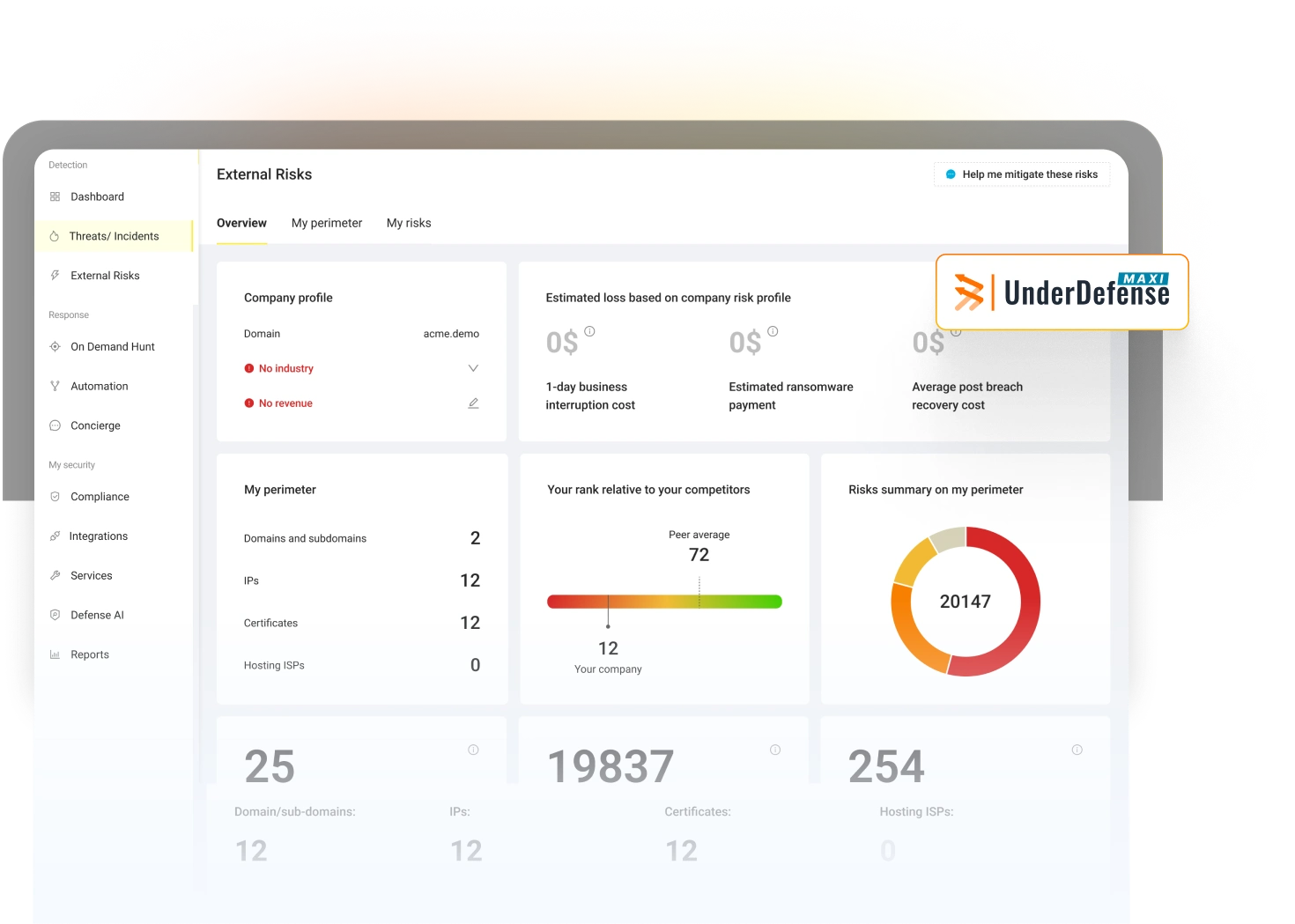
UnderDefense MAXI is an agentic AI security operations and compliance automation platform built to sit on top of whatever SIEM or XDR an organization already runs (Splunk, Microsoft Sentinel, Google Chronicle, Elastic, and others), rather than requiring a rip-and-replace migration. Multiple specialized AI agents handle detection, investigation, response, and threat intelligence roles, ingesting raw alerts.
The platform pairs this agentic automation with what UnderDefense calls a "concierge" layer: for ambiguous cases such as a suspicious login, agents can verify activity directly with the affected user over Slack or Teams before escalating, combining machine-speed triage with human confirmation rather than presenting a raw alert and asking the SOC to investigate from scratch.
Key features include:
- Vendor-agnostic stack integration: Connects to 250+ existing security tools and works on top of a customer's current SIEM/XDR investment rather than forcing migration, preserving existing correlation rules and custom detections.
- Multi-agent architecture: Deploys separate agentic "Teammates" across detection, investigation, response, and threat intelligence, coordinating across the full incident lifecycle rather than a single generalist agent.
- Detection Logic as Code: Writes detection rules in Python, versioned and unit-tested, then deployed through CI/CD, giving security teams a governable, auditable foundation for detection engineering.
- Concierge human verification: Confirms suspicious activity directly with affected users through Slack or Teams before escalation or containment, reducing false-positive response actions.
- SOAR-native response orchestration: Combines autonomous multi-agent investigation with response orchestration and continuous compliance automation (including ISO 27001 and SOC 2 support) in a single platform.
- Flexible deployment model: Available as cloud-delivered SaaS or fully on-premises, including air-gapped deployment with self-hosted AI model inference for financial institutions and other regulated or sovereign environments.
- Full observability and audit trail: Every investigative step is designed to be observable and auditable rather than a black-box verdict, supporting governance and compliance review.
Limitations (based on publicly available sources, including G2):
- Limited independent review volume: As a platform launched publicly less than two years ago, UnderDefense MAXI has a smaller base of published third-party reviews than more established agentic SOC vendors, giving prospective buyers less peer benchmarking to draw on.
- MDR-oriented delivery model: The platform is built around a blended AI-plus-human-analyst delivery model (including managed SOC and concierge verification), which may be less of a fit for organizations specifically wanting a self-service software product without an accompanying service layer.
- Newer entrant in a fast-moving category: UnderDefense positions MAXI's agentic architecture and on-premises/air-gapped offering as recent additions to its roadmap, so organizations evaluating long-term fit should confirm current feature maturity against their specific compliance and deployment requirements.
- Pricing transparency: Published cost references position MDR-style pricing in the $10-30 per asset per month range depending on stack and requirements, but detailed, self-service pricing comparable to pure-software competitors is less readily available without direct vendor engagement.
Source: UnderDefense
3. Prophet Security
Best for: SOCs wanting triage, hunting and detection tuning in one platform
Strengths: Multiple coordinated agents with auditable investigation plans
Things to consider: Relies on upstream tools for detection, with no SIEM functionality
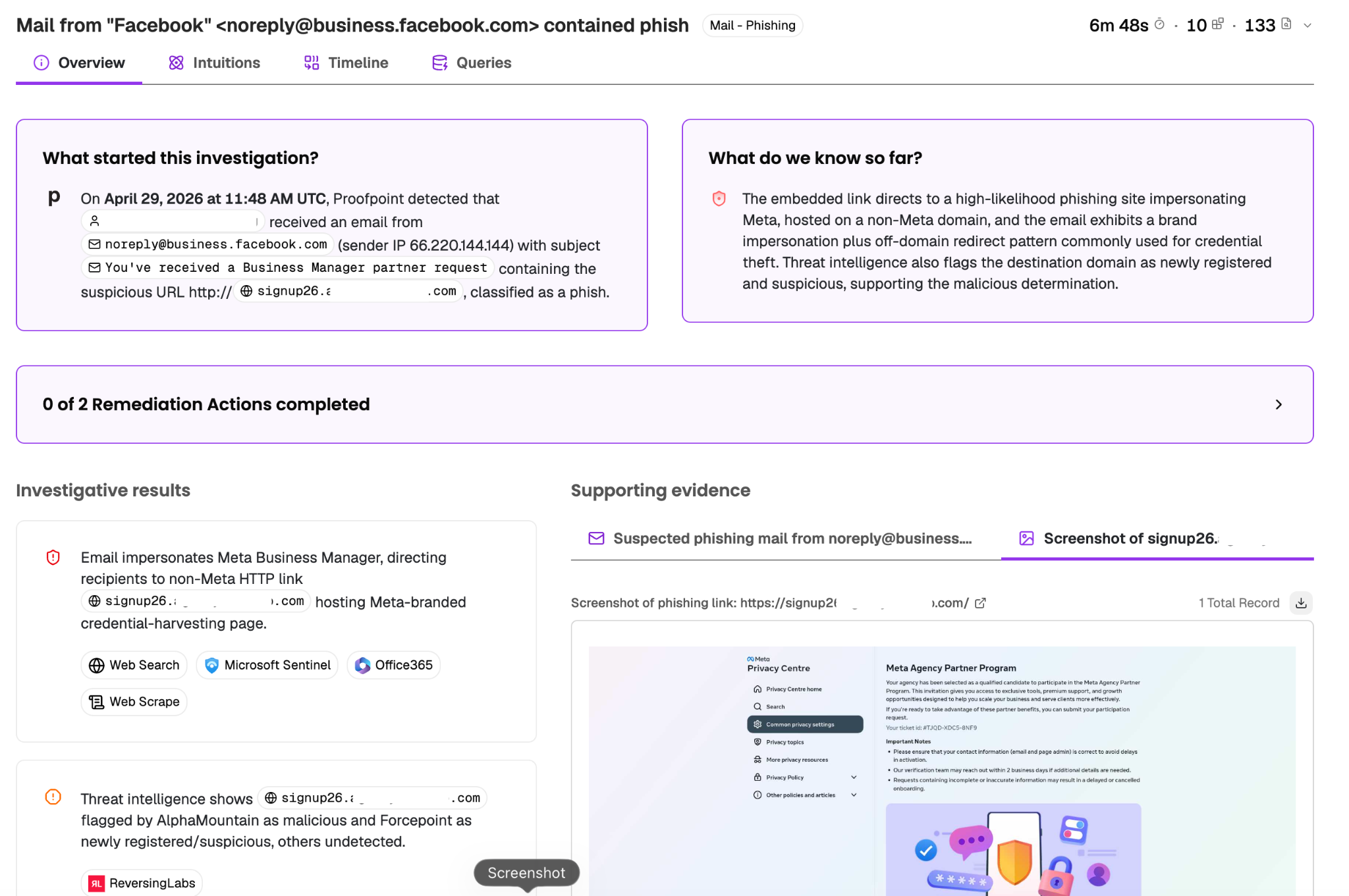
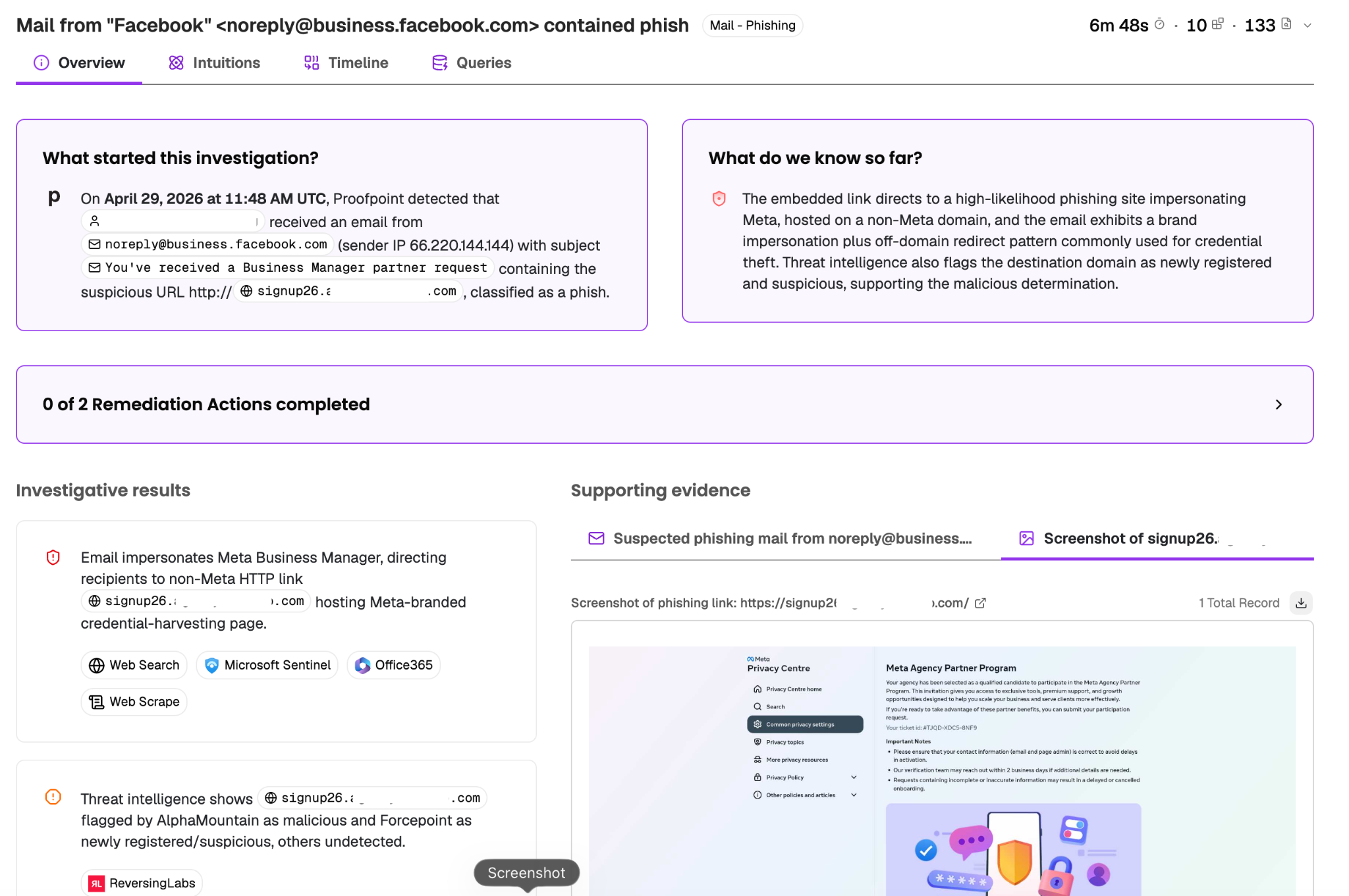
Prophet Security runs a set of specialized agents across the security operations lifecycle rather than a single triage agent. The AI SOC Analyst investigates alerts and delivers determinations analysts can audit, while separate agents handle threat hunting and detection engineering.
The platform deploys through read-only API access to existing tools and returns results in an investigation workbench. Response runs through scoped agent actions that can execute autonomously or wait for analyst sign-off, and a human expert service reviews malicious determinations.
Key features include:
- AI SOC Analyst agent: Investigates every alert with a documented reasoning path, showing the investigation plan, queries run and evidence gathered for each determination.
- Scoped agent actions: Executes response steps within defined boundaries, either autonomously or subject to analyst approval, depending on how each action is configured.
- AI Threat Hunter agent: Accepts plain-language questions about the environment, researches emerging threats, and produces hunts that can be run immediately or scheduled.
- AI Detection Engineer agent: Maps actual MITRE ATT&CK coverage using the organization's own investigations, then proposes tuned and net-new detections that are backtested before approval.
- Watchtower human review: Provides a 24x7 expert team that reviews malicious determinations, with validated escalations delivered within 30 minutes.
- Environment adaptation: Learns customer context and policies, with changes previewed and backtested before being applied across the platform in real time.
- Single-tenant deployment: Runs as a dedicated single-tenant instance with a bring-your-own-key option and no model training on personal data.
- Broad integration coverage: Offers more than 200 out-of-the-box integrations spanning endpoint, email, identity, cloud, DLP and network use cases.
Limitations (as reported by users on Gartner Peer Insights):
- No detection generation: Reviewers note the platform does not create new detections of its own, although it can identify which existing detections need tuning.
- Not a detection or SIEM tool: The platform depends on integrated alert sources such as SIEM, EDR, email security and cloud security, and does not provide those functions itself.
- Alert-driven scope: Feedback on product capabilities points to room for more autonomous analysis beyond the current alert-triggered model.
Source: Prophet Security
Related content: Read our article about Prophet Security
4. Exaforce

Best for: Cloud and SaaS-heavy SOCs replacing SIEM and MDR spend
Strengths: Multi-model AI, natural language data exploration, four Exabots
Things to consider: Data source coverage still expanding, and a dense, sometimes slow UI
Exaforce splits security operations across four AI agents, called Exabots, covering detection, triage, investigation and response. They run on a data platform that ingests and normalizes cloud and SaaS telemetry, which the vendor positions as a SIEM replacement rather than an add-on layer.
The AI engine combines machine learning and behavioral baselining with large language models rather than relying on LLMs alone. The platform is available as a SaaS product teams operate themselves or as a fully managed MDR service.
Key features include:
- Exabot Detect: Monitors IaaS and SaaS environments including AWS, Okta, OpenAI and GitHub, correlating behavioral baselines with contextual intelligence to surface attacks that rule-based and UEBA approaches miss.
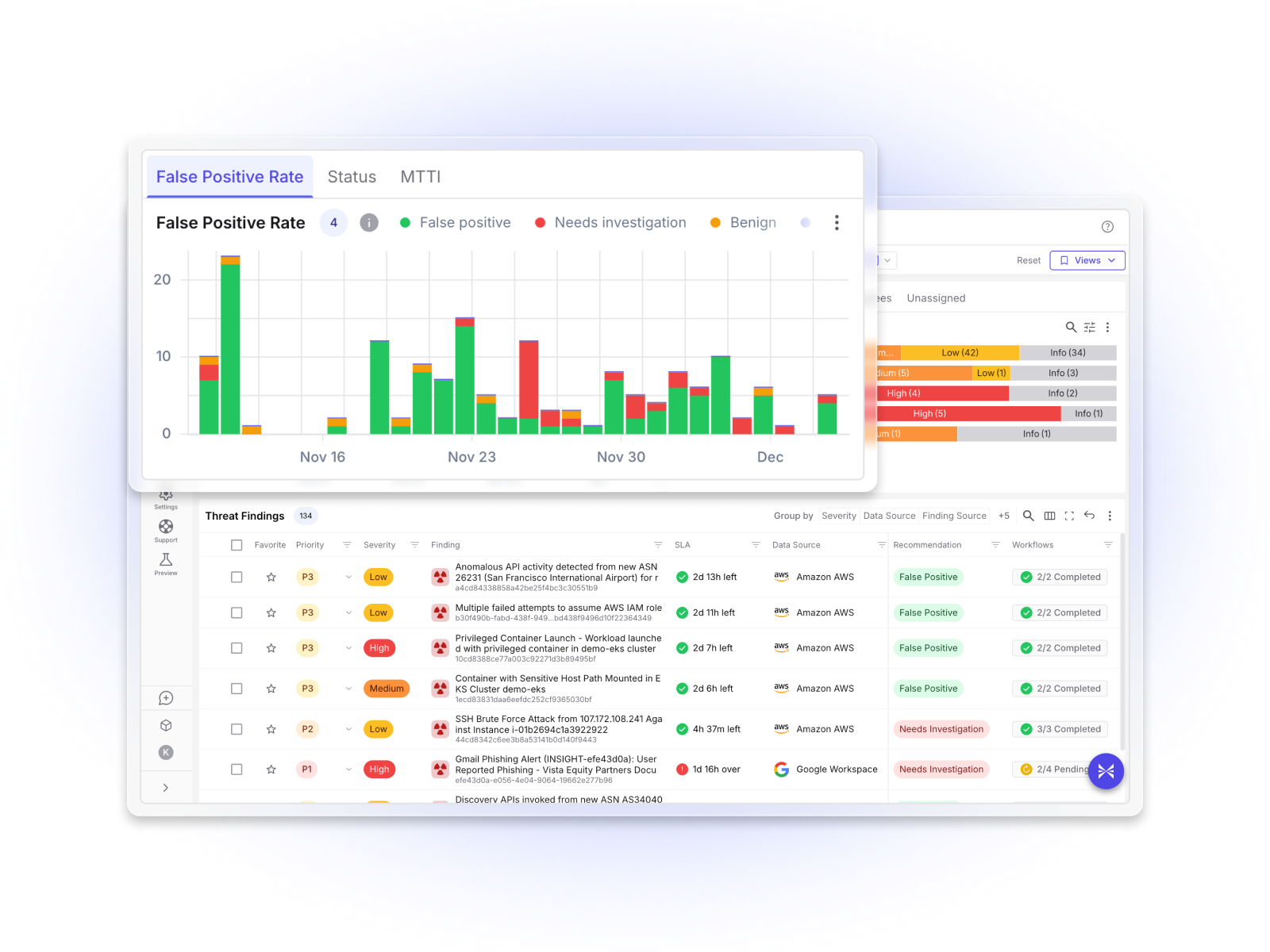
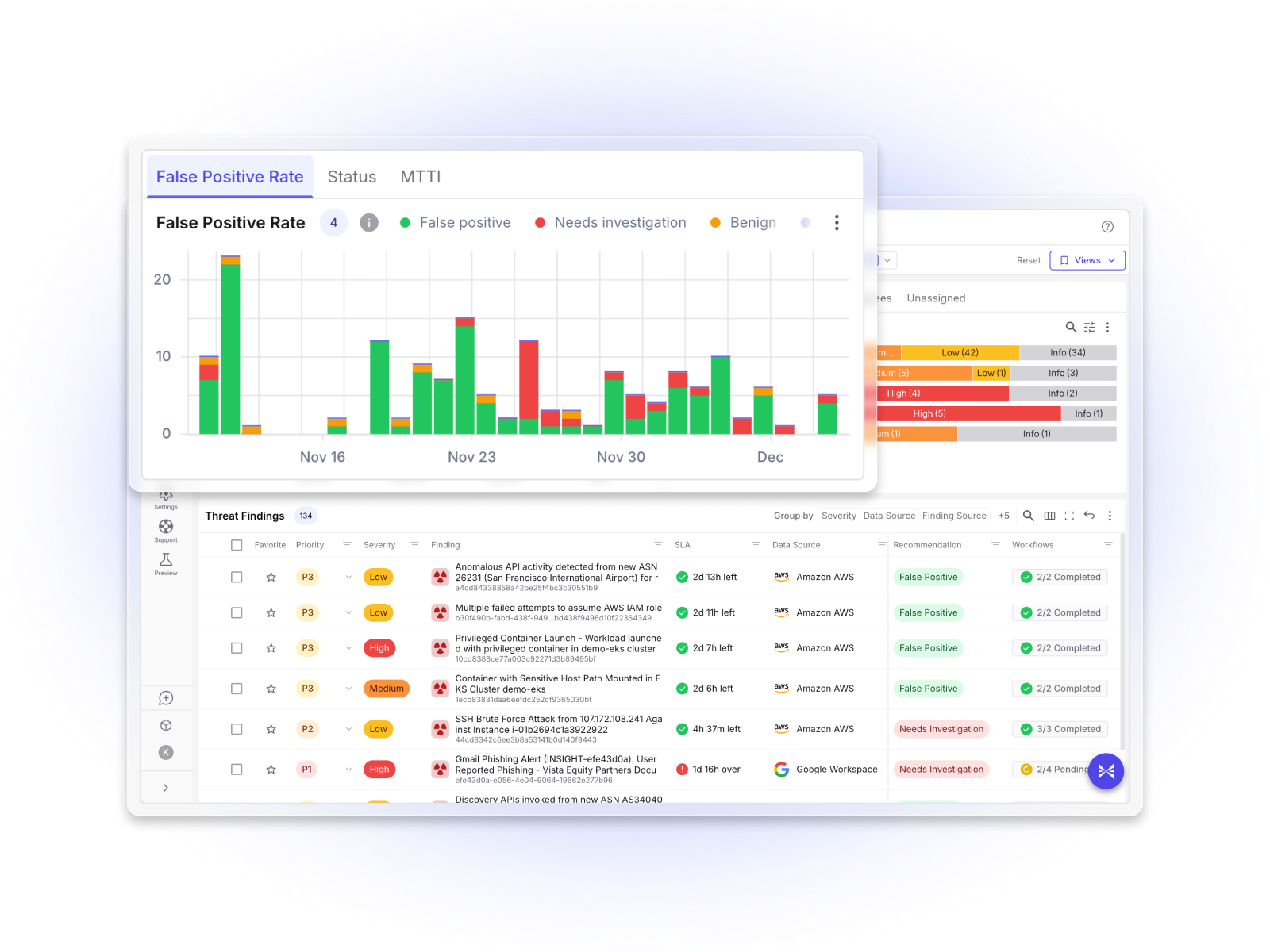
- Exabot Triage: Autonomously investigates alerts from SIEM, EDR, phishing tools and Exaforce's own detections, performing Tier 1 through Tier 3 analysis and classifying each as false positive, benign or needs investigation.
- Exabot Investigate: Provides a BI-style interface and natural language search so analysts can pivot across events, identities, devices and cloud resources without writing SQL or SIEM queries.
- Exabot Respond: Runs stateful multi-step response workflows including user verification, device containment and access revocation, with built-in error handling and retries.
- Multi-model AI engine: Combines data semantics, behavioral baselining, machine learning and large language models to produce decisions the platform can explain and audit.
- Data platform: Deduplicates, transforms and correlates high-volume telemetry, using storage tiering to keep recent data immediately queryable while retaining full history.
- Deployment options: Available as hosted SaaS or as a managed MDR service where Exaforce operates the platform on the customer's behalf.
Limitations (as reported by users on G2):
- Data source coverage: Reviewers report that out-of-the-box support does not extend to every source they need, with some requiring staging in cloud storage before ingestion.
- Permissions and onboarding: Adding certain data sources takes time and requires administrators to grant additional permissions periodically.
- Interface complexity: Some users describe the volume of dashboards and data as complex to navigate.
- Performance on large datasets: Reviewers note the interface can be slow to load, and complex queries against large datasets sometimes fail.
- Ingestion maturity: Users report that some ingestion methods are still under development.
Source: Exaforce
Established SOC Automation Platforms Adding Agentic Capabilities
5. Microsoft Security Copilot

Best for: Teams standardized on Microsoft Defender, Entra, Intune and Purview
Strengths: Agents embedded in existing consoles, and capacity included in E5 and E7
Things to consider: Consumption pricing and weaker coverage outside Microsoft tools
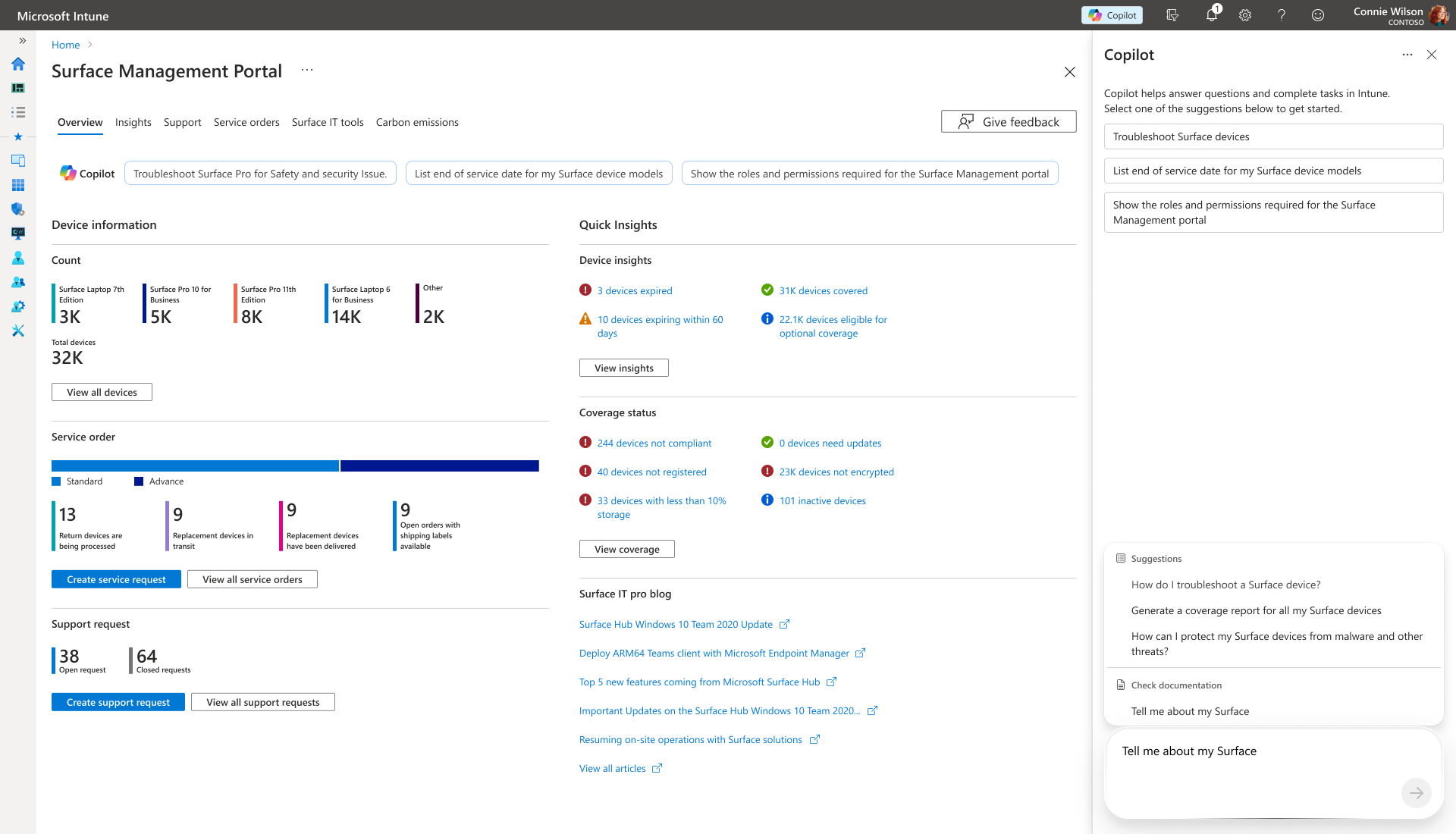
Microsoft Security Copilot places agents directly inside the Microsoft security products teams already use, rather than presenting a separate console. Agents run in Defender, Entra, Intune and Purview and handle tasks such as phishing triage, alert triage and vulnerability remediation.
Alongside Microsoft's own agents, the platform supports partner-built agents and agents organizations build themselves without coding. Capacity is provisioned through security compute units, with an allocation included for Microsoft 365 E5 and E7 customers.
Key features include:
- Embedded agents: Provides ready-to-use agents inside Microsoft Defender, Entra, Intune and Purview for phishing triage, alert triage and vulnerability remediation.
- Custom and partner agents: Supports agents built by partners for extended use cases and agents organizations create themselves for tailored workflows without writing code.
- Investigation and remediation support: Turns complex alerts into actionable summaries with the surrounding incident context, then provides step-by-step response guidance.
- Natural language scripting: Generates query-language scripts and explains or reverse-engineers malware scripts, removing the need for specialist scripting knowledge.
- Stakeholder reporting: Produces reports summarizing the incident context, open issues and protective measures taken, adjusted to the audience.
- Cross-product integration: Connects with Microsoft Sentinel, Defender XDR, Intune, Entra, Purview, Defender for Cloud and Azure security tools, and with third-party products through plugins and promptbooks.
- Security-specific model: Uses a specialized language model with security skills informed by Microsoft's threat intelligence and signal volume.
- Capacity-based licensing: Runs on security compute units, with eligible Microsoft 365 E5 and E7 customers receiving 400 units per month for every 1,000 user licenses, capped at 10,000.
Limitations (as reported by users on PeerSpot):
- Non-Microsoft coverage: Reviewers ask for stronger cross-system functionality and deeper integration with tools outside the Microsoft ecosystem.
- Interface and performance: Users describe the interface as unintuitive and report slowness during use.
- Accuracy on complex cases: Reviewers report occasional hallucinations and inconsistent responses on complex investigations spanning large datasets or multi-stage attacks.
- Cost predictability: Consumption-based pricing and licensing complexity draw comments, with some customers surprised by costs during high-activity periods.
- Transparency and customization: Users ask for clearer visibility into how agents reach decisions and more adaptation to organization-specific workflows.
Source: Microsoft

Related content: Read our article about Microsoft Security Copilot
6. CrowdStrike Charlotte AI
Best for: Falcon platform users adding agentic triage and response
Strengths: No-code agent building, bounded autonomy, ISO 42001 governance
Things to consider: Credit-based consumption, and some modules still maturing
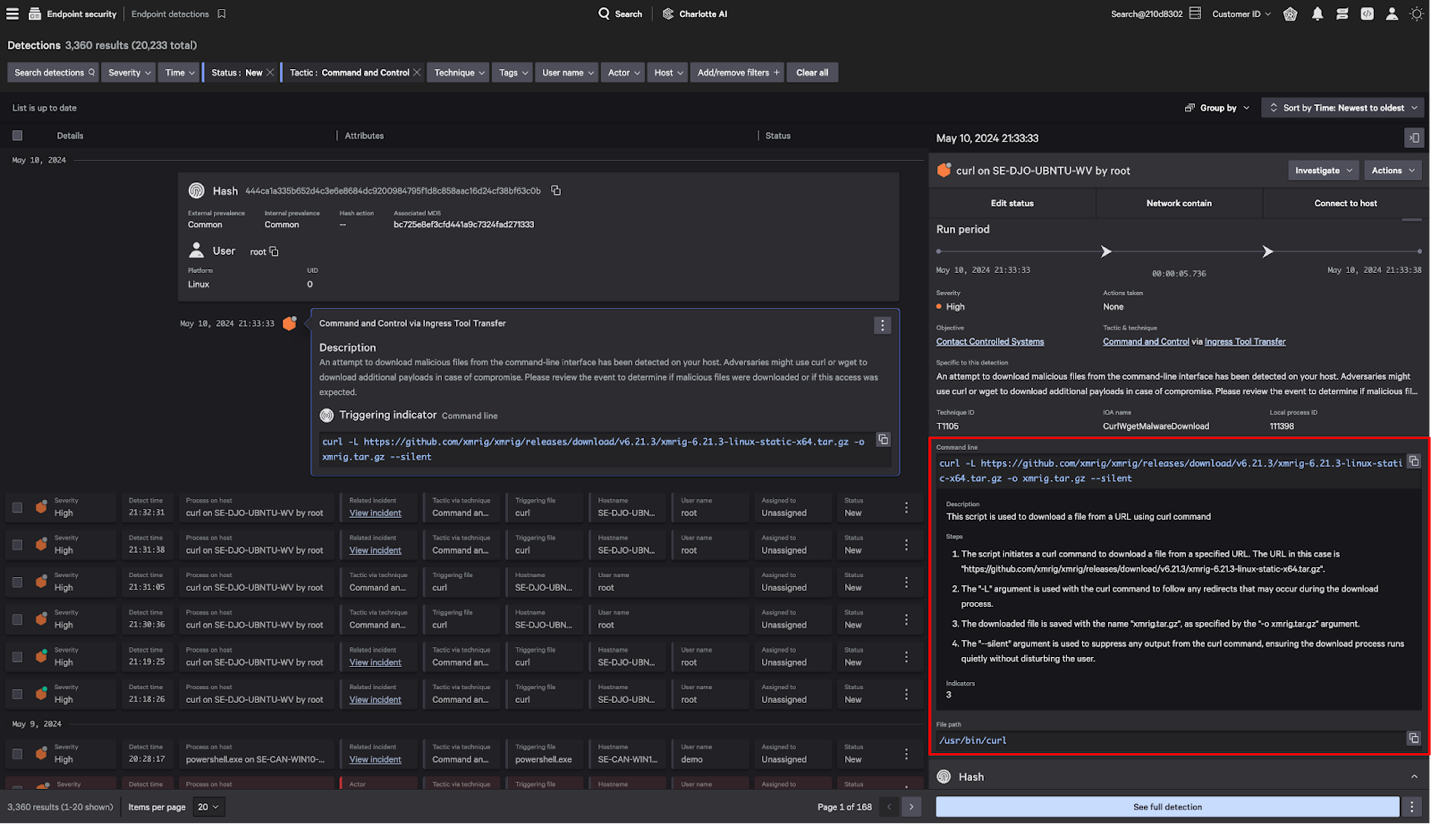
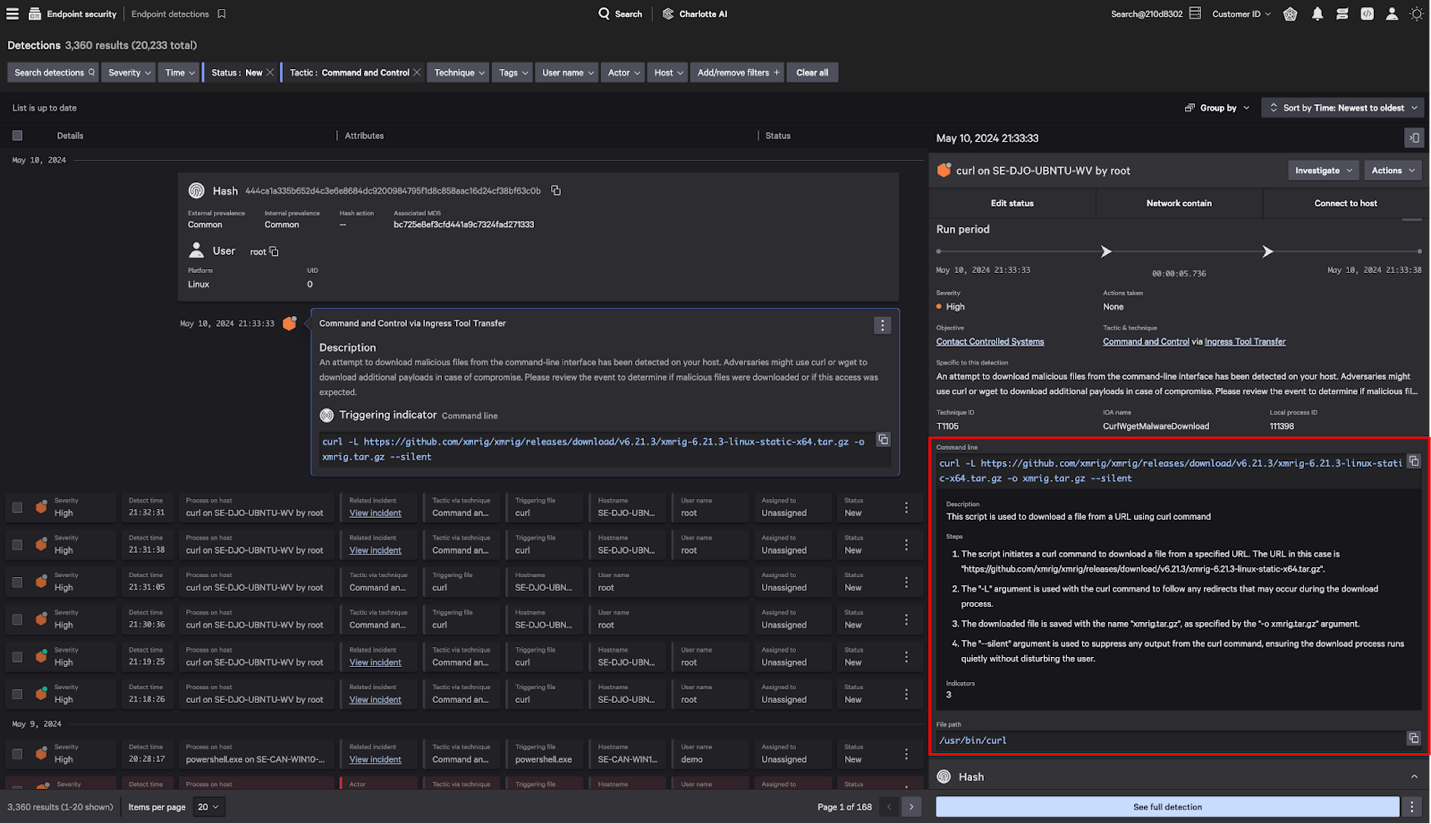
Charlotte AI is CrowdStrike's agentic layer across the Falcon platform, handling detection triage, investigation support and coordinated response. Its triage capability is trained on decisions made by CrowdStrike's own analysts and filters detections before they reach the queue.
The platform pairs agents with governance controls. Actions require user authorization, answers are traceable to validated data, and permissions align to analyst roles. Teams can also build their own agents in natural language.
Key features include:
- AgentWorks agent builder: Lets teams build, test, deploy and manage agents using natural language, setting goals, defining data access and controlling agent behavior without code.
- Detection triage: Triages detections across endpoint, identity and cloud within the Falcon platform, filtering false positives and surfacing what warrants attention.
- Investigation canvas: Supports human-agent collaboration during investigations, letting analysts inject context and set priorities while reasoning runs.
- Charlotte Agentic SOAR: Combines structured automation logic with agentic reasoning to coordinate agent-to-agent and human-AI activity across response workflows.
- Bounded autonomy controls: Requires user authorization for actions, keeps answers traceable, grounds decisions in validated data and aligns them to the analyst's role.
- AI governance certification: Holds ISO 42001 certification for AI governance, with the associated controls built into how agents operate.
- Response agent: Provides an out-of-the-box agent for response tasks alongside the detection triage and investigation capabilities.
Limitations (as reported by users on G2):
- Cost of entry: Early adopters found the product expensive before enterprise customers began receiving monthly complimentary credits.
- Credit-based consumption: Usage is governed by credits and usage limits, which teams need to monitor as adoption grows.
- Modules still in development: Reviewers note that some functionality within the products Charlotte AI integrates with is still being built out, requiring attention to the roadmap.
Source: CrowdStrike
7. Palo Alto Networks Cortex XSIAM

Best for: Organizations consolidating SIEM, SOAR and EDR onto one platform
Strengths: Unified data layer, 13,300+ detections, and AgentiX response agents
Things to consider: High cost, licensing complexity and mixed support experiences
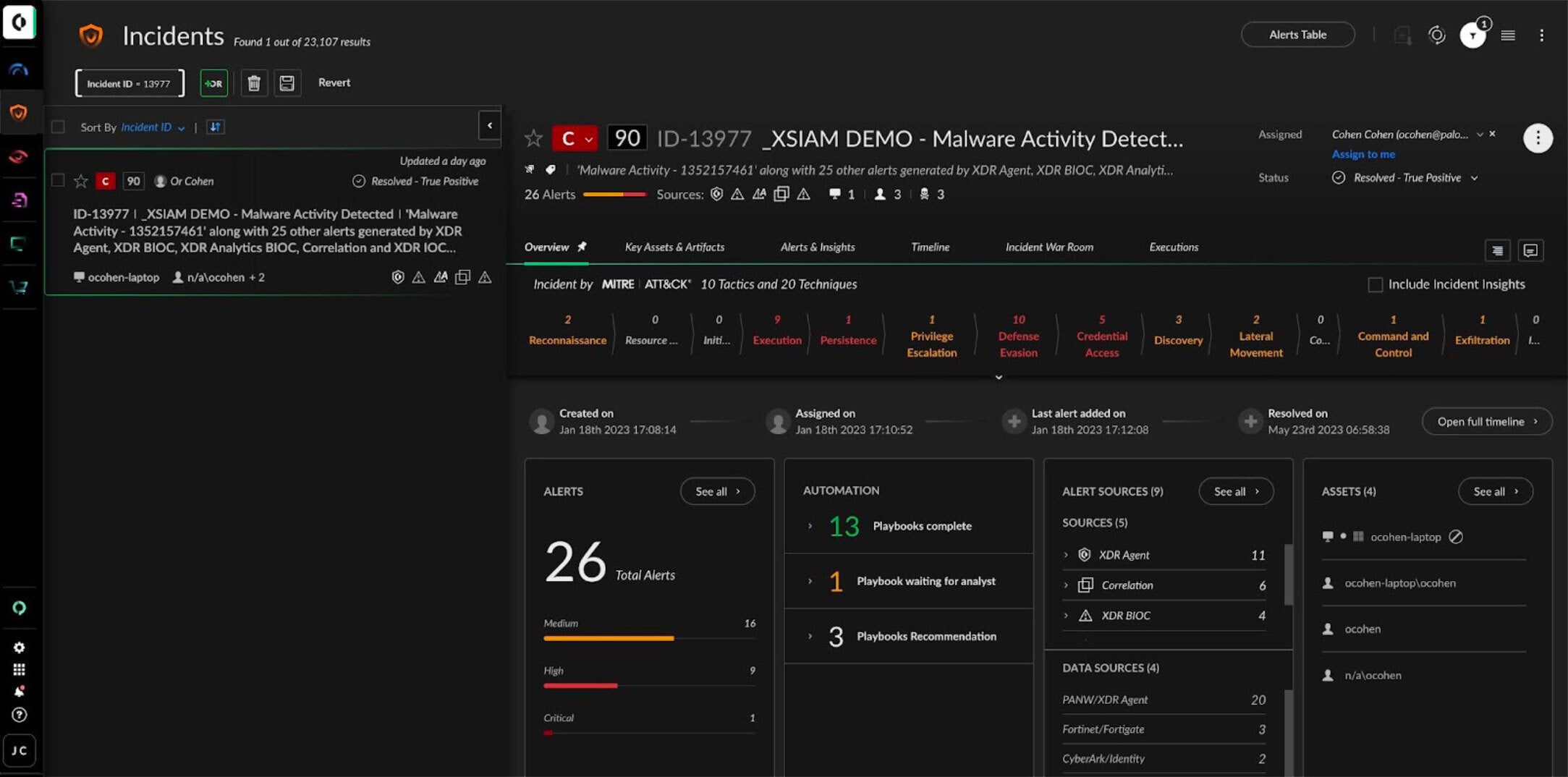
Cortex XSIAM consolidates SIEM, SOAR, EDR, NDR and cloud detection and response onto a single data layer, with agentic AI layered on top. The platform ingests telemetry from Palo Alto products and third-party sources through an open ecosystem model.
Detection runs against a large library of rules and machine learning models rather than analyst-written correlation searches alone. Alerts are grouped into prioritized cases with an attack story and root cause, and Cortex AgentiX handles response within enterprise guardrails.
Key features include:
- Unified data layer: Consolidates endpoint, network, identity, cloud and exposure data through Cortex XDL, accepting input from any source rather than Palo Alto products alone.
- Consolidated SOC functions: Brings SIEM, SOAR, EDR, NDR and cloud detection and response together on one platform instead of separate tools.
- Large detection library: Applies more than 13,300 detections and over 2,900 machine learning models, drawing on expanded EDR telemetry and enriched firewall logs.
- Alert-to-case correlation: Reduces large alert volumes into a small number of prioritized cases, presenting the attack story and root cause in a single place.
- Cortex AgentiX: Runs AI agents that plan, reason and act on response tasks, operating within enterprise guardrails that keep the security team in control.
- Extended capabilities: Adds email security, exposure management, threat intelligence management and identity threat detection and response on the same platform.
- Unit 42 managed services: Offers Managed XSIAM, managed detection and response, and managed threat hunting for teams that want expert coverage alongside the platform.
Limitations (as reported by users on PeerSpot):
- Cost: Reviewers describe pricing as high relative to competitors, with costs varying significantly depending on which add-ons are selected.
- Licensing complexity: Users report the licensing process is more complex than at some competing vendors, with additional expenses for integration and support.
- Interface intuitiveness: Reviewers ask for a more intuitive portal and faster search and filtering.
- Integration breadth: Users want integration with a wider set of third-party security products and shorter integration validation cycles.
- Support consistency: Feedback on support is mixed, with some reporting slow responses and others describing prompt, effective assistance.
- Initial setup: Some users encountered connectivity and infrastructure difficulties during deployment.
Source: Palo Alto Networks
8. Torq

Best for: SOCs that need automation and case closure, not just triage
Strengths: 300 integrations, HyperAgents, and Socrates agent orchestration
Things to consider: AI output quality depends on context, with UI and reporting maturing
Torq combines agentic reasoning with the hyperautomation platform the company built first, covering the threat lifecycle from triage through remediation. Universal Auto Triage ingests and normalizes telemetry across the security stack, then correlates and deduplicates events before issuing verdicts.
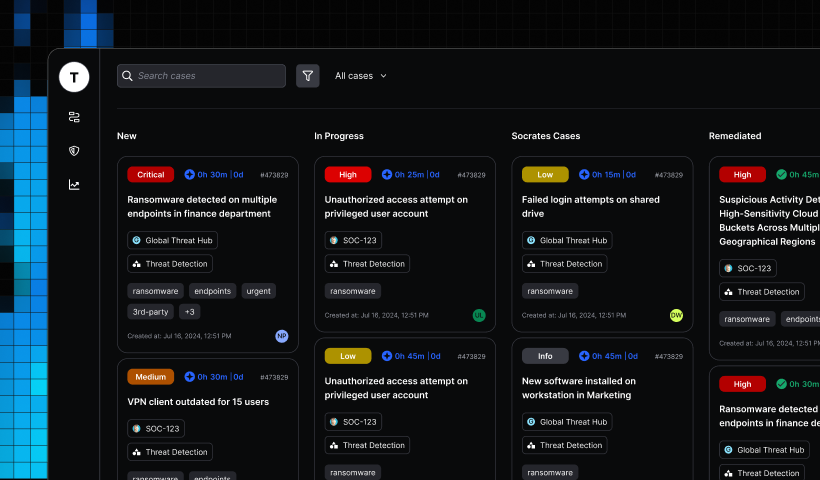
Investigation and response run through customizable AI agents coordinated by Socrates, which manages cases end to end and accepts natural language direction. Native case management holds evidence, timelines and summaries.
Key features include:
- Universal Auto Triage: Ingests and normalizes telemetry from across the security stack, correlates and deduplicates events, then analyzes risk context and threat intelligence to separate noise from real risk.
- Torq HyperAgents: Provides autonomous, customizable AI agents that gather evidence, assemble timelines and summarize findings, working at the direction the security team sets.
- Socrates orchestration: Coordinates the specialized agents, manages cases from open to close, and lets analysts direct work through natural language.
- Native case management: Maintains a single record with evidence, timelines and case summaries, updated as investigation and remediation progress.
- Agentic response actions: Executes containment and remediation steps and routes critical threats to the right people, with the platform closing over 90% of cases autonomously.
- Hyperautomation library: Ships with 300 pre-built integrations and more than 4,000 pre-built steps for building workflows across the stack.
- Agent-built integrations: Uses AI agents to create new integrations, workflows and custom use cases rather than requiring them to be coded by hand.
Limitations (as reported by users on PeerSpot):
- AI output consistency: Reviewers report that results depend heavily on how well case data is scoped and summarized, with token limits constraining how much context can be supplied.
- Interface and dashboards: Users describe the interface as needing more maturity, particularly the case management dashboards.
- Reporting depth: Some reviewers, including MSSP users, report that reporting capabilities are limited for their needs.
- Bug resolution pace: Users note issues with custom steps and describe the speed of fixes as slower than expected.
- Scale performance: Reviewers report slowness with very large workflows, with modularization suggested as a workaround.
- Documentation and training: Some users find documentation unclear and training resources insufficient.
Source: Torq
Conclusion
Agentic AI changes security operations from fixed automation toward systems that can investigate, reason, and act based on the evidence available at each step. Traditional automation remains useful for predictable, repeatable tasks, while agentic approaches are better suited to investigations that require context, cross-tool correlation, and changing decision paths. The most practical model combines both: deterministic workflows for well-understood actions, AI agents for complex analysis, and human approval for decisions with significant security or business impact.