
Best AI SOC Platforms for Mid-Sized Enterprises: Top 8 in 2026
In this article

TL;DR: AI SOC platforms, also known as autonomous SOC, automate alert triage, investigation and response so lean mid-market teams can cover enterprise-grade threat volumes. Intezer is best for teams wanting forensic-depth triage on every alert, Dropzone AI Tier 1 offload, Torq automation-led response, and Microsoft Security Copilot Microsoft-heavy stacks.
What Is an AI SOC Platform?
AI SOC (Security Operations Center) platforms use agentic AI to automate alert triage, investigation, and response for mid-sized organizations facing enterprise-grade threats with lean security teams. Unlike traditional SOCs that rely heavily on manual processes and large teams of analysts, AI SOC platforms simplify security workflows by leveraging automation and advanced analytics.
These platforms ingest data from various sources (such as endpoints, networks, and cloud environments) and continuously analyze it for suspicious activity, reducing the time needed to detect and respond to threats.
Key evaluation criteria for mid-market budgets:
- Fast deployment with minimal tuning: Look for prebuilt integrations, guided onboarding, and useful default detections that reduce setup and maintenance effort.
- Automated Tier 1 investigation: The platform should autonomously collect evidence, enrich alerts, correlate activity, and close obvious false positives.
- Cross-domain attack correlation: It should connect signals from endpoint, identity, email, network, and cloud sources into unified incidents.
- Natural-language threat hunting: Analysts should be able to investigate suspicious activity using plain-language questions instead of complex query syntax.
- Case management and reporting: Built-in workflows should track evidence, ownership, remediation status, and generate audit or executive-ready reports.
- Configurable response guardrails: Teams should be able to define which actions run automatically, require approval, or are blocked entirely.
- Support for hybrid and multi-cloud environments: The platform should collect and correlate telemetry across on-premises systems and multiple cloud providers.
- Clear escalation to human analysts: High-risk or uncertain cases should be routed to people with the evidence, reasoning, and recommended next steps attached.
AI SOC Platforms at a Glance
The table below summarizes the key differences between the platforms covered in this guide, including who each one fits and the trade-offs to weigh. Each platform is explored in more detail in the sections that follow.
| Category | Platform | Best For | Key Strengths | Things to Consider |
|---|---|---|---|---|
| Agentic AI SOC analyst platforms | Intezer | Lean teams needing forensic-depth triage across every alert | Built-in forensics, endpoint-based pricing, human-in-the-loop review | Interface density |
| Agentic AI SOC analyst platforms | Dropzone AI | SOC teams offloading Tier 1 investigation to AI agents | 90+ API integrations, threat hunting agents, unlimited users | Capacity-based licensing tied to annual investigation counts |
| Agentic AI SOC analyst platforms | UnderDefense MAXI | Teams wanting agentic AI triage backed by human-verified response | Vendor-agnostic stack overlay, 2-minute alert-to-triage, concierge-style human verification | Newer platform with a thinner independent review base |
| Agentic AI SOC analyst platforms | Prophet Security | Teams wanting triage, hunting and detection tuning in one place | Auditable investigations, plain-language hunting, MITRE gap mapping | Newer vendor with a limited independent review base |
| Agentic AI SOC analyst platforms | Radiant Security | Teams pairing AI triage with lower-cost log retention | Wide alert-type coverage, one-click response, built-in log management | Navigation steps for custom queries and case management depth |
| Broader SecOps platforms with AI SOC capabilities | Torq | SOCs wanting triage, cases and response in one automation layer | Universal auto triage, native case management, 300 integrations | Learning curve, licensing complexity and premium pricing |
| Broader SecOps platforms with AI SOC capabilities | Swimlane Turbine | Teams standardizing SOC and GRC workflows on one platform | Low-code playbooks, case management, broad connector marketplace | Engineering effort to deploy and maintain playbooks and connectors |
| Broader SecOps platforms with AI SOC capabilities | Microsoft Security Copilot | Microsoft-centric teams adding AI agents inside existing tools | Embedded agents, natural-language querying, E5 and E7 inclusion | Cost, setup complexity and best fit inside the Microsoft stack |
Related content: Read our guide to the top AI SOC tools for a wider vendor comparison.
Why Mid-Sized Enterprises Are Adopting AI SOC Platforms
Limited Security Staffing
Mid-sized enterprises often face significant challenges due to limited security staffing. Unlike large organizations, they rarely have the budget or resources to maintain a full-scale, round-the-clock security operations team. This staffing gap makes it difficult to handle the volume and complexity of modern cyber threats, leading to delayed responses and increased risk of breaches.
How AI SOC platforms help:
These platforms address this challenge by automating many routine security tasks. Automated analysis, triage, and response free up existing staff to focus on higher-level work, improving overall efficiency. With AI handling the bulk of repetitive processes, mid-sized organizations can achieve a level of security coverage that would otherwise require a much larger team.
Related content: Read our article about building an AI SOC team.
Alert Fatigue and False Positives
Security teams in mid-sized enterprises frequently struggle with alert fatigue, caused by an overwhelming number of security alerts and a high volume of false positives. Analysts can become desensitized to alerts or miss genuine threats buried among irrelevant notifications, undermining the effectiveness of security monitoring.
How AI SOC platforms help:
They mitigate alert fatigue by using advanced analytics and machine learning to filter out false positives and prioritize high-risk incidents. Automated correlation and contextual analysis ensure that only relevant, actionable alerts reach human analysts. This reduces noise, helps prevent burnout, and enables teams to focus their attention where it is needed most.
Need for 24/7 Security Operations
Cyber threats can emerge at any time, but most mid-sized enterprises cannot afford to staff a SOC around the clock. This leaves security blind spots outside of regular business hours, increasing the risk that attacks go undetected or unaddressed until significant damage is done.
How AI SOC platforms help:
These platforms offer continuous, automated monitoring and response capabilities that bridge this gap. By operating 24/7 without human intervention, these platforms provide consistent threat detection and rapid response at all times. This persistent vigilance ensures that incidents are identified and managed promptly, regardless of when they occur.
Compliance and Reporting Requirements
Meeting compliance and reporting requirements is a growing burden for mid-sized enterprises, particularly as regulations become more stringent and complex. Manual processes for tracking incidents, documenting investigations, and producing audit-ready reports are time-consuming and prone to errors.
How AI SOC platforms help:
They simplify compliance by automating data collection, evidence gathering, and report generation. Built-in tools help organizations maintain detailed records of security activities, support regulatory audits, and demonstrate adherence to industry standards. This reduces administrative overhead and minimizes the risk of compliance failures.
Key Features and Evaluation Criteria for a Mid-Market AI SOC
1. Fast Deployment with Minimal Tuning
Mid-sized enterprises often lack the time and expertise to perform extensive platform customization or tuning. A key requirement for an AI SOC platform is the ability to deploy quickly and start delivering value with minimal manual configuration. Solutions that offer pre-built integrations and out-of-the-box detection capabilities accelerate time to value and reduce operational disruption.
Platforms designed for fast deployment often include:
- Automated onboarding
- Guided setup
- Best-practice templates
This approach allows organizations to begin monitoring and responding to threats almost immediately, even without dedicated security engineers. Minimal tuning requirements also mean ongoing maintenance is less burdensome, making the platform more sustainable for lean security teams.
2. Automated Tier 1 Investigation
Tier 1 security investigations typically involve repetitive tasks like:
- Initial alert triage
- Basic correlation
- Enrichment with contextual information
Automating these processes is critical for mid-sized enterprises, which may not have dedicated Tier 1 analysts. An effective AI SOC platform should be able to handle these first-level investigations autonomously, drastically reducing response times.
By automating Tier 1 activities, the platform frees up skilled analysts to focus on higher-priority incidents and complex investigations. Automated investigation also ensures a consistent, repeatable process that reduces human error and improves the quality of security outcomes. This capability is especially valuable for organizations aiming to maintain robust security with limited personnel.
3. Cross-Domain Attack Correlation
Modern cyberattacks often span multiple domains, such as:
- Endpoints
- Networks
- Cloud environments
Mid-sized enterprises need an AI SOC platform capable of correlating data across these different domains to detect multi-stage and lateral attacks that might evade isolated security tools. Cross-domain attack correlation enables a unified view of threats and more accurate detection.
Platforms with strong cross-domain correlation capabilities can automatically link related events and indicators, providing context that is essential for understanding the scope and impact of an attack. This holistic perspective allows security teams to respond more effectively, prioritizing threats that pose the greatest risk to the organization.
4. Natural-Language Threat Hunting
Threat hunting is a proactive security practice that can uncover hidden threats and improve an organization’s security posture. However, traditional threat hunting requires specialized skills and knowledge of complex query languages, which many mid-sized enterprises lack. AI SOC platforms with natural-language threat hunting capabilities make this process more accessible.
These platforms allow analysts to use plain English queries to:
- Search for suspicious activity
- Investigate specific threats
- Lower the barrier to entry
By democratizing threat hunting, AI SOC solutions enable more team members to participate in proactive security efforts, leading to better threat detection and incident response.
5. Case Management and Reporting
Efficient case management is essential for tracking incidents from detection through resolution. Mid-sized enterprises benefit from AI SOC platforms that offer integrated case management tools, allowing analysts to document investigations, assign tasks, and collaborate within the platform. Centralized case management simplifies workflows and improves accountability.
In addition, automated reporting capabilities simplify the generation of:
- Incident reports
- Compliance documentation
- Executive summaries
These features save time, reduce manual effort, and ensure that stakeholders receive timely, accurate information about the organization’s security posture and incident response activities.
6. Configurable Response Guardrails
Automated response actions are a central feature of AI SOC platforms, but they must be carefully controlled to avoid unintended consequences. Configurable response guardrails allow organizations to define policies and limits for automated actions, such as:
- Isolating endpoints
- Blocking network traffic
This ensures that responses are appropriate and aligned with business risk tolerance. By providing granular control over automated response, guardrails help prevent disruption to critical business operations and reduce the risk of overreaction to benign events. This flexibility is particularly important for mid-sized enterprises, where the impact of a mistaken automated action could be significant.
7. Support for Hybrid and Multi-Cloud Environments
Most mid-sized enterprises operate in hybrid or multi-cloud environments, with data and workloads spread across on-premises infrastructure and multiple cloud providers. An effective AI SOC platform must:
- Support seamless integration with diverse environments
- Collect and correlate security data from all relevant sources
Comprehensive support for hybrid and multi-cloud environments ensures consistent visibility and protection, regardless of where assets reside. This capability is critical for detecting threats that move between environments and for maintaining compliance with security policies across the organization’s entire digital footprint.
8. Clear Escalation to Human Analysts
While automation can handle many tasks, certain incidents require human judgment and intervention. AI SOC platforms should have clear escalation workflows that route complex or high-risk cases to human analysts. Effective escalation ensures that critical incidents receive the attention they deserve without overwhelming staff with routine tasks.
Clear escalation paths improve incident response by ensuring that analysts are engaged only when necessary and provided with all the context and evidence gathered by the platform. This approach:
- Maximizes efficiency
- Reduces response times
- Ensures that human expertise is applied where it has the greatest impact
Notable AI SOC Platforms for Mid-Sized Enterprises
How we selected these platforms: We shortlisted AI SOC platforms based on autonomous alert triage and investigation, integration with an existing security stack, response controls and human oversight, case management and reporting, and support for hybrid and multi-cloud environments.
Agentic AI SOC Analyst Platforms
These platforms sit on top of an existing detection stack and take over triage and investigation work, rather than replacing the SIEM or EDR that generates the alerts.
1. Intezer

Best for: Lean teams needing forensic-depth triage across every alert
Strengths: Built-in forensics, endpoint-based pricing, human-in-the-loop review
Things to consider: Interface density
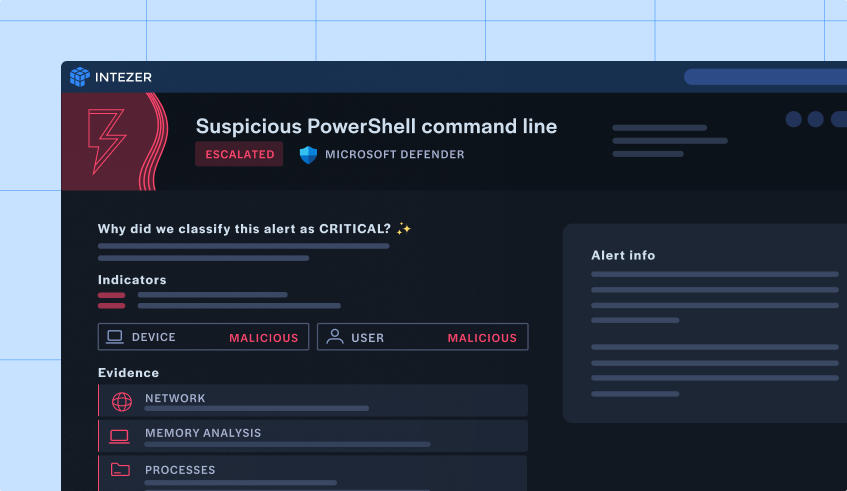
Intezer AI SOC investigates alerts from endpoint, identity, phishing, network and cloud sources, combining forensic capabilities with agentic AI reasoning. It connects to CrowdStrike, SentinelOne and Microsoft Defender for endpoint alerts, and to Entra ID and Okta for identity alerts.
The platform triages 100% of alerts, escalating fewer than 2% for human review with a stated 98% verdict accuracy. Remediation actions are automated with explicit human approval, and analysts can review or override escalated alerts. Pricing is tied to organizational size, such as the number of endpoints, rather than alert volume.
Key features include:
- Full alert coverage. Triages 100% of incoming alerts regardless of severity, so low and medium signal alerts are investigated rather than ignored.
- Endpoint alert triage: Integrates with CrowdStrike, SentinelOne, and Microsoft Defender to collect and analyze files, logs, command lines, and memory images, resolve false positives, and escalate real threats with recommended actions for review or automated remediation.
- Identity alert triage: Queries identity provider data from Entra ID and Okta, reviews findings against threat intelligence, contacts users for feedback, and proposes and executes the next steps to close identity-related alerts.
- Reported-phishing handling: Connects to Office 365 and Proofpoint abuse mailboxes, parses raw email data, scans attachments, and analyzes URLs to return a verdict with priority, classification, and context so only alerts that need a human reach one.
- SIEM and network triage: Analyzes IPs and URLs, correlates alerts to identify patterns, and reviews environment context across tools such as Splunk, Microsoft Sentinel, Sumo Logic, and Elastic, resolving false positives and escalating real threats.
- Cloud alert investigation: Integrates with SIEM, cloud workload protection tools, and Wiz to investigate cloud alerts with full log context, determine the scope of a threat, and recommend or automatically execute remediation steps.
- Forensic investigation. Combines endpoint analysis, memory scanning, reverse engineering with agentic AI to determine whether activity is malicious.
- Agentic AI triage. Uses deterministic forensic analysis alongside agentic AI to auto-resolve false positives and surface real threats with supporting evidence.
- Response workflows. A built-in workflow engine replaces standalone SOAR for SOC automation, closing alerts back in source tools, isolating devices, disabling users, and running human approval loops, all triggered by forensic verdicts. Workflows can be generated from plain-language descriptions and refined visually.
- Detection engineering feedback. Feeds investigation results back into SIEM and EDR detection rules to improve MITRE ATT&CK coverage and reduce recurring noise.
- Integrations and access. Connects to SIEMs, EDRs, phishing pipelines, ticketing, and existing SOAR tools for teams migrating gradually, and can be operated through a REST API, Python SDK, and MCP.
Intezer is highly rated on Gartner Peer Insights. See what users have to say.
Limitations:
- Requires mature telemetry to work. Investigation quality depends on the customer’s existing EDR/SIEM health. Organizations with immature tooling won’t get full value out of the box.
- MITRE ATT&CK coverage has a realistic ceiling with Intezer benchmarking 60–70% as “top-tier” and flags anything higher as likely inflated. Some technique categories remain outside reliable coverage for any vendor.
- Focused on enterprise-size customers with a minimum of 1,000 employees.
Source: Intezer
2. Dropzone AI
Best for: SOC teams offloading Tier 1 investigation to AI agents
Strengths: 90+ API integrations, threat hunting agents, unlimited users
Things to consider: Capacity-based licensing tied to annual investigation counts
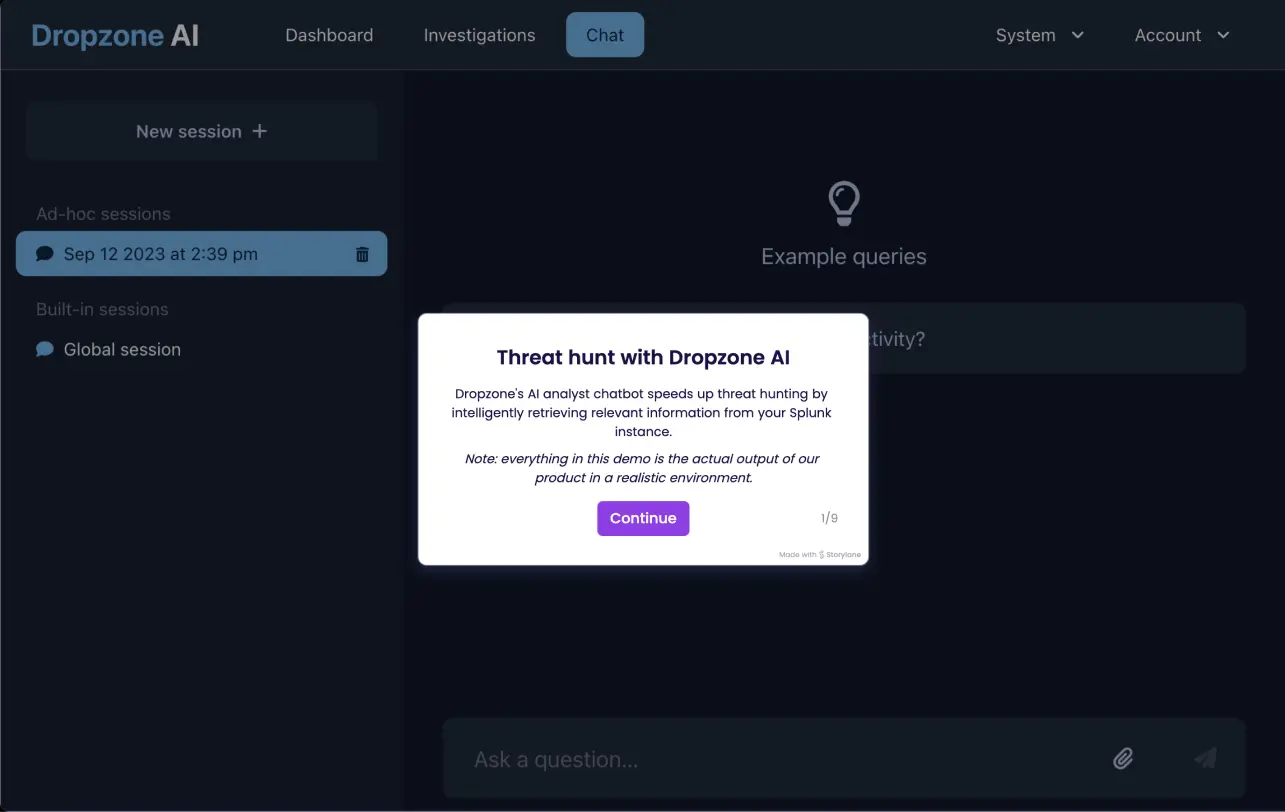
Dropzone AI provides a set of coordinated AI agents for security operations. AI SOC Analyst investigates alerts end to end across the tool stack and shows the evidence behind each verdict. AI Threat Hunter runs hypothesis-driven hunts across SIEM, EDR and cloud data on every shift.
A third agent, AI Threat Intel Analyst, tracks threat sources and converts new CVEs and campaigns into hunt packs, and is listed as available in Fall 2026. The agents query existing tools through APIs rather than ingesting and normalizing data, and security teams set the strategies the agents follow.
Key features include:
- API-based integration model: More than 90 integrations across SIEM, EDR, cloud, identity and email, with Dropzone querying tools the same way analysts do, avoiding data migration or normalization work.
- Alert type coverage: Supports phishing, endpoint, network, cloud, identity and insider threat alerts.
- Autonomous investigation with visible reasoning: Investigates alerts end to end 24/7 and surfaces the evidence behind each verdict for analyst review.
- Hypothesis-driven threat hunting: Runs recurring hunts across SIEM, EDR and cloud sources without manual hunt construction.
- Analyst-defined operating strategy: Teams set what to prioritize, how investigations run and what normal looks like in their environment, with all work running in software the team operates.
- Deployment and residency options: EU data residency, a dedicated single-tenant environment on the enterprise plan, and a multi-tenant environment with pooled investigation capacity for MSSPs.
- Subscription contents: Up to 4,000 full investigations per year per AI analyst, unlimited users, prebuilt integrations, threat intelligence feeds, an AI chatbot for ad-hoc investigation and an eight-hour support SLA.
Limitations (based on publicly available sources):
- Capacity-based licensing: Subscriptions are sized by annual investigation counts, and additional capacity must be purchased when a team approaches its limit.
- Tiered deployment options: Single-tenant environments, custom workflows and premium SLAs sit in the enterprise and MSSP plans rather than the standard subscription.
- Roadmap dependency: The AI Threat Intel Analyst agent is listed as arriving in Fall 2026, so hunt pack automation is not available to all customers yet.
- Tuning period: Reviewer feedback on Gartner Peer Insights notes that fine-tuning the platform takes time after deployment.
Source: Dropzone AI

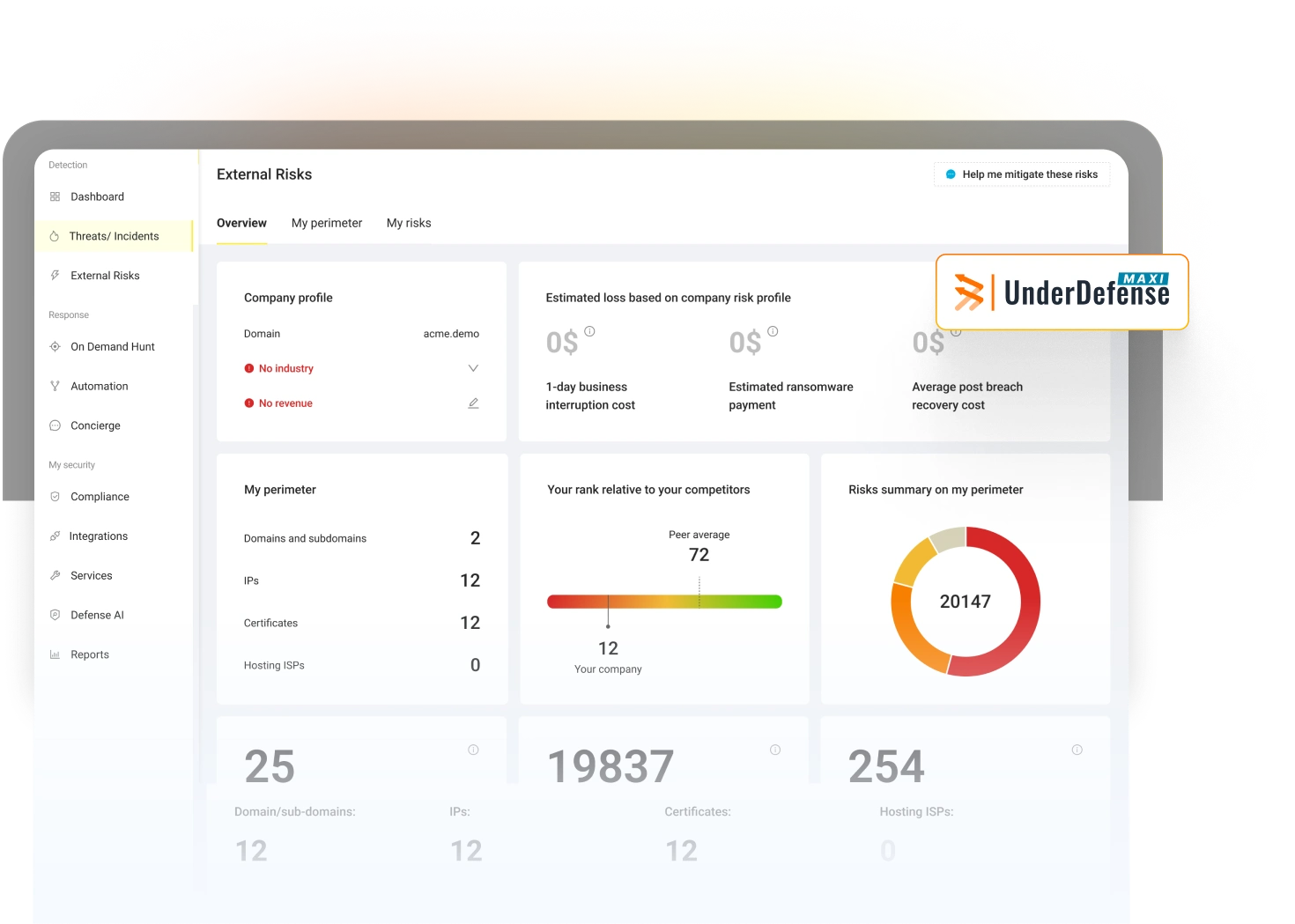
3. UnderDefense MAXI

Best for: Teams wanting agentic AI triage backed by human-verified response, without replacing their existing SIEM/XDR
Strengths: Vendor-agnostic overlay on existing security stacks, 2-minute alert-to-triage, concierge-style human verification
Things to consider: Newer platform with a thinner independent review base; MDR-style delivery model may not suit teams wanting pure self-service software
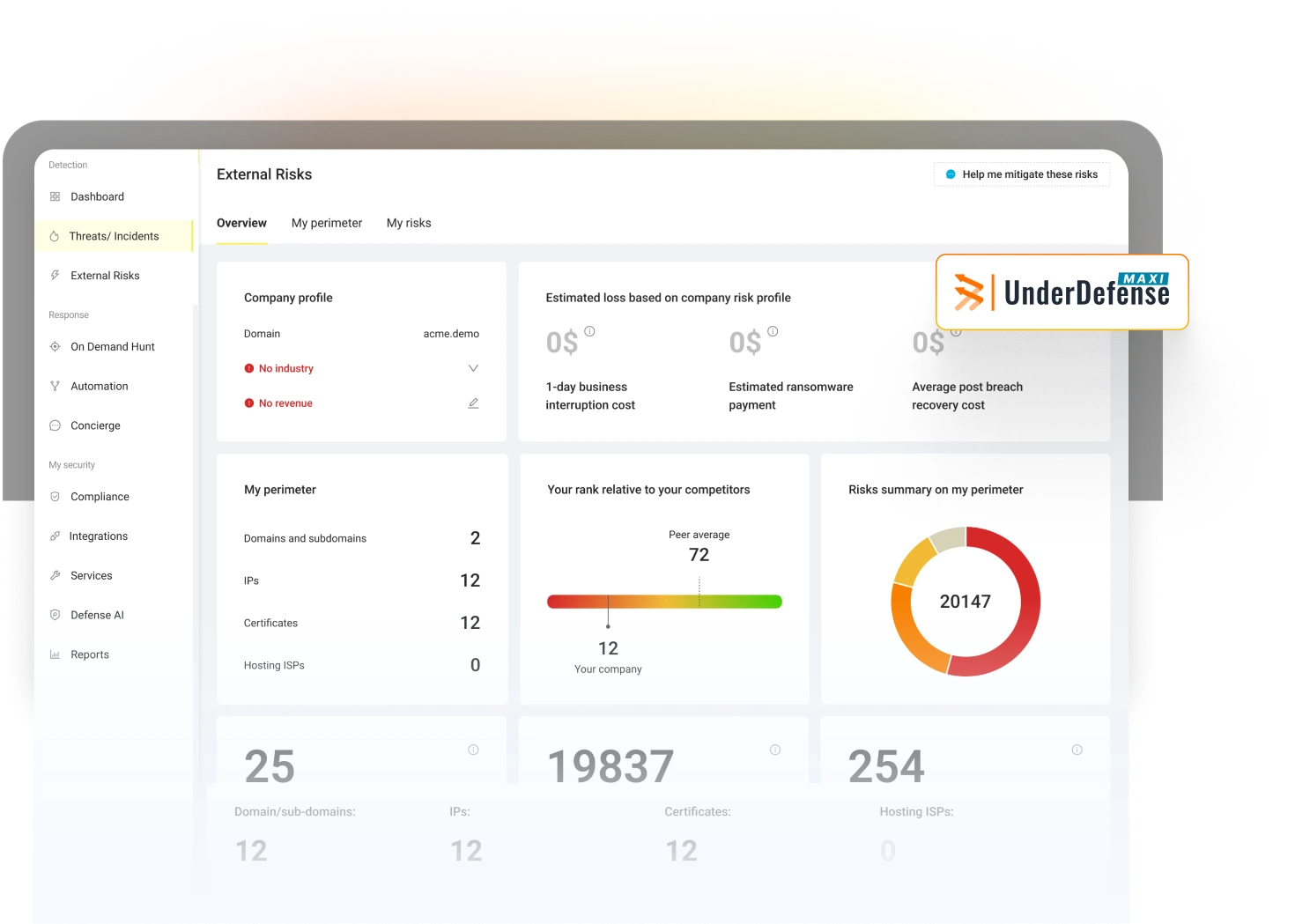
UnderDefense MAXI is an agentic AI security operations and compliance automation platform built to sit on top of whatever SIEM or XDR an organization already runs (Splunk, Microsoft Sentinel, Google Chronicle, Elastic, and others), rather than requiring a rip-and-replace migration. Multiple specialized AI agents handle detection, investigation, response, and threat intelligence roles, ingesting raw alerts.
The platform pairs this agentic automation with what UnderDefense calls a "concierge" layer: for ambiguous cases such as a suspicious login, agents can verify activity directly with the affected user over Slack or Teams before escalating, combining machine-speed triage with human confirmation rather than presenting a raw alert and asking the SOC to investigate from scratch.
Key features include:
- Vendor-agnostic stack integration: Connects to 250+ existing security tools and works on top of a customer's current SIEM/XDR investment rather than forcing migration, preserving existing correlation rules and custom detections.
- Multi-agent architecture: Deploys separate agentic "Teammates" across detection, investigation, response, and threat intelligence, coordinating across the full incident lifecycle rather than a single generalist agent.
- Detection Logic as Code: Writes detection rules in Python, versioned and unit-tested, then deployed through CI/CD, giving security teams a governable, auditable foundation for detection engineering.
- Concierge human verification: Confirms suspicious activity directly with affected users through Slack or Teams before escalation or containment, reducing false-positive response actions.
- SOAR-native response orchestration: Combines autonomous multi-agent investigation with response orchestration and continuous compliance automation (including ISO 27001 and SOC 2 support) in a single platform.
- Flexible deployment model: Available as cloud-delivered SaaS or fully on-premises, including air-gapped deployment with self-hosted AI model inference for financial institutions and other regulated or sovereign environments.
- Full observability and audit trail: Every investigative step is designed to be observable and auditable rather than a black-box verdict, supporting governance and compliance review.
Limitations (based on publicly available sources, including G2):
- Limited independent review volume: As a platform launched publicly less than two years ago, UnderDefense MAXI has a smaller base of published third-party reviews than more established agentic SOC vendors, giving prospective buyers less peer benchmarking to draw on.
- MDR-oriented delivery model: The platform is built around a blended AI-plus-human-analyst delivery model (including managed SOC and concierge verification), which may be less of a fit for organizations specifically wanting a self-service software product without an accompanying service layer.
- Newer entrant in a fast-moving category: UnderDefense positions MAXI's agentic architecture and on-premises/air-gapped offering as recent additions to its roadmap, so organizations evaluating long-term fit should confirm current feature maturity against their specific compliance and deployment requirements.
- Pricing transparency: Published cost references position MDR-style pricing in the $10-30 per asset per month range depending on stack and requirements, but detailed, self-service pricing comparable to pure-software competitors is less readily available without direct vendor engagement.
Source: UnderDefense
4. Prophet Security
Best for: Teams wanting triage, hunting and detection tuning in one place
Strengths: Auditable investigations, plain-language hunting, MITRE gap mapping
Things to consider: Newer vendor with a limited independent review base
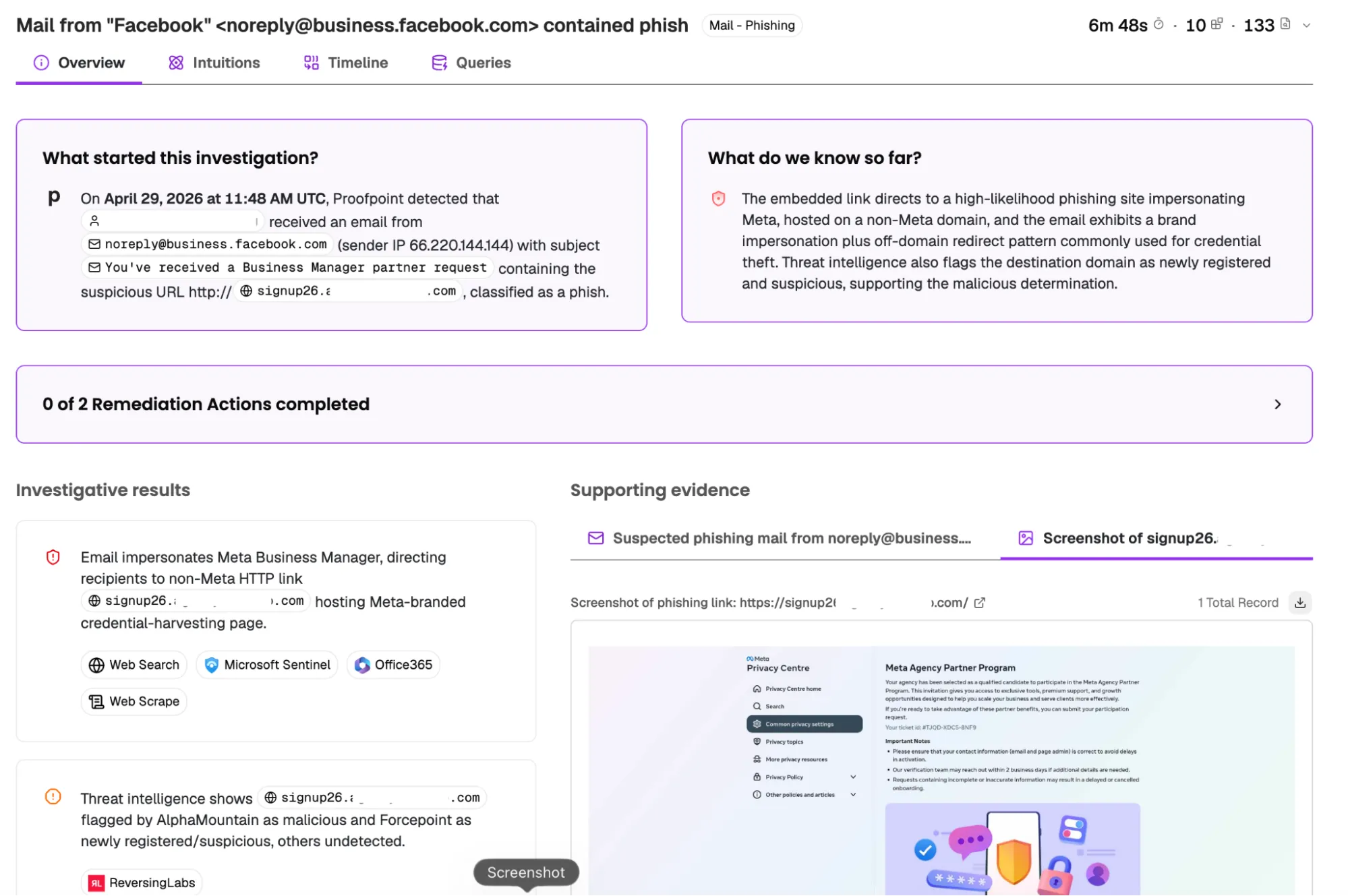
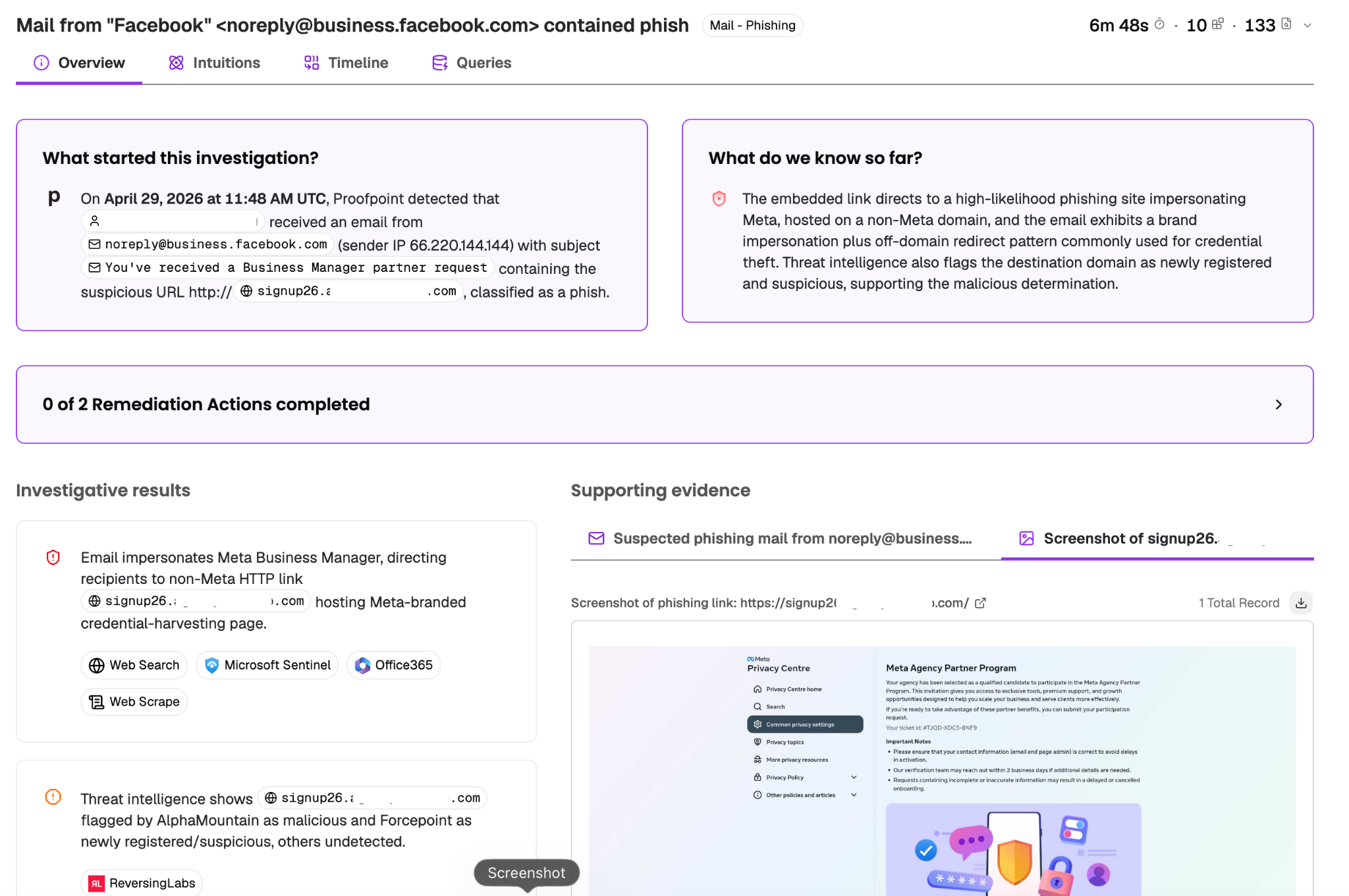
Prophet Security runs a group of AI agents across the security operations lifecycle. AI SOC Analyst investigates every alert to reach a determination that can be audited step by step, then contains confirmed threats through scoped response actions, either autonomously or with analyst sign-off.
AI Threat Hunter answers plain-language questions about the environment and returns the evidence behind each answer, while AI Detection Engineer maps detection coverage against MITRE ATT&CK and authors or tunes rules. AI Watchtower adds human experts who review every malicious determination.
Key features include:
- Auditable alert investigation: Investigations are reconstructed step by step so analysts can inspect the reasoning and evidence behind each determination.
- Scoped response with approval gates: Confirmed threats are contained through response actions that run autonomously or wait for analyst sign-off.
- Natural-language threat hunting: Analysts query the environment in plain language, and proactive agents research emerging threats and produce hunts that can be scheduled or run automatically.
- Detection coverage mapping and authoring: Maps coverage against MITRE ATT&CK using evidence from investigations and hunts, then authors new detections and tunes noisy ones, each backtested before approval.
- Human review layer: AI Watchtower staff review malicious determinations 24x7x365, with validated escalations delivered in under 30 minutes.
- Integration breadth: More than 200 out-of-the-box integrations covering endpoint, email, identity, cloud, DLP and network use cases.
- Deployment and data handling: Single-tenant deployment with a bring-your-own-key option and no training of AI models on personal data.
- Environment adaptation: Learns customer context and policies, with changes previewed, backtested and applied across the platform in real time.
Limitations (based on publicly available sources):
- No published pricing: Pricing is not listed on the vendor site, so cost comparison requires a sales conversation.
- Limited independent validation: Fewer than ten verified ratings appear on Gartner Peer Insights, with no published reviews on other major review platforms.
- Vendor maturity: The company profile lists a 2024 founding date and 11 to 50 employees, which is worth weighing against longer-established vendors.
- Human review is a separate layer: Expert review of determinations is delivered through the AI Watchtower service rather than the core platform.
Source: Prophet Security
5. Radiant Security

Best for: Teams pairing AI triage with lower-cost log retention
Strengths: Wide alert-type coverage, one-click response, built-in log management
Things to consider: Navigation steps for custom queries and case management depth
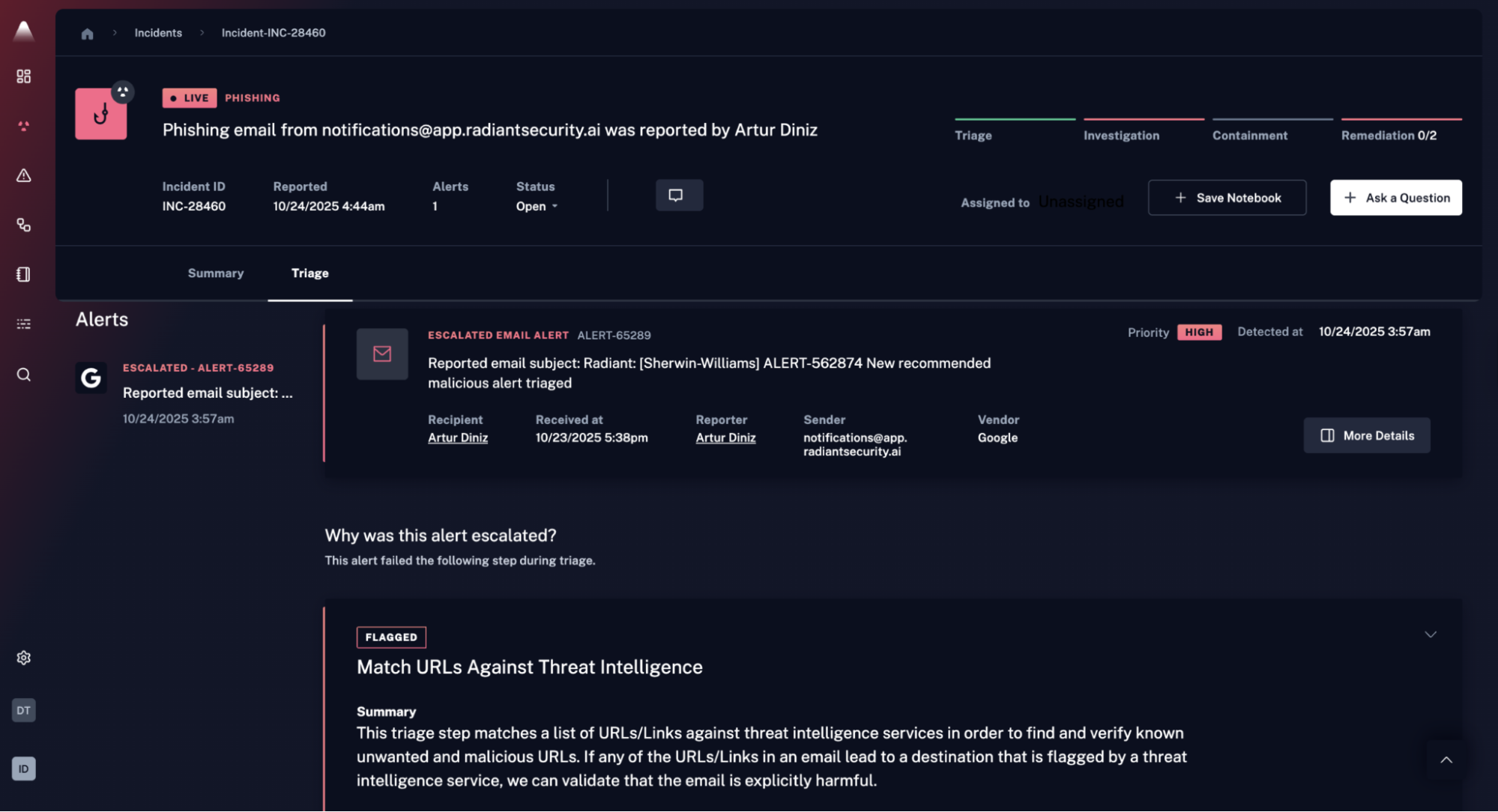
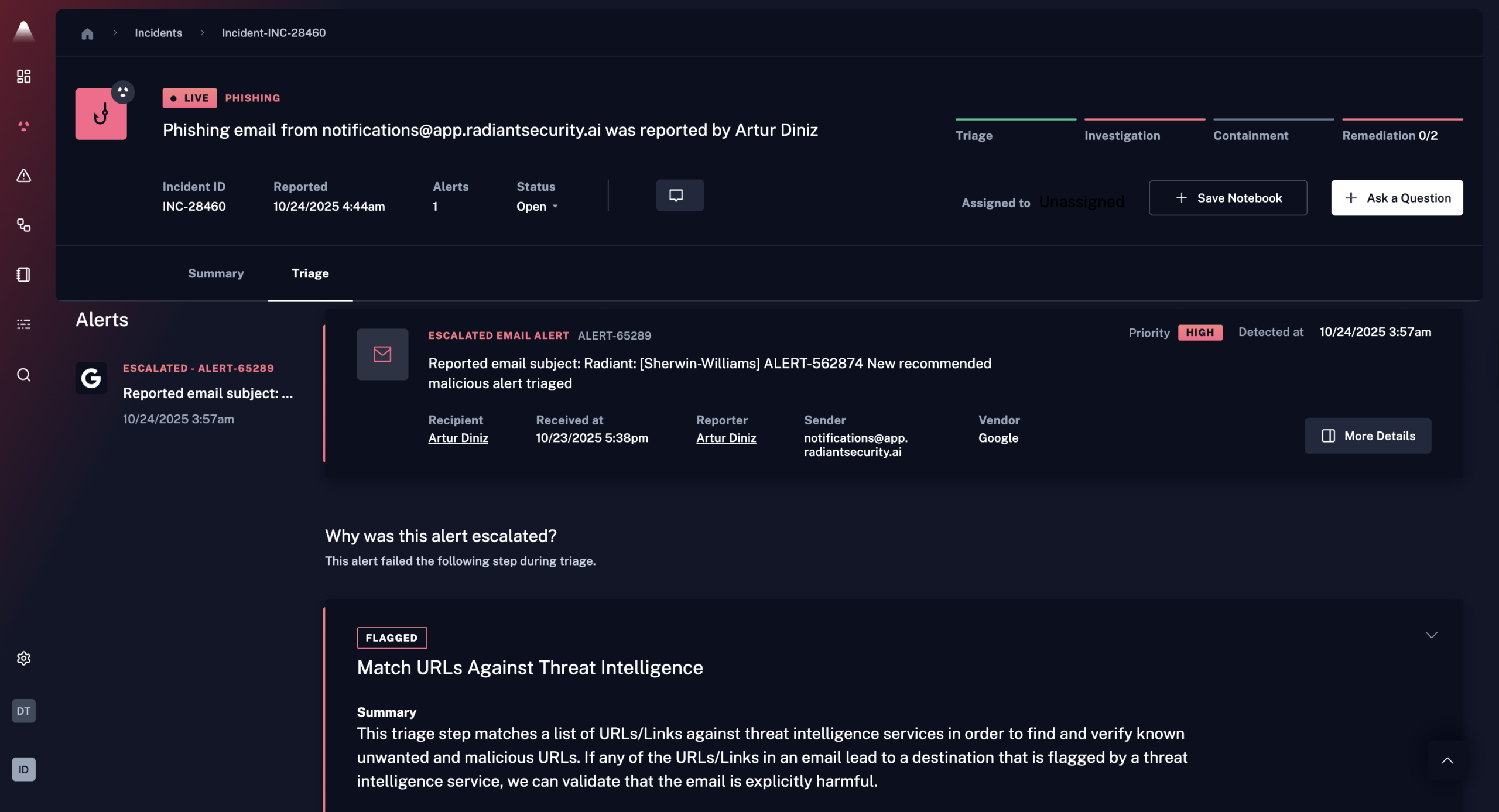
Radiant Security combines agentic AI triage, integrated response and log management in a single platform. Its AI builds and executes triage logic dynamically for each alert rather than working from a fixed set of pre-trained scenarios, and exposes the reasoning behind every decision.
Escalated incidents arrive with auto-generated remediation steps that analysts execute in one click or hand off to automation. Log management is included, storing and searching security logs with unlimited retention. Radiant also packages the platform for MSSPs and for after-hours shift coverage.
Key features include:
- Broad alert-type triage: Covers cloud, insider, custom, network, dark web, OT and IoT, DLP, SIEM, email, supply chain, endpoint, WAF and identity alerts.
- Transparent triage reasoning: Shows the logic behind each escalation or dismissal so analysts can validate decisions and adjust policy.
- Integrated response from cases: Case management supports one-click response actions across multiple alerts, with manual or automated execution and no requirement to build playbooks first.
- Built-in log management: Stores, searches and analyzes security logs with unlimited retention and no vendor lock-in, positioned as a way to reduce SIEM spend.
- Guardrails, policies and exclusions: Security teams shape AI behavior through configurable guardrails, policies and exclusions.
- Packaging for service delivery: Includes Radiant for MSSPs, a program for replacing legacy tooling, and a Night Shift Analyst option for after-hours alert coverage.
Limitations (as reported by users on G2, drawn from the critical feedback within otherwise positive reviews, as the listing currently carries only two reviews):
- Interface navigation: Moving between investigation views takes more steps than reviewers expected.
- Custom query building: Constructing custom queries is described as less intuitive than the rest of the workflow.
- Case management depth: Case management capabilities are noted as an area with room for improvement.
Source: Radiant Security
Broader SecOps Platforms with AI SOC Capabilities
These platforms started as detection or automation suites and have added agentic AI on top, which suits mid-sized teams that also want to consolidate other parts of the stack.
6. Torq

Best for: SOCs wanting triage, cases and response in one automation layer
Strengths: Universal auto triage, native case management, 300 integrations
Things to consider: Learning curve, licensing complexity and premium pricing
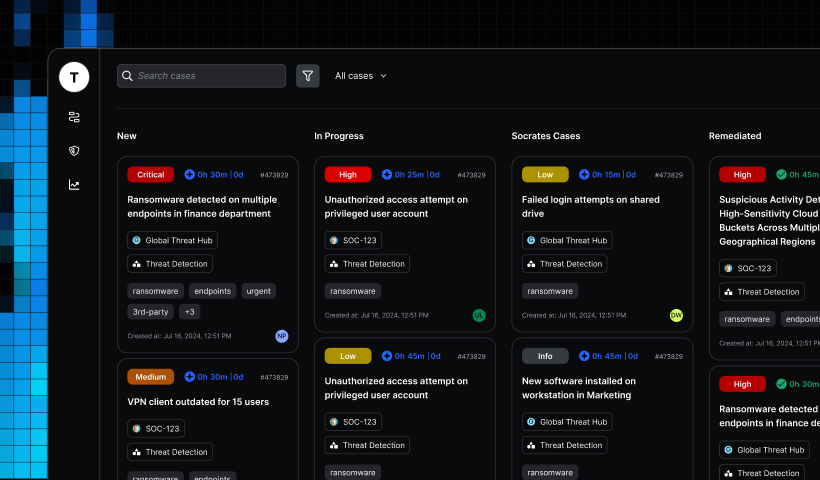
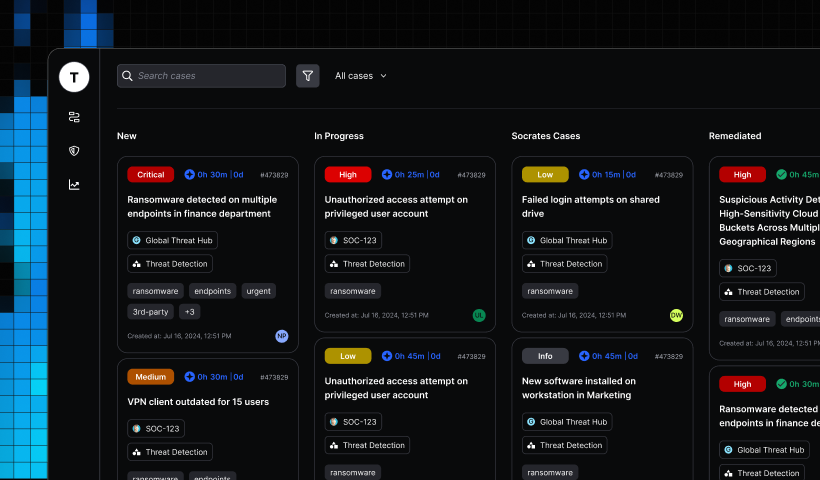
The Torq AI SOC Platform ingests and normalizes telemetry from across the security stack, correlating and deduplicating events to reduce noise, then analyzes risk context and threat intelligence to separate false positives from real risk.
Cases are opened and assigned to specialized, customizable AI agents that gather evidence, assemble timelines and summarize findings. Socrates coordinates those agents, manages cases end to end and takes direction in natural language. Torq states that more than 90% of cases are remediated autonomously, with agentic response actions handling containment and coordination.
Key features include:
- Universal Auto Triage: An agentic engine that prioritizes threats and separates noise from real risk, learning and retaining how a given SOC works.
- Torq HyperAgents: A group of autonomous, transparent and customizable AI agents that adapt to specific use cases, automate routine tasks and assist with workflow design.
- Socrates orchestrating agent: Coordinates the specialized agents, manages cases end to end and provides a natural-language interface for analysts.
- Native case management: Maintains a single source of truth with evidence, timelines and case summaries for collaboration from investigation through remediation.
- Hyperautomation and integrations: Ships with 300 prebuilt integrations and more than 4,000 prebuilt steps, and AI agents can build new integrations, workflows and custom use cases.
- Context graph and memory: Retains environment context across investigations to inform later triage decisions.
- Agentic response actions: Contains threats, coordinates stakeholders and routes critical items to the right people with oversight and control retained by the team.
Limitations (as reported by users on G2):
- Learning curve: Reviewers report that building advanced workflows takes time and training, particularly for teams new to automation.
- Missing built-in content: Some note gaps in prebuilt playbooks and widgets that would shorten the path to value.
- Interface and troubleshooting friction: Reviewers describe buggy interactions, hard-to-locate steps and limited debugging for complex branching workflows.
- Cost and licensing: The platform is described as expensive, and reviewers find the licensing model complicated to keep track of.
- Support responsiveness: Reviewers report slow responses on open tickets during periods of rapid company growth.
Source: Torq
7. Swimlane Turbine

Best for: Teams standardizing SOC and GRC workflows on one platform
Strengths: Low-code playbooks, case management, broad connector marketplace
Things to consider: Engineering effort to deploy and maintain playbooks and connectors
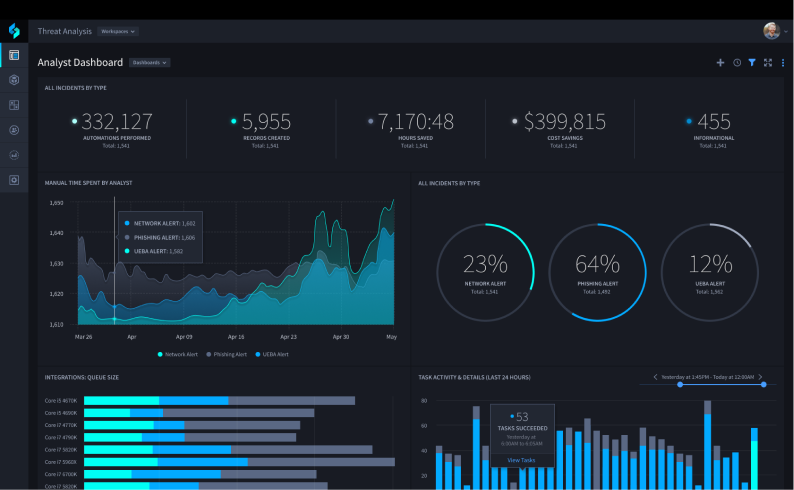
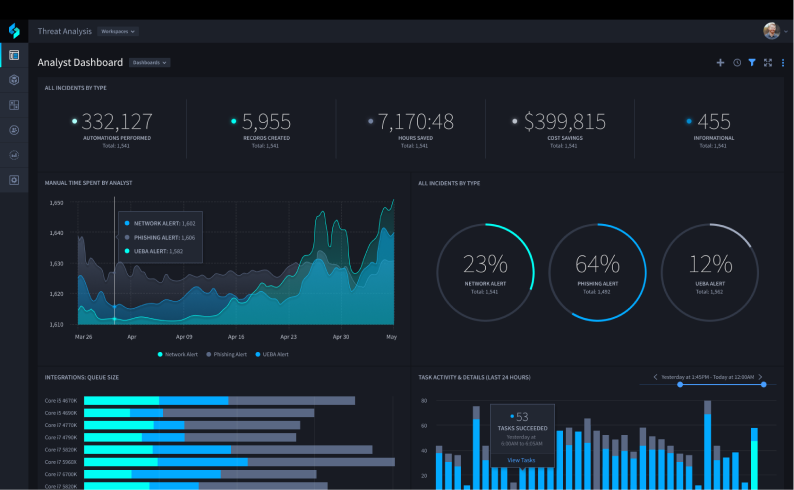
Swimlane Turbine is an agentic AI automation platform used for AI SOC workflows, vulnerability response management, compliance audit readiness and business continuity management. Hero AI turns natural-language commands into automated actions and provides incident response agents alongside a private agentic AI companion.
Turbine Canvas is the low-code playbook and agent builder, and case management is built in with AI agents assisting on incidents. The Active Sensing Fabric handles large-scale data ingestion, and the platform runs cloud-native with on-premises and air-gapped deployment options. Enterprise and MSSP pricing tiers are published separately.
Key features include:
- Low-code playbook and agent builder: Turbine Canvas lets teams build playbooks and AI agents to automate processes across the organization without deep development work.
- Governed AI agents: Hero AI provides incident response agents and a private agentic companion, with the platform positioned around explainable decisions and auditable actions.
- AI-driven case management: Customizable case management with domain expert AI agents supporting the incident response process.
- Active Sensing Fabric: Distributed big data ingestion and processing, with the platform executing up to 25 million actions per day for a single customer.
- Marketplace and open integrations: A marketplace of prebuilt connectors plus the ability to integrate with any REST API in the environment, avoiding lock-in to a fixed connector list.
- Dashboards and AI-augmented reporting: Customizable dashboards and reporting used to measure KPIs, demonstrate ROI, maintain compliance and update stakeholders.
- Deployment flexibility: Cloud-native architecture with support for on-premises and air-gapped environments.
- Coverage beyond the SOC: Vulnerability response management, compliance audit readiness and business continuity management run on the same platform.
Limitations (as reported by users on G2):
- Deployment effort: Initial deployment and playbook design are described as resource-intensive and dependent on skilled engineering support.
- Connector maintenance: Connectors and APIs require frequent updates to stay current.
- Automation risk: Poorly tuned or over-automated playbooks can push false positives into automated actions.
- Upgrades and support: Reviewers report upgrade failures requiring engineering help and support responses that can be slow.
- Interface complexity: Workflow pages become cluttered and harder to navigate as automations grow more complex.
Source: Swimlane
8. Microsoft Security Copilot

Best for: Microsoft-centric teams adding AI agents inside existing tools
Strengths: Embedded agents, natural-language querying, E5 and E7 inclusion
Things to consider: Cost, setup complexity and best fit inside the Microsoft stack
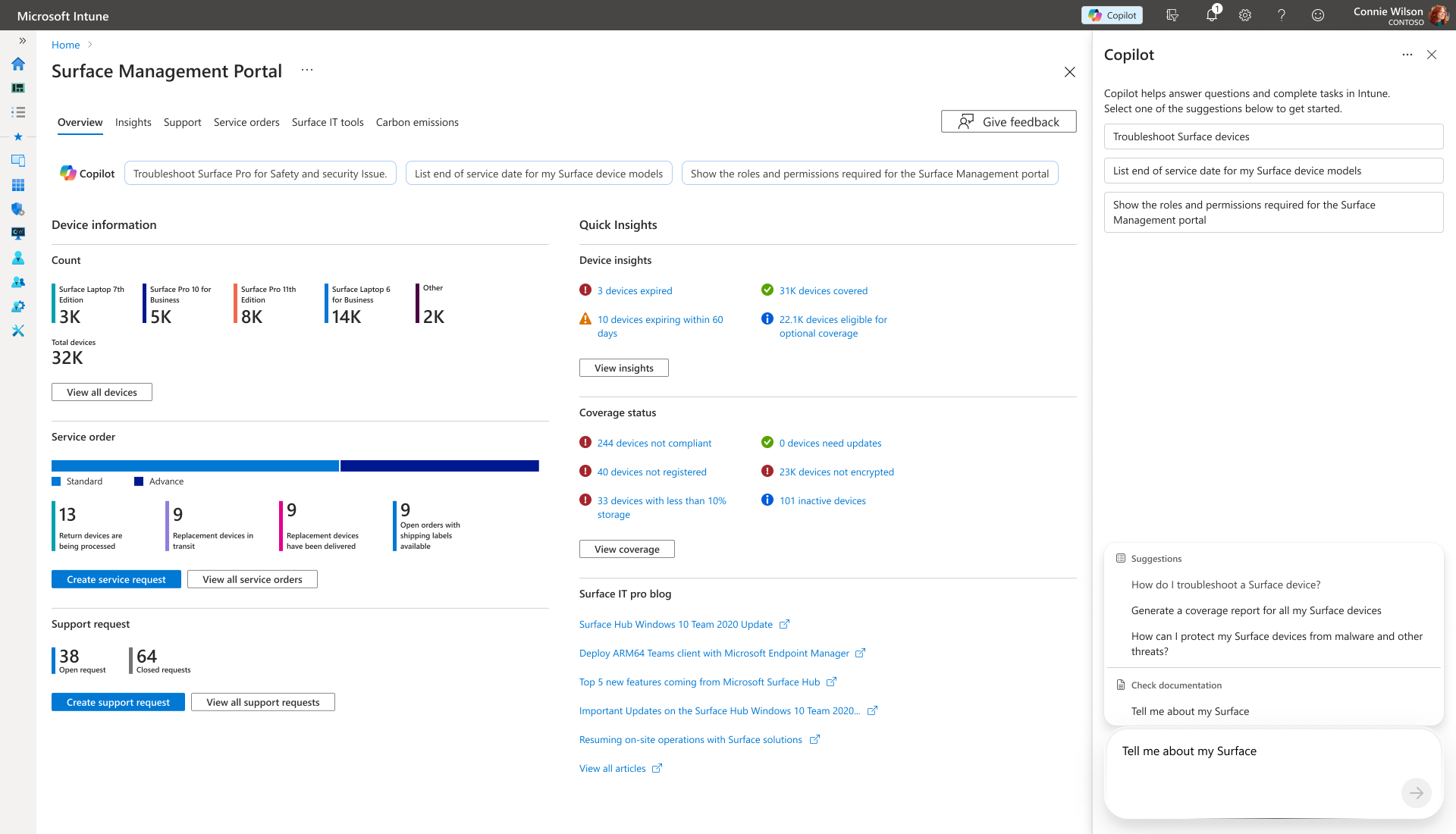
Microsoft Security Copilot embeds AI agents inside Microsoft Defender, Entra, Intune and Purview, so analysts work with them in the tools they already use. Ready-to-use agents handle tasks such as phishing triage, vulnerability remediation and alert triage.
Copilot summarizes signals into insights across identities, devices, data, clouds and apps, and supplies step-by-step response guidance during incidents. It also translates natural language into query-language scripts and reverse-engineers malware scripts. Capacity is provisioned through security compute units, with an allocation included for eligible Microsoft 365 E5 and E7 customers.
Key features include:
- Embedded agents across Microsoft security products: Prebuilt agents run inside Defender, Entra, Intune and Purview to handle phishing triage, vulnerability remediation and alert triage.
- Partner-built and community-built agents: Agents from the partner ecosystem extend agentic use cases, and teams can build their own agents for tailored workflows without coding.
- Investigation and remediation guidance: Turns complex alerts into actionable summaries and provides step-by-step response guidance during remediation.
- Script generation and reverse engineering: Removes the need to manually write query-language scripts or reverse-engineer malware scripts by translating from natural language.
- Stakeholder reporting: Produces reports summarizing environment context, open issues and protective measures, adjusted for the audience.
- Integration coverage: Works with Microsoft Sentinel, Defender, Defender for Cloud, Intune, Entra and Purview, plus Azure Web Application Firewall, Azure Firewall and partner products.
- Capacity-based provisioning: Runs on security compute units, with eligible Microsoft 365 E5 and E7 customers receiving 400 units per month for every 1,000 user licenses, up to 10,000 units per month.
Limitations (as reported by users on G2):
- Cost: Reviewers describe the product as expensive relative to alternatives in the market.
- Learning curve: Teams less experienced with AI-based security tooling need time to adapt, and reviewers note the tool itself takes time to learn.
- False positives: Some results require additional verification, which adds time back into the workflow.
- Setup and customization limits: Reviewers report that it can be tricky to set up alongside existing tooling and that customization options are constrained.
- Access limitations: Availability is not extended to every user, which reviewers say limits day-to-day usability across a team.
Source: Microsoft

Conclusion
AI SOC platforms can help mid-sized enterprises extend security coverage without building a large 24/7 operations team. The strongest options automate repetitive triage and investigation, correlate activity across security domains, support natural-language hunting, and apply controlled response actions while preserving human oversight. For mid-market buyers, the key is balancing automation depth with deployment effort, integration coverage, pricing predictability, and clear escalation paths so the platform reduces analyst workload without introducing unnecessary operational risk.