
How to Compare Agentic SOC Platforms and Top 8 Solutions Evaluated
In this article

TL;DR: Agentic SOC platforms use AI agents to triage, investigate and respond to alerts. Best for forensic-depth triage: Intezer. Suitable for human-verified response on top of an existing stack: UnderDefense MAXI. Suitable for Microsoft-native SOCs: Security Copilot. Suitable for Falcon-centric SOCs: CrowdStrike Charlotte AI.
What Is an Agentic SOC Platform?
An agentic SOC platform uses autonomous AI agents to perform security operations tasks that normally require manual analyst work. These agents can investigate alerts, gather context from security tools, correlate evidence, determine likely causes, and take predefined response actions.
Unlike basic automation, agents can adapt their workflow based on what they discover during an investigation. Compare agentic Security Operations Center (SOC) platforms by evaluating their autonomous investigation depth, integration agnosticism, governance controls, and pricing architecture.
Key evaluation criteria
Use these five dimensions to compare platforms consistently:
- Investigation depth and evidence quality: how far the agent digs, what evidence it can collect, and how it handles unfamiliar alerts
- Agent autonomy and human control: which actions run automatically, which need approval, and how that boundary is configured
- Integration coverage across the security stack: how many alert sources and response tools connect, and how deep each connection goes
- Transparency, explainability and auditability: whether reasoning, queries and actions are recorded in a reviewable form
- Deployment, scalability and cost predictability: onboarding effort, behaviour under alert volume, and how pricing scales
Solutions covered in this guide:
- AI-native agentic SOC platforms:
- Intezer AI SOC: Forensic-depth autonomous triage across alerts of every severity.
- UnderDefense MAXI:Agentic triage and investigation with concierge-style human verification, deployed on top of an existing SIEM/XDR.
- Prophet AI SOC Analyst: Parallel, dynamically planned investigations with controlled remediation.
- Radiant Security: Vendor-agnostic triage across known and unfamiliar alert types.
- Agentic SOC capabilities in enterprise security platforms:
- Microsoft Security Copilot: Embedded security agents for Microsoft-centric SOC environments.
- CrowdStrike Charlotte AI: Agentic investigation and automation built on Falcon telemetry.
- Palo Alto Networks Cortex AgentiX: Configurable security agents with broad integration coverage.
- Google Security Operations: Agentic triage, threat hunting, and detection engineering within the SIEM and SOAR platform.
This is part of a series of articles about AI SOC
How to Choose an Agentic SOC Platform
Each criterion below covers a different dimension of platform behaviour. Work through them in order and apply the same checks to every vendor on your shortlist.
1. Investigation Depth and Evidence Quality
Investigation depth is the difference between an agent that summarises an alert and one that resolves it. Depth depends on what evidence the agent can reach, whether it can analyse artifacts rather than just look them up in threat intelligence, and what happens when it meets an alert type it has not seen before. Platforms with narrow, pre-trained coverage perform well on common phishing and endpoint alerts and stall elsewhere. Depth also determines whether low-severity alerts get real scrutiny or get closed on a heuristic.
Evaluation criteria:
- Which evidence types can the agent collect: logs, files, processes, memory, network artifacts, identity data, organizational context?
- Can it analyse artifacts directly through sandboxing, script analysis or reverse engineering, or only enrich them?
- How does it handle alert types outside its trained set, and does it build a plan dynamically?
- Does it group related alerts into a single attack story, or treat each one in isolation?
- Are low-severity and informational alerts investigated with the same rigor as high-severity ones?
2. Agent Autonomy and Human Control
Autonomy is where agentic platforms diverge most. Some stop at a verdict and a recommendation. Others execute containment such as disabling an account or isolating a host. Neither is inherently better, but the control model must match your risk tolerance and change process. The important question is not how autonomous the platform can be, but how precisely you can draw and move the line, and whether the agent operates inside your existing roles and permissions.
Evaluation criteria:
- Which actions run without approval by default, and which require a human?
- Can autonomy be set per action type, per alert source or per environment?
- Do agents inherit the same roles and permissions as human analysts?
- Can proposed changes be previewed or tested against historical data before they go live?
- Can the team widen or narrow autonomy over time without vendor involvement?
Related content: Read our article about the autonomous SOC and how far automation can go.
3. Integration Coverage Across the Security Stack
Agents can only investigate what they can reach. Coverage has two parts: breadth, meaning how many of your alert sources and response tools are supported; and depth, meaning how much each connector can actually do. A read-only connector that ingests alerts is not the same as a bidirectional one that can pull additional evidence mid-investigation and execute containment. Check whether integration requires log migration or normalization, which adds a project before value arrives.
Evaluation criteria:
- Are your SIEM, EDR, identity provider, cloud, email and ticketing tools supported natively?
- Are connectors bidirectional, so the agent can both gather evidence and take action?
- Does onboarding require moving or reformatting log data?
- Is there support for open interfaces such as APIs, webhooks or MCP for custom sources?
- How are unsupported or in-house tools handled?
4. Transparency, Explainability and Auditability
An agent's verdict is only usable if the team can check it. Transparency means the platform records the questions the agent asked, the queries it ran, the evidence it saw and the reasoning that led to the conclusion, in a form an analyst can review and challenge. This matters for building trust during rollout, for handling disputed verdicts, and for audit and compliance evidence when an agent closes or acts on an alert unattended.
Evaluation criteria:
- Is the full investigation trail available, including tools queried and evidence collected?
- Can analysts override a verdict, and does that feedback change future behaviour?
- Are agent actions logged with the identity and permissions used?
- Is the reasoning readable by a Tier 1 analyst, not only by an engineer?
- Are there formal governance controls or certifications covering AI use and data handling?
5. Deployment, Scalability and Cost Predictability
The last criterion covers what the platform costs to run, in effort and in money. Onboarding ranges from connecting a few read-only APIs to a multi-week data and parser project. Scalability matters because investigation quality should not degrade when alert volume triples. Pricing units differ significantly across the market: per endpoint, per investigation, per compute unit, per ingested data volume. The unit determines whether investigating every alert is affordable or self-defeating.
Evaluation criteria:
- What is required to reach first value: API keys, log migration, parser work, playbook building?
- Does investigation time stay flat as alert volume rises?
- What is the pricing unit, and does it penalise investigating 100% of alerts?
- How predictable is the bill month to month, and are there overage mechanics?
- What ongoing engineering effort is needed to keep the platform tuned?
Common Agentic SOC Platforms and How They Meet the Criteria
The table below summarises how each platform measures up against the five criteria. Each one is explored in detail in the sections that follow.
| Category | Solution | How It Meets the Criteria |
|---|---|---|
| AI-native agentic SOC platforms | Intezer AI SOC | Forensic evidence collection and analysis across all alert severities, with policy-based response, bidirectional integrations, transparent triage logic and endpoint-based pricing. |
| AI-native agentic SOC platforms | UnderDefense MAXI | Vendor-agnostic overlay on existing SIEM/XDR, 2-minute alert-to-triage, Detection Logic as Code, concierge-style human verification via Slack/Teams before escalation, and full observability of every investigative step. |
| AI-native agentic SOC platforms | Prophet AI SOC Analyst | Dynamically planned investigations on 100% of alerts in parallel, documented reasoning, 200+ integrations, and remediation that is previewed and backtested before running. |
| AI-native agentic SOC platforms | Radiant Security | Vendor-agnostic triage across known and unknown alert types, one-click integrated response, transparent reasoning, and integrated log management with predictable pricing. |
| Agentic SOC capabilities in enterprise security platforms | Microsoft Security Copilot | Embedded and custom agents across Defender, Entra, Intune and Purview, with strongest depth inside the Microsoft stack and consumption-based SCU pricing. |
| Agentic SOC capabilities in enterprise security platforms | CrowdStrike Charlotte AI | Triage and investigation built on Falcon telemetry, no-code agent building in AgentWorks, agent orchestration via Agentic SOAR, and ISO 42001-certified AI governance. |
| Agentic SOC capabilities in enterprise security platforms | Palo Alto Networks Cortex AgentiX | Prebuilt and custom agents with configurable autonomy, role-bound permissions, 1,100+ integrations and native MCP support, delivered across the Cortex products. |
| Agentic SOC capabilities in enterprise security platforms | Google Security Operations | Separate triage, detection engineering and threat hunting agents backed by Mandiant intelligence, with deterministic playbooks retaining control of high-impact actions. |
Notable Agentic SOC Platforms
How we selected these platforms: We shortlisted agentic SOC platforms based on autonomous alert triage and investigation, evidence collection across the security stack, configurable agent autonomy and response, transparency of agent reasoning, and integration with existing SOC tooling.
AI-Native Agentic SOC Platforms
1. Intezer AI SOC

Best for: Forensic-depth triage of every alert, including low severity
Strengths: Deterministic forensics paired with agentic AI reasoning
Things to consider: Endpoint-based pricing suits some team profiles better
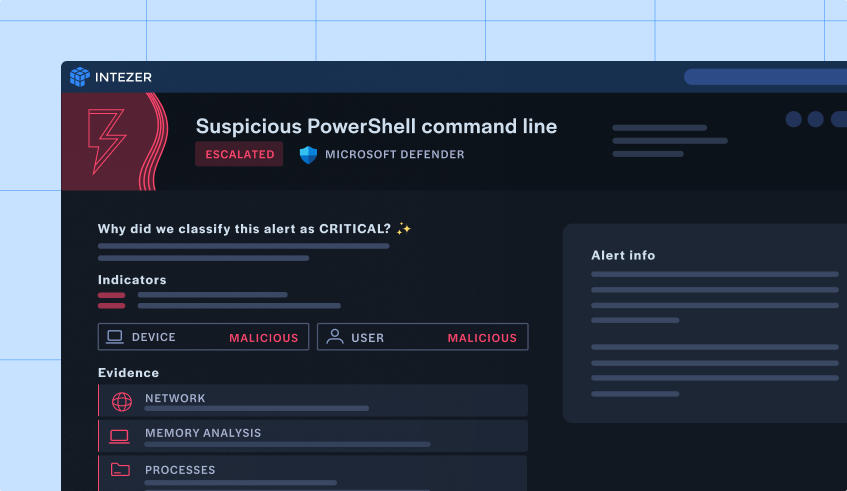
Intezer AI SOC investigates every incoming alert and returns a verdict, combining agentic AI reasoning with deterministic forensic analysis. The platform ingests alerts from endpoint, identity, phishing, network, cloud and SIEM sources, then runs a four-stage process: evidence collection, analysis, grouping and decision.
Evidence collection pulls SIEM and EDR logs, files and processes, memory images, network artifacts and organizational context from sources such as CMDB and calendar systems, and can query the end user directly. Analysis applies correlation, sandboxing, reverse engineering, script and code analysis, live memory forensics and network forensics alongside LLM reasoning.
Key features include:
- Forensic evidence collection and analysis: Automated collection from EDR, SIEM and IDP feeds into memory analysis, reverse engineering, sandboxing and network artifact forensics, so triage covers artifacts rather than reputation lookups alone.
- Alert grouping into attack stories: Related alerts across sources are grouped before a verdict is reached, so a multi-stage attack surfaces as one case rather than a series of separate tickets.
- Continuous AI-based detection engineering: The platform maps SIEM and EDR detection coverage against MITRE ATT&CK, identifies gaps, and builds, tests and deploys behavioral rules, with quarterly executive posture and MITRE reports.
- Policy-based automated response: Response actions run according to defined policy, including escalation and case creation, notifications, user deactivation, IOC blocking, machine isolation, and custom actions through webhooks or workflows.
- Org Brain context layer: The platform learns from past cases and tickets, users and roles, devices and assets, procedures and exceptions, fetches live context mid-investigation, and writes every verdict back into that knowledge base.
- Bidirectional native integrations: Connections to CrowdStrike, SentinelOne, Microsoft Defender, Entra ID, Okta, JumpCloud, Office 365, Proofpoint, Wiz, SIEMs, asset management, ticketing and SOAR tools support both evidence gathering and remediation with explicit human approval.
- Extensibility and analyst workspace: Custom agents, workflows with approvals and webhooks, and custom triage logic per alert type sit alongside built-in case management, with MCP access so analysts can work from tools such as ChatGPT, Cursor or Claude.
| Criterion | Solution Fit | Key Considerations |
|---|---|---|
| Investigation depth and evidence quality | Deterministic forensics including memory analysis, reverse engineering, sandboxing and network forensics, applied to 100% of alerts including low severity. | Deep endpoint analysis on some artifact types takes longer than pure log-based reasoning. |
| Agent autonomy and human control | Response runs according to customer-defined policy, from escalation and notification through to IOC blocking and machine isolation, with remediation gated by explicit approval. | Teams that want fully hands-off containment on day one will need to widen policy scope deliberately. |
| Integration coverage across the security stack | Bidirectional native integrations across EDR, SIEM, IDP, email, cloud, ticketing and SOAR, connected using API keys in minutes. | In-house or niche tools are handled through custom agents and webhooks rather than prebuilt connectors. |
| Transparency, explainability and auditability | Transparent triage logic with clear explanations, analyst review and override on escalated alerts, plus ongoing self-testing and benchmarking. | Reviewers have asked for richer export and reporting options around analysis output. |
| Deployment, scalability and cost predictability | Onboarding connects alert sources by API key and adds users; pricing is tied to organizational size such as endpoint count, so investigating every alert carries no volume penalty. | Endpoint-based pricing fits endpoint-heavy estates best; alert-light, endpoint-heavy environments should model it. |
Source: Intezer
2. UnderDefense MAXI

Best for: Teams wanting agentic triage backed by human-verified response, without replacing their existing SIEM/XDR
Strengths: Vendor-agnostic stack overlay, 2-minute alert-to-triage, concierge-style human verification of ambiguous activity
Things to consider: Newer platform with a thinner independent review base; MDR-style delivery model may not suit teams wanting pure self-service software
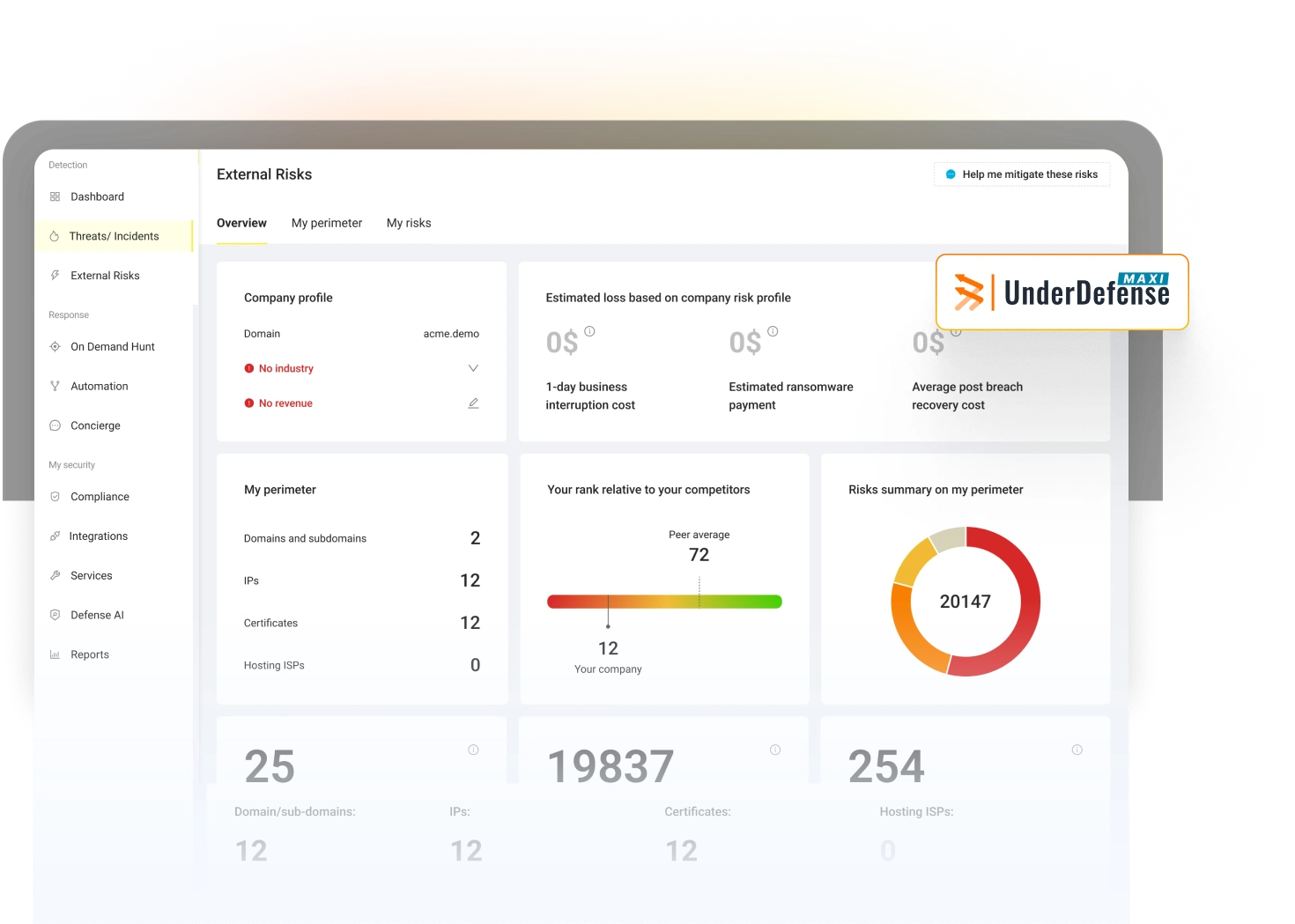
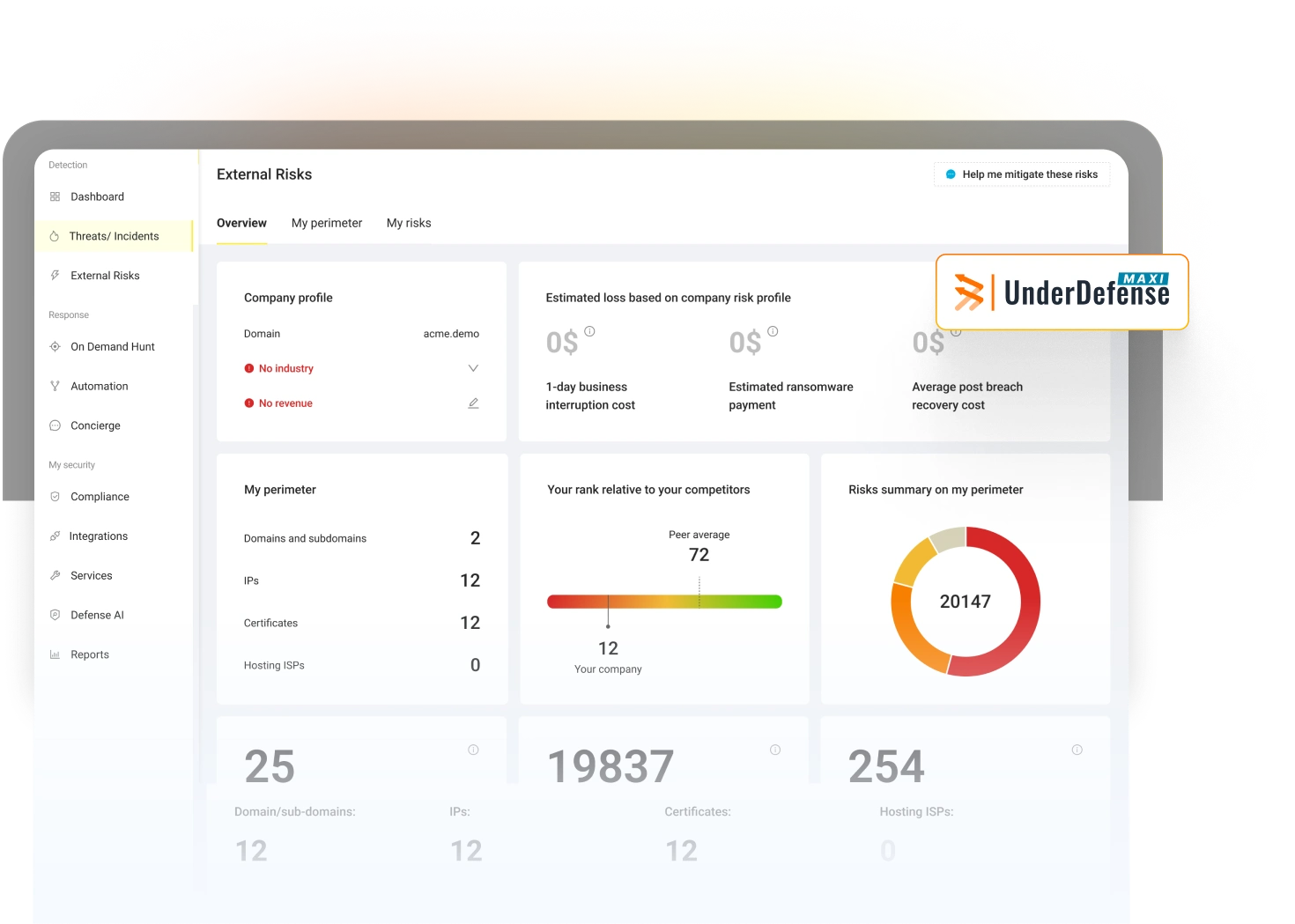
UnderDefense MAXI is an agentic AI security operations and compliance automation platform built to sit on top of whatever SIEM or XDR an organization already runs (Splunk, Microsoft Sentinel, Google Chronicle, Elastic, and others) rather than requiring a rip-and-replace migration. Multiple specialized AI agents handle detection, investigation, response, and threat intelligence roles, ingesting raw alerts, auto-enriching them with threat intelligence and organizational context.
The platform pairs this agentic automation with a "concierge" layer distinct from most agents in this category: for ambiguous cases such as a suspicious login, agents can verify activity directly with the affected user over Slack or Teams before escalating, combining machine-speed triage with human confirmation rather than presenting a raw alert and asking the SOC to investigate from scratch.
Key features include:
- Vendor-agnostic stack integration: Connects to 250+ existing security tools and works on top of a customer's current SIEM/XDR investment rather than forcing migration, preserving existing correlation rules and custom detections.
- Multi-agent architecture: Deploys separate agentic "Teammates" across detection, investigation, response, and threat intelligence, coordinating across the full incident lifecycle rather than a single generalist agent.
- Detection Logic as Code: Writes detection rules in Python, versioned and unit-tested, then deployed through CI/CD, giving security teams a governable, auditable foundation for detection engineering.
- Concierge human verification: Confirms suspicious activity directly with affected users through Slack or Teams before escalation or containment, reducing false-positive response actions.
- SOAR-native response orchestration: Combines autonomous multi-agent investigation with response orchestration and continuous compliance automation (including ISO 27001 and SOC 2 support) in a single platform.
- Flexible deployment model: Available as cloud-delivered SaaS or fully on-premises, including air-gapped deployment with self-hosted AI model inference for financial institutions and other regulated or sovereign environments.
- Full observability and audit trail: Every investigative step is designed to be observable and auditable rather than a black-box verdict, supporting governance and compliance review.
| Criterion | Solution Fit | Key Considerations |
|---|---|---|
| Investigation depth and evidence quality | Auto-enriches raw alerts with threat intelligence and organizational context (user role, asset criticality, historical behavior), correlating across multiple data sources into structured investigation reports within minutes. | Depth relies on the breadth of the customer's existing SIEM/XDR data rather than proprietary forensic artifact analysis (memory imaging, reverse engineering) native to the platform itself. |
| Agent autonomy and human control | Distinctive "concierge" verification step confirms ambiguous activity directly with the affected user over Slack or Teams before escalation, adding a human-context checkpoint most agentic platforms in this category lack. | Full containment automation depends on which of the 250+ connected tools expose bidirectional response actions through their APIs. |
| Integration coverage across the security stack | Vendor-agnostic overlay connecting to 250+ existing tools including Splunk, Microsoft Sentinel, Google Chronicle, and Elastic, explicitly designed to preserve rather than replace existing correlation rules and custom detections. | Public documentation gives limited connector-by-connector depth comparable to named EDR/SIEM integration lists published by longer-established competitors. |
| Transparency, explainability and auditability | Every investigative step is designed to be observable and auditable, with Detection Logic as Code (versioned, unit-tested Python rules deployed via CI/CD) giving a governable foundation for detection engineering. | Independent, published governance certifications comparable to competitors' ISO 42001 AI-governance credentials are not documented on the product page. |
| Deployment, scalability and cost predictability | Reports triage time dropping from 30-45 minutes to under 2 minutes per alert, with critical incidents escalated within 15 minutes; available as SaaS or fully on-premises/air-gapped for regulated environments. | As a platform publicly launched less than two years ago, published peer reviews and long-run scaling evidence are thinner than for more established agentic SOC vendors; MDR-style pricing (cited around $10-30 per asset/month) is less transparent for self-service comparison than usage-unit pricing published by pure-software competitors. |
Source: UnderDefense
3. Prophet AI SOC Analyst
Best for: Parallel investigation of every alert at every severity
Strengths: Remediation is previewed and backtested before it runs
Things to consider: Young vendor with a small verified review base
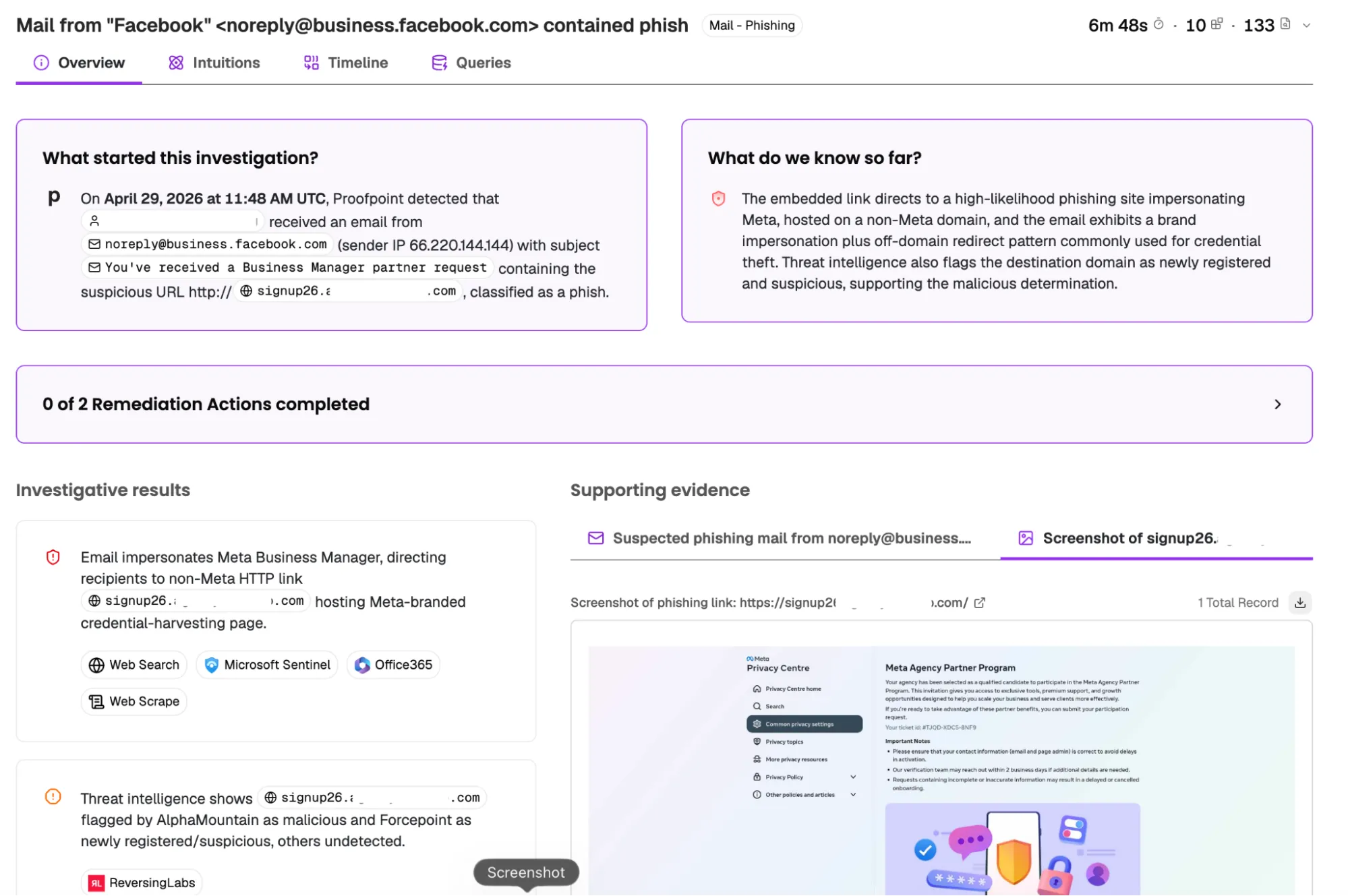
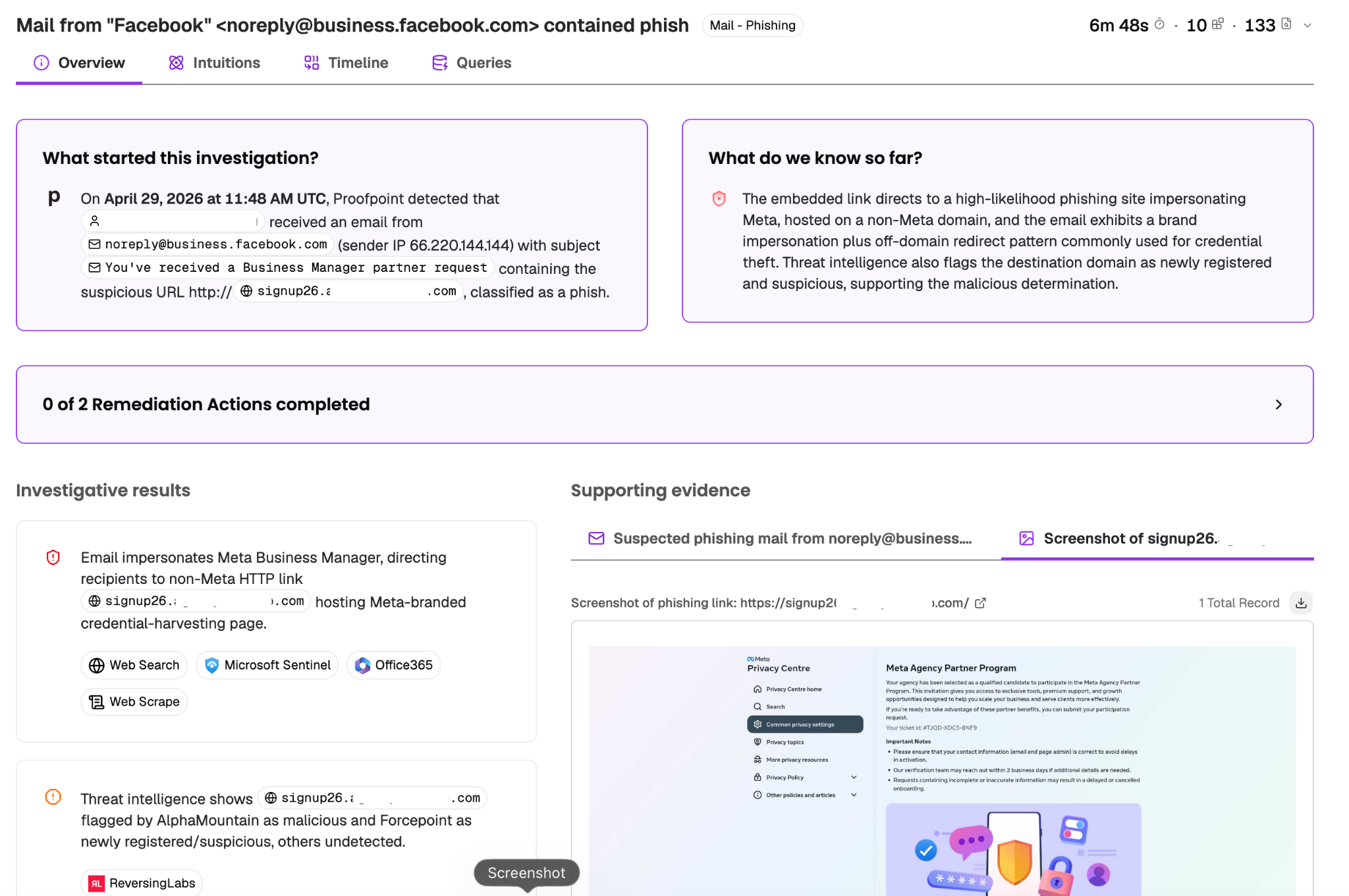
Prophet AI SOC Analyst runs a dynamically planned investigation on every alert at every severity as it arrives. It summarises the alert, extracts the artifacts, plans the questions an experienced analyst would ask, then runs those questions across SIEM, EDR, identity, cloud and email tools.
Investigations run in parallel, so investigation time stays flat whether a day brings 50 alerts or 2,000. Every question asked, query run and reasoning step is documented so a team can verify how a determination was reached. Related investigations are grouped into a single incident, so a campaign reads as one story rather than dozens of tickets.
Key features include:
- Dynamically planned investigations: The agent plans the questions for each alert rather than following a fixed script, then runs them across the connected SIEM, EDR, identity, cloud and email tools.
- Parallel investigation at volume: Alerts are investigated on arrival and in parallel, keeping investigation time constant as daily volume rises.
- Documented evidence trail: Every question, query and reasoning step is recorded so analysts can verify exactly how a determination was reached.
- Incident grouping: Related investigations are grouped into one incident, so a multi-alert campaign is presented as a single narrative.
- Scoped auto remediation: Remediation ranges from notifications to quarantining a machine, is bounded by permissions, and is previewed before it runs and backtested against the organization's history.
- Plain-language guidance and learning: Teams teach playbooks, policies and preferences organization-wide, on a full investigation or on a single step; each learned entry's source is visible and correctable, and changes are previewed and backtested before applying.
- Workflow integrations: 200+ out-of-the-box integrations cover security tools, SIEMs, security data lakes, threat intelligence feeds and case management, with delivery into Slack, Teams or a custom webhook and per-channel control over scope and frequency.
| Criterion | Solution Fit | Key Considerations |
|---|---|---|
| Investigation depth and evidence quality | Full dynamically planned investigation on 100% of alerts at every severity, with artifacts extracted and questions run across the connected stack. | Depth depends on what the connected read-only sources expose; there is no native artifact-level forensic analysis. |
| Agent autonomy and human control | Investigates autonomously from day one but executes only approved actions, with autonomy widened as track record justifies it. | Reaching broad autonomy is a staged process rather than a configuration switch. |
| Integration coverage across the security stack | 200+ out-of-the-box integrations across security tools, SIEMs, data lakes, threat intelligence and case management, plus Slack, Teams and webhooks. | Read-only access to two or three sources starts the trial, but full response coverage requires broader permissions. |
| Transparency, explainability and auditability | Every question, query and reasoning step is documented, and learned context entries show their source and can be corrected. | Formal AI governance certifications are not described on the product page. |
| Deployment, scalability and cost predictability | Setup takes 30 minutes or less using read-only access to two or three data sources, and parallel investigation keeps timing flat under load. | Founded in 2024 with a small verified review base, so long-run scaling evidence from peers is limited. |
Source: Prophet Security
4. Radiant Security

Best for: Triage of unusual alert types plus integrated log management
Strengths: Vendor-agnostic triage with one-click integrated response
Things to consider: Very few published peer reviews to draw on
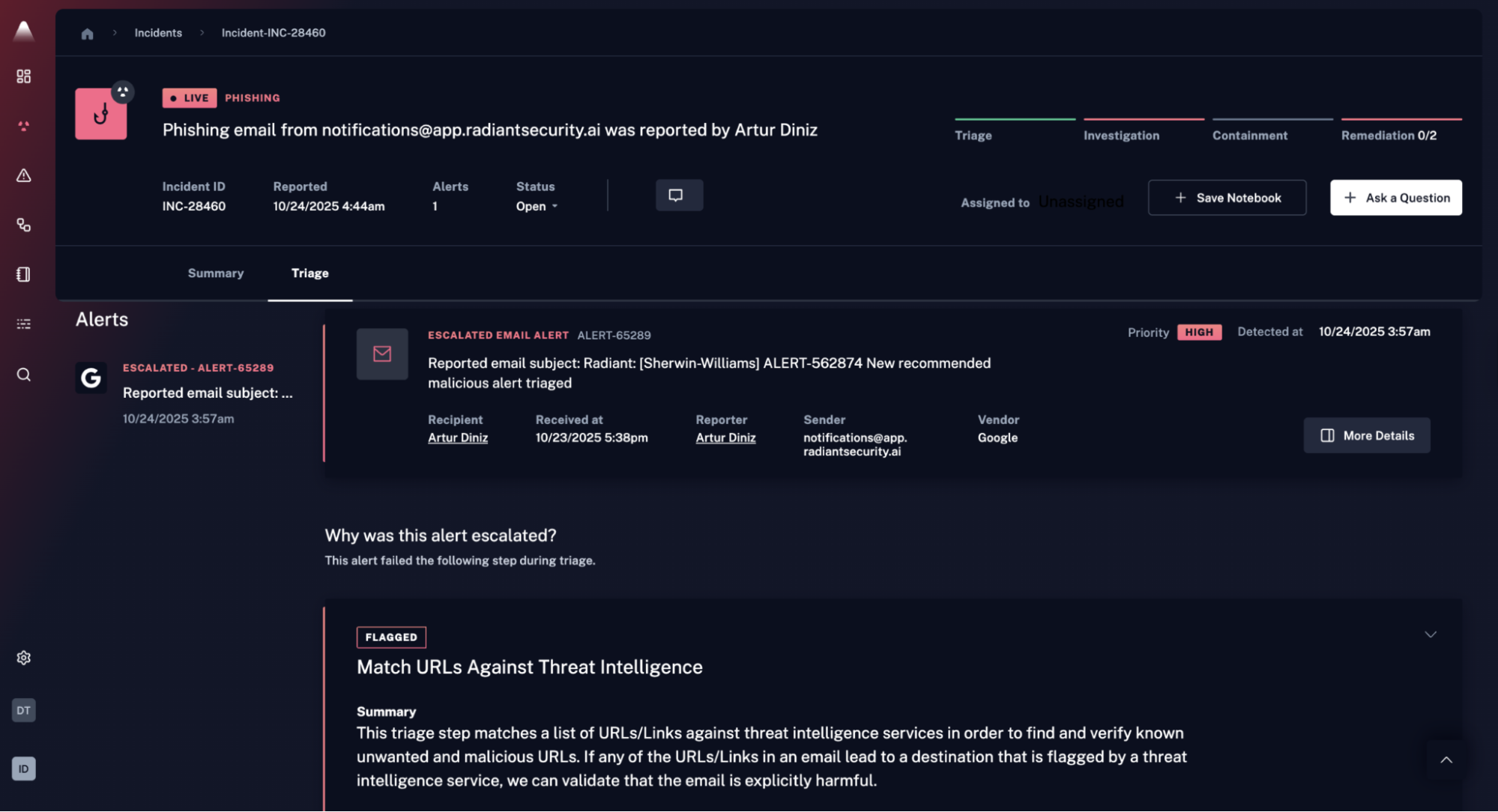
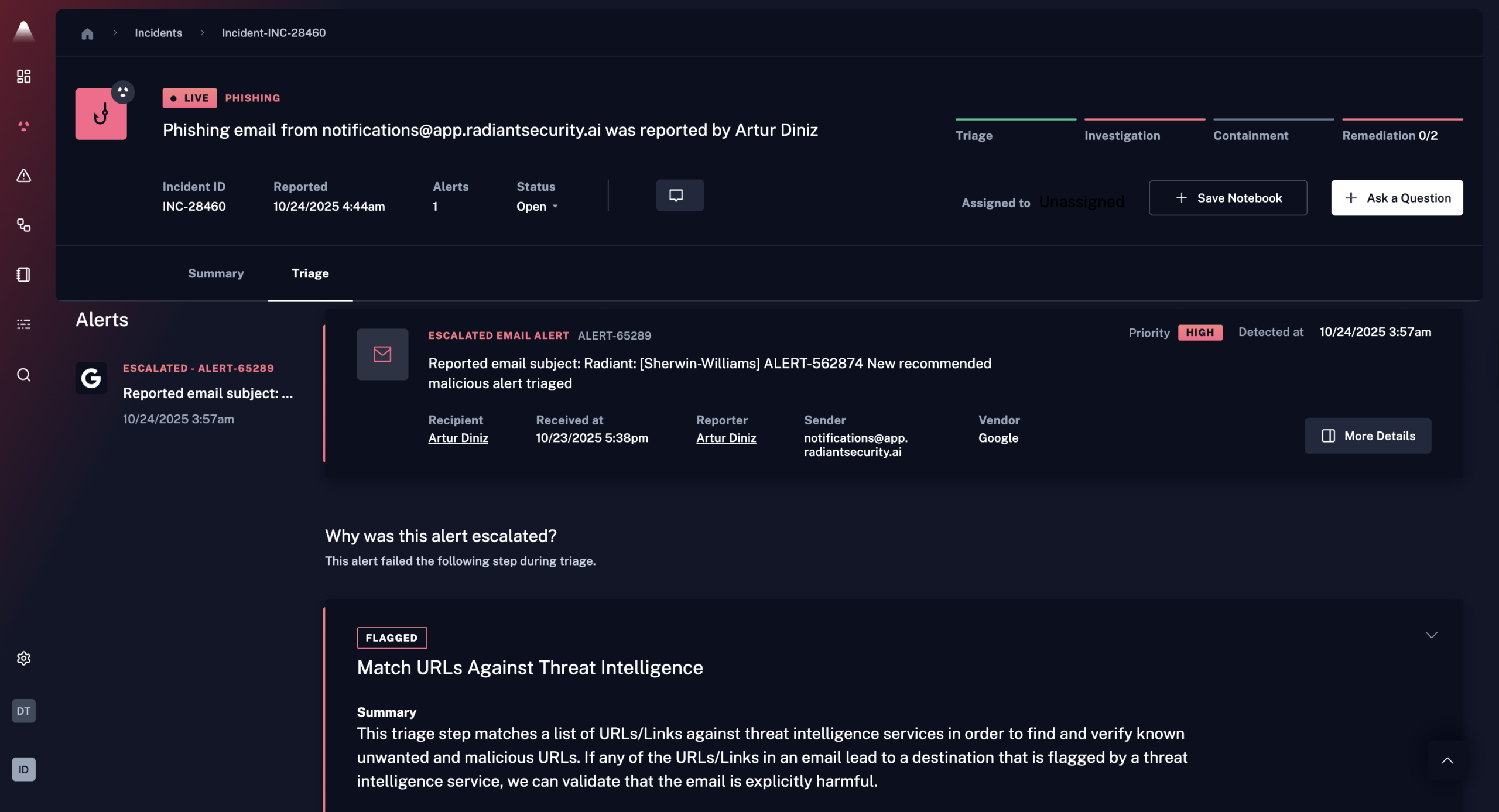
Radiant Security triages and investigates every alert that reaches the SOC, including alert types it has not encountered before, and escalates only what it assesses as a real threat. Alerts arrive from SIEM, EDR, identity, cloud and network sources, and the platform extracts the artifacts inside each one before running a structured triage plan.
Investigations follow the flow a human analyst would use: understand, enrich, plan, execute and conclude. The platform interprets the alert to determine the threat type and whether it has seen something similar, which decides whether an existing plan is reused or a new one is generated. Enrichment pulls threat intelligence, identity data and asset information automatically.
Key features include:
- Structured five-step investigation: Alerts move through Understand, Enrich, Plan, Executeand Conclude, with the plan reused or generated from scratch depending on whether the threat type has been seen before.
- Coverage of known and unknown alert types: Triage is not bound to a fixed set of pre-defined alert categories, so uncommon and emerging alert types are handled alongside the common ones.
- Automatic enrichment: Threat intelligence, identity data and asset information are pulled from across the environment during investigation, so analysts do not stitch data together by hand.
- Integrated response and case management: Analysts review verdicts, group related alerts into cases, and execute response actions on the surfaced artifacts in one click, with available actions determined by the tenant's active connectors.
- Built-in log management: A security data lake stores, indexes and queries security logs in one place with unlimited retention and no vendor lock-in, positioned as an alternative to paying SIEM storage costs.
- Transparent reasoning and governance: The platform explains every step of triage and response with complete reasoning, is SOC 2 compliant, logs every user action, and does not train AI models on customer data.
- API-based connectivity: Plug-and-play API connectors link the platform to existing detection tooling without a data migration project.
| Criterion | Solution Fit | Key Considerations |
|---|---|---|
| Investigation depth and evidence quality | Structured five-step investigation covering both familiar and previously unseen alert types, with automatic enrichment from threat intelligence, identity and asset data. | Investigation works over connected data sources rather than artifact-level forensic analysis. |
| Agent autonomy and human control | Response actions are executed by analysts in one click or automated for future occurrences, with guardrails, policies and exclusions shaping AI behaviour. | Default posture leans toward analyst-triggered response, so hands-off containment requires configuration. |
| Integration coverage across the security stack | API-based connectors across SIEM, EDR, identity, cloud, network and email sources, with available response actions tied to active connectors. | Public product documentation gives limited detail on individual connector depth. |
| Transparency, explainability and auditability | Complete reasoning shown for every triage and response step, SOC 2 compliance, logging of every user action, and no model training on customer data. | Independent verification is limited because very few peer reviews have been published. |
| Deployment, scalability and cost predictability | Predictable pricing by security use case rather than alert volume, with integrated log management offered as a lower-cost alternative to SIEM retention. | Adopting the log management layer expands project scope beyond triage alone. |
Source: Radiant Security
Agentic SOC Capabilities in Enterprise Security Platforms
5. Microsoft Security Copilot

Best for: Microsoft-centric SOCs already running Defender and Sentinel
Strengths: Agents embedded directly in Defender, Entra, Intune, Purview
Things to consider: SCU consumption pricing is hard to forecast
Microsoft Security Copilot places AI agents inside the security products a Microsoft-centric team already uses. Agents run across Microsoft Defender, Entra, Intune and Purview, and the platform is also available as a standalone experience for teams that want a separate workspace.
Ready-to-use embedded agents handle tasks such as phishing triage, vulnerability remediation and alert triage. Beyond those, teams can deploy agents built by Microsoft's partner ecosystem or build their own for tailored workflows without writing code. Copilot summarises signals into incident context, provides step-by-step response guidance, translates natural language into query-language scripts, reverse-engineers malware scripts, and produces stakeholder reports.
Key features include:
- Embedded security agents: Ready-to-use agents sit inside Microsoft Security products and handle tasks including phishing triage, vulnerability remediation and alert triage without separate deployment.
- Partner-built and community-built agents: Agents from Microsoft's partner ecosystem extend agentic use cases, and teams can build their own for tailored workflows in minutes with no coding required.
- Investigation and remediation guidance: Copilot turns complex alerts into actionable summaries and provides step-by-step response guidance for the incident at hand.
- Script analysis and query building: Natural language translation removes the need to hand-write query-language scripts or manually reverse-engineer malware scripts.
- Stakeholder reporting: Generated reports summarise environment context, open issues and protective measures, written in the tone and language suited to the audience.
- Microsoft security stack integration: Copilot is embedded across Sentinel, Defender, Intune, Entra, Purview and Defender for Cloud, drawing on unified security data from those products.
- Multi-agent workflows: Agents work together across security and IT tasks for continuous protection, and can be run from the standalone experience or from inside the individual products.
| Criterion | Solution Fit | Key Considerations |
|---|---|---|
| Investigation depth and evidence quality | Summarises signals across identities, devices, data, clouds and apps into incident context, with dedicated agents for phishing and alert triage. | Depth is greatest inside the Microsoft estate; third-party sources reach Copilot mainly through Sentinel. |
| Agent autonomy and human control | Agents automate defined processes such as closing false positive phishing alerts, operating inside Microsoft's identity and permission model. | Autonomy configuration is distributed across the individual products rather than one central console. |
| Integration coverage across the security stack | Native integration across Sentinel, Defender, Intune, Entra, Purview and Defender for Cloud, extended by partner-built agents. | IoT and OT are not supported, and the service is not available for US government cloud customers. |
| Transparency, explainability and auditability | Agents show the guidance and analysis behind recommendations, and activity is governed by Microsoft's existing security and compliance tooling. | Reviewers raise data privacy questions given the sensitivity of the security data processed. |
| Deployment, scalability and cost predictability | Available standalone via Security Compute Units on Azure and included with an SCU allowance for Microsoft 365 E5 customers. | Consumption pricing at $4 per provisioned SCU per hour and $6 for overage is difficult to forecast, and long sessions can hit token limits. |
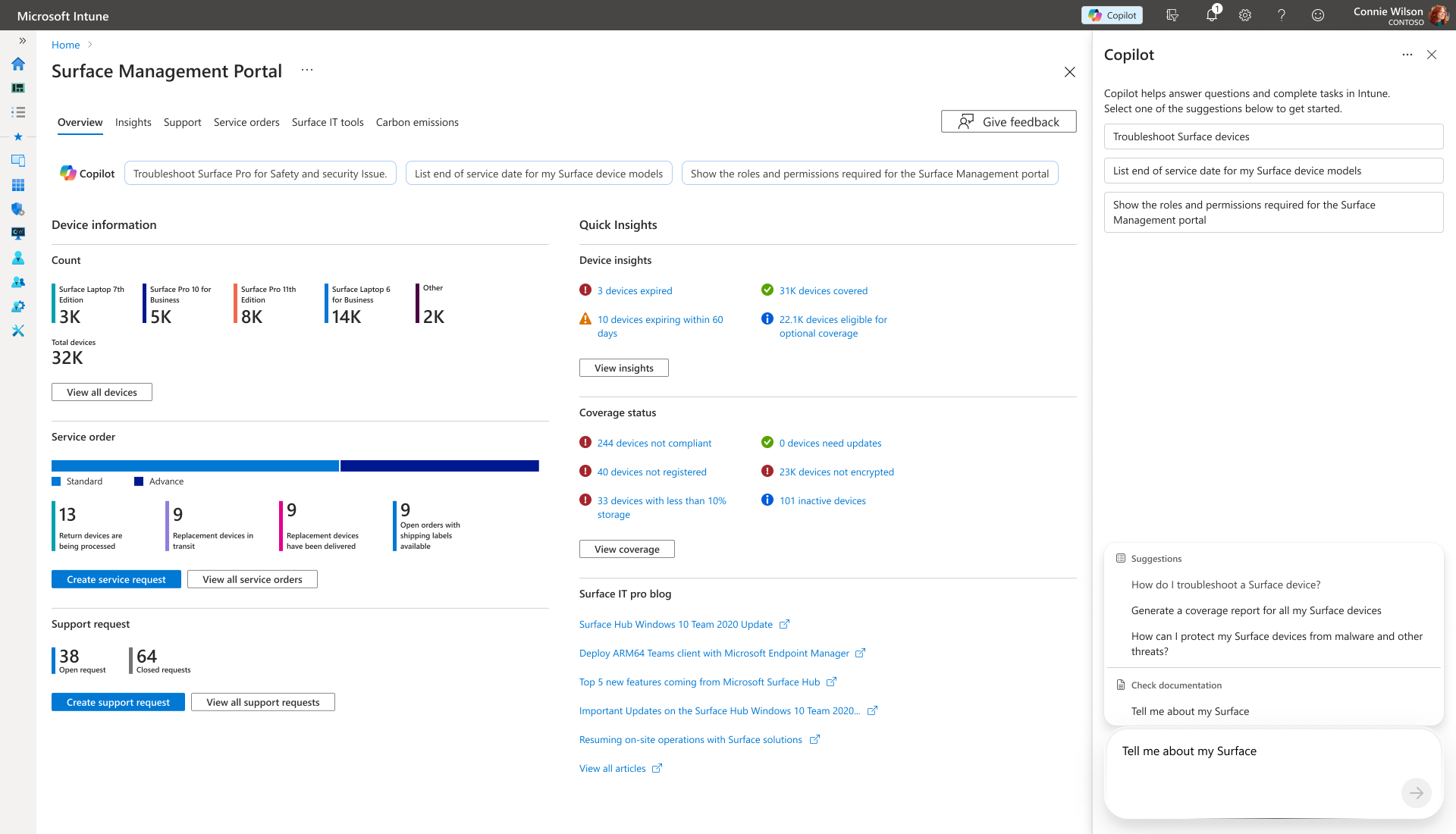
Source: Microsoft

6. CrowdStrike Charlotte AI
Best for: SOCs standardised on the CrowdStrike Falcon platform
Strengths: No-code agent building with ISO 42001 AI governance
Things to consider: Value depends on Falcon telemetry and module licensing
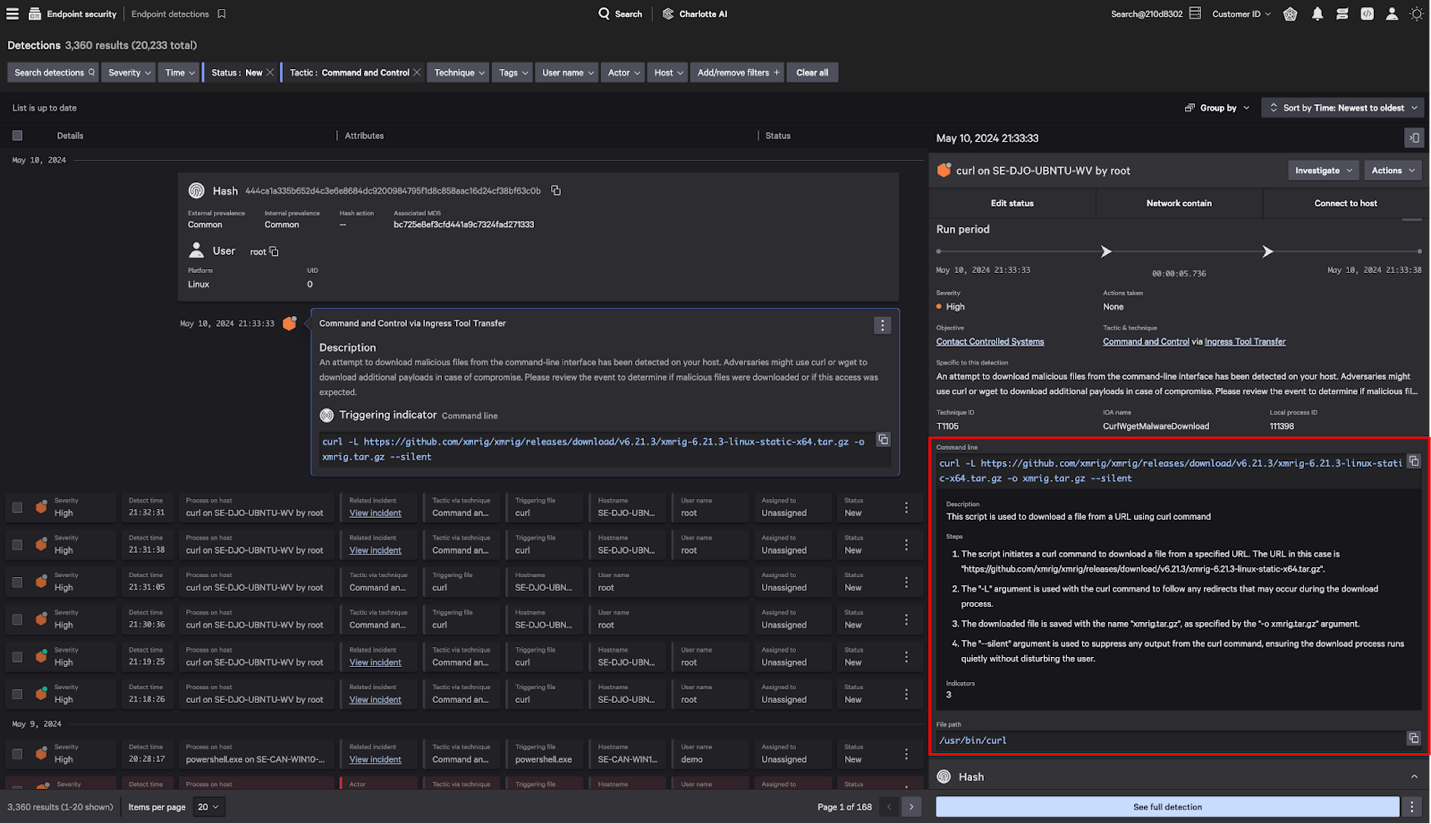
CrowdStrike positions Charlotte AI as the reasoning layer of the agentic SOC, unifying AI reasoning with analyst judgment across the security ecosystem. It triages detections, filters false positives and surfaces what needs attention, drawing on decisions made by CrowdStrike analysts and on the Falcon platform's data layer.
Investigations run in a canvas where analysts collaborate with the agent in real time, injecting context and setting priorities as the investigation develops rather than waiting for a finished report. Charlotte AI AgentWorks lets teams build, test, deploy and manage custom security agents using natural language, and Charlotte Agentic SOAR coordinates agent-to-agent and human-agent workflows.
Key features include:
- Automated detection triage: Charlotte AI triages detections, filters false positives and surfaces the items that require analyst attention, trained on decisions made by experienced analysts.
- Charlotte AI AgentWorks: A no-code workspace inside the Falcon platform where teams set goals, define data and control agent behaviour using natural language to build, test, deploy and manage custom security agents.
- Charlotte Agentic SOAR: Structured automation logic is combined with agentic reasoning so agents coordinate with each other and with analysts across security workflows.
- Collaborative investigation canvas: Analysts guide investigations in real time, injecting context and setting priorities while the agent reasons through the evidence.
- Falcon data foundation: Agents operate on unified cross-domain security events, threat intelligence covering more than 265 tracked adversaries, and insights from CrowdStrike incident responders and threat hunters.
- Built-in governance controls: Guardrails, role-based access and audit trails keep analysts in control, with ISO 42001 certification for AI governance, traceable answers and user-authorized actions.
- Frontier model optionality: The AgentWorks ecosystem integrates models including Anthropic Claude, NVIDIA Nemotron and OpenAI GPT, alongside AI infrastructure services such as Amazon Bedrock and SageMaker.
| Criterion | Solution Fit | Key Considerations |
|---|---|---|
| Investigation depth and evidence quality | Triage and investigation built on the Falcon unified data foundation, with agent reasoning grounded in cross-domain events and adversary intelligence. | Investigation depth is strongest where Falcon telemetry exists; other sources depend on ingestion into the platform. |
| Agent autonomy and human control | Actions are user-authorized and role-scoped, with guardrails and human-agent collaboration built into the investigation canvas and Agentic SOAR. | Orchestrating agents across the wider stack generally means adopting Charlotte Agentic SOAR as well. |
| Integration coverage across the security stack | Agents act across the security ecosystem through the Falcon platform and Agentic SOAR, with partner and third-party agents supported under bounded autonomy. | Reviewers report integrations with non-CrowdStrike products are more complex to configure. |
| Transparency, explainability and auditability | ISO 42001 certification for AI governance, with traceable answers, audit trails, role-based access and decisions grounded in validated data. | Charlotte AI is a module of the Falcon platform, so published peer reviews cover the parent platform rather than the agent layer. |
| Deployment, scalability and cost predictability | Deployed within the existing Falcon console, with agents built and managed without code in AgentWorks. | Reviewers frequently cite cost and module-based licensing, along with a learning curve on the console. |

Source: CrowdStrike
7. Palo Alto Networks Cortex AgentiX

Best for: Cortex customers extending SOAR workflows into agentic AI
Strengths: 1,100+ integrations with native MCP support
Things to consider: Benefits are tied to the Cortex platform footprint
Cortex AgentiX is the next generation of Cortex XSOAR, built to create, deploy and govern AI agents across security operations. Agents plan, reason and execute workflows to resolve incidents, and can be prompted in real time by an analyst or triggered to run autonomously.
Teams choose from a library of specialized agents, including threat intel, email investigation, endpoint investigation, cloud security, network security and IT agents, or build their own with a no-code GenAI builder. Agents are grounded in the organization's own context and policies. Teams define when agents act independently and when high-impact actions require approval, agents operate within the same roles and permissions as analysts.
Key features include:
- Prebuilt and custom agents: A library of specialized agents covers threat intelligence, email, endpoint, cloud, network and IT workflows, and custom agents are built with a no-code GenAI builder.
- Real-time or autonomous triggering: Agents can be prompted directly by an analyst during an investigation or triggered to run on their own as part of a workflow.
- Configurable autonomy with role binding: Teams define when agents act independently and when approval is required for high-impact actions, and agents operate inside existing roles and permissions.
- AI reasoning inside playbooks: Prebuilt AI prompts drop into existing playbooks or are written in natural language, automating tasks such as summarising raw logs, normalizing data and analyzing threats at scale.
- Broad integration surface: Over 1,100 prebuilt integrations are supported, alongside native Model Context Protocol support for assigning external MCP server tools to agents and a Cortex MCP Server for querying Cortex data from another model.
- Agent tagging across the workflow: Specialized agents can be tagged in at any stage of detection and response rather than only at triage.
- Delivery across Cortex products: AgentiX supports the Cortex Agentic Assistant inside Cortex XSIAM, Cortex XDR and Cortex Cloud, and is also available as a standalone platform.
| Criterion | Solution Fit | Key Considerations |
|---|---|---|
| Investigation depth and evidence quality | Specialized agents plan, reason and execute across email, endpoint, cloud and network investigations, informed by a large body of prior playbook executions. | Depth is shaped by the workflows and playbooks a team configures rather than delivered as fixed triage coverage. |
| Agent autonomy and human control | Autonomy is configurable per action, agents inherit analyst roles and permissions, and human-in-the-loop approval can be enforced for impactful actions. | Getting the autonomy model right requires deliberate design work up front. |
| Integration coverage across the security stack | Over 1,100 prebuilt integrations, native MCP support and a Cortex MCP Server for external model access. | Reviewers of the predecessor SOAR product report connector fragility when third-party APIs change. |
| Transparency, explainability and auditability | Complete transparency into each step of an agent's reasoning, with plans reviewable in plain language before execution. | Audit review depends on teams building the review step into their workflows. |
| Deployment, scalability and cost predictability | Delivered inside Cortex XSIAM, Cortex XDR and Cortex Cloud, or as a standalone platform, with no-code agent building. | Reviewers of Cortex products cite platform complexity and ongoing engineering effort; benefits are strongest for existing Cortex customers. |
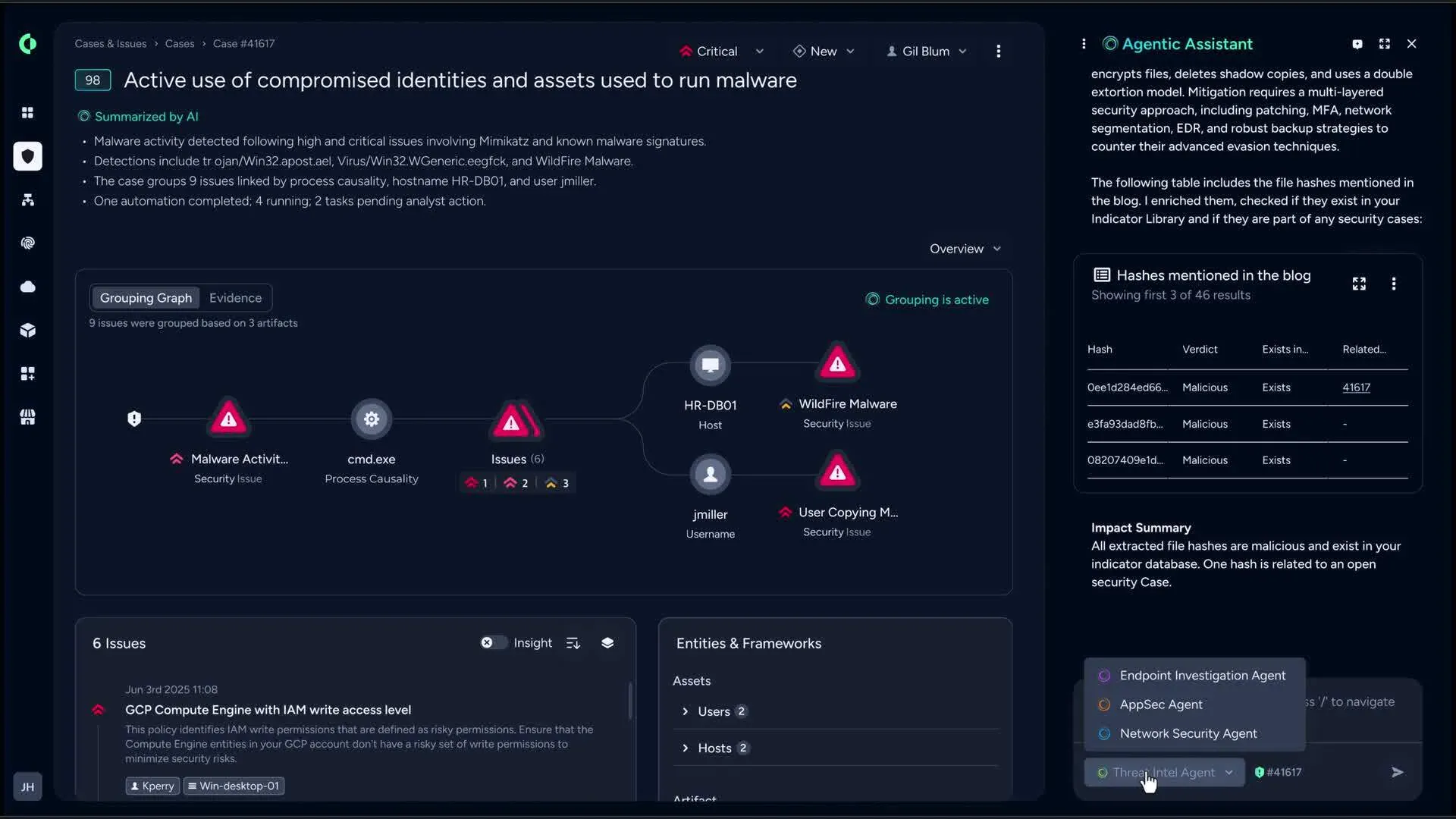
Source: Palo Alto Networks
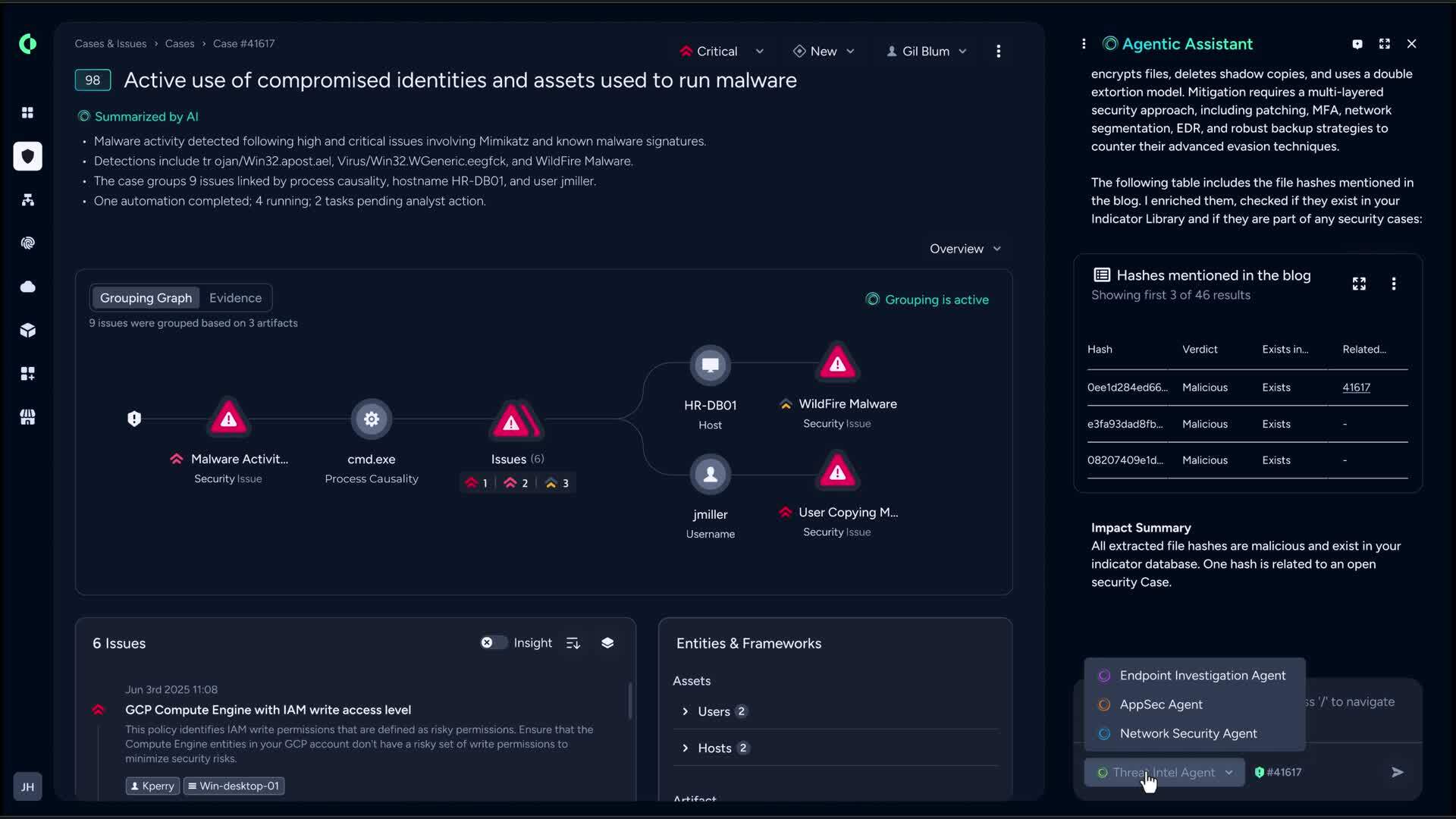
8. Google Security Operations

Best for: Google SecOps users wanting agents inside their existing SIEM
Strengths: Separate triage, detection and hunting agents with Mandiant intel
Things to consider: Onboarding and query language carry a learning curve
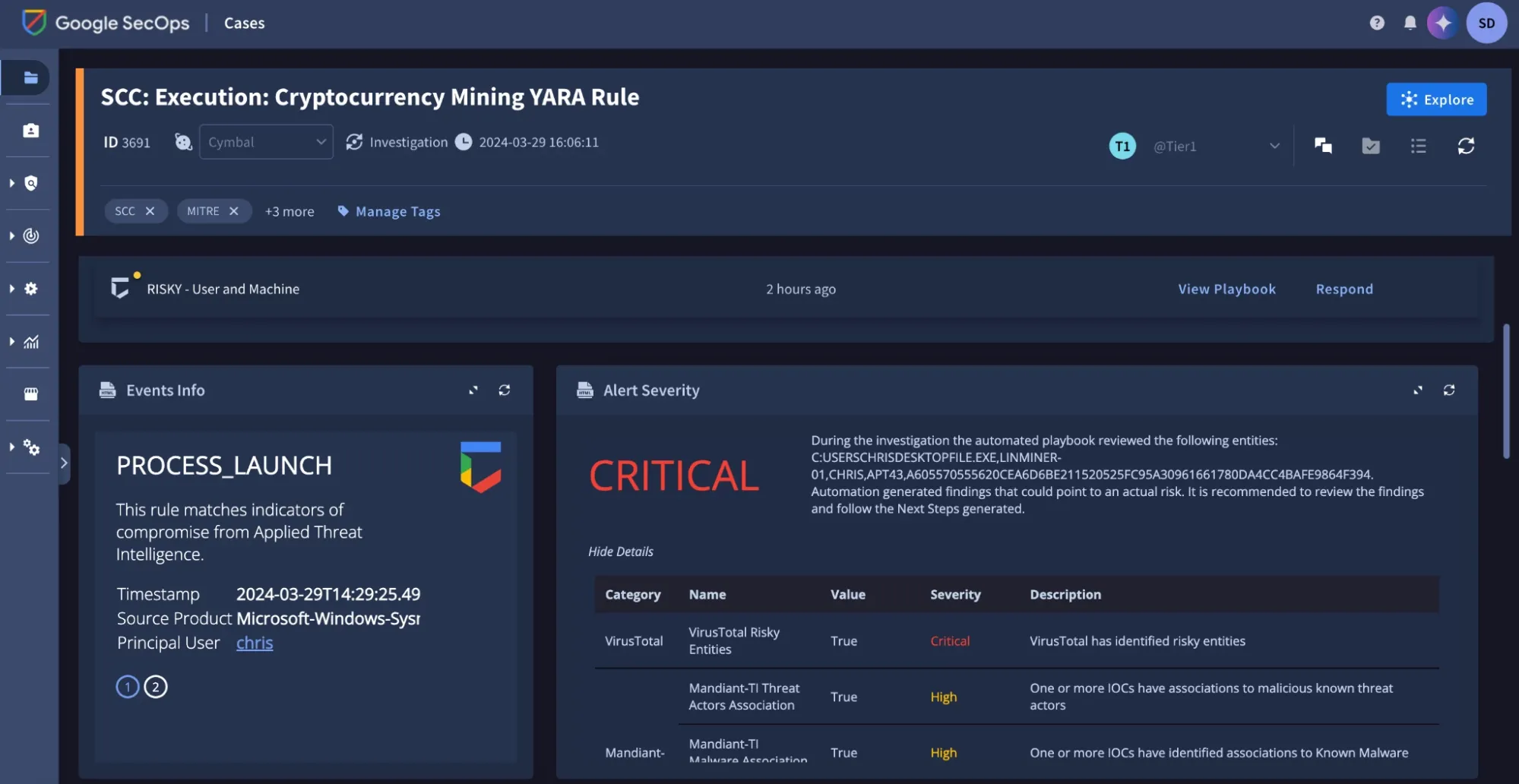
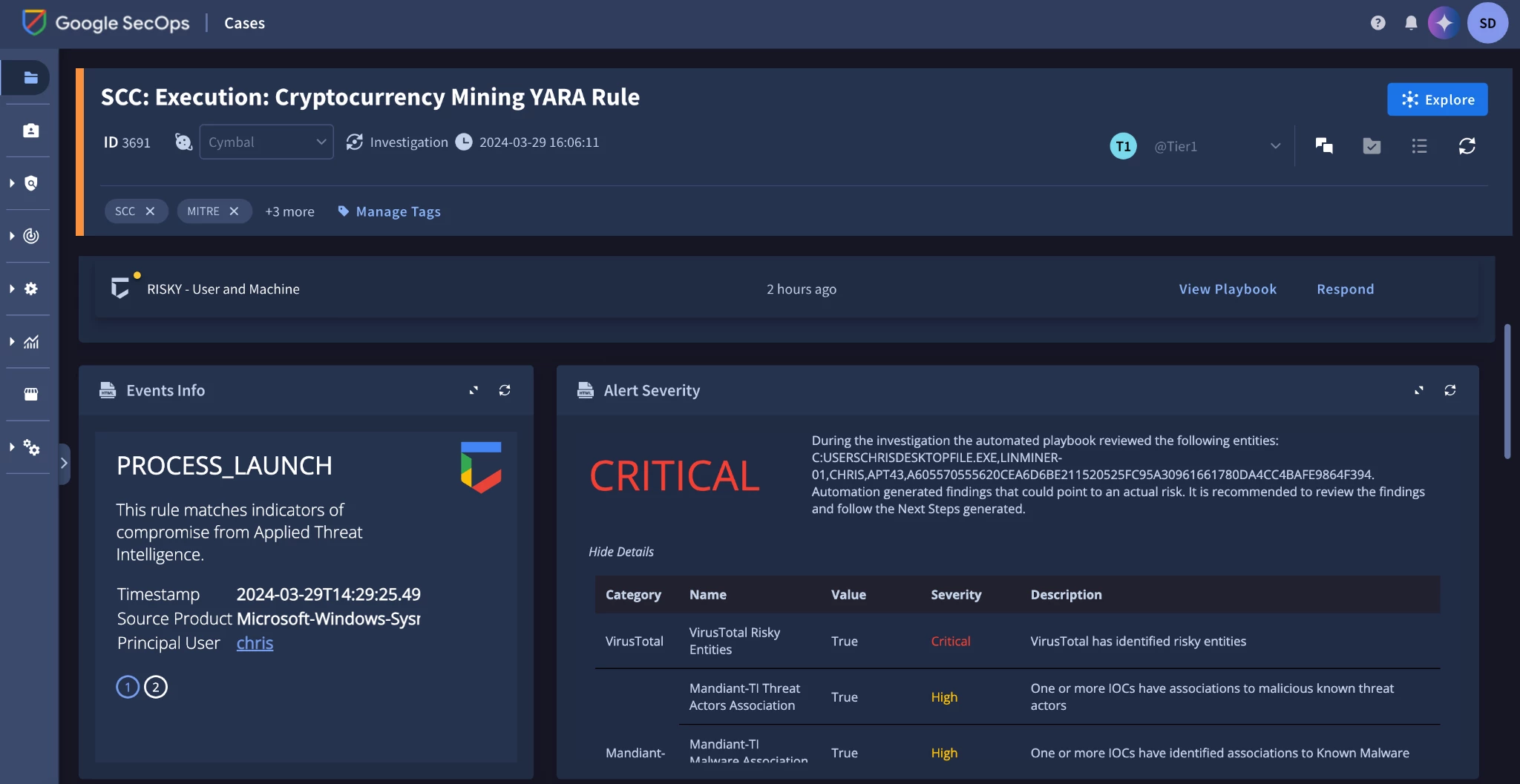
Google Security Operations provides Gemini-native agentic capability for workflows including alert triage, threat hunting and detection engineering, delivered as a set of connected agents inside the SecOps platform rather than as a single assistant.
The Triage and Investigation agent autonomously investigates alerts, enriches them with threat intelligence and issues a verdict with an explanation, and supports alert closure and remediation flows. Agents are trained on real-world intelligence and insights from Mandiant. Agentic automation pairs dynamic AI agents that gather evidence and reason through complex alerts with deterministic enterprise playbooks.
Key features include:
- Triage and Investigation agent: Alerts are investigated autonomously, enriched with threat intelligence, and returned with a verdict and a comprehensive explanation, feeding into alert closure and remediation flows.
- Detection Engineering agent: The agent continuously analyzes the organization's threat profile to create, test and generate detection rules, proactively building new rules and validating them with synthetic events to close coverage gaps.
- Threat Hunting agent: Hunts search the environment for novel attack patterns and stealthy behaviours that bypass traditional defences, drawing on intelligence from Mandiant, VirusTotal and Google.
- Hybrid agentic automation: Dynamic AI agents are combined with deterministic enterprise playbooks so evidence gathering and reasoning are automated while high-impact actions stay under analyst control.
- Mandiant-grounded intelligence: Agents are trained on frontline intelligence and insights from Mandiant experts, which informs both investigation and hunting.
- AI Threat Defense: The platform supports monitoring, detection and response for threats originating in code the organization does not own or cannot patch.
- Configurable investigation triggers: Automatic investigations can be enabled across supported log types, with control over investigation timing and filter criteria for which alerts get investigated.
| Criterion | Solution Fit | Key Considerations |
|---|---|---|
| Investigation depth and evidence quality | Autonomous investigation with threat intelligence enrichment and an explained verdict, backed by Mandiant intelligence and separate detection engineering and hunting agents. | Investigation operates over data ingested into Google SecOps, so coverage depends on parser and onboarding work. |
| Agent autonomy and human control | Dynamic agents handle evidence gathering and reasoning while deterministic playbooks keep critical, high-impact actions under analyst control. | Agentic containment and response capabilities have been introduced progressively, so feature availability should be confirmed. |
| Integration coverage across the security stack | Agents work across endpoint, on-premises firewall, identity, network, cloud telemetry and custom application logs ingested into the platform. | Reviewers report broader third-party integration beyond the Google ecosystem is an area they would like improved. |
| Transparency, explainability and auditability | Investigations open into a detailed view showing the analysis, reasoning and supporting data, with disposition, confidence level and a timeline of analysis steps. | Reviewers describe SIEM and SOAR components as feeling stitched together, with occasional interface inconsistencies. |
| Deployment, scalability and cost predictability | Runs inside an existing Google SecOps deployment, with agent usage metered through security tokens and included entitlements on higher tiers. | Reviewers consistently cite a steep learning curve, custom parser complexity and pricing that grows with log volume. |
Source: Google
Conclusion
Comparing agentic SOC platforms requires looking beyond whether they can automate alert triage. Teams should assess how deeply agents investigate evidence, how precisely autonomous actions can be controlled, whether integrations support both investigation and response, and whether reasoning remains visible for analyst review. Deployment effort, scalability, and pricing also matter because an agentic platform delivers the most operational value when it can investigate large alert volumes consistently without creating unpredictable costs or additional engineering overhead.