What are AI-Driven MDR Solutions?
Managed Detection and Response (MDR) solutions are outsourced cybersecurity services that provide organizations with advanced threat detection, incident response, and continuous monitoring. MDR providers typically use a combination of security operations center (SOC) analysts, threat intelligence, and specialized tools to monitor customer environments 24/7.
Modern MDR solutions integrate machine learning (ML) and artificial intelligence (AI) to provide proactive threat detection, investigation, and automated response capabilities. These services identify anomalies and behavioral deviations from established baselines rather than relying only on known signatures, significantly enhancing detection of zero-day exploits and sophisticated attacks.
Key capabilities of AI-driven MDR solutions:
- Proactive threat hunting: AI algorithms continuously scan for anomalies and patterns indicative of malicious activity.
- Reduced alert fatigue: ML models filter out noise and correlate signals across endpoints, networks, and cloud environments, allowing human analysts to focus on high-fidelity alerts.
- Automated response & remediation: Automated systems can instantly isolate compromised systems, block malicious IP addresses, or stop malicious processes, decreasing the “mean time to contain” threats.
- Continuous learning: Models refine themselves by learning from historical incidents and new threat intelligence feeds, adapting to evolving attack techniques.
How machine learning improves MDR functionality:
Machine learning in MDR addresses the limitations of manual threat analysis by:
- Contextualizing threats: Correlating data points to provide a full picture of an incident.
- Identifying anomalies: Recognizing unusual behavior, such as unexpected data transfers or unusual login times, that deviate from normal user behavior.
- Accelerating analysis: Assisting human security experts in investigating incidents faster, improving analyst efficiency and output.
This is part of a series of articles about MDR security
How ML Improves MDR Functionality
Contextualizing Threats
Machine learning (ML) enhances MDR solutions by providing deeper context to detected threats. Traditional security tools often generate alerts based on static rules or known signatures, which can result in a high volume of generic alerts. ML algorithms analyze large volumes of network, endpoint, and user data to identify patterns and relationships that indicate potential threats. By correlating disparate events and providing context, ML helps security analysts prioritize alerts based on severity and relevance.
ML-driven contextualization supports faster incident triage and more accurate threat assessments. These algorithms factor in the history of affected assets, user behavior, and threat intelligence to distinguish between benign anomalies and genuine attacks. This reduces false positives and ensures that security teams focus on incidents with the highest potential impact.
Identifying Anomalies
ML models identify anomalies within network traffic, user behavior, and system activity. Instead of relying only on predefined signatures or static rules, ML algorithms learn normal patterns over time and flag deviations that could indicate malicious activity. This approach is useful for detecting zero-day threats, insider attacks, and tactics that evade traditional defenses. By continuously analyzing new data, ML helps MDR solutions uncover indicators of compromise that might otherwise go unnoticed.
The ability to identify anomalies in real time allows MDR teams to act quickly when suspicious activity arises. Automated anomaly detection speeds up detection and reduces manual workload on analysts. With ML-driven insights, MDR providers can assess the significance of anomalies, filter out noise, and initiate investigations or responses.
Accelerating Analysis
ML improves the analysis phase of incident response by automating the correlation and prioritization of security events. Large environments generate significant amounts of data, making manual analysis time-consuming and error-prone. ML algorithms process and correlate this data at scale, identifying relationships and patterns that analysts might overlook. This leads to faster root cause analysis and more efficient threat hunting.
ML-driven automation also helps MDR solutions provide recommendations based on historical and real-time data. By learning from past incidents and refining detection models, ML can surface relevant indicators and suggest remediation steps tailored to the threat context. This accelerates response and improves mitigation efforts, reducing dwell time.
Key Capabilities of AI-Driven MDR Solutions
Proactive Threat Hunting
AI-driven MDR solutions use machine learning and automation to search for threats that evade standard detection methods. Threat hunting teams use ML models to analyze network traffic, endpoint activity, and user behavior, identifying indicators of compromise and advanced persistent threats. This approach helps organizations uncover risks before they escalate into major incidents.
Proactive threat hunting also involves continuous updates to detection strategies. As new attack techniques emerge, AI models adapt by learning from new data and analyst feedback. By automating routine tasks and surfacing high-priority alerts, AI-driven threat hunting allows analysts to focus on complex investigations.
Reduced Alert Fatigue
AI-driven MDR solutions reduce alert fatigue. Traditional security systems often overwhelm analysts with large volumes of low-priority or false-positive alerts. Machine learning algorithms filter and prioritize alerts by analyzing historical data, threat intelligence, and contextual information. This ensures that the most relevant and high-risk incidents reach analysts.
Reducing alert fatigue lowers the risk of missed threats. When analysts are not inundated with irrelevant notifications, they can focus on investigating and responding to real incidents. AI-driven MDR platforms continuously refine alerting mechanisms to adapt to changing environments and threats.
Automated Response and Remediation
AI-driven MDR solutions automate many aspects of incident response and remediation, enabling rapid containment of threats. When malicious activity is detected, the system can isolate affected devices, block malicious traffic, or apply security patches without manual intervention. These automated actions are based on predefined playbooks and real-time analysis.
Automated remediation reduces response time and limits the impact of security incidents. By removing delays caused by manual processes, organizations can prevent lateral movement and data exfiltration. AI-driven MDR platforms update response strategies based on new intelligence and past incidents.
Continuous Learning
Continuous learning is a core capability of AI-driven MDR solutions. Machine learning models evolve over time, adapting to new threats and changing network environments. By ingesting data from diverse sources, such as network logs, endpoint telemetry, and external threat feeds, these models refine detection algorithms and improve accuracy.
Continuous learning also supports threat intelligence integration and incident response. As ML models learn from real-world incidents and analyst feedback, they improve at distinguishing between benign activity and true threats. This reduces false positives and accelerates detection.
Key Features to Look for in ML-Driven MDR Solutions
24/7 Monitoring and Response
Around-the-clock monitoring is a core feature of ML-driven MDR solutions. Cyber threats can occur at any time, making continuous vigilance necessary. MDR providers use ML-powered monitoring tools to detect and respond to threats in real time.
In addition to real-time detection, 24/7 response capabilities mean that incidents are addressed immediately, even outside standard business hours. Automated workflows and on-call analysts work together to contain and remediate threats. This reduces dwell time and the risk of business disruption.
Integration with SIEM/XDR
Integration with security information and event management (SIEM) and extended detection and response (XDR) platforms is a key feature of modern MDR solutions. ML-driven MDR tools ingest and analyze data from SIEM and XDR systems, providing a unified view of security events. This integration improves threat detection by correlating data from multiple sources.
SIEM/XDR integration also simplifies incident response by consolidating alerts, automating workflows, and providing centralized visibility. MDR providers can use existing SIEM/XDR infrastructure while adding analytics and response capabilities.
Automated Incident Response
Automated incident response enables organizations to respond to threats quickly. When suspicious activity is detected, automated playbooks execute predefined actions such as isolating endpoints, blocking malicious IP addresses, or resetting compromised credentials. These actions are triggered by ML-driven analysis.
Automated response accelerates containment and ensures consistent handling of incidents. By codifying best practices into workflows, organizations can reduce human error and maintain compliance with internal policies and regulatory requirements.
Threat Intelligence Integration
ML-driven MDR solutions use integrated threat intelligence to improve detection accuracy and response speed. These platforms ingest data from external feeds, such as known malicious IPs, domains, file hashes, and emerging attack techniques. Machine learning models correlate this intelligence with internal telemetry to identify threats that match known indicators and uncover new patterns.
Integration with threat intelligence supports faster decision-making during incident response. When an alert is triggered, enriched context, such as attacker tactics, techniques, and procedures (TTPs), helps analysts understand the scope and intent of the threat.
Custom Reporting and Dashboards
Custom reporting and dashboards provide visibility into security operations for different stakeholders. ML-driven MDR platforms generate reports that highlight metrics such as incident volume, response times, and threat types. These reports can be customized for technical teams, executives, or compliance needs.
Dashboards provide real-time insights into the security environment, using visualizations to track trends and monitor incidents. Machine learning enhances these dashboards by identifying patterns and shifts in threat activity over time.
Notable AI-Driven MDR Solutions
AI SOC Solutions
1. Intezer

Intezer is an AI SOC platform that replaces the human-constrained operating model of traditional managed detection and response with machine-scale forensic investigation across every alert. Where other solutions sample alerts or deprioritize low-severity signals due to human capacity or per-alert cost constraints, Intezer investigates 100% of alerts, including low and medium severity, through a continuous loop of automated triage, forensic analysis, and closed-loop detection improvement. Founded by researchers from hands-on reverse engineering and CERT-level incident response, Intezer is built on the conviction that AI can only be trusted to operate autonomously when investigation depth is forensic rather than merely probabilistic. The platform escalates fewer than 2% of alerts to human analysts, with every verdict backed by a complete, auditable evidence trail. Customers including Equifax, NVIDIA, Salesforce, and MGM Resorts trust Intezer to run their security operations at machine scale.
General features include:
- Full alert coverage across all severities: Investigates 100% of alerts from endpoint, identity, cloud, network, phishing, and SIEM sources, including low and medium severity signals where early-stage threats most often hide
- Per-endpoint pricing model: Charges based on monitored endpoints rather than alert volume, removing the economic penalty that forces other solutions to cherry-pick which alerts to analyze and leaving low-severity signals uninvestigated
- Closed-loop detection engineering: Investigation outcomes feed directly back into detection logic, continuously identifying noisy rules, broken telemetry, missing detections, and MITRE ATT&CK coverage gaps rather than treating detection improvement as a periodic exercise
- Full transparency on every verdict: Each investigation produces a complete forensic record of what was analyzed, what indicators were found, and what techniques were applied, rather than opaque escalations or black-box summaries
- Direct expert access during escalation: When Intezer escalates, customers reach a security expert with full investigation context already in hand, rather than a ticketing queue or automated response
- Customer-owned detection assets: All detection rules and investigation learnings live in the customer’s own SIEM, so accumulated institutional memory is never tied to the provider relationship
AI and ML features include:
- Genetic Analysis for code-level threat identification: Intezer’s proprietary binary analysis references every piece of code executing in memory against a database of trusted and malicious code, identifying threats through code reuse patterns rather than known signatures alone and catching novel malware variants that evade signature-based tools
- Automated memory forensics and endpoint scanning: The platform deploys a lightweight scanner to analyze process memory, detect fileless attacks and code injections, and collect execution logs across Windows, Linux, and Mac endpoints without requiring persistent installation
- Forensic-depth automated investigation: Applies network forensics, behavioral analysis, threat intelligence correlation, reverse engineering, and sandboxing to each alert, producing evidence-based verdicts rather than confidence scores that still require human validation to close the loop
- AI triage across the full alert stream: Correlates and triages 100% of incoming alerts at machine scale, with approximately 98% resolved autonomously and fewer than 2% escalated to human analysts as high-confidence incidents
- Continuous detection posture improvement: AI-driven detection engineering maps coverage continuously against MITRE ATT&CK, deploys new behavioral detection rules tuned to the customer environment, and reduces false positives over time, replacing periodic tuning cycles with a self-improving detection layer.
ReliaQuest GreyMatter

ReliaQuest GreyMatter is an AI-driven security operations platform that centralizes and automates core SecOps functions across prevention, detection, investigation, and response. It aggregates telemetry from multiple tools into a unified layer, allowing security teams to detect threats earlier and act faster without switching between systems.
General features include:
- Unified telemetry aggregation: Collects and correlates data from endpoints, cloud platforms, networks, and third-party security tools
- At-source detection: Identifies threats directly within integrated tools, avoiding delays caused by routing data through centralized systems such as traditional SIEMs
- Digital risk protection: Monitors open, deep, and dark web sources to detect data leaks, brand impersonation, and external threat activity
- Automated asset discovery: Scans environments to identify assets, uncover visibility gaps, and maintain an up-to-date inventory for risk assessment
- Risk prioritization: Evaluates internal and external risks and highlights critical exposures based on context and impact
AI/ML features include:
- Agentic AI for SecOps automation: Uses autonomous AI agents to perform Tier 1 and Tier 2 investigation and response tasks
- Automated alert ingestion and prioritization: Applies AI to process large volumes of alerts, filter noise, and surface high-priority incidents
- AI-driven threat intelligence: Generates tailored insights by analyzing internal telemetry alongside external threat data
- Machine learning-based risk analysis: Identifies vulnerabilities and misconfigurations, then prioritizes them based on likelihood and impact
- Automated containment actions: Executes response steps such as host isolation or IP blocking based on AI-driven decisions

Stellar Cyber

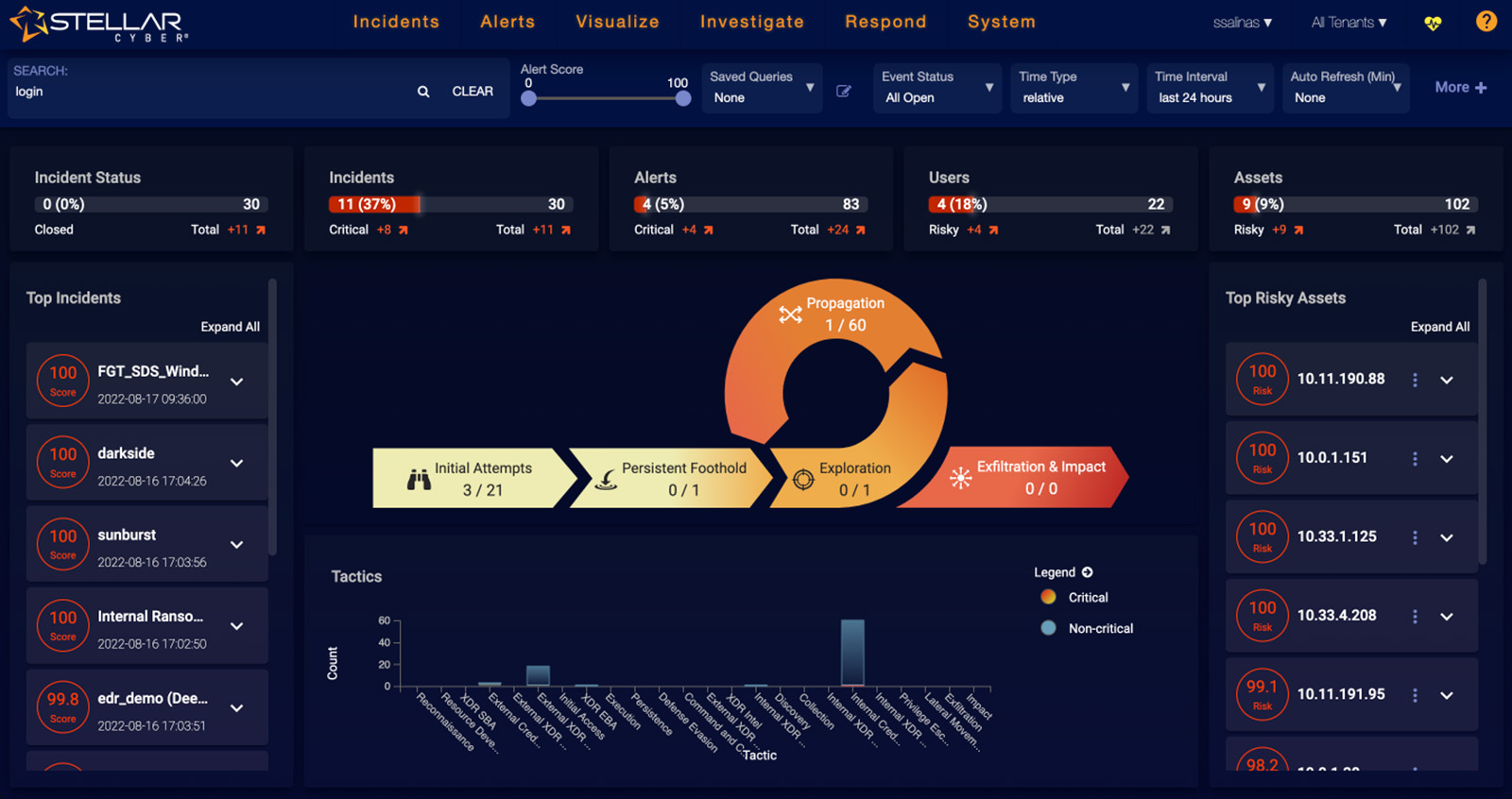
Stellar Cyber provides a SOC platform that unifies security operations and embeds AI-driven automation across detection, investigation, and response. It combines SIEM, NDR, and XDR capabilities into a single system, reducing tool fragmentation and giving teams visibility across their environment. The platform uses a human-augmented model, where agentic AI handles routine tasks and improves through analyst feedback.
General features include:
- Unified SecOps platform: Integrates SIEM, NDR, and XDR capabilities into a single system to simplify operations
- Open integration architecture: Connects with EDR and a range of security and network data sources
- Full environment visibility: Provides centralized monitoring across endpoints, networks, and cloud environments
- Built for lean teams: Delivers SOC capabilities without requiring large, specialized security teams
- Support for MSSPs (multi-tenancy): Enables service providers to manage multiple customers from a single console with separation
AI/ML features include:
- Agentic AI for automation: Automates SOC tasks such as triage, investigation, and response
- Human-in-the-loop learning: Uses LLM-based feedback loops where analyst input improves AI models and automation over time
- AI-driven threat detection: Applies machine learning to identify threats in real time and reduce alert fatigue
- Automated event correlation: Links related events across data sources to surface attack chains
- AI-powered incident response: Executes playbooks for containment and mitigation of threats
Notable MDR Solutions With Machine Learning
4. Cybereason MDR

Cybereason MDR is a managed security service that delivers endpoint-focused threat detection, triage, and remediation through a combination of technology, processes, and a global SOC team. It identifies and stops threats by correlating activity into “MalOps” (malicious operations), which represent complete attack narratives rather than isolated alerts.
General features include:
- End-to-end MDR service: Delivers prevention, detection, triage, remediation, and reporting as a managed offering
- Global SOC coverage (24/7/365): Provides continuous monitoring and response through a distributed team of analysts
- Endpoint-wide visibility: Monitors and protects endpoints across distributed environments
- Rapid deployment: Operational within hours
- MalOp-based detection model: Groups related alerts into a single attack story
AI/ML features include:
- MalOp severity scoring: Uses a proprietary scoring system to triage and prioritize threats based on severity and context
- Automated alert correlation: Links endpoint events into unified attack narratives
- Real-time detection capabilities: Identifies threats across endpoints in near real time using analytics
- AI-assisted triage: Applies automated logic to evaluate threats and determine response actions
- Accelerated remediation: Enables automated response actions to contain threats

5. Sophos MDR

Sophos MDR is a managed detection and response service that combines agentic AI with human expertise to deliver security operations. It operates as an always-on SOC where AI handles high-speed detection, investigation, and initial response, while human analysts oversee decisions when judgment is required. The platform integrates with a wide range of security tools and environments.
General features include:
- Fully managed 24/7 SOC: Provides continuous monitoring, investigation, and response through a global team
- AI-human hybrid operations model: Combines automated actions with human oversight
- Vendor-agnostic integration: Works across environments and integrates with 350+ security and IT tools, including Microsoft technologies
- Full incident response included: Eliminates threats without additional fees or limits
- Broad attack surface coverage: Protects across endpoints, cloud, identity, email, SaaS, and business applications
AI/ML features include:
- Agentic AI for autonomous operations: Executes investigations and response actions automatically when appropriate
- AI-accelerated detection and response: Identifies and responds to threats in seconds, with reported response times as low as ~89 seconds
- High automation rate: Resolves a portion of cases end-to-end using AI
- AI-driven alert prioritization: Reduces noise and focuses analyst attention on high-risk incidents
- Autonomous threat hunting: Uses AI agents to scan for emerging threats and suspicious behavior
6. Rapid7 MDR

Rapid7 MDR is a managed detection and response service that combines exposure intelligence, threat detection, and response into a continuous operational loop. It analyzes vulnerabilities, asset risk, and attack paths alongside telemetry across the environment, pairing AI-enhanced analysis with a 24/7 SOC team.
General features include:
- Exposure-informed MDR approach: Integrates vulnerability data and asset risk context into detection and response workflows
- Unified attack surface visibility: Provides coverage across endpoint, cloud, identity, email, network, SaaS, and external intelligence sources
- Multi-vector telemetry ingestion: Combines native data collection with third-party integrations
- Continuous anticipate, investigate, respond cycle: Aligns prevention, detection, and response into a single operational loop
- 24/7 global SOC partnership: Offers round-the-clock monitoring and response
AI/ML features include:
- AI-enhanced SOC operations: Uses AI to scale triage and investigation across large volumes of telemetry
- AI-accelerated investigations: Analyzes and correlates events to validate threats
- Automated alert prioritization: Focuses analyst attention on high-risk threats by filtering noise using contextual risk data
- Exposure-aware analytics: Combines ML-driven detection with vulnerability and risk scoring to prioritize weaknesses
- Intelligent event correlation: Links signals across data sources to provide a view of attack activity