
What Are Managed Detection and Response (MDR) Services?
Choosing the right Managed Detection and Response (MDR) service involves evaluating a provider’s ability to offer 24/7, human-led threat hunting, rapid investigation, and active containment, rather than just sending alerts. Key criteria include verifying their ability to integrate with your existing technology stack, ensuring they provide full visibility into threats across endpoints and cloud workloads, and validating their expertise through real-world incident response examples.
Key considerations for selecting an MDR provider:
- 24/7 monitoring and proactive hunting: Ensure the provider offers true, around-the-clock, human-led monitoring and proactive threat hunting to find threats before they cause damage.
- Active response and remediation: Choose a provider that goes beyond “log-and-flog” alerting by taking active steps to contain and remediate threats, such as isolating hosts.
- Expertise and threat intelligence: Evaluate the team’s experience, certifications, and use of specialized threat intelligence to detect sophisticated attacks.
- Technology compatibility and integration: Confirm the provider can ingest data from your current security tools, such as EDR, SIEM, and cloud environments.
- Transparency and visibility: Look for a provider with a user-friendly portal that offers clear, actionable intelligence, rather than just technical jargon.
- Reporting and compliance: Verify the provider offers custom reporting tailored to your regulatory requirements (e.g., HIPAA, GDPR).
This is part of a series of articles about MDR security.
Why Choosing the Right MDR Provider Matters
Choosing an MDR provider has a direct impact on how effectively threats are identified, contained, and resolved. Not all providers offer the same depth of visibility, response capability, or expertise, so differences in service quality can lead to gaps in protection:
- Response capability varies widely: Some providers only notify you of threats, while others actively contain and remediate them. The level of hands-on response determines how quickly incidents are controlled.
- Quality of threat detection: Detection accuracy depends on the provider’s tools, analytics, and threat intelligence. Weak detection leads to missed threats or excessive false positives.
- Expertise and staffing: MDR services rely on skilled analysts. Providers with experienced security teams can investigate complex attacks and reduce dwell time.
- Integration with existing systems: A good provider integrates with your current infrastructure, such as endpoints, cloud platforms, and identity systems, without major disruption.
- Visibility and reporting: Clear reporting and access to investigation details help internal teams understand incidents and improve overall security posture.
- Scalability and coverage: The provider should support your organization’s growth and cover all relevant environments, including hybrid and multi-cloud setups.
- Compliance and data handling: Different industries require specific compliance standards. The provider must align with regulatory requirements and handle sensitive data securely.
- Cost vs. value: Lower-cost services may limit response actions or coverage. Evaluating what is included ensures you are not sacrificing protection for price.
Key Considerations for Selecting an MDR Service Provider
24/7 Monitoring and Proactive Hunting
Threats can occur at any time, so the MDR provider must maintain persistent vigilance over the environment. This includes monitoring endpoints, networks, and cloud resources for suspicious activity, leveraging automated tools and human analysts to spot indicators of compromise. Without 24/7 coverage, critical incidents might go undetected for hours. Furthermore, the ability to investigate 100% of all alerts, including low-severity ones is critical. Otherwise, real threats can slip in undetected.
Proactive threat hunting sets advanced MDR providers apart. Rather than waiting for automated alerts, skilled analysts actively search for hidden threats using threat intelligence, behavioral analytics, and forensic techniques. This helps identify sophisticated attacks that evade traditional detection methods, reducing dwell time and minimizing the impact of breaches.
Active Response and Remediation
Active response means the MDR provider does more than just notify you when a threat is found—they take direct action to contain and remediate the incident. This may include isolating infected endpoints, blocking malicious IP addresses, or removing compromised accounts. Immediate containment is essential to prevent lateral movement and limit the scope of an attack.
Remediation support often extends beyond technical actions. Leading MDR providers guide your internal teams through recovery steps, assist with root cause analysis, and help implement preventive measures to avoid recurrence. This hands-on involvement ensures that threats are not only neutralized but also that your security posture improves after each incident.
Expertise and Threat Intelligence
The value of an MDR service hinges on the expertise of its analysts and the quality of its threat intelligence. Experienced security professionals are better equipped to investigate complex incidents, correlate data across multiple sources, and provide actionable guidance. Their expertise enables faster identification of false positives and more accurate threat classification.
Access to up-to-date threat intelligence is critical for identifying emerging attack techniques and understanding adversary behavior. MDR providers should leverage global threat feeds, industry-specific intelligence, and in-house research to keep their detection methods current. This ensures that your organization is protected against both known and novel threats.
Technology Compatibility and Integration
MDR solutions must integrate seamlessly with your existing security infrastructure, including EDR, SIEM, firewalls, and cloud services. Compatibility minimizes deployment friction and ensures that the MDR team can collect comprehensive telemetry across your environment. The provider should demonstrate the ability to work with your current tools or offer alternatives that enhance visibility and response.
Integration also affects the speed and accuracy of threat detection. A tightly integrated MDR platform can correlate events from multiple sources, automate workflows, and orchestrate responses more efficiently. This results in faster threat identification and reduces the likelihood of missed incidents due to data silos or interoperability issues.
Transparency and Visibility
Transparency is essential for building trust between your organization and the MDR provider. You need clear visibility into what actions the provider is taking, which threats have been detected, and the status of ongoing investigations. Regular communication channels, detailed dashboards, and thorough documentation help keep your internal security and IT teams informed.
Visibility also extends to access to raw and processed data, investigation details, and response timelines. The best MDR providers offer granular reporting and real-time alerts, enabling your organization to audit security activities and understand the rationale behind critical decisions. This openness is vital for compliance, incident reviews, and continuous improvement.
Reporting and Compliance
Comprehensive reporting is a mandatory feature for MDR services, especially in regulated industries. Reports should provide clear summaries of incidents, investigation steps, response actions, and remediation outcomes. Detailed documentation helps satisfy auditors and demonstrates due diligence in managing security events.
MDR providers should also understand and support the organization’s compliance requirements, such as GDPR, HIPAA, or PCI DSS. They should be able to tailor their services and reports to align with regulatory frameworks, ensuring that you meet both internal and external obligations. This alignment reduces compliance risks and simplifies audit processes.
Key Questions to Ask Potential MDR Service Providers
Here’s a more detailed look into the main questions to ask when evaluating MDR service providers.
Do You Provide Active Remediation, or Just Alert Us When a Threat Is Found?
It’s critical to determine whether the MDR provider offers active remediation or simply issues alerts when threats are detected. Active remediation means the provider takes direct steps to contain and eliminate threats, while alert-only services leave the burden of response on the internal team. This distinction impacts your incident response readiness and the resources you need to allocate internally.
A provider that delivers active remediation can significantly reduce the time to containment and limit damage from security incidents. They act as an extension of your security team, managing threats even outside business hours. In contrast, an alert-only approach may result in slower response times and increased risk if your team cannot act immediately.
How Does Your Team Investigate and Respond to Live Threats?
Understanding the provider’s investigation and response process is crucial. Ask how their security analysts triage alerts, conduct forensic analysis, and coordinate with your team during active incidents. A structured, well-documented process ensures threats are handled consistently, minimizing confusion during high-pressure situations.
Providers should describe how they escalate issues, communicate findings, and execute containment or remediation steps. The ability to provide clear timelines, responsibilities, and communication protocols demonstrates maturity and preparedness, which are essential for incident management. Additionally, providers should be able to tell you if they cover 100% of all alerts, including low-severity ones, which is where real threats are frequently hidden by attackers.
Can You Integrate With Our Current EDR/SIEM Tools?
Compatibility with existing EDR and SIEM tools determines how quickly and effectively the MDR service can be deployed. Integration allows the MDR team to leverage your current investments, maintain visibility, and simplify data collection. Ask for examples of successful integrations and discuss any potential challenges upfront.
A provider that supports a wide range of tools can adapt to your environment and minimize disruptions during onboarding. Seamless integration also enables faster detection, comprehensive coverage, and unified incident response across the security stack.
What Is Your Average Mean Time to Detect (MTTD) and Mean Time to Contain?
MTTD and Mean Time to Contain (MTTC) are key performance metrics for MDR providers. MTTD measures how quickly threats are identified after they enter your environment, while MTTC tracks how long it takes to contain an incident once detected. Low averages in both metrics indicate a provider’s efficiency and effectiveness in limiting the impact of attacks.
Ask providers to share their historical data and explain how they achieve and maintain these metrics. Consistently low MTTD and MTTC demonstrate mature processes, well-trained analysts, and robust technology. These metrics should be part of ongoing service level reviews to ensure continued performance.
What Does the Onboarding Process Look Like in the First 30–90 Days?
The onboarding process sets the foundation for a successful MDR partnership. Ask providers to detail the steps involved, such as deploying sensors, integrating with your tools, and establishing communication protocols. Effective onboarding includes a thorough assessment of your environment and alignment of detection and response procedures with your business needs.
A well-defined onboarding timeline should include milestones for initial monitoring, baseline threat detection, and incident response testing. Providers should offer training for your internal teams and regular check-ins to address issues. A transparent and structured onboarding process accelerates time to value and reduces the risk of gaps during the transition.
Related content: Read our guide to MDR threat containment (coming soon)
Notable MDR Services that Meet These Criteria
AI SOC Platforms
1. Intezer

Intezer is an AI SOC platform that investigates every alert at forensic depth, enabling security teams to scale operations beyond human capacity. Where other platforms summarize or enrich alerts and leave analysts to validate conclusions, Intezer executes the full investigation autonomously — collecting evidence, performing memory forensics, correlating threat intelligence, and delivering an auditable verdict. Only alerts confirmed as real incidents are escalated to human analysts.
The platform’s forensic foundation sets it apart from the other options in this list. Intezer’s Genetic Analysis technology compares every piece of code running in memory against a vast database of trusted and malicious code, identifying threats through code reuse rather than signatures alone. This enables detection of fileless malware, injected code, and advanced threats that purely LLM-based platforms miss. The result is evidence-based verdicts, not summaries — which is precisely what makes it safe to trust automation at scale.
Key features include:
- 100% alert investigation: Every alert is triaged and investigated regardless of severity — including low and medium signals where early-stage threats most often hide. No alert is deprioritized to a backlog.
- Forensic-depth investigation: Automated evidence collection, memory forensics, binary analysis, reverse engineering, and behavioral context are applied to each alert. Investigation conclusions are fully auditable, not black-box.
- Closed-loop detection engineering: Every investigation feeds outcomes back into detection logic. Noisy rules, broken telemetry, and coverage gaps are identified continuously and mapped to MITRE ATT&CK — replacing periodic tuning with a self-improving system.
- Per-endpoint pricing: Because Intezer’s architecture relies on deterministic forensic analysis rather than heavy LLM compute, it can offer per-endpoint pricing instead of per-alert pricing. Customers can investigate 100% of alerts without cost escalation as volumes grow.
- Direct expert access: When Intezer escalates — which happens for fewer than 2% of alerts — customers reach Intezer security experts directly, with full incident context already in hand. Not a chatbot. Not a queue.
- Broad integration coverage: Connects natively with leading EDR, SIEM, cloud, identity, and email platforms. Automated response actions — endpoint isolation, hash blocking, account disabling — execute based on forensic verdicts, with no playbook engineering required.
How it meets the criteria: Intezer is the only platform in this list that delivers true 100% alert coverage at forensic depth, directly addressing the most common failure mode in MDR services: the approximately 60% of alerts that go unreviewed when human capacity is the gating factor. Its evidence trail satisfies the Transparency and Visibility criteria more completely than any other option reviewed — every verdict is auditable with the full investigation trace available for inspection. The closed-loop detection engineering model addresses the Reporting and Compliance criteria by continuously improving detection posture against MITRE ATT&CK and providing quarterly coverage assessments. The per-endpoint pricing model removes the cost barrier to full coverage that per-alert models impose, aligning vendor and customer incentives. For organizations that have outgrown MDR or want to bring security operations in-house under AI supervision, Intezer represents the natural next step.
2. Dropzone

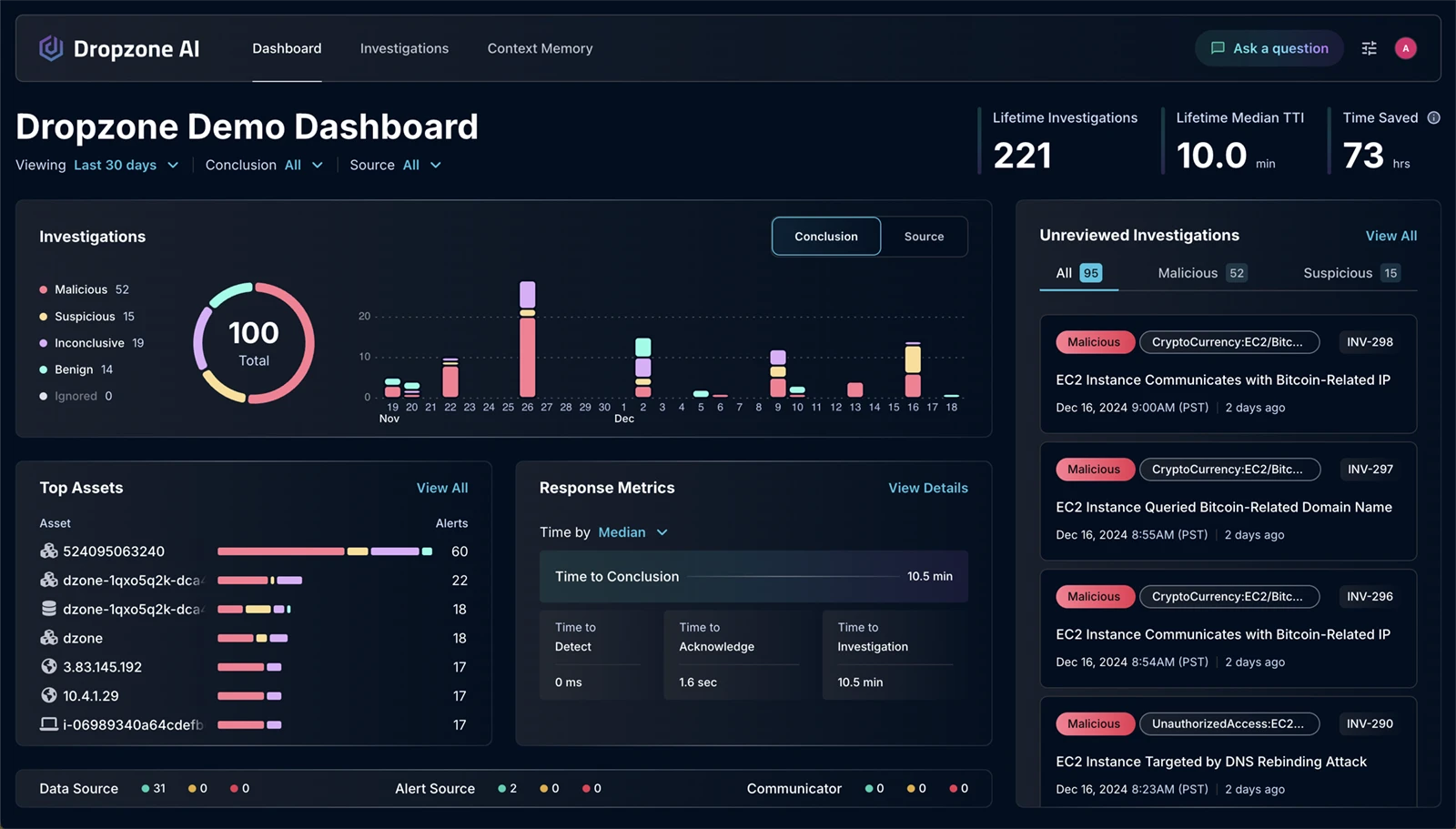
Dropzone is an AI-driven SOC platform that uses autonomous agents to investigate alerts, hunt threats, and respond to incidents across the security lifecycle. It operates continuously, using pre-trained agents that integrate with existing security tools to analyze data, apply threat intelligence, and execute response actions.
Key features include:
- Autonomous alert investigation: AI agents analyze and investigate alerts across the security stack without human involvement, producing detailed reports with evidence.
- Threat hunting and response: Continuously hunts for threats and responds to new attacks as they emerge, using operationalized threat intelligence.
- Agent-based architecture: Multiple specialized agents collaborate, sharing context to investigate incidents, enrich data, and take action.
- Integrated threat intelligence: Includes access to external threat intelligence sources and automatically converts new intelligence into actionable hunts.
- Seamless tool integration: Connects to existing SIEM, EDR, cloud, identity, and email systems via API without requiring data migration or normalization.
How it meets the criteria:
Dropzone meets the criteria for 24/7 monitoring, proactive hunting, and active response by using an autonomous, agent-based architecture for continuous threat investigation and response. It also aligns with technology compatibility through seamless API integration with various security tools. However, it currently falls short on the criteria for Transparency and Visibility, and Reporting and Compliance due to limitations in its reporting features, inadequate export capabilities for full investigation reports, and challenges in handling duplicate alerts, which can hinder full visibility for human analysts.
3. Torq
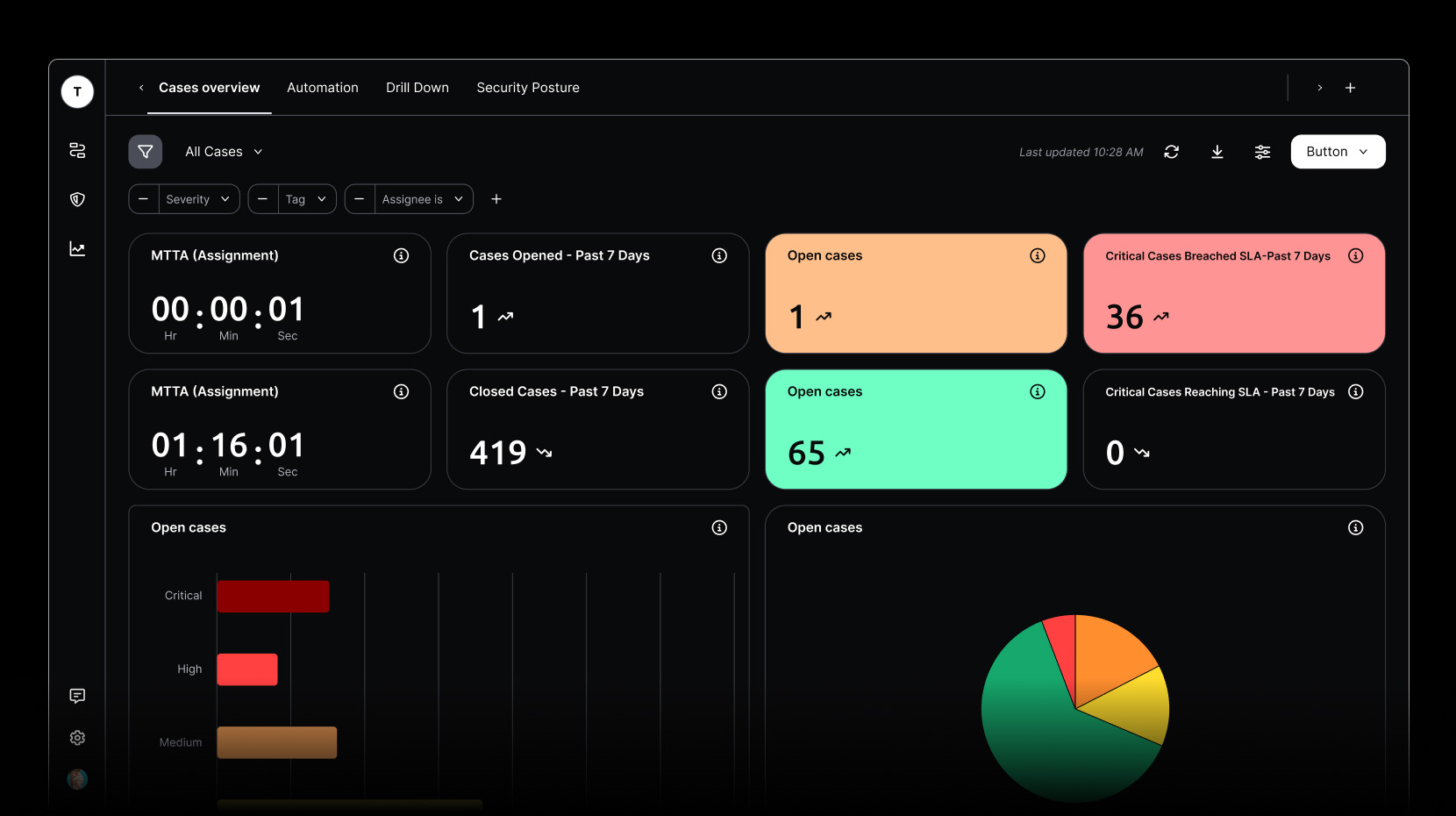
Torq delivers an AI-driven SOC platform focused on automating the threat lifecycle, from initial alert triage through investigation and remediation. Its approach centers on agentic AI, where autonomous agents handle repetitive and time-consuming security tasks while operating under human guidance and oversight.
Key features include:
- Threat lifecycle management: Covers the entire process from alert ingestion to remediation. The platform enriches data, investigates incidents, and takes action.
- Autonomous case resolution: Closes over 90% of security cases automatically. This reduces manual workload.
- Alert triage and noise reduction: Ingests and normalizes telemetry from across the security stack, then correlates and deduplicates events. This reduces alert noise and surfaces only relevant threats.
- Context-aware risk analysis: Applies threat intelligence and contextual analysis to determine whether alerts represent real risk or false positives. This improves detection accuracy and prioritization.
- AI-driven investigation with HyperAgents: Uses customizable AI agents to gather evidence, build timelines, and summarize findings. These agents operate under team-defined guidance.
How it meets the criteria:
Torq excels in the Active Response and Remediation criteria by autonomously closing over 90% of security cases, demonstrating high efficiency. It also meets the Transparency and Visibility and Expertise criteria through context-aware risk analysis and detailed AI-driven investigations using HyperAgents. The main area of potential concern is the reliance on a high degree of automation; while efficient, it may raise questions for some about human oversight and accountability in complex or novel threat scenarios, potentially affecting the Expertise and Active Response criteria for those who prefer human-led MDR.
MDR Providers
4. Arctic Wolf MDR

Arctic Wolf MDR is a managed security service that combines continuous monitoring, expert analysis, and AI-driven operations to detect, respond to, and remediate threats. Using the Aurora Agentic SOC, it integrates telemetry across environments to provide visibility and uses a combination of automated investigation and human expertise to reduce the frequency and impact of attacks.
Key features include:
- Threat detection and monitoring: Provides continuous monitoring across attack surfaces using integrated telemetry. This helps ensure threats are identified quickly.
- Threat lifecycle coverage (detect, respond, remediate): Covers detection, investigation, response, and post-incident remediation. Each incident is resolved and used to improve future security posture.
- Aurora Agentic SOC with AI and human expertise: Combines AI-driven investigations with human validation. AI analyzes large volumes of data in parallel, while security experts provide oversight and decision-making.
- Swarm of specialized AI agents: Uses over 300 specialized agents that collaborate to investigate threats. This distributed approach improves speed and depth of analysis.
- Managed investigation and guided response: Security events are reviewed, enriched, and triaged before reaching the customer. Clear context and recommended actions are provided to support fast response.
How it meets the criteria:
Arctic Wolf addresses the key criteria by combining AI for scale with human validation from its Aurora Agentic SOC, satisfying both 24/7 Monitoring and Expertise. Its full threat lifecycle coverage, including remediation, aligns with Active Response requirements. It provides excellent Visibility by integrating telemetry across attack surfaces and offering managed investigation. The critical point for evaluation might be how quickly the human-validated approach can respond compared to platforms relying on immediate, deterministic AI automation for containment.

5. Sophos MDR

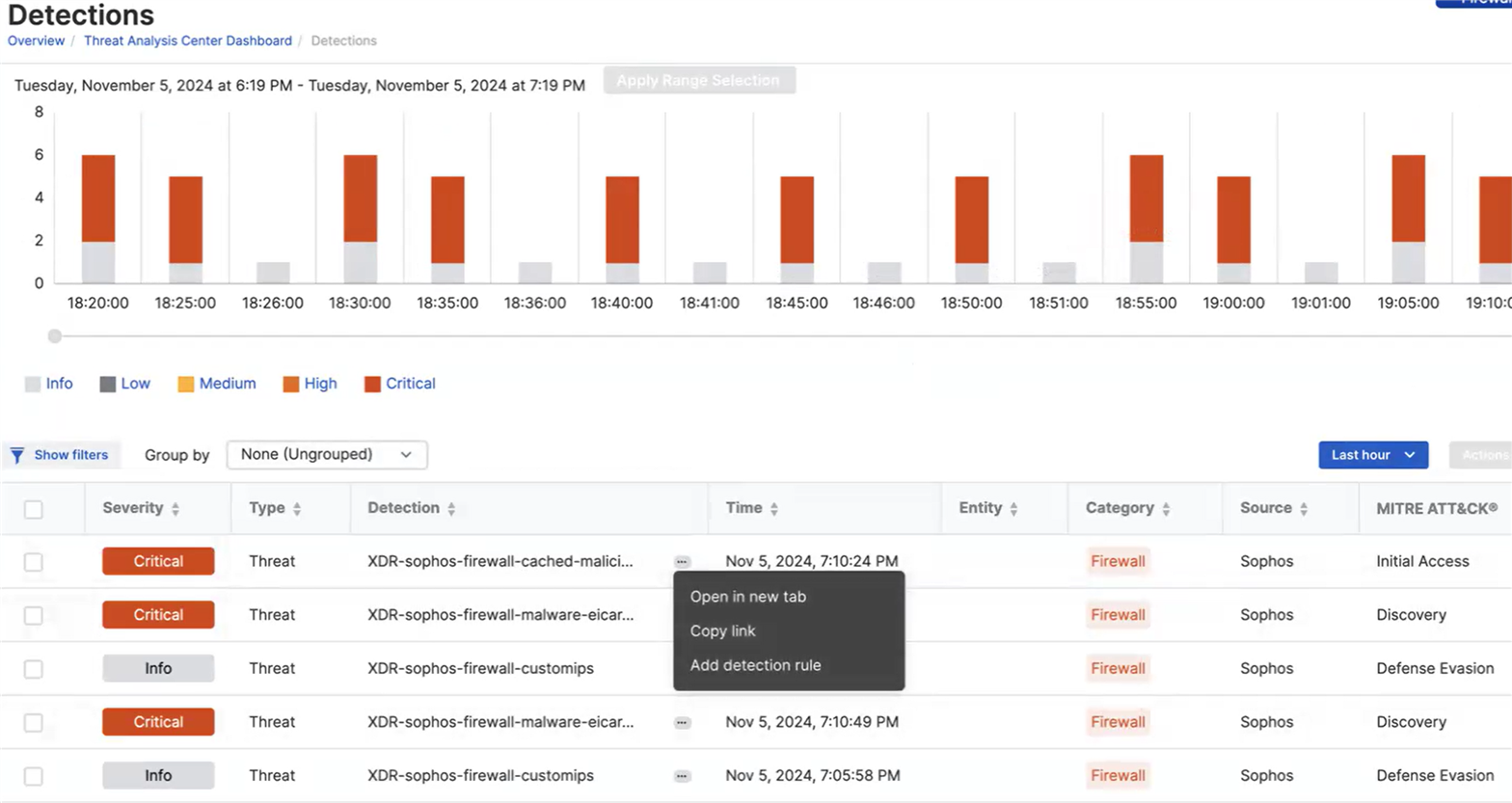
Sophos MDR is a managed detection and response service that combines AI speed with human judgment to deliver continuous protection. It uses AI to investigate and respond to threats within seconds, while human analysts provide oversight, decision-making, and accountability. The service integrates across a range of security tools and environments.
Key features include:
- AI-accelerated detection and response: Uses agentic AI to investigate alerts and trigger response actions in seconds. This enables rapid handling of threats that would otherwise take much longer with manual processes.
- Human-led oversight and accountability: Security analysts validate decisions and manage complex incidents. AI handles speed and scale, while humans ensure accuracy and appropriate response.
- Managed SOC operations: Provides continuous monitoring, investigation, and response through a global team of security experts.
- Autonomous case resolution: A significant portion of security cases are resolved end-to-end by AI. This reduces manual workload and accelerates incident handling.
- Incident response and remediation: Includes complete threat removal, not just containment. There are no limits or additional charges for response actions.
How it meets the criteria:
Sophos MDR meets the Active Response and Remediation criteria by offering complete threat removal with no limits, backed by AI-accelerated response in seconds. The service’s blend of AI speed and human judgment satisfies the Expertise and 24/7 Monitoring criteria effectively. However, it heavily relies on Sophos’s own tools for effectiveness, which may limit full visibility into data sources outside the core Sophos security stack compared to truly open MDR platforms.
6. CrowdStrike Falcon Complete

CrowdStrike Falcon Complete is a managed MDR service that combines AI-driven automation with expert human oversight to detect, investigate, and remediate threats. It uses agentic AI and deterministic automation to execute response actions while experienced analysts validate decisions and manage outcomes.
Key features include:
- Agentic MDR with AI and human expertise: Combines autonomous AI agents with 24/7 expert oversight. AI handles investigation and response at scale, while analysts validate actions and ensure accurate outcomes.
- Deterministic automation for immediate response: Executes proven response actions instantly and consistently. This ensures fast, reliable containment without delays caused by manual intervention.
- Adaptive AI agents for investigation and response: Uses AI agents that learn, collaborate, and adapt. These agents drive analysis and continuously improve detection and response processes.
- Full-cycle threat remediation: Covers the lifecycle from detection to eradication. The service isolates affected systems, removes persistence mechanisms, and restores environments to a secure state.
- Unified cross-domain visibility: Provides visibility across endpoints, identities, cloud workloads, and third-party data. This enables detection and response across the attack surface.
How it meets the criteria:
Falcon Complete meets the criteria for Active Response and MTTC with deterministic automation for immediate containment and full-cycle remediation. The combination of AI agents and human analysts strongly supports the Expertise and Proactive Hunting criteria. Its unified visibility across endpoints, identity, and cloud meets the Technology Compatibility requirement. The primary factor to consider is the necessity of adopting the CrowdStrike Falcon platform for the service to function, which could be a barrier for organizations aiming for MDR services that integrate more flexibly with existing non-CrowdStrike security stacks.

Conclusion
Choosing an MDR provider requires careful evaluation of their ability to detect, investigate, and respond to threats in real time. Differences in response capabilities, integration, visibility, and expertise can significantly impact how effectively incidents are handled. A strong provider combines continuous monitoring, proactive threat hunting, and active remediation with clear reporting and alignment to your environment. Focusing on these factors helps ensure consistent protection, faster response times, and a more resilient security posture.